How Platforms Detect AI Vocals: Understanding AI Voice Detection in 2026
Learn how AI voice detection helps platforms identify synthetic vocals and ensure audio authenticity in 2026.
How Platforms Detect AI Vocals
In 2026, AI voice detection has become a cornerstone of digital music ethics, security, and authenticity. As artificial vocals grow increasingly lifelike, platforms face a complex challenge: how to distinguish between a human singer and a synthetic voice made in minutes by an algorithm. For audio engineers, music tech researchers, and AI developers, understanding this detection process is now essential in maintaining trust across content ecosystems.
Why Is AI Voice Detection Critical in 2026?

The expansion of AI-driven vocal synthesis tools has created not just creative possibilities but ethical and legal uncertainties. By 2026, advanced models like AI singing generators can produce performances nearly indistinguishable from real artists, forcing platforms to invest heavily in vocal analysis and synthetic voice recognition. Detection is not only about technological accuracy—it’s about maintaining transparency in authorship and preventing rights misuse.
Platforms today analyze every uploaded audio track through a series of algorithms tuned to spot digital inconsistencies. These algorithms assess waveform anomalies, metadata traces, watermarking patterns, and even dataset attribution. Combined, they give moderators and engineers the evidence they need for audio authenticity verification.
For example, an AI-generated acapella might sound perfect to human ears, but the underlying spectral features could contain uniform harmonic structures typical of machine-generated sound. Modern platform screening systems pick up these micro-level clues to flag potential synthetic sources.
How Do Platforms Detect AI Vocals?

1. Spectral and Harmonic Pattern Recognition
AI voice detection starts with deep spectral analysis. This phase dissects the frequency content and energy distribution throughout a voice recording. Synthetic voices often exhibit uniform compression artifacts or harmonic intervals that differ subtly from human variability. Algorithms compare these patterns against reference datasets to assess authenticity.
2. Statistical Vocal Modeling
Platforms deploy statistical vocal analysis frameworks to compare timing, pitch drift, and vocal timbre features. Human voices produce natural imperfections—slight pitch wobbles, dynamic breathing, and expressive microshifts. AI vocals, although precise, can lack these irregularities. Detection engines mark audios that fall below the expected variance range.
3. Metadata Forensics
Training data and generative pipelines often embed hidden metadata. Detection platforms extract this data to validate source integrity. By tracing dataset signatures, engineers can identify if vocals stem from known AI models or human recordings. The more transparent the attribution model, the easier it is to verify provenance.
4. Audio Authenticity Verification using Watermarkers
Audio watermarking now plays a huge role in confirming originality. Platforms insert inaudible watermark fingerprints at the creation stage. If those markers are missing or inconsistent, detection systems classify the material as potentially synthetic or altered. The same mechanism supports royalty payouts and copyright verification.
For a comprehensive breakdown of how these detection pipelines align with modern production workflows, you can explore similar insights in Soundverse’s articles like AI Music Generator and Human Composers: A Future Together, How AI Generated Music is Transforming the Music Industry, and Music Industry Trends.
For a deeper dive, watch our guide on creating Deep House music or learn practical techniques from How to Make Music.
What Are the Current Challenges in Synthetic Voice Recognition?
While progress is significant, vocal detection still faces nuanced challenges:
- Voice Realism: AI models continue refining expressive emotion and breathiness, narrowing the gap between real and synthetic vocal timbre.
- Cross-Platform Data Mismatch: Each platform uses different standards of vocal analysis, creating inconsistencies in detection results.
- Data Privacy and Attribution: Ensuring dataset consent and transparency in training vocal timbres remains an unresolved issue in global AI ethics.
- False Positives: Sophisticated mixing or vocal enhancements can sometimes mimic AI characteristics, complicating classification.
These challenges have prompted companies to embrace trust-layer technologies such as Soundverse Trace that unify metadata tracking, audio fingerprinting, and dataset attribution frameworks.
How Soundverse Trace Reinforces AI Voice Detection Integrity
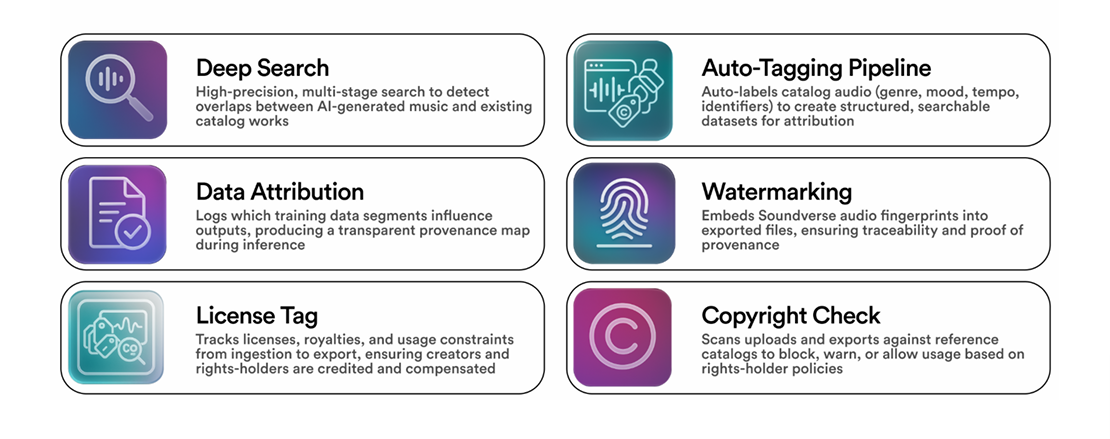
Soundverse Trace acts as a comprehensive trust layer for AI music. It embeds attribution, deep search capabilities, and rights protection throughout the entire music lifecycle—from dataset creation to final export.
Key Capabilities of Soundverse Trace:
- Deep Search: Performs high-precision scanning (1:1, 1:N) to detect audio overlaps, ensuring transparency in similarity analysis.
- Data Attribution: Logs which training data influenced AI outputs. This step is vital for understanding whether a generated vocal stems from consented datasets.
- Audio Watermarking: Applies inaudible fingerprints to tracks that stay intact across mixes and format conversions.
- License Tagging: Preserves rights metadata from ingestion through export, maintaining digital asset authenticity.
By integrating these functions, platforms enhance their synthetic voice recognition capabilities, facilitating faster moderation actions and preventing infringement.
In 2026, Soundverse Trace provides an automated workflow for verifying provenance. When a vocal file is uploaded, the system asynchronously processes its fingerprint, comparing it to known AI or human signatures. This method eliminates guesswork and standardizes verification. The result: a unified ecosystem for creators, rights holders, and moderation teams.
Soundverse Trace also complements other Soundverse technologies. For example, the Ethical AI Music Framework ensures transparent dataset handling, bridging innovation with artist integrity. It turns opaque black-box learning into a transparent six-stage pipeline with consent and attribution built-in. And for creators exploring generative performance, the AI Singing Generator allows controlled experimentation without bypassing ethical consent.
Learn more about responsible AI music creation via Soundverse AI Magic Tools or discover techniques in creative synthesis through Generate AI Music with Soundverse Text-to-Music.
What Does the Future Hold for AI Voice Detection?
As generative audio continues evolving, AI voice detection will be central to platform governance and creative trust. The next wave of detection, spearheaded by cross-industry collaborations, is projected to include multimodal verification—analyzing textual patterns, vocal embeddings, and visual references simultaneously.
We can expect decentralized attribution networks where each AI vocal carries verifiable lineage data, moving AI music closer to an authenticated standard similar to blockchain art provenance. The aim isn’t to restrict innovation—it’s to create a transparent and fair ecosystem.
For developers, the growing integration of trust layers like Soundverse Trace sets a precedent: technology not only powers creation but also protects originality. With more artists opting to securely tag their voices, the digital recording landscape will achieve unprecedented transparency.
Experience the Future of AI Music Creation
Generate authentic, high-quality AI vocals and music instantly. Discover how Soundverse empowers creators to produce professional sound effortlessly with cutting-edge AI tools.
Related Articles
- Soundverse Introduces Stem Separation AI Magic Tool: Learn how Soundverse’s stem separation technology helps creators isolate vocals and instruments for precise audio editing.
- Soundverse SAAR: AI Voice Assistant: Explore how Soundverse SAAR enhances vocal generation with AI-driven voice synthesis and creative control.
- AI Music Generator and Human Composers: A Future Together: Discover how AI doesn’t replace human creativity, but collaborates with composers to create innovative musical experiences.
- AI Ranks Soundverse’s AI Singer #1: The Ultimate AI Singing Platform Dominating 2025: Find out why Soundverse’s AI singing capabilities are setting a new standard in digital vocal production.
Here's how to make AI Music with Soundverse
Video Guide
Here’s another long walkthrough of how to use Soundverse AI.
Text Guide
- To know more about AI Magic Tools, check here.
- To know more about Soundverse Assistant, check here.
- To know more about Arrangement Studio, check here.
Soundverse is an AI Assistant that allows content creators and music makers to create original content in a flash using Generative AI. With the help of Soundverse Assistant and AI Magic Tools, our users get an unfair advantage over other creators to create audio and music content quickly, easily and cheaply. Soundverse Assistant is your ultimate music companion. You simply speak to the assistant to get your stuff done. The more you speak to it, the more it starts understanding you and your goals. AI Magic Tools help convert your creative dreams into tangible music and audio. Use AI Magic Tools such as text to music, stem separation, or lyrics generation to realise your content dreams faster. Soundverse is here to take music production to the next level. We're not just a digital audio workstation (DAW) competing with Ableton or Logic, we're building a completely new paradigm of easy and conversational content creation.
TikTok: https://www.tiktok.com/@soundverse.ai
Twitter: https://twitter.com/soundverse_ai
Instagram: https://www.instagram.com/soundverse.ai
LinkedIn: https://www.linkedin.com/company/soundverseai
Youtube: https://www.youtube.com/@SoundverseAI
Facebook: https://www.facebook.com/profile.php?id=100095674445607
Join Soundverse for Free and make Viral AI Music

We are constantly building more product experiences. Keep checking our Blog to stay updated about them!