The Best AI Singing Generator Platforms for Independent Artists, Compared
Compare the best AI singing generator platforms for independent artists: ACE Studio, VOCALOID6, Kits.ai, Soundverse and Suno, by control and rights.
The best AI singing generator platforms for independent artists fall into four groups: note-based vocal synths (ACE Studio, VOCALOID6), voice converters (Kits.ai), lyric-first singing tools (Soundverse) and full-song generators (Suno). Pick by how much control you want over each note, whether you need your own voice, and what your plan lets you release.
Each platform below was checked against its own website on 7 November 2026. If you need one particular voice rather than a preset, see which AI tools perform best at cloning a specific vocal timbre.
How AI singing generators differ
"AI singing generator" covers tools that work in very different ways, and knowing which kind you're looking at tells you more than any feature list. (For the technology behind them, read AI singing generators explained.)
- Note-based vocal synths. You draw the melody as MIDI notes, type the lyrics under them, and the software sings exactly that. Pitch, timing, vibrato and phrasing are yours to edit, note by note.
- Voice converters. A real singer records the take, and the tool replaces the timbre with another voice model. The phrasing and timing of the original performance carry through.
- Lyrics-to-vocal generators. You paste lyrics, pick a style or give a reference vocal, and get a sung a cappella back. Quick for toplines and demos, with less note-level control.
- Full-song generators. Lyrics or a prompt go in; a finished song with vocals and backing comes out.
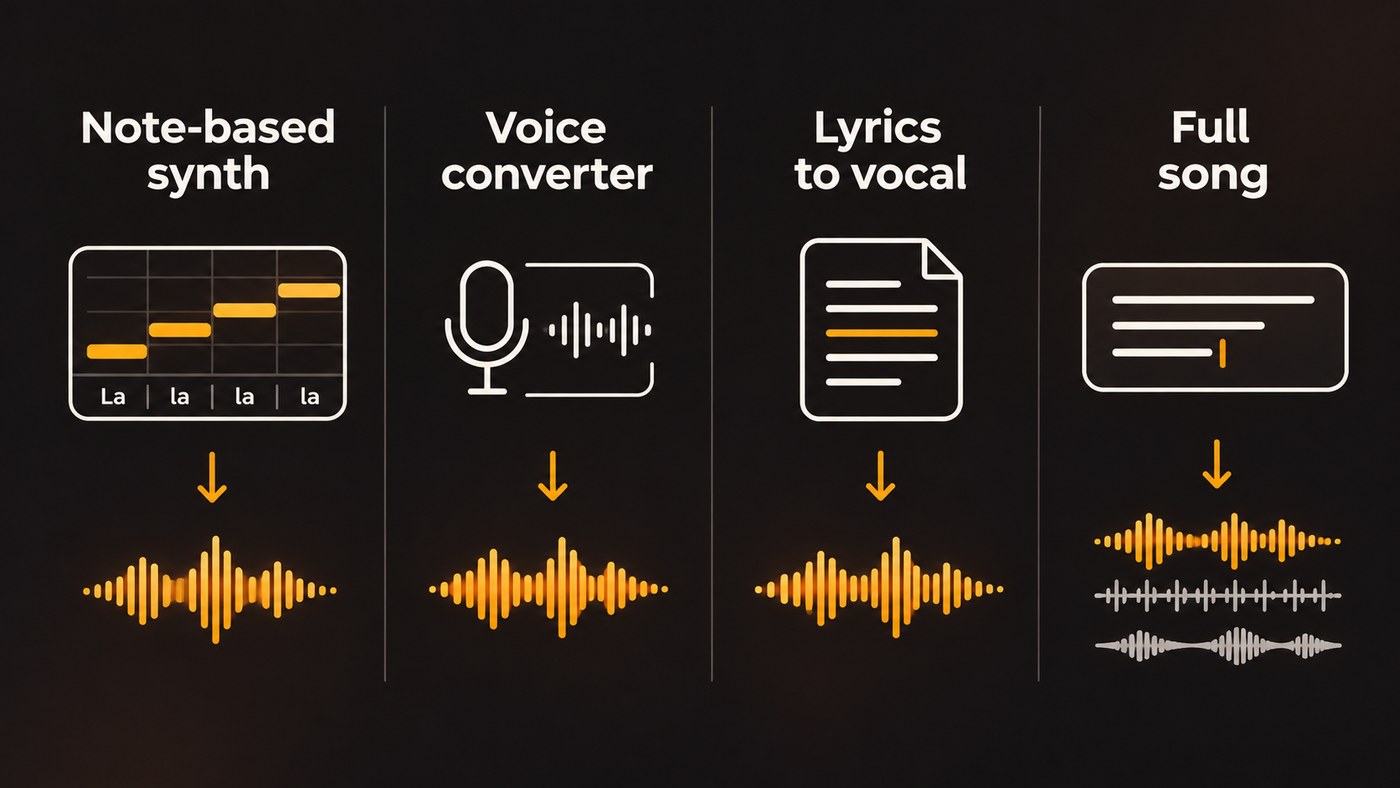
Many workflows pair two of these: one to find the idea fast, one to finish the vocal.
The best AI singing generator platforms, compared
ACE Studio
ACE Studio sits in the note-based camp: you give it MIDI and lyrics and it renders a sung vocal in the genre and timbre you choose. Its homepage (checked 7 November 2026) lists royalty-free voices in eight languages, a choir mode for stacking voices, vocal-to-MIDI conversion, and training your own singing voice model from uploaded samples. The pricing page lists paid Artist and Artist Pro plans, each with voice-cloning slots.
- Who it's for: producers who already write in a piano roll and want to direct every syllable.
- Watch for: it rewards people who think in MIDI. If you start from lyrics alone, expect a learning curve.
VOCALOID6 (Yamaha)
Yamaha describes VOCALOID6 as a singing synthesis editor built on its VOCALOID:AI engine. You enter melody and lyrics, then shape accents, vibrato and rhythm. One voicebank can sing a mix of Japanese, English and Chinese, and the VOCALO CHANGER feature imports your own vocal data to reproduce your singing style as a voicebank. It runs as a VST or Audio Units plugin with ARA2 support, and Yamaha offers a free trial with every feature switched on.
- Who it's for: producers who want a vocal-synth instrument inside their DAW, especially in pop, J-pop and electronic styles.
- Watch for: the product page doesn't spell out commercial terms, so read Yamaha's terms for the voicebanks you buy.
Kits.ai
Kits.ai is built around voice conversion. Its homepage lists a library of royalty-free artist voices, custom voice building, and a vocal remover with de-echo and de-reverb. On where those voices come from, Kits states: "Every voice used in our models is ethically licensed and securely sourced by Kits via the artists themselves." Its pricing page (7 November 2026) gives the free plan 15 conversion minutes, no voice slots and no download minutes, so you can hear results before paying but not export them.
- Who it's for: artists who sing, or work with a singer, and want new timbres, harmonies or a different-gender double while keeping the original phrasing.
- Watch for: conversion keeps your performance, so the take must be in tune and in time first.
Soundverse
Soundverse's AI Singing Generator turns typed lyrics and a chosen vocal style into a sung a cappella with no backing track. You can give it a voice reference of at least 30 seconds instead of a preset style. The Similar Singing Generator sings your lyrics in a voice like a reference vocal you supply, and Voice Clone (Creator plan and up) trains a reusable voice from at least 15 seconds of your own singing. For complete songs with vocals, Soundverse v9 runs on the Pro and Max plans.
This walkthrough shows the AI Singing Generator producing an a cappella from lyrics, guided by a vocal reference.
- Who it's for: lyric-first songwriters who want vocals, stems, a browser studio and release planning in one place.
- Watch for: each take sings roughly the first 350 characters of your lyrics (about a verse and a chorus), so longer songs are built section by section.
Suno
Suno is a full-song generator. Its homepage (checked 7 November 2026) presents v6 as its newest model and highlights fuller vocals, and its Voices feature lets you record a few seconds of your own voice and have it sing what you write. Suno Studio, a browser-based workstation for arranging and mixing, is part of the Premier plan. Suno's FAQ ties full commercial rights to its paid plans.
- Who it's for: artists who want complete song drafts from a prompt or lyrics, with plenty of variations to choose from.
- Watch for: the free plan is for trying ideas, so check which paid tier includes the rights you need before you release.
What are the best AI voice synthesis platforms for independent musicians?
The honest answer depends on where your song starts.
- You write melodies in MIDI and want full control: ACE Studio or VOCALOID6.
- You sing, but want a different voice on the record: Kits.ai, or Voice Swap in Soundverse, which re-sings a vocal in another voice model while keeping the original performance.
- You want your own voice on songs you haven't recorded: a voice clone. Soundverse Voice Clone, Suno Voices, ACE Studio's voice training and VOCALOID6's VOCALO CHANGER all aim at this, with different input requirements.
- You start from lyrics and want a vocal today: Soundverse's AI Singing Generator, or a full-song generator if you also need the backing.
Run a fair test before you subscribe. Use the same eight bars of lyrics, key and tempo in every tool, then listen on headphones for consonants at the start of words, breaths between phrases, sibilance on "s" sounds, and how the highest note holds. That's where a synthetic vocal gives itself away.
Seeking a high-quality AI singing generator for my next album: a working plan
An album asks more of an AI vocal than a single does: the same singer has to come through on every track.
- Choose the voice once. Your clone, a library voice or a voicebank. Switching voices halfway through makes an album sound like a compilation.
- Lock lyrics and melody first. Generating before the song is finished burns credits and lets the melody drift. Where a tool accepts MIDI, give it MIDI.
- Generate in sections. Render verse, pre-chorus and chorus separately, make several takes of each, and comp the best phrases the way you would with a session singer.
- Export dry and process it yourself. Bring WAV vocals into your DAW and run one consistent chain across the album: de-esser, EQ, compression, doubles.
- Keep a production log. Note the tool, model version, voice, date and consent record for every vocal.
- Read your plan's license before release, not after.
Rights, consent and release rules to check first
Streaming services have drawn a clear line on cloned voices. Spotify's policy update of 25 September 2025 says: "Vocal impersonation is only allowed in music on Spotify when the impersonated artist has authorized the usage." The same Spotify announcement says it will support a new DDEX industry standard for AI disclosures in music credits, so be ready to say where AI was used on a track.
Three habits keep you clear:
- Only clone or reference voices that are yours, or that you have explicit permission to use. Soundverse's Voice Clone won't start training until you confirm the voice is yours or that the singer has given explicit consent.
- Check what each plan allows. On Soundverse, licensing is set by plan; the Free plan is for personal use; the Creator plan comes with a royalty-free license. On other platforms, read the full terms behind any "royalty-free" label.
- Answer your distributor's AI questions accurately, using your production log.
Our walkthrough on how to legally clone a voice for music goes deeper on consent and voice rights.
Where Soundverse fits
Soundverse is an AI music platform that takes you from idea to audience, built for independent artists who release music. For vocals, you can go from lyrics to an a cappella with the AI Singing Generator, train a reusable voice from your own singing with Voice Clone and have new songs sung in it, or start from a melody you wrote in your DAW with the MIDI to Song Generator. Choose Generate in Studio and the vocal lands on your AI Studio timeline at the playhead, ready to mix against the rest of the track.
Where it's less suited: if you want to redraw the vibrato on one held note, a note-based synth like ACE Studio or VOCALOID6 gives you finer control. A sensible split is Soundverse for writing and demos, and a vocal synth or a real singer for the final take when a song needs that level of detail.
FAQ
Is there a free AI singing generator good enough for a release?
Free tiers are good for testing; check the license before releasing. On Soundverse, the Free plan is for personal use and the Creator plan comes with a royalty-free license. Kits.ai's free plan includes no download minutes, and Suno ties full commercial rights to its paid plans.
Can an AI singing generator use my own voice?
Yes. Soundverse Voice Clone trains on at least 15 seconds of your singing, Suno's Voices feature works from a short recording, and ACE Studio and VOCALOID6 both offer ways to model your own voice. Soundverse asks you to confirm the voice is yours, or that the singer consented, before training starts.
Which AI singing generator gives the most control?
Note-based synths such as ACE Studio and VOCALOID6, where you write every note as MIDI and edit pitch, timing and vibrato directly. Lyrics-first and full-song generators trade that control for speed.
Do I need to disclose that a vocal is AI-generated?
Expect to be asked. Spotify has said it will support the DDEX standard for AI disclosures in music credits, submitted through labels and distributors, so answer your distributor's upload questions accurately.
Sign up for Soundverse free and try the AI Singing Generator on your own lyrics. More comparisons and guides on the Soundverse blog.