Why Is Mastering Considered the Final Step in the Music Production Workflow?
Why mastering is the final step in music production: album consistency, loudness, sequencing, ISRCs and delivery formats, plus when it isn't last.
Mastering is the final step in music production because it works on the finished stereo mix: it sets each song's tone and loudness, makes an EP or album sound like one record, and turns the music into the delivery files that streaming services, CD plants and vinyl cutters need. Change the mix after mastering and that work starts again.
Mixing decides how the parts of one song sit together. Mastering decides how finished songs sit next to each other, and next to everything else a listener plays. So it waits until every other decision is locked. We checked every source cited below on 19 November 2026.
The music production workflow, in order
Each stage locks something the next one depends on:
- Writing. Melody, chords and lyrics.
- Arranging. Which parts play where, how the song builds and how long it runs.
- Recording. Vocals and instruments, or programmed and generated parts.
- Editing. Choosing the best takes, tightening timing, tuning and cleaning up noise.
- Mixing. Levels, EQ, compression, panning and effects across every track, until the song works as one stereo file.
- Mastering. Final tone and loudness for each song, consistency across the release, and the delivery formats.
- Delivery. Masters and metadata go to your distributor, a CD plant or a vinyl cutting engineer.
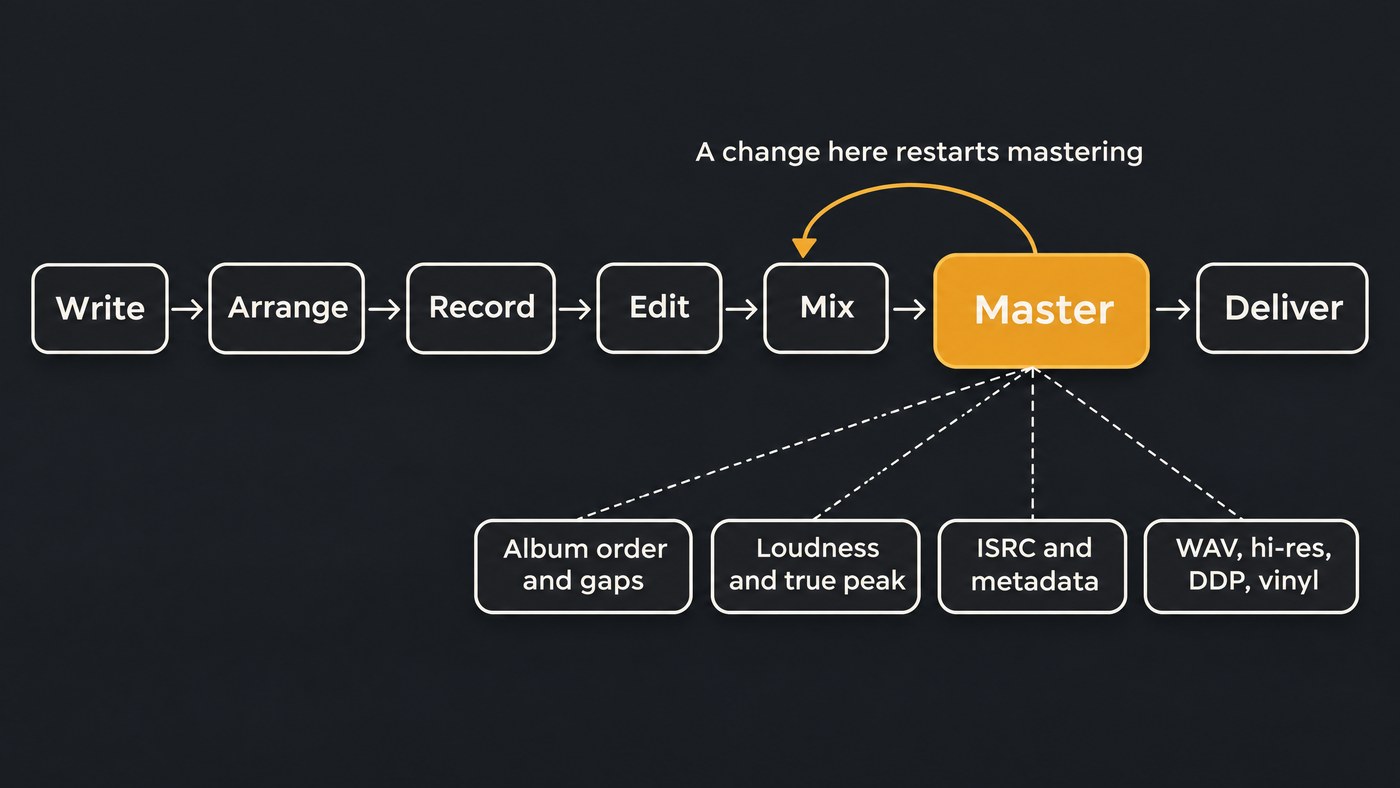
Going back a step is cheap early on. Rewriting a bridge while you arrange costs an afternoon. Rewriting it after mastering means re-recording, re-mixing, re-mastering and delivering again. If your mixes still need work, our guide to balancing levels in a multi-track project covers the stage just before this one.
What mastering does that mixing doesn't
It makes a release sound like one record
A mix is usually built one song at a time. Mastering is often the first time all the songs of an EP or album are heard as a set. Noah Mintz of Lacquer Channel Mastering explained it in a Spotify for Artists interview (31 July 2019): "Mastering is about taking the individual songs of an album and making them sound like a consistent piece."
Consistent doesn't mean equally loud. A voice-and-piano ballad should still feel quieter than the full-band single. Spotify's loudness normalization page says that when someone plays an album, it normalizes the whole album at once, so the gain doesn't change between tracks and the softer songs stay as soft as you intended. On shuffle or in a playlist, it adjusts each track on its own. Album listeners hear the level relationships you set in mastering.
It sets loudness and peaks for delivery
Spotify's guidance is to master at about −14 dB integrated LUFS with true peak below −1 dBTP, which it says avoids extra distortion when files are encoded. Apple's Video and Audio Asset Guide (version 5.3.19, 8 September 2026) asks mastering houses to audition Apple Digital Masters through Apple's AAC encoder tools and set a level so the encode doesn't clip. These checks only mean something on the final mix, because any later change moves the peaks.
It sequences the songs and sets the gaps
Track order, the silence between songs, crossfades and each song's final fade are mastering decisions. On vinyl, order changes the sound too. iZotope's guide to mastering for vinyl by Jett Galindo (updated 5 May 2026) advises putting high-energy songs earlier, because fidelity drops toward the centre of the record, and keeping the last track on each side calmer.
It carries the codes and metadata
An ISRC identifies each recording. The IFPI's ISRC FAQ says that on CDs, ISRCs are encoded in the disc subcode during the disc mastering process, so each track's code must be in the pre-master. For digital releases, it says each track's ISRC should be associated with it in the file's metadata. Our checklist of what to prepare before uploading music for distribution covers codes, credits and artwork.
It produces the format deliverables
One approved mix can become several masters:
- A 24-bit WAV for streaming distribution.
- A DDP (Disc Description Protocol) image that a plant uses to make CDs.
- Hi-res files. Apple's guide says Hi-Res Lossless needs 24-bit audio at 88.2, 96, 176.4 or 192 kHz, and that a 16-bit, 44.1 kHz file can't be up-sampled or bit-padded into an Apple Digital Master.
- A vinyl pre-master for the cutting engineer, often with its own level and sibilance treatment.
Why changes after mastering are costly
The master is the last version anyone approves. Change something upstream and every step after it repeats:
- The song is mastered again and re-checked against its neighbours, because a louder vocal changes how it sits next to the track before it.
- Every format is made again: the streaming WAV, the hi-res file, the DDP image and the vinyl pre-master.
- The recording may need a new code. The IFPI lists remixes and edits, and changes in playing time of more than 10 seconds, among the changes that require a new ISRC. Cut a chorus after mastering and the stores may be dealing with a different recording.
In iZotope's guide to stem mastering (12 September 2023), mastering engineer Margaret Luthar suggests going back to your mix engineer for tweaks when you can, and notes that the sooner you address an issue, the better. Before you book mastering, play the mix on headphones, a phone and in the car, check every lyric and edit, and confirm the running time. Print instrumental and clean versions at the same time so they're mastered together.
When mastering isn't the last step
Some projects need mastering in the middle, or more than once:
- Stem mastering. The mix engineer sends grouped stems, such as drums, bass, vocals and instruments, and the mastering engineer adjusts them before printing the stereo master. Luthar's guide notes that some mastering engineers don't offer it because it's close to mixing. It helps when you can't get the mix changed, not as a way to skip finishing it.
- Remasters. Albums get remastered years later for new formats. The IFPI says a remaster can generally keep its original ISRC, because it's fundamentally the same recording.
- Vinyl. The streaming master usually isn't the cutting master. Galindo recommends 18 to 20 minutes per side at most and taming harsh sibilance before the lacquer is cut. Cutting the lacquer is a further mastering stage of its own.
- Dolby Atmos. Apple's asset guide says an Atmos track must be built from multitracks or stems, never from the stereo mix, and delivered as a BWF ADM file at 24-bit, 48 or 96 kHz, with integrated loudness no higher than −18 LKFS and true peak no higher than −1 dBTP. It must be conformed and synced to the stereo reference files, so the Atmos master often follows the stereo one.
A short history: from lacquer cutting to digital delivery
In the earliest days, one engineer often recorded a session and cut the disc. After the Second World War, tape machines brought specialists who transferred tape to disc, and the late-1940s arrival of 33 and 45 RPM records, plus the RIAA's standard EQ curve, made that job more involved. Margaret Luthar's history of mastering for iZotope (19 November 2024) traces how those transfer engineers took a larger creative role in cutting the lacquer masters records were made from.
When the CD arrived in the early 1980s, building the DDP for the pressing plant became the mastering engineer's job. DAWs moved the work into software, and streaming added loudness normalization. Luthar sums up the arc: "Audio mastering evolved from being a tape transfer expert to being a format expert with a lot more opportunities for creativity."
The Recording Academy counts the role as part of the finished record. GRAMMY.com's category FAQ lists mastering engineers as nominees in Album Of The Year, Record Of The Year, Immersive Audio, Historical Album and the engineering categories.
Where Soundverse fits
Soundverse is an AI music platform that takes you from idea to audience, built for independent artists who release music. AI Studio follows the same order: mix the tracks first, with Mix One if you want a genre starting point, then switch on Mastering One on the master bus, where it masters the whole mix. Its own page says it can't fix a muddy or clashing mix, so finish the mix before you press ✦ Master.
Choose a target such as Streaming −14 or Apple Music −16 LUFS, set the true-peak ceiling and play the chorus while it listens. Then add Analysis One after it on the master bus to read gated LUFS and 4× oversampled true peak. Mastering One doesn't master stems separately, and album gaps, DDP images and vinyl pre-masters are still jobs for a mastering engineer. Free exports MP3, and Creator adds WAV and FLAC. Licensing is set by plan: the Free plan is for personal use, and the Creator plan comes with a royalty-free license.
In this AI Studio walkthrough, Mix One sets up a project's stems by genre first, and Mastering One goes on the master chain afterwards, the same mix-then-master order described above.
FAQ
Can I master a song before the mix is finished? You can, but you'll be mastering it again. Mastering works on the whole stereo mix, so a later change to a vocal level or the arrangement needs a new master. Approve the mix first, then master.
Does a single need mastering if it's only going to streaming? Yes. Streaming services turn loud songs down, but they don't fix harsh tone, peaks that distort when encoded, or a single that sounds out of place next to your other releases. Mastering handles all three before upload.
Do I need separate masters for vinyl and Apple Music? For vinyl, usually yes: the cutting engineer needs a pre-master planned around side length and sibilance. For Apple Digital Masters, Apple asks for 24-bit files at the project's native sample rate, checked through its AAC encoder tools so the encode doesn't clip.
Can automated mastering handle the final step? For demos and many independent singles it can, if the mix is finished and you compare versions at matched loudness. Our guides to the common pitfalls of automated mastering plugins and budget AI mastering for singer-songwriters show how to get a good result. For albums, vinyl or Atmos, book a mastering engineer.
Sign up for Soundverse free and finish your next mix with Mastering One. More mixing and mastering guides on the Soundverse blog.