Which Audio Software Platforms Are Most Popular for Indie Music Labels?
Audio software for indie labels by job: the DAWs surveys rank highest, plus repair, mastering, samples, file sharing, AI tools and a lean starter stack.
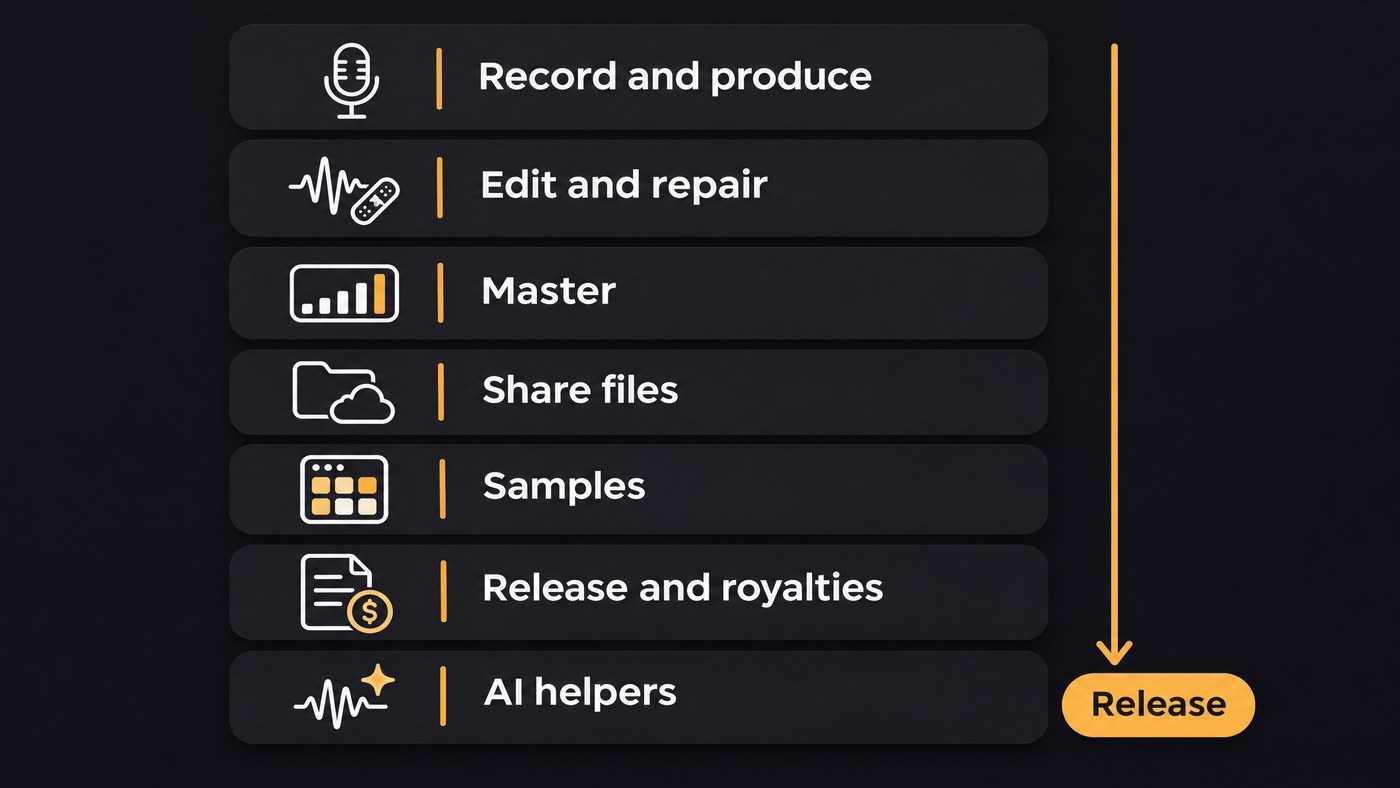
The audio software for indie labels that comes up most is a stack of tools by job: a DAW such as Pro Tools, Logic Pro, Ableton Live, FL Studio, Cubase, Fender Studio Pro or Reaper, iZotope RX for repair, Ozone or an AI service like LANDR for mastering, Splice for samples, a shared drive and a distributor's label plan.
No survey measures small labels directly. The public data covers producers and engineers, the people who make a label's records, so read the numbers below as "what your collaborators probably run". Pages were checked on 19 November 2026.
Which DAWs are most popular, and with whom
Two recent surveys name different leaders because they asked different people.
- Production Expert DAW Survey 2025 (published 11 September 2025): over 2,500 responses from a self-selected audience that skews professional and post-production. Pro Tools led by a wide margin, Logic Pro and Studio One came second and third, and Cubase plus Nuendo combined would rank third. Reaper showed solid use among advanced users. The authors' other finding matters for labels: very few people use just one DAW.
- University of Milan study (Federico Avanzini and colleagues, SMC 2025): 613 responses gathered from December 2023 to January 2024, 57.6% of them from Italy. Ableton Live was the most preferred DAW, followed by Reaper and Logic Pro. The authors sum it up: "Pro Tools remains the industry standard for professional audio engineers, while Ableton Live is gaining traction among hobbyists and independent producers, and Reaper appears to be well balanced between professionals and hobbyists." Unlike Production Expert's readers, many professionals here relied on a single DAW, and the authors caution that mailing-list responses are over-represented.
MIDiA Research's 2025 music creator survey (2,109 respondents, report published January 2026) includes DAW user profiles, but the full report is for clients and buyers, so we haven't quoted it.
The practical point: a label rarely chooses its artists' DAW. It chooses the formats everyone delivers in.
The DAWs, and where each fits at a small label
- Pro Tools. Production Expert calls it the standard in many professional environments, particularly post-production and commercial studios, so it matters when you book an outside mix or a sync edit.
- Logic Pro. For Mac and iPad. Apple's Logic Pro page lists Stem Splitter, which separates drums, bass, vocals, guitar, piano and other instruments, and Mastering Assistant.
- Ableton Live. Gaining ground with hobbyists and independent producers in the Milan data. Ableton's release notes show Live Suite 12.3 (25 November 2025) adding local stem separation into vocals, drums, bass and others.
- FL Studio. Image-Line's editions page promises lifetime free updates in every edition and lists stem separation from Producer Edition up.
- Cubase. Steinberg ranked third in Production Expert's survey when Cubase and Nuendo were counted together.
- Fender Studio Pro, formerly Studio One. Sound On Sound reports that from 13 January 2026, Studio One is known as Fender Studio Pro. Older surveys list it under the old name.
- Reaper. The budget pick. Cockos's purchase page (version 7.86, 13 November 2026) sells one version: a $60 discounted license, which a business may use if its yearly gross revenue doesn't exceed $20,000, or a $225 commercial license, after a free 60-day evaluation with full functionality.
For how AI features differ across these DAWs, see our guide to the best AI DAWs.
Editing and repair: iZotope RX
Labels need repair for home-recorded demos, live recordings, archive transfers and the vocal an artist can't re-record. Boris FX, which bought iZotope on 2 July 2026, calls RX the industry standard in audio repair and restoration and says it is used on most major film and television productions. At a small label the jobs are usually hum, clicks, background noise and one damaged moment in an otherwise good take. For the alternatives studios use, see what high-end audio editing programs studios use.
Mastering: Ozone, LANDR and AI mastering services
- Ozone. Boris FX says Ozone has set the standard for music mastering technology for more than twenty years. iZotope's Ozone 12 documentation has you add it to your DAW's master channel, where Master Assistant analyzes playback and adjusts settings, so someone on your team drives it.
- LANDR. Its mastering page offers album mastering that applies the same settings and loudness standards across every uploaded track, plus reference mastering against a track you choose. Its studio plans include unlimited online masters, with WAV downloads on the Standard and Pro tiers.
- Built-in assistants, such as Logic's Mastering Assistant, for quick references.
A sensible split: a mastering engineer for the singles you'll push, AI mastering for demos, alternates and reference masters, and one agreed loudness target per release. We compare the services in AI mastering for independent labels.
Collaboration and file sharing
Shared cloud drives such as Dropbox and Google Drive are widely used, and they work when the folders are boring and identical for every release:
01_Demos,02_Sessions,03_Mixes,04_Masters,05_Stems06_Artwork,07_Metadata(credits, splits, ISRCs),08_Licenses(sample licenses, contracts)- File names with artist, title, version and format:
ARTIST_Title_MIX_v03_24-48.wav
When people need to work in the same project rather than pass files, browser studios help. Soundverse's Collaborative AI Studio lets you invite people by email or link and pin comments to a track at the exact bar. Our explainer on cloud collaboration versus local project files covers the trade-offs.
Sample libraries: Splice and a sample log
Splice markets itself as a royalty-free sample library, and its licensing FAQ lists distributing a new recording via a record label as commercial use. The license for sounds downloaded while subscribed is perpetual. One line matters for label admin: "Please be aware that most distributors still require you to disclose the use of any licensed third-party materials in your content, even if they are royalty-free." Splice offers a certified license for that, so keep one per release in the licenses folder, along with a log of every sample and where it came from.
Release and royalty tools
Distributors sell label plans for several artists; Ditto's, for example, advertise automatic royalty splits. Royalty software such as Curve handles royalty accounting for labels and publishers. Our guide to distribution tools for label workflows compares them.
AI-assisted tools labels actually use
The clearest recent data comes from Water & Music, which surveyed 1,525 musicians for Moises in late 2025 (report, March 2026). About 80% were recruited through Moises' user base, so expect a tilt. Among AI users, stem separation led at 71%, mixing and mastering reached 32% and full song generation 24%.
- Stem separation for instrumentals and acapellas when sessions are lost, remix packs and sync alternates, on material you hold the rights to.
- AI mastering for demos and alternate versions, as above.
- Demo generation for writing sessions and pitches; see AI music software for small labels streamlining demos.
A lean starter stack for a 1–3 person label
- One house DAW for editing and assembly: Reaper on the discounted license if you qualify, or whatever the founder knows best.
- Repair: RX, or your DAW's noise tools for light jobs.
- Mastering: an engineer for focus singles, AI mastering for everything else.
- A shared drive with the folder template above and one owner per release.
- Samples: Splice or your producers' own libraries, plus the sample log.
- Release and royalties: a distributor label plan, and royalty software once splits multiply.
- AI helpers: stem separation and release planning.
Where Soundverse fits
Soundverse is an AI music platform that takes you from idea to audience; it isn't a label or a distributor. Stem Separator splits a mix into 2 or 6 stems (vocals, drums, bass, guitar, piano and other) as WAV or FLAC, and on Creator and above a maximum split gives every part its own file plus MIDI. Mastering One sits on the master bus of every AI Studio project on every plan, with targets such as Streaming −14, Apple Music −16 and Club / DJ −7 LUFS and a true-peak ceiling you set. Release Planner turns a finished track into a dated, platform-split rollout with pre-save, smart link and playlist pitch deadlines; it writes the plan and doesn't post or pitch for you. Licensing is set by plan: the Free plan is for personal use, and the Creator plan comes with a royalty-free license.
From 1:28, this walkthrough of Soundverse's Edit tools shows Stem Separator splitting a track, from input to result.
FAQ
What DAW do most indie labels use? No survey measures labels directly. Pro Tools leads among professionals in Production Expert's 2025 survey, while Ableton Live led the University of Milan's mixed sample of amateurs and professionals. The practical move is to work with whatever your artists use and standardize the delivery formats.
Is Reaper good enough for a label? For editing, assembly and preparing masters, yes. Its discounted license covers businesses with yearly gross revenue up to $20,000, and the 60-day evaluation has full functionality.
Can a small label rely on AI mastering? For demos and alternate versions, usually. For focus singles, compare an AI master with an engineer's before you choose, and keep one loudness target across an EP.
Do I have to tell my distributor about Splice samples? Splice says most distributors require you to disclose licensed third-party material, even when it is royalty-free. Generate the certified license and keep it with the release.
Sign up for Soundverse free and split, master and plan your next release in one place. More guides on the Soundverse blog.