What Makes an AI Voice Sound Robotic Versus Authentic?
What makes an AI voice sound robotic: flat pitch, grid-locked timing, level dynamics, buzzy artifacts. The cues of a real voice and how to fix each one.
What makes an AI voice sound robotic is too much regularity: pitch that sits dead flat on every note, onsets locked to the grid, dynamics that never swell, missing breaths and scoops, and metallic artifacts on held notes. An authentic vocal drifts, breathes and pushes in small, musical ways, and carries the sound of a real mouth, mic and room.
Below are the cues, why some AI voices pass, a fix for each cue and a blind test. Tool settings come from each maker's own pages, checked on 19 November 2026.
The cues that make an AI vocal sound robotic
Most listeners can't name the problem. They just stop believing the singer. These are the usual culprits.
Pitch
- Flat or over-quantized notes. Each note sits dead centre from start to finish, and the jump to the next note is instant.
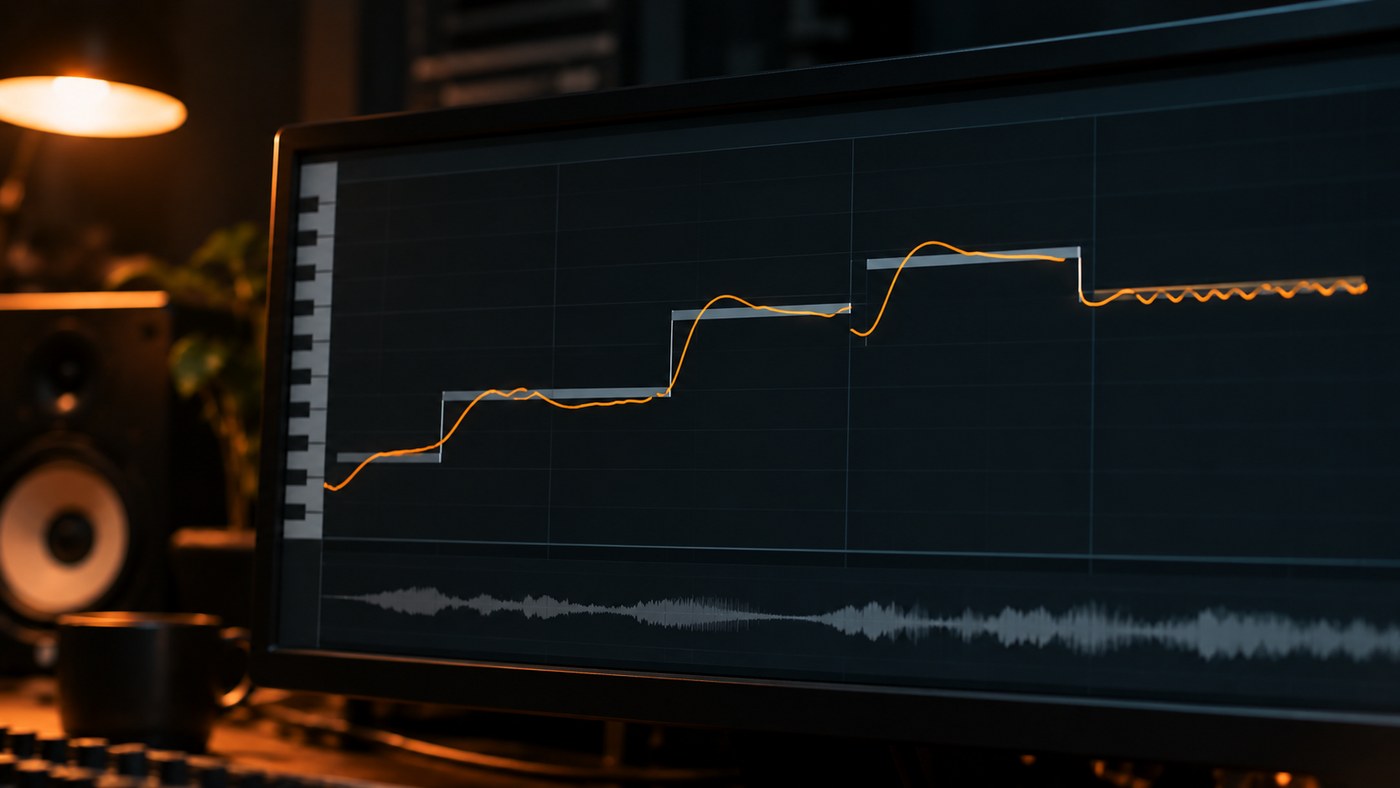
- No scoops or drift. No slide up into a note, no fall-off at the end of a phrase, no sag on a long note as air runs out.
- Identical vibrato. The same rate and depth on every long note, starting at the same moment. Singers delay it, widen it and leave some notes straight.
Timing
- Identical note onsets. Every syllable starts exactly on the 16th-note grid.
- Consonants locked to the grid. In a real take, the consonant starts before the beat so the vowel lands on it. When the consonant itself sits on the grid, the word sounds late and mechanical.
Dynamics
- One level all the way through. No swell into the key word of a line, no softer tail.
Texture
- Vocoder and phase artifacts. A metallic ring, a buzzy or phasey sheen on held vowels, or a warble when the pitch moves. These come from how the waveform is rebuilt, not from the performance.
- Smeared or lisping sibilants and plosives. An "s" that smears into the vowel, a "t" with no snap, a "p" with no puff or far too much.
- Missing breaths. A singer who never inhales has no body. Our guide to breathiness and subtle vocal artifacts covers breath in depth.
Language
- Wrong word stress. "be-CAUSE" sung as "BE-cause", "the" and "and" hit as hard as the nouns, or an unstressed syllable on the long note. Listeners hear a machine reading the lyric, even when every pitch is right.
What authentic vocals do instead
Authenticity lives in small deviations that never repeat exactly:
- Micro-timing. Syllables land a little early or late, differently each time.
- Pitch scoops and overshoot. The pitch dips before a note change, overshoots after it and settles, with a tiny wobble even on straight notes.
- Breath. Inhales sized to the phrase that follows, and some air in the tone on soft lines.
- Phrase-level dynamics. Each line has a shape: louder into its key word, softer at the end.
- Room and mic character. Proximity warmth, early reflections, a touch of preamp colour. Without them a vocal sounds pasted on top of the track.
Research backs up the pitch part. In psychoacoustic experiments published in Speech Communication in 2005, Takeshi Saitou, Masashi Unoki and Masato Akagi found that "several types of F0 fluctuation – overshoot, vibrato, preparation, and fine-fluctuation – affect the perception and quality of a singing-voice, and that overshoot has the greatest effect" (JAIST repository). F0 is the pitch curve, preparation is the small opposite dip before a note change, and fine fluctuation is the wobble on a held note. That's the measurable version of "too perfect".
Why do some AI voices sound more natural than others?
Three things separate the vocals that pass.
- Where the performance came from. Voice conversion re-sings a human take in another voice, so the human timing, scoops and breaths come along. A vocal generated from text or MIDI has to invent all of them.
- How the model rebuilds the sound. The DiffSinger paper by Jinglin Liu and colleagues (arXiv, accepted at AAAI 2022) explains that earlier singing models trained with simple loss functions produce over-smoothed output, which makes the singing less natural. In a mix, that tends to show up as a dull top, soft consonants and a buzzy sheen.
- The data behind the voice. Clean, varied training singing gives a model more natural movement to draw on.
Sounding natural and sounding like the right person are different tests. In the Singing Voice Conversion Challenge 2023, which ran a large crowd-sourced listening test on 26 submissions, Wen-Chin Huang and the organisers reported that "although human-level naturalness was achieved by the top system, no team was able to obtain a similarity score as high as the target speakers" (arXiv, 2023).
Naturalness is usually scored as a mean opinion score (MOS): listeners rate clips from 1 to 5 and the ratings are averaged. Our explainer on how AI voice synthesis works covers MOS and its limits. Context changes the verdict as well. Rob Clark and colleagues compared rating synthetic speech one sentence at a time with rating whole paragraphs, and found the outcomes differed and didn't necessarily correlate (SSW10, 2019). A vocal line that passes on its own can fail across a whole verse.
How to fix a robotic AI vocal, cause by cause
Work in this order, because each step changes what the next one has to do.
- Generation settings and re-takes. Generate several takes and comp the best lines. If one line is wrong in a good song, Soundverse's Inpainting (Creator plan and up) rewrites only the section you select. Fix word stress here too: rewrite the line so the stressed syllable lands on the long note.
- Start from a human take when you can. Sing or hum the line yourself, then convert it, so the timing and scoops are real from the start.
- Pitch editing with retune speed. Fast, hard correction is the classic robot sound. Antares' pitch correction guide (19 August 2026) puts transparent correction at a retune speed of 20 to 80 ms with Flex-Tune on and moderate Humanize, the hard effect at 0 to 10 ms, and suggests starting at 50 ms or higher. Humanize relaxes correction on sustained notes so vibrato and drift survive. In Soundverse's AI Autotune, use Natural, or Custom at a lower strength with Adaptive strength on, which eases off on breathy and unvoiced sounds. If a vocal came out too straight, draw scoops and varied vibrato back in, as our guide to adjusting pitch and vibrato on synthesized vocals shows.
- Timing nudges. Pull a few onsets off the grid by hand: consonants slightly early, the last word of a line a touch late. When a whole vocal drifts, AI Vocal Quantizer moves each phrase toward the grid by a strength you set. Its page says vocals usually sound best between 30% and 60%, while 100% snaps hard and can sound robotic.
- Breath layering. Add real inhales before long lines and high notes, never the same breath twice in a row.
- De-essing and plosives. Tame smeared "s" sounds before the reverb. De-Esser One in AI Studio spreads six bands from about 4.8 to 10.8 kHz, and its DELTA switch plays only what it removes, so you hear when it starts to cause a lisp. AI Vocal Cleaner's De-plosive turns down P and B pops only where they burst.
- Dynamics, saturation and room. Ride the level so each line has a shape, then add light saturation and a short room before any long reverb, so the voice sits in the same space as the band.
A blind test you can run before you release
You need a few friends and 20 minutes. This is an informal version of the MOS method.
- Pick the versions. Two or three AI vocal versions of one section, plus a human reference such as your guide vocal.
- Put each one in the mix. Same beat, same effects, the same 30 seconds including the chorus. Judge vocals in context.
- Match loudness. The louder clip tends to win, so match levels with a loudness meter.
- Hide the labels. Have someone else rename the files A, B, C and D and keep the key.
- Ask two questions. "How natural does the singer sound, from 1 to 5?" and "At what second, if any, did it stop sounding like a person?"
- Use several listeners and two playback systems. Five or more people, on earbuds and a phone speaker: earbuds exaggerate sibilance, phone speakers expose a thin, buzzy midrange.
- Average the scores, then read the timestamps. When several people flag the same moment, that's the cue to fix first.
Where Soundverse fits
Soundverse is an AI music platform that takes you from idea to audience, built for independent artists who release music, and most of the fix list maps onto its vocal tools. Voice Swap changes the voice and keeps the performance, so the phrasing and timing you sang carry through. AI Autotune runs from a Natural touch-up to a deliberate hard tune, AI Vocal Quantizer tightens timing phrase by phrase at a strength you choose, and AI Vocal Effects adds a preset chain with sliders for compression, brightness, reverb, delay and saturation. Licensing is set by plan: the Free plan is for personal use, and the Creator plan comes with a royalty-free license.
This walkthrough of Soundverse's Edit tools covers Inpainting and Voice Swap, two quick ways to replace a robotic line; Voice Swap starts at 2:18.
FAQ
Why does my AI voice sound robotic even when it's perfectly in tune?
Perfect tuning is often the problem: notes dead centre with instant changes, onsets on the grid and one loudness throughout read as a machine. Bring back scoops, varied vibrato and phrase-level dynamics, or slow the pitch correction.
Does auto-tune make a voice sound robotic?
Only at fast settings: Antares' guide puts the hard-tuned effect at a retune speed of 0 to 10 ms. AI vocals are often near pitch already, so try less correction first.
What's the quickest fix for a robotic AI vocal?
Replace the performance before you edit it: sing the line and convert it, or regenerate just that line. If you have to edit, start with timing and dynamics.
Why does my AI vocal sound metallic or buzzy?
Usually it's how the sound was rebuilt: over-smoothed output, heavy pitch shifting or a voice pushed outside the range it learned. Regenerate the line, shift it less, and de-ess before reverb.
Sign up for Soundverse free and put your next vocal through the blind test above.
More vocal production guides on the Soundverse blog.