Edit & enhance · Free
Put a drifting vocal back on the beat, without changing its pitch
AI Vocal Quantizer moves each phrase toward the beat grid by the strength you choose, and keeps the vocal's length. 2 tokens a minute, on every plan.
1,000 free tokens to start · No card needed · Cancel paid plans anytime
Do more with AI Vocal Quantizer on Creator — from $9.99/mo, or ₹399/mo in India. 4,000 tokens a month. Billed $119.88 a year, or $12.49 month to month.
What you get
Tighter timing
Each phrase moves toward its nearest grid line, from a light nudge to a full snap.
The same pitch
Only timing changes, and Preserve formants keeps the voice natural where it's stretched.
Drops back into the song
The result keeps the vocal's length, and with the instrumental added its grid starts from the beat, so it lines up.
Who it's for
Rappers
Lock a flow to the beat without re-recording the verse.
Singers
Keep a great-sounding take whose timing drifted in places.
Producers
Tighten a client's vocal or stacked harmonies before the mix.
When to use it
- A verse rushes ahead of the beat
- A chorus lands late
- Stacked vocals don't line up
- You like a take's sound but not its timing
- You know the song's tempo and want the vocal on its grid
What you can make with it
A rushed verse, steadied
Add the beat and run the verse at 50% so it sits back on the grid.
A late chorus
Tighten a chorus that drags behind the beat.
A tight rap flow
Use the 1/16 or 1/32 grid at a higher strength for a locked-in flow.
Harmonies that line up
Quantize each harmony stem to the same grid so they hit together.
A set tempo
Turn off Auto-detect tempo and type the song's BPM when you know it.
A light touch
Use a strength around 30% to steady the timing while keeping the human feel.
Screenshots
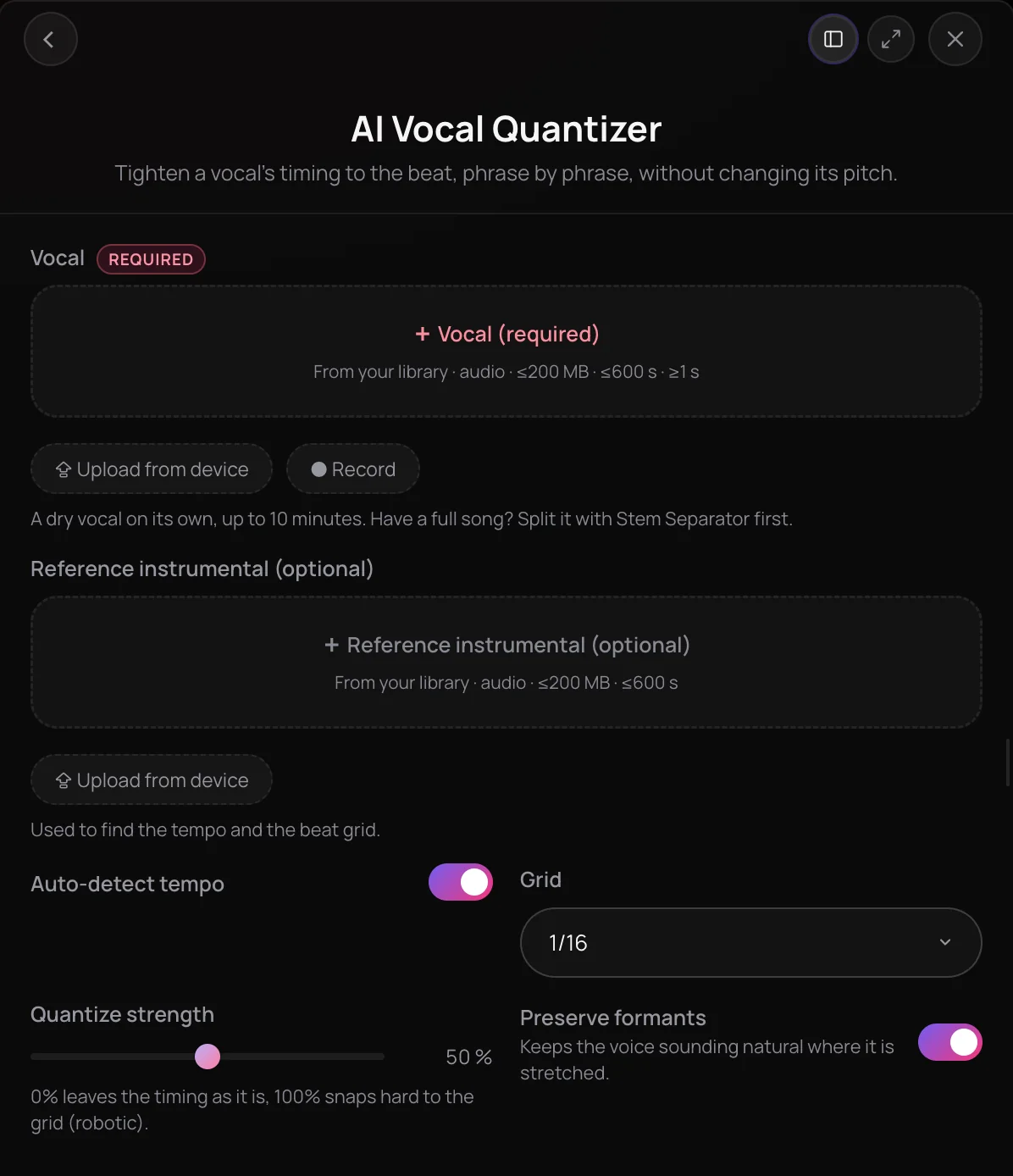
AI Vocal Quantizer is Soundverse's timing correction for a vocal. It finds the tempo, from your instrumental, the vocal or a BPM you type, splits the vocal into phrases at its pauses and moves each phrase toward the nearest line of the beat grid by the strength you choose. The pitch stays the same, the stretch stays small, and the result keeps the vocal's length, so it still lines up with your instrumental. It's for vocalists and producers whose takes drift from the beat.
What you can do
The controls
A tempo, a grid and how far to move.
Tempo
Auto-detect tempo reads it from the instrumental when you add it, else from the vocal; or turn it off and type it, from 60 to 200 BPM.
Grid
1/4, 1/8, 1/16 (the default) or 1/32 notes.
Quantize strength
From 0% (left as sung) to 100% (snapped to the grid, robotic), 50% by default.
Preserve formants
On by default: keeps the voice sounding natural where it's stretched.
How it works
Open AI Vocal Quantizer
Choose AI Vocal Quantizer in the Vocal Production section of AI Tools.
Add the vocal and the beat
Pick a vocal from your Library, upload one or record it in the panel: WAV, MP3, M4A or FLAC, up to 10 minutes. Add the instrumental as the reference to find the tempo and the beat grid.
Set the grid
Leave Auto-detect tempo on or type the tempo, from 60 to 200 BPM. Pick a grid of 1/4, 1/8, 1/16 or 1/32 notes and a Quantize strength, 50% by default.
Quantize and listen
Click Quantize Vocal. The tightened vocal arrives in your chat and is saved to your Library, with the tempo used, the phrases found and the largest correction.
Why use AI Vocal Quantizer
On the beat, still in tune
Timing moves; the pitch doesn't. Preserve formants keeps the voice sounding natural where it's stretched.
Whole phrases, not chopped notes
The vocal is split at its pauses and each phrase moves as one, so the words keep their flow.
You set the feel
Strength runs from 0%, as sung, to 100%, snapped to the grid. Vocals usually sound best between 30% and 60%.
Lines up with your beat
With the instrumental added, the grid starts from its first beat, and the result keeps the vocal's length, so it drops straight back in.
What it costs
Works on the Free plan. New accounts get 1,000 free tokens, enough for about 166 3-minute vocals.
- Quantize a 3-minute vocal: 6 tokens at 2 tokens a minute (about $0.01–$0.02 on Creator, or ₹1 in India).
A vocal is charged for its real length, with a one-minute minimum, and the total is rounded up to a whole token. Before a run, the panel shows its price for your vocal, or the rate a minute until the vocal's length is known.
Running the same vocal with the same settings again soon after returns the earlier result, and nothing is charged.
Creator $12.49 a month, or $9.99 a month billed yearly ($119.88 a year) · Pro $31.24 a month, or $24.99 a month billed yearly ($299.88 a year) · Max from $72 a month, or $60 a month billed yearly ($720 a year).
In India (PayU): Creator ₹499 a month, or ₹399 a month billed yearly (₹4,788 a year) · Pro ₹1,299 a month, or ₹1,039 a month billed yearly (₹12,468 a year) · Max from ₹2,999 a month, or ₹2,399 a month billed yearly (₹28,788 a year).
Prices outside India are in US dollars, billed through Stripe; in India they are in rupees, billed through PayU. Monthly tokens reset each month and don't roll over.
Good to know
Needs a tempo
If none can be detected and none is set, the run stops instead of guessing. Set the BPM or add the instrumental.
Phrases, not notes
Whole phrases move toward the grid; single notes inside a phrase keep their own timing.
One solo vocal
Start from a vocal on its own, 1 second to 10 minutes long. For a full song, split out the vocal with Stem Separator first.
Frequently asked questions
Is AI Vocal Quantizer free?
AI Vocal Quantizer works on every Soundverse plan, including Free, and each run uses tokens: 2 a minute of vocal, with a one-minute minimum, so a 3-minute vocal costs 6 tokens. The panel shows the price for your vocal before you run it. Soundverse is free to sign up, and new accounts get 1,000 free tokens.
Will a quantized vocal sound robotic?
Not at moderate strength. Each phrase moves toward the grid by the strength you set: 0% leaves the timing as sung and 100% snaps it hard, which can sound robotic. Vocals usually sound best between 30% and 60%. The stretch between phrases stays between 0.94× and 1.08× of the original speed, and Preserve formants keeps the voice natural where it's stretched.
Can I use the quantized vocal commercially?
On the Free plan, what you make on Soundverse is for personal use. Paid plans add a commercial license; the Pricing page lists what each plan covers. AI Vocal Quantizer processes a vocal you bring, so you need the rights to the recording and to any instrumental you add.
What can't AI Vocal Quantizer do?
It moves whole phrases, not single notes, and it doesn't change the pitch or the song's tempo, so it isn't a way to speed a track up or slow it down. It needs a tempo: if none can be detected and you haven't set one, the run stops and asks you to set the BPM or add the instrumental. It works on one solo vocal, 1 second to 10 minutes long.
What is AI Vocal Quantizer?
AI Vocal Quantizer is a Soundverse tool that tightens a vocal's timing to the beat. It finds the tempo, splits the vocal into phrases at its pauses, moves each phrase toward the beat grid by the strength you choose without changing the pitch, and saves the result as a new file in your Library.
Which grid should I pick?
1/16 notes is the default. A coarser grid, 1/8 or 1/4, gives each phrase fewer places to land, on bigger beats, and 1/32 gives it more, closer together. The grid follows the tempo, so set the tempo correctly or add the instrumental.
How does AI Vocal Quantizer split a vocal into phrases?
A new phrase starts after 200 milliseconds of quiet, and each phrase moves as a whole toward its nearest grid line. That keeps the words of a phrase together. The result says how many phrases it found, the tempo it used and the largest correction it made.
Does AI Vocal Quantizer fix pitch too?
No. AI Vocal Quantizer changes timing only. To correct the pitch, use AI Autotune, or use AI Vocal Producer to clean, tune, time and polish a vocal in one run.
Ready to put your vocal on the beat?
Add a vocal and its instrumental, pick a grid and a strength, and get back a vocal that sits on the beat.
