Legal Precedents in Voice Cloning Cases (2024–2026): How Courts Shaped AI Voice Rights
Explore major court decisions on AI voices and voice rights law shaping legal precedents in voice cloning between 2024–2026.
Legal Precedents in Voice Cloning Cases (2024-2026)
Voice cloning has transitioned from a curious experiment in machine learning to a fully regulated field of artificial intelligence jurisprudence. Between 2024 and 2026, global courts began addressing complex issues surrounding AI-generated voices, deepfake audio, and the extent to which voice likeness can be protected under intellectual property law. While early cases set the tone for how voice rights are recognized, recent decisions have formed the foundation for sustainable legal frameworks.
What are the key legal precedents in voice cloning from 2024 to 2026?
From 2024 to 2026, several landmark rulings around AI voice reproduction clarified concepts of consent, likeness, and monetization. In early 2024, courts in the United States and the European Union began classifying voice data as biometric property — not just creative output. This distinction allowed individuals to claim ownership of their vocal signatures. By mid-2025, the first civil lawsuits targeting unauthorized cloning of celebrity voices underscored personal rights of publicity and privacy violations. These cases expanded the interpretation of likeness protection to include auditory characteristics. You can read about the U.S. developments in New York Court Tackles the Legality of AI Voice Cloning | Insights.
In early 2026, international tribunals began citing precedent-setting cases that demanded AI developers to secure consent for voice model training. The emphasis shifted from punitive measures to proactive licensing structures. Legislative amendments in the UK, Japan, and South Korea embedded voice rights into broader AI regulation, defining how models could learn from human voices. The outcomes of these cases now serve as strategic guidelines for developers and record labels embracing AI audio technologies.
How do court decisions on AI voices establish boundaries for creators and algorithms?
Court decisions on AI voices during this period have fundamentally changed how vocal synthesis technology can be used commercially. For instance, while developers can generate speech textures, using distinctive voice DNA without explicit permission now constitutes a violation of personality rights. Some judgments treated vocal imitation as a form of deepfake manipulation, thereby linking voice cloning phenomena to broader deepfake legal regulation policy discussions. Read more on regulatory influences in Synthetic Media & Voice Cloning: Right of Publicity Risks for 2026.
Legal professionals and technology policy analysts observed that judges consistently emphasized transparency and traceability. AI companies were asked to prove the origin of model data, an effort echoing principles discussed in ethical AI frameworks such as attribution and consent-first design. The rulings also incentivized enterprises to adopt watermarking and traceable export systems — components now becoming standard across legitimate voice generation tools.
For academic researchers, this judicial pattern represents a fascinating evolution. Where once AI audio was considered a derivative novelty, courts now frame AI voice reproduction within a matrix of intellectual property and performance art. Between 2025 and 2026, the convergence of voice rights law and deepfake legal regulation produced hybrid precedents that do not just cover music publishing but cross into media ethics and data governance.
What does voice rights law look like in 2026?
The voice rights law landscape in 2026 is dynamic but comparatively harmonized. Following multi-jurisdictional negotiations in the European Parliament, voice rights were officially added under the “Digital Creativity Integrity Act,” marking the first integrated recognition of vocal likeness as a monetizable creative asset. Similarly, in North America, the “AI Transparency and Accountability Act” empowered artists and everyday individuals with legal grounds to seek recurring compensation from AI companies using their voices. See practical compliance discussions in Is Voice Cloning Legal in 2025? A Practical Compliance Guide for ....
Voice rights law in Asia evolved rapidly after several pop artists filed AI-generated voice lawsuits in 2025. Courts responded by requiring AI studios to adopt contractual consent protocols before dataset creation, aligning regional practice with global ethics. The modern interpretation extends beyond singer protection — podcasts, voice-over artists, and even influencers now safeguard their brands through proactive licensing agreements.
Within this framework, intellectual property and AI coexist under shared governance. The core philosophy emphasizes authenticity, attribution, and ongoing participation, echoing the same vision that Soundverse developed through its Ethical AI Music Framework.
For further technical examples, watch our guide on creating Deep House music or explore the Soundverse Tutorial - How to Make Music for advanced creative workflow applications.
How do deepfake legal regulation and AI-generated voice lawsuits influence global standards?
Deepfake legal regulation became intertwined with voice cloning cases because voice manipulation represents one of the most accessible and potentially harmful forms of deepfake technology. After several high-profile impersonation scandals in 2024 and 2025, governments accelerated protections against synthetic deception. By 2026, penalties for distributing AI-altered voices without disclosure were codified in multiple countries. Further considerations on federal court actions are highlighted in AI Voice Cloning Lawsuit Moves Forward in Court - IIPLA.
In courtrooms, AI-generated voice lawsuits established precedents around the duty of disclosure. The burden now lies on creators and platforms to identify synthetic voices with clear labeling systems. Watermarking and traceability became integral features of compliant AI operations across industries. These decisions safeguard not only artists but enterprise users, who must prove lawful sourcing of AI-generated audio during commercial production.
The ripple effects go further. Corporate compliance departments in entertainment, advertising, and gaming began deploying third-party verification tools, ensuring that all AI voices meet attribution requirements. Law firms specializing in IP and AI ethics also adapted, advising clients on transparent auditing, dataset licensing, and compensation management.
How to make voice cloning legally compliant with Soundverse The Ethical AI Music Framework
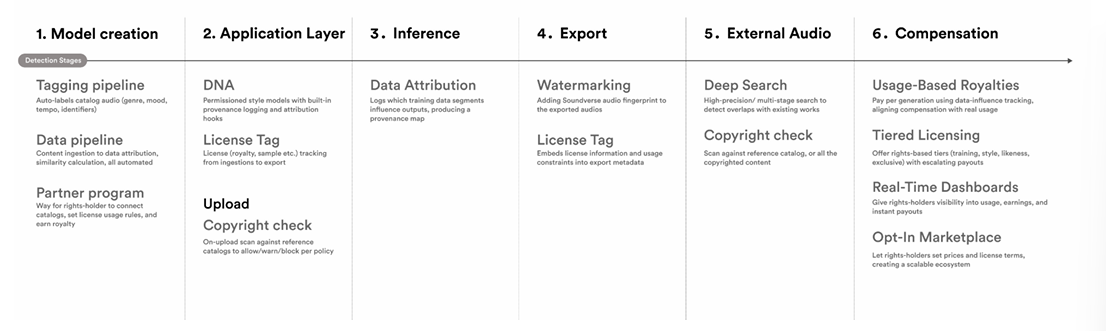
Soundverse’s Ethical AI Music Framework offers an end-to-end infrastructure designed precisely to address the legal and ethical complexities illuminated by the 2024–2026 precedents. Instead of opaque generative pipelines, Soundverse operates through six transparent stages:
Stage 1 – Licensed Data Sourcing: All training data is sourced under explicit licensing agreements. There is no scraping or unauthorized data ingestion. This ensures legal compliance from the start.
Stage 2 – Permissioned Models (DNA): Every voice model has documented consent. Permission-based DNA encoding guarantees that vocal likeness is replicated only with authorized rights.
Stage 3 – Explainable Inference (Attribution): Generated outputs maintain attribution data tracing back to model sources, enabling creators to verify how their voice DNA has been used.
Stage 4 – Traceable Export (Watermarking): Every exported audio file contains transparent watermark markers, ensuring traceability across distribution networks.
Stage 5 – Deep Search (External Scanning): Soundverse deploys deep scanning for external use or misuse of licensed voices, facilitating protective actions under current voice rights law.
Stage 6 – Recurring Compensation (Partner Program): Artists participating in the framework receive ongoing royalties when their voice DNA contributes to generated works, establishing a fair monetization model that aligns with 2026 AI accountability standards.
These six stages encapsulate the compliance principles emphasized by courts in recent AI-generated music cases. They directly respond to the judicial demand for transparency and attribution formulated through legal precedents in voice cloning.
For enterprise users navigating international regulations, Soundverse safeguards their production pipeline with documented legality. For artists, it represents ethical restoration: consent-first voice modeling, traceability, and continuous compensation. This is precisely what global legal systems have been calling for since the earliest deepfake rulings in 2024.
To explore related transformations in AI music law and technology, see how AI-generated music is transforming the music industry at https://www.soundverse.ai/blog/article/how-ai-generated-music-is-transforming-the-music-industry and how Soundverse revolutionizes music creation at https://www.soundverse.ai/blog/article/soundverse-ai-revolutionizing-music-creation-for-new-age-content-creators. For insights on music industry trends, visit https://www.soundverse.ai/blog/article/music-industry-trends or learn how ethical AI practices integrate with creative workflows in https://www.soundverse.ai/blog/article/soundverse-assistant-your-ai-music-co-producer.
Explore the Future of Ethical AI Voice Creation
Stay ahead of legal and creative trends shaping voice cloning and AI-generated music. Learn how Soundverse empowers creators to produce responsibly, legally, and authentically.
Start Creating with Soundverse AI
Related Articles
- AI Music in the USA - Discover how AI technology is transforming music creation and copyright law across the United States.
- Copyright-Free vs Royalty-Free Music: What Creators Should Know - Learn the legal distinctions that affect how creators use and share music in the digital age.
- Navigating the World of Royalty-Free and Copyright-Free Music Using Soundverse AI - Understand how Soundverse AI supports fair use and compliance for ethical content creation.
- The Role of AI Music in Film and Television - Explore how AI-generated compositions are influencing licensing and creative rights in entertainment media.
Here's how to make AI Music with Soundverse
Video Guide
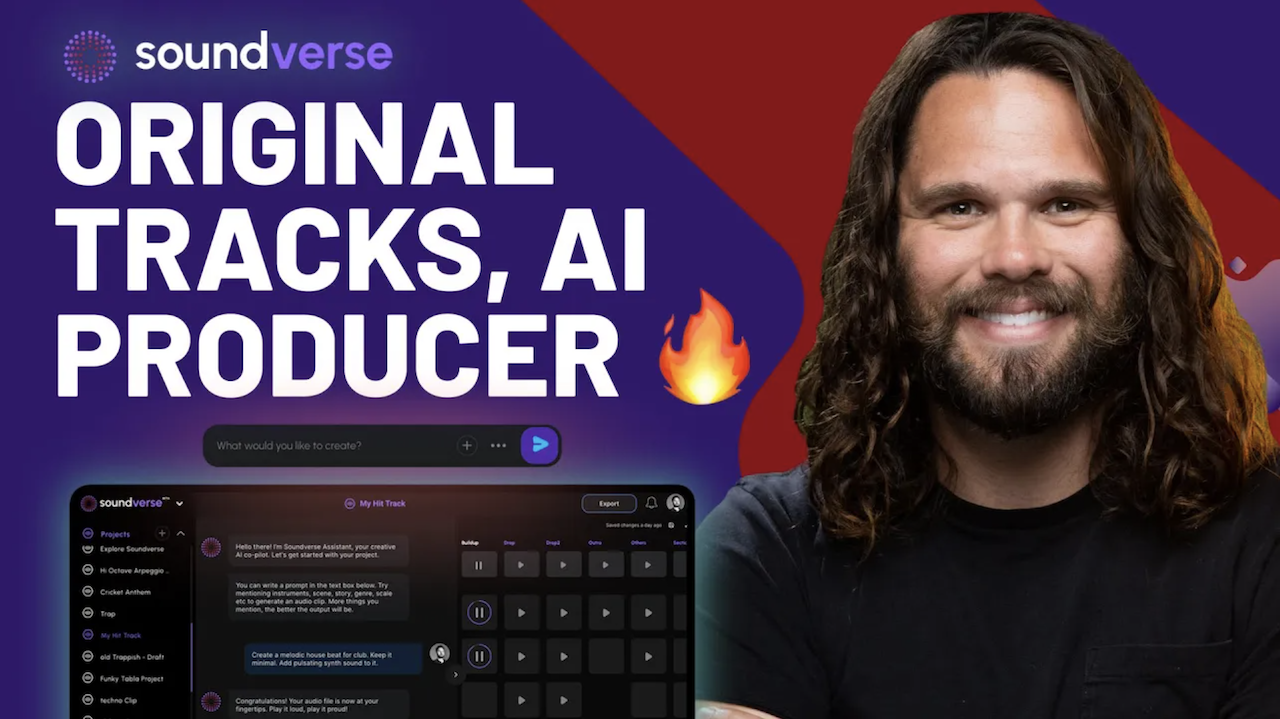
Here’s another long walkthrough of how to use Soundverse AI.
Text Guide
- To know more about AI Magic Tools, check here.
- To know more about Soundverse Assistant, check here.
- To know more about Arrangement Studio, check here.
Soundverse is an AI Assistant that allows content creators and music makers to create original content in a flash using Generative AI. With the help of Soundverse Assistant and AI Magic Tools, our users get an unfair advantage over other creators to create audio and music content quickly, easily and cheaply. Soundverse Assistant is your ultimate music companion. You simply speak to the assistant to get your stuff done. The more you speak to it, the more it starts understanding you and your goals. AI Magic Tools help convert your creative dreams into tangible music and audio. Use AI Magic Tools such as text to music, stem separation, or lyrics generation to realise your content dreams faster. Soundverse is here to take music production to the next level. We're not just a digital audio workstation (DAW) competing with Ableton or Logic, we're building a completely new paradigm of easy and conversational content creation.
TikTok: https://www.tiktok.com/@soundverse.ai
Twitter: https://twitter.com/soundverse_ai
Instagram: https://www.instagram.com/soundverse.ai
LinkedIn: https://www.linkedin.com/company/soundverseai
Youtube: https://www.youtube.com/@SoundverseAI
Facebook: https://www.facebook.com/profile.php?id=100095674445607
Join Soundverse for Free and make Viral AI Music

We are constantly building more product experiences. Keep checking our Blog to stay updated about them!