Is Voice Cloning Legal? State-by-State Guide (2026 Update)
Explore voice cloning legality by state in 2026 and learn how AI voice laws differ across the U.S.
Is Voice Cloning Legal? State-by-State Guide
Voice cloning has rapidly evolved from a niche technology into a mainstream tool for entertainment, marketing, and communication. By 2026, AI-driven voice replication tools can recreate speech patterns and emotional tones so precisely that distinguishing synthetic vocals from real ones often requires digital forensics. But with this innovation comes a critical question: Is voice cloning legal in the United States? This article explores voice cloning legality state by state, reviews core federal guidelines, and explains how frameworks like Soundverse’s Ethical AI Music Framework ensure compliance and protect voice rights.
What is voice cloning and why does legality matter in 2026?
Voice cloning refers to the process of using artificial intelligence to replicate or synthesize a person’s voice, often from small audio samples. It may serve creative goals—such as recreating singing performances or preserving voices for storytelling—but can also raise privacy, intellectual property, and consent issues. As AI-generated voices become integral in music creation and film dubbing, knowing the cloning legality boundaries has become essential for developers and legal experts.
In 2026, states vary in defining voice likeness as an element of an individual’s identity protected by law. Legislators are now balancing innovation against the right of publicity, biometric privacy, and artistic freedom. This legal patchwork requires businesses to navigate different standards when generating or distributing cloned voices.

Which federal laws influence voice cloning regulations?
Although no single U.S. federal law directly prohibits voice cloning, several statutes provide guiding principles:
- Right of Publicity (common law and state statutes): Prevents unauthorized commercial use of a person’s voice, name, likeness, or persona.
- Biometric Information Privacy Acts: Some states treat voiceprints as biometric identifiers, requiring user consent before collection or processing.
- Copyright and Digital Millennium Copyright Act (DMCA): Regulates derivative works and prohibits unauthorized reproduction or modification of copyrighted materials that include vocal performances.
- Federal Trade Commission (FTC) guidelines: Address deceptive AI practices in advertising—using a cloned celebrity voice without disclosure may qualify as consumer deception.
These frameworks influence state-level interpretations, shaping the overall landscape of AI voice laws.

How do voice rights differ state by state?
State regulation determines whether an individual’s voice is treated like their image or likeness and whether consent is necessary for voice-cloning applications.
California
California’s Civil Code §3344 and biometric privacy provisions make it one of the strictest states. Voice is considered part of a person’s identity. Commercial voice cloning without permission can result in civil penalties, especially in entertainment and advertising sectors (California AI Laws January 2026 - Real AI Voice & Web Solutions).
Texas
In Texas, the Biometric Privacy Act covers voiceprints, but consumer applications with non-identifiable synthetic voices may be permitted if consent is obtained. Unauthorized cloning of public figures may trigger a right-of-publicity violation (Synthetic Media & Voice Cloning: Right of Publicity Risks for 2026).
Illinois
Illinois’ Biometric Information Privacy Act (BIPA) explicitly includes voiceprints, making it illegal to record or replicate voices without explicit written consent. Several lawsuits since 2024 have clarified that synthetic voice models derived from personal data are covered by BIPA (AI Voice Cloning & Identity: The Limits of Intellectual Property).
New York
New York recognizes a statutory Right of Publicity as of 2025. In 2026, this law protects voices under the likeness clause, preventing commercial AI replication of artists and public figures without prior licensing (New York Court Tackles the Legality of AI Voice Cloning | Insights).
Florida
Florida currently relies on tort-based right-of-publicity rules. While not explicitly banning voice cloning, courts have treated well-known voices as property interests in recent rulings. AI sound generation tools operating in Florida must maintain transparent consent mechanisms (Understanding the Legal Implications of AI Voice Cloning).
Washington
Washington’s Biometric Privacy Act (HB 1493) includes voice data protection. Developers collecting or generating speech profiles for cloning must notify users and provide deletion rights (Is Voice Cloning Legal in 2025? A Practical Compliance Guide for ...).
Nevada and Arizona
These states have adopted emerging AI transparency statutes focusing on disclosure. As of 2026, voice cloning applications for commercial entertainment must include labels or watermarks indicating AI synthesis (Are AI Voices Copyrighted? Understanding the Legal Side).
States Without Specific Legislation
States like Wyoming, Idaho, and Mississippi lack targeted AI voice laws, relying on general data protection and intellectual property norms. However, cross-border digital distribution means companies must still comply with stricter states when operating nationally.
What are current industry compliance challenges?
The absence of unified law means developers face several challenges:
- Consent management across multiple jurisdictions.
- Attribution tracking for voice datasets.
- Royalties and recurring compensation when cloned voices generate revenue.
- Watermarking synthetic voice outputs for transparency.
The difference between personal rights and creative licensing also affects musicians who wish to use cloned vocals legally. Artists collaborating with AI platforms often seek frameworks guaranteeing attribution and fair compensation, similar to songwriters’ protection under copyright.
For additional context on evolving music technology, explore music industry trends, AI music in the USA, and how AI-generated music is transforming the music industry to understand interconnected legal impacts.
For a deeper dive into creative workflow applications, watch Soundverse Tutorial Series - 9. How to Make Music or explore our Deep House production guide.
How to make voice cloning ethically compliant with Soundverse The Ethical AI Music Framework
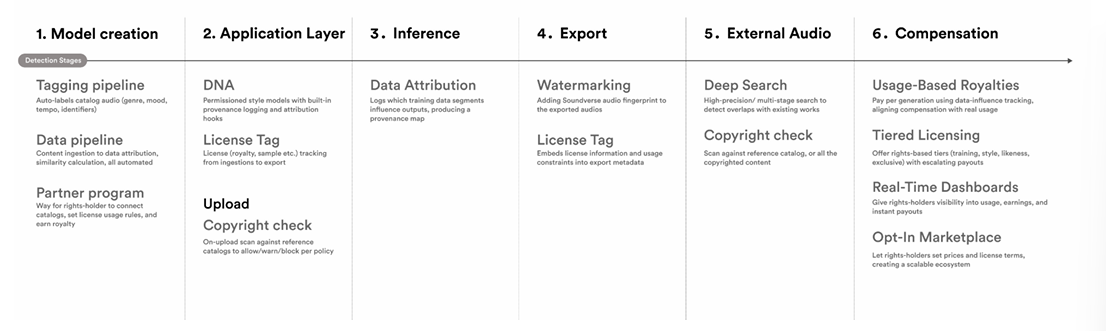
Soundverse’s Ethical AI Music Framework was designed as a blueprint for responsible innovation. This six-stage infrastructure ensures that every AI-generated vocal segment maintains transparency, consent, and monetization alignment.
Core system outline:
- Stage 1: Licensed Data Sourcing (No scraping) – Voice and music data are sourced through approved licensing, ensuring participants’ consent and eliminating unauthorized scraping practices.
- Stage 2: Permissioned Models (DNA) – AI models operate on permissioned datasets representing voice rights owners who have opted into the system.
- Stage 3: Explainable Inference (Attribution) – Every generated vocal is traceable to its underlying licensed dataset for clear attribution.
- Stage 4: Traceable Export (Watermarking) – Soundverse embeds invisible watermarking to distinguish synthetic voices from real recordings.
- Stage 5: Deep Search (External Scanning) – Allows detection of voice usage across external media channels, verifying proper credit and license adherence.
- Stage 6: Recurring Compensation (Partner Program) – Rights-holders receive usage-based royalties directly linked to attribution data, promoting continuous fair compensation.
By integrating this framework, enterprises and independent creators can confidently operate within state and federal standards. It serves as both compliance assurance and an ethical compass in AI voice creation.
Complementary tools such as Soundverse Trace extend these protections across the voice creation lifecycle, and the Content Partner Program lets voice artists and labels participate monetarily through data licensing. These systems transform potential legal grey zones into verifiable, rights-respecting operations.
Learn more about how Soundverse’s music generation tools already enable transparent creation on platforms such as Soundverse AI Magic Tools and generate AI music with Soundverse text-to-music.
How can businesses ensure compliance when using voice cloning technology?
- Obtain written consent for identifiable voices, even if the voice belongs to a fictional character or celebrity impersonation.
- Label synthetic outputs clearly. Transparent disclosure is critical for avoiding consumer deception claims.
- Implement watermarking or traceability systems similar to Soundverse’s pipeline.
- Engage in periodic audits to verify that data collection complies with BIPA, California Consumer Privacy Act (CCPA), or equivalent.
- Join licensing frameworks such as Soundverse’s Content Partner Program to guarantee recurring royalties.
What does the future of voice cloning legality look like?
As AI governance expands, voice cloning will likely become federally standardized around 2027. The FTC and U.S. Copyright Office are reviewing models defining synthetic voice identity as protected property. States may adopt uniform right-of-publicity rules, integrating real-time disclosure requirements and ethical flags embedded within AI outputs.
The momentum toward transparency is being shaped by demand from creators and ethical music AI organizations. Businesses integrating legal compliance frameworks now are positioned to lead responsibly as AI-generated voices dominate creative production.
Explore Legal-Friendly AI Voice Creation Today
Ensure your voice cloning projects stay on the right side of the law. With Soundverse’s AI tools, you can generate authentic voices and music while respecting ethical and legal standards.
- AI Music in the USA – Understand how AI is shaping the music landscape across different states and what creators should know about regional adoption.
- Copyright-Free vs. Royalty-Free Music: What Creators Should Know – Learn the key differences between copyright-free and royalty-free music to ensure your content stays compliant and monetizable.
- Navigating the World of Royalty-Free and Copyright-Free Music Using Soundverse AI – Discover how Soundverse simplifies finding and using legal music for creators and businesses worldwide.
- Soundverse SAAR: AI Voice Assistant – Explore Soundverse SAAR, the AI voice assistant designed to help creators generate unique voice assets with precision and ease.
Here's how to make AI Music with Soundverse
Video Guide
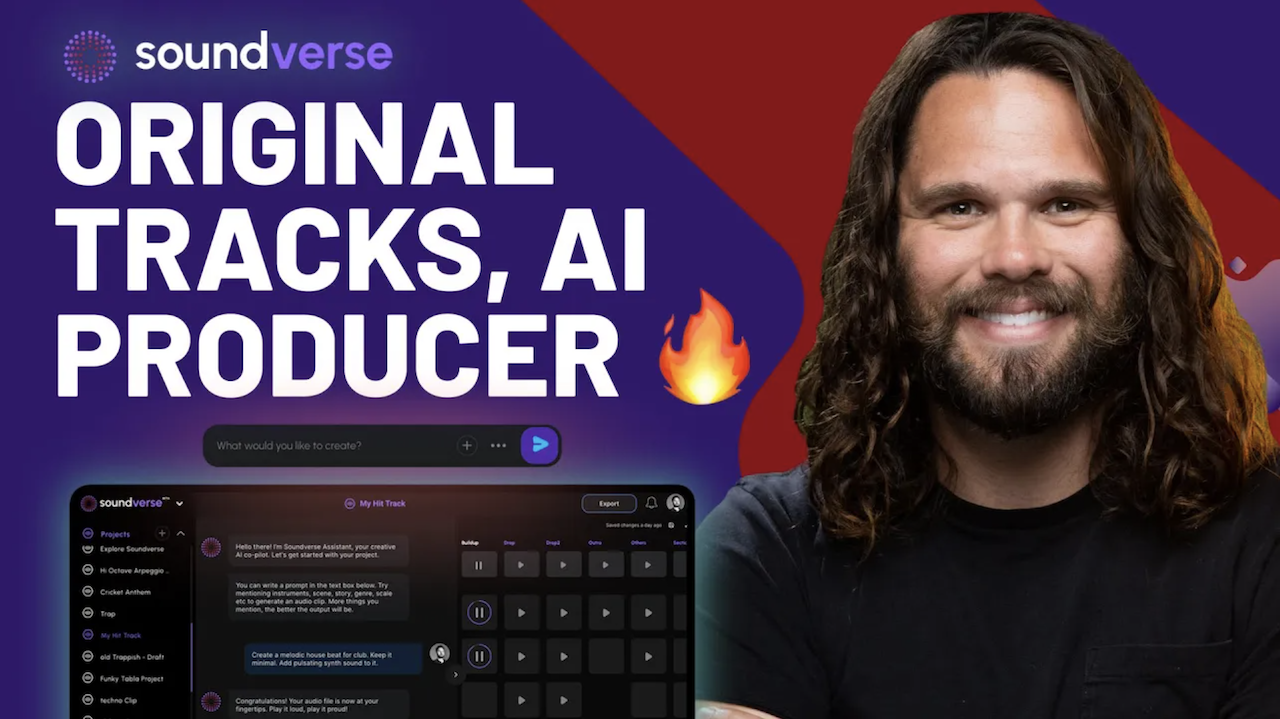
Here’s another long walkthrough of how to use Soundverse AI.
Text Guide
- To know more about AI Magic Tools, check here.
- To know more about Soundverse Assistant, check here.
- To know more about Arrangement Studio, check here.
Soundverse is an AI Assistant that allows content creators and music makers to create original content in a flash using Generative AI.
With the help of Soundverse Assistant and AI Magic Tools, our users get an unfair advantage over other creators to create audio and music content quickly, easily and cheaply.
Soundverse Assistant is your ultimate music companion. You simply speak to the assistant to get your stuff done. The more you speak to it, the more it starts understanding you and your goals.
AI Magic Tools help convert your creative dreams into tangible music and audio. Use AI Magic Tools such as text to music, stem separation, or lyrics generation to realise your content dreams faster.
Soundverse is here to take music production to the next level. We're not just a digital audio workstation (DAW) competing with Ableton or Logic, we're building a completely new paradigm of easy and conversational content creation.
TikTok: https://www.tiktok.com/@soundverse.ai
Twitter: https://twitter.com/soundverse_ai
Instagram: https://www.instagram.com/soundverse.ai
LinkedIn: https://www.linkedin.com/company/soundverseai
Youtube: https://www.youtube.com/@SoundverseAI
Facebook: https://www.facebook.com/profile.php?id=100095674445607
Join Soundverse for Free and make Viral AI Music
We are constantly building more product experiences. Keep checking our Blog to stay updated about them!