Is Splitter AI Safe? Understanding Splitter AI Safety in 2026
Learn about Splitter AI safety, reliability, and privacy in 2026 for content creators.
Is Splitter AI Safe?
Is Splitter AI Safe? Understanding Splitter AI Safety in 2026
Artificial Intelligence has redefined audio processing, allowing creators to separate vocals, drums, and instruments effortlessly. For many, Splitter AI has become popular for audio stem separation. Yet, as more professionals use AI for music production and podcast editing, questions arise: Is Splitter AI safe? How reliable and secure are AI-driven separation tools? And what privacy risks do users face when uploading audio files to cloud platforms?
This article dives deeply into Splitter AI safety, evaluates privacy and data risks, compares current standards in AI music separation, and explores how Soundverse addresses trust and security for AI audio workflows in 2026.
Why Do Creators Care About Splitter AI Safety?

In 2026, the lines between creativity and machine intelligence have blurred. Music producers, podcasters, and sound designers rely on tools like Splitter AI to save time separating stems for remixing or editing. However, these same users often share unreleased recordings, collaborative sessions, or copyrighted tracks—raising concerns about who accesses the data and how securely it is stored.
Main Reasons Safety Matters:
- Privacy: Artists and podcasters upload sensitive recordings. Unauthorized exposure or leaks could harm reputations or breach contracts.
- Copyright Protection: AI models trained on copyrighted data without consent may generate derivative content, sparking legal complications.
- Data Storage Risks: Many online AI tools store uploaded tracks on external servers, sometimes indefinitely.
- Reliability in Separation: Creators need consistent, artifact-free output. Poorly processed stems could distort mixes or require rework. These concerns contribute to the growing conversation around AI music separation security and music AI privacy concerns across the creative industry.
What Security Challenges Do AI Music Tools Face in 2026?

AI audio processing brings transparency challenges. Most free or public tools rely on cloud computation, making data exposure possible if not encrypted properly.
1. Dataset Transparency Issues
AI models powering music separation often learn from proprietary or public datasets. Without transparent licensing, creators cannot verify whether their outputs derive from copyrighted works—an issue tied to Splitter AI reliability.
2. Cloud Processing Vulnerabilities
When users upload audio to online platforms, files may pass through multiple third-party servers. Even if Splitter AI provides encryption, the architecture could still expose data points to intermediaries. As noted by PointGuard AI, AI-related security incidents have grown rapidly with cloud-driven architectures.
3. Limited User Control
Most AI music applications do not specify deletion timelines or control over retained audio files. Users rarely know how long their uploads remain stored. Reports like Aikido’s 2026 AI Security Study highlight these transparency deficiencies among app developers.
4. Intellectual Property (IP) Ambiguity
If an AI model separates your song’s stems, who owns the processed result? This ambiguity creates contractual grey zones for creators using AI music separation tools commercially.
How Reliable Is Splitter AI for Professional Use?
Reliability in AI music tools is not just about technical accuracy—it’s about predictable performance and ethical handling of creative data.
Professionals in 2026 rate reliability through:
- Separation Quality: How clean are the vocal-instrument splits?
- Data Handling: Is there clarity on storage and deletion practices?
- Attribution Consistency: Can you trace influences or verify provenance?
While Splitter AI performs well for basic stem isolation, many advanced producers and podcast editors now integrate ethical AI layers offering deeper verification and rights tracking—such as Soundverse’s Trace system. For example, Soundverse’s YouTube tutorials—like the Deep House Music guide and How to Make Music walkthrough—show creators how ethical AI separation blends with creative performance tracking.
What Are the Privacy Risks of AI-Based Audio Separation?
When uploading content to an AI tool, users may unknowingly consent to data usage. Many services include vague terms indicating uploaded tracks may be used to improve algorithms. For creators working with unreleased or licensed music, this poses substantial risk.
Common AI Privacy Risks:
- Model Reinforcement: Uploaded files may influence future training without explicit consent.
- Metadata Exposure: Audio files often include hidden author tags and project info.
- Unclear Data Ownership Policies: Few AI platforms specify whether users retain full rights after processing.
- Third-Party API Sharing: External APIs sometimes analyze your files for machine learning benchmarking.
All these elements fuel conversations around safe use of Splitter AI and related online AI tools. For insights on evolving AI security frameworks, see SentinelOne’s 2026 cybersecurity forecast, which highlights the need for attribution-rich processing models.
For example, some creators who first used Splitter AI later migrated to privacy-resilient ecosystems like Soundverse. Platforms promoting ethics-first development have grown since 2024, reshaping how audio applications handle user trust.
To further understand ethical applications, watch Soundverse’s tutorial on the “Explore” Tab, where data provenance tools are demonstrated.
How Splitter AI Safety Compares to New 2026 Standards
As of 2026, global regulations around AI transparency have matured. The EU and several creative organizations introduced guidelines requiring AI services to disclose dataset provenance and processing architectures.
The best AI music platforms today provide:
- Encryption Encryption: Full end-to-end encryption from upload to export.
- Attribution Visibility: Showing which data trained each output.
- Watermark Protection: Embedding inaudible identifiers for ownership tracking.
- Consent-Based Training Models: Allowing creators to opt-in or opt-out of data reuse.
While Splitter AI offers accessible separation features, it lacks integrated attribution layers or rights-preservation metadata across the full music lifecycle. These gaps mean that professionals demanding full transparency now prefer integrated frameworks built around traceability and auditability.
For deeper insight into how AI music creation is evolving with ethical safeguards, see How AI-Generated Music is Transforming the Music Industry and Navigating the World of Royalty-Free and Copyright-Free Music Using Soundverse AI.
How to Make Safe AI-Based Audio Separation Decisions in 2026
To ensure safety when using AI separation tools like Splitter AI:
- Review Terms of Service: Understand how uploads are used beyond processing.
- Use Copyright-Free Inputs: Avoid sending licensed or unreleased material to platforms lacking transparent storage policies.
- Consider Attribution Support: Prioritize AI systems offering traceability between datasets and outputs.
- Prefer Encrypted Platforms: End-to-end encryption prevents unauthorized exposure.
If your creative workflow depends on reliable AI audio splitting, integrating platforms that embed trust layers—like Soundverse Trace—is key.
For creators seeking additional AI content generation workflows, learn how Soundverse AI Magic Tools support genre- or vibe-specific projects, or explore Mubert Alternatives for diversified AI music ecosystems.
How to Make Splitter AI Safe with Soundverse Trace
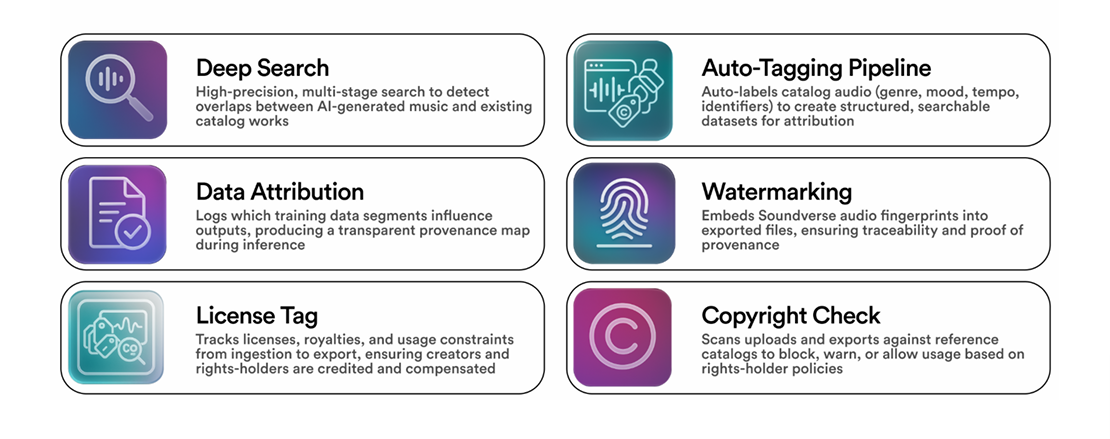
Now that you understand the challenges surrounding Splitter AI safety, here is how to create secure audio workflows instantly using Soundverse Trace.
Soundverse Trace acts as a comprehensive trust layer for AI music, embedding attribution, deep search, and rights protection throughout your audio’s entire lifecycle—from dataset creation to the export stage.
Core Capabilities:
- Deep Search: Performs high-precision scanning (1:1 and 1:N) to detect data overlaps or copyright risks.
- Data Attribution: Logs which training data influenced final outputs, maintaining traceability.
- Audio Watermarking: Embeds inaudible fingerprints for provenance and royalty tracking.
- License Tagging: Preserves metadata from ingestion to export, automating rights payouts or takedown actions.
Key Benefits for Creators:
- Provenance Verification: Detect potential copyright conflicts before publishing.
- Rights Automation: Simplify royalty distribution and ownership confirmations.
- Ethical Transparency: Understand exactly how AI-generated audio derives its components.
Soundverse Trace integrates seamlessly with the Ethical AI Music Framework, forming a transparent six-stage pipeline that ensures consent, attribution, and recurring compensation for artists and rights holders.
Together, these pillars make Soundverse Trace not only vital for ethical AI creation but also essential for those seeking to balance innovation with security.
For deeper creative applications, explore related workflows like Generate AI Music with Soundverse Text-to-Music and Soundverse Assistant: Your AI Music Co-Producer.
Create Safe and Stunning AI Music with Soundverse
Experience secure, high-quality AI-powered music generation and stem separation with Soundverse. Protect your creative process while exploring innovative tools for effortless sound production.
Start Creating Safely
Related Articles
- Soundverse Introduces Stem Separation AI Magic Tool: Discover how Soundverse’s AI stem separation tool lets creators isolate vocals, instruments, and beats with precision while maintaining music quality.
- What Are Song Stems and Why Do You Need Them: Learn the basics of song stems and how they help musicians remix, produce, and refine tracks more efficiently using AI tools.
- Soundverse AI Magic Tools: Create Content Quickly with AI: Explore the range of AI Magic Tools offered by Soundverse to accelerate your content creation while ensuring safety and originality.
- Navigating the World of Royalty-Free and Copyright-Free Music Using Soundverse AI: Uncover how to safely use royalty-free and copyright-free AI-generated music for your content projects with Soundverse.
Here's how to make AI Music with Soundverse
Video Guide
 Here’s another long walkthrough of how to use Soundverse AI.
Text Guide
- To know more about AI Magic Tools, check here.
- To know more about Soundverse Assistant, check here.
- To know more about Arrangement Studio, check here.
Soundverse is an AI Assistant that allows content creators and music makers to create original content in a flash using Generative AI. With the help of Soundverse Assistant and AI Magic Tools, our users get an unfair advantage over other creators to create audio and music content quickly, easily and cheaply. Soundverse Assistant is your ultimate music companion. You simply speak to the assistant to get your stuff done. The more you speak to it, the more it starts understanding you and your goals. AI Magic Tools help convert your creative dreams into tangible music and audio. Use AI Magic Tools such as text to music, stem separation, or lyrics generation to realise your content dreams faster. Soundverse is here to take music production to the next level. We're not just a digital audio workstation (DAW) competing with Ableton or Logic, we're building a completely new paradigm of easy and conversational content creation.
TikTok: https://www.tiktok.com/@soundverse.ai
Twitter: https://twitter.com/soundverse_ai
Instagram: https://www.instagram.com/soundverse.ai
LinkedIn: https://www.linkedin.com/company/soundverseai
Youtube: https://www.youtube.com/@SoundverseAI
Facebook: https://www.facebook.com/profile.php?id=100095674445607
Join Soundverse for Free and make Viral AI Music
 We are constantly building more product experiences. Keep checking our Blog to stay updated about them!