Is AI a Metal? Understanding the Physical Nature of Artificial Intelligence in 2026
Explore whether AI is a metal, its material properties, and composition. Learn how AI processes data and how Soundverse generates music with artificial intelligence.
Is AI a Metal?
Is AI a Metal?
The question “is AI a metal?” may sound curious at first, but it pushes us to think about what artificial intelligence actually is. When students or enthusiasts ask this in classrooms or online discussions in 2026, they are usually blending the world of physics with computing—wondering whether AI has tangible, metallic properties or is built from substances we can hold and touch.
What Does 'AI as a Metal' Mean?
AI, or artificial intelligence, refers to computer systems designed to simulate human-like decision-making and creative processes. It is not a metal in the traditional sense; it doesn’t exist as an elemental solid like iron, aluminum, or copper. Metals have distinct properties—conductivity, malleability, and luster—while AI is a conceptual framework manifested through software algorithms, data models, and digital infrastructure. However, AI's physical existence relies on metal-based components like microchips, circuit boards, and servers. So while AI itself isn't metallic, it operates through metallic mediums.

What are the Material Properties of AI?
Students often ask about AI material properties—the tangible substances that enable AI systems to exist. While AI is software, its hardware counterpart has measurable physical characteristics:
- Composition of Processors: Made from silicon wafers with embedded metal conductors, mainly copper and aluminum, to enhance signal transmission.
- Heat Conductivity: Metallic components dissipate heat efficiently, a critical factor in data centers where AI models are trained.
- Electromagnetic Functionality: Metals allow for electron flow, powering the computational cycles that run neural networks and music generation models like Soundverse's.
So, when you think about AI's ‘material properties,’ you are truly referring to the hardware infrastructure—a balance between conductive metals and non-metallic semiconductor materials.
Artificial Intelligence vs. Metals: A Scientific Comparison
1. Structure and Substance
Metals have crystalline atomic structures with repeating patterns. AI, by contrast, is a non-physical construct—built of code, mathematics, and logic.
2. Behavior
Metals respond to physical forces; they bend, melt, or corrode. AI “responds” to data inputs and training, showing changes in behavior or accuracy rather than physical form.
3. Conductivity and Smartness
Metals conduct electricity superbly; AI conducts information. The two share metaphorical similarities—both enable interaction and flow, but one in the physical domain, the other in computation.
This contrast has led to intriguing philosophical reflections in 2026: AI and metals are both human-made tools, yet only metals have tangible weight, while AI has intellectual weight—it shapes industries, art forms, and science innovations without being material in itself.
What is AI Made Of? Understanding the Composition
When asking what is AI made of, you can separate the answer into two parts:
- Software Composition: Algorithms, training data, and decision frameworks that define behavior. These are intangible lines of code that evolve through machine learning.
- Hardware Composition: Chips, servers, and computation networks composed of metals and materials like silicon, gold, and copper. Without them, AI couldn’t physically function.
So technically speaking, the physical shell of AI systems involves metals—microchip surfaces, conductors, cooling units—but AI itself, the intelligence, is not a material. It’s a dynamic set of mathematical principles stored and executed using those materials.
AI Science Explanation for Students in 2026
Modern high school and college courses in 2026 cover how artificial intelligence builds knowledge through neural architectures. A neural network functions like a brain model—layers of nodes process information. But beneath that abstract logic lies a metal framework—the data centers filled with servers that crunch thousands of computations per second. Metals provide stability and speed; AI provides adaptability.
For example, when a Soundverse AI model generates a musical soundscape, it doesn’t rely on musical intuition—it relies on trained algorithms mapped onto physical metallic processors. The outcome is non-physical (digital sound), yet the process is powered by solid materials. That interplay—computation meeting physical endurance—is the true fusion between metal and intelligence.
For deeper insights into Soundverse's creative tools, watch Soundverse Tutorial Series - 9. How to Make Music and Soundverse Tutorial Series - 8. "Explore" Tab.
How AI Generation in Music Mirrors Metal Processing
AI music systems mimic certain metallic principles:
- Efficiency: Just as metals conduct energy perfectly, AI conducts creativity efficiently.
- Adaptability: Metals can form diverse shapes; AI can form diverse outputs—from ambient tracks to EDM beats.
- Durability: Metal resist wear; AI models refine over time using feedback, achieving durable performance through data.
You can explore such creative parallels further in resources like Soundverse AI Magic Tools, where artificial intelligence demonstrates industrial-grade consistency similar to engineered materials.
Why People Still Ask 'Is AI a Metal?' in 2026
Curiosity drives this question. Since early AI systems in 2024 and 2025 were often portrayed as robotic entities, people tend to imagine them as metallic beings. Movies and popular media link AI with shiny steel robots, hence the association. But by 2026, AI has evolved far beyond physical robotics—it powers virtual creativity such as AI-generated music, art synthesis, and data-driven storytelling.
The idea of AI being metal is thus symbolic: metal represents power, strength, and precision—the same qualities associated with modern AI capabilities.
The Intersection of AI, Metal, and Music Creation
Aspiring musicians often test the fusion of ‘metal’ both as a genre and as a substance. Through tools like Soundverse, users can now generate metal-inspired music tracks using text prompts. This doesn’t mean AI itself is metallic—it means it can simulate metallic resonance and timbre through data interpretation.
Soundverse’s generative music models analyze musical styles and emulate metallic tones found in electric guitars and heavy percussion. The platform thus symbolizes the merging of computational intelligence with sound textures that traditionally rely on metal instruments. You can explore this fusion in guides like Create Metal Music with AI, which shows how data and creativity intertwine seamlessly.
How to Make AI-Based Metal Soundscapes with Soundverse AI Music Generator
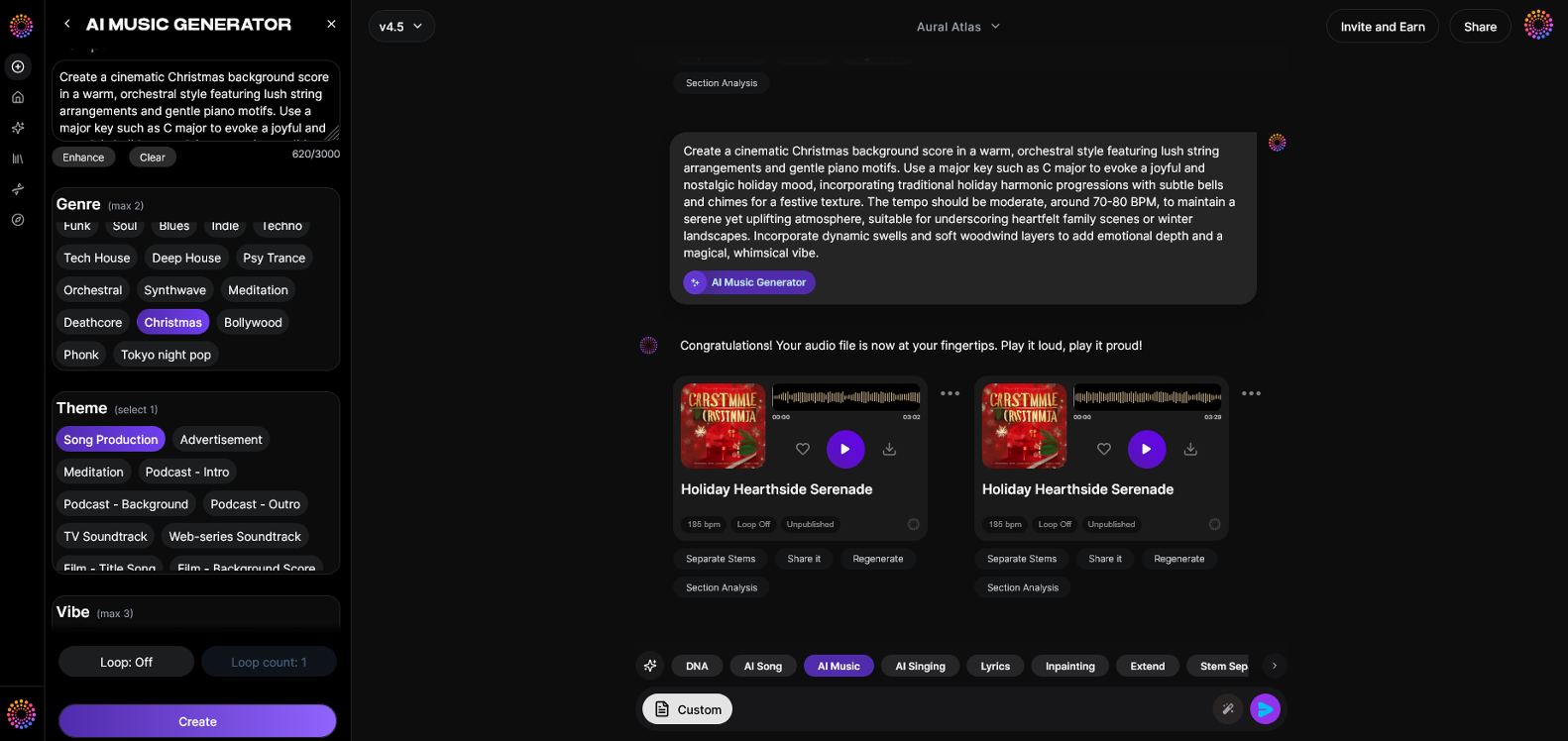
Now that you understand why AI itself is not a metal but depends on metallic components for functioning, you can use the Soundverse AI Music Generator to create instrumental tracks inspired by metal or any genre instantly.
Soundverse’s AI Music Generator allows users to transform text prompts into full-fledged instrumental music pieces. Its primary features include text-to-music conversion, mood and genre selection, and seamless looping for background or commercial use.
Here’s how it works:
- Enter your description (e.g., “intense metal-inspired background score”).
- Select length, genre, and mood—choose between high-energy beats or cinematic guitar sounds.
- Generate the music, and Soundverse processes your request through its advanced models (V4 or V5).
- Export and loop your composition for game soundtracks, ads, or digital media.
Soundverse doesn’t rely on metals musically—it uses data algorithms trained on musical patterns. But behind the scenes, it functions through metal-based servers, symbolizing the marriage of AI and metallic engineering.
Whether you are composing for film, experimenting with futuristic tones, or exploring meditation soundscapes, Soundverse bridges the scientific and artistic—turning intangible intelligence into tangible creativity. Discover how AI influences modern music culture through related resources like AI Music in the USA and The Role of AI Music in Film and Television.
Create Your Own AI Metal Track Today
Unleash the power of Soundverse to generate fierce, high-energy metal music in minutes. Shape your sound, experiment with riffs, and let AI amplify your creativity like never before.
Start Creating with Soundverse
Related Articles:
- Create Metal Music with AI — Discover how to generate intense metal tracks using Soundverse’s AI-powered tools and take your production to the next level.
- How AI-Generated Music Is Transforming the Music Industry — Explore how AI music platforms are changing how songs are composed, produced, and shared across the music world.
- AI Music Generator and Human Composers: A Future Together — Find out how AI complements the creativity of human musicians and opens a new era of collaborative artistry.
- The Benefits of Composing with AI Music Generator — Learn how AI composition tools help artists streamline workflow and enhance originality in music-making.
Here's how to make AI Music with Soundverse
Video Guide

Here’s another long walkthrough of how to use Soundverse AI.
Text Guide
- To know more about AI Magic Tools, check here.
- To know more about Soundverse Assistant, check here.
- To know more about Arrangement Studio, check here.
Soundverse is an AI Assistant that allows content creators and music makers to create original content in a flash using Generative AI.
With the help of Soundverse Assistant and AI Magic Tools, our users get an unfair advantage over other creators to create audio and music content quickly, easily and cheaply.
Soundverse Assistant is your ultimate music companion. You simply speak to the assistant to get your stuff done. The more you speak to it, the more it starts understanding you and your goals.
AI Magic Tools help convert your creative dreams into tangible music and audio. Use AI Magic Tools such as text to music, stem separation, or lyrics generation to realise your content dreams faster.
Soundverse is here to take music production to the next level. We're not just a digital audio workstation (DAW) competing with Ableton or Logic, we're building a completely new paradigm of easy and conversational content creation.
TikTok: https://www.tiktok.com/@soundverse.ai
Twitter: https://twitter.com/soundverse_ai
Instagram: https://www.instagram.com/soundverse.ai
LinkedIn: https://www.linkedin.com/company/soundverseai
Youtube: https://www.youtube.com/@SoundverseAI
Facebook: https://www.facebook.com/profile.php?id=100095674445607
Join Soundverse for Free and make Viral AI Music

We are constantly building more product experiences. Keep checking our Blog to stay updated about them!