How Does AI-Based Mastering Compare to Manual Audio Engineering Processes?
AI mastering vs manual mastering, compared: what engineers do by hand, what AI automates, blind-test results, where each wins and a hybrid workflow.
In AI mastering vs manual mastering, the processors are largely the same: EQ, compression, stereo width and a limiter. The difference is who decides. AI mastering measures your mix and sets a chain toward a genre or loudness target in seconds. A mastering engineer listens, talks to you, fixes what the mix hides and shapes a whole release.
Published listening tests suggest the gap is smaller than many producers expect on a single dense track, and larger on dynamic genres and on jobs that need judgment. For background, see why mastering is the final step in music production; for the traps in automated tools, see the common pitfalls of automated mastering plugins. We checked every source cited below on 19 November 2026.
What a mastering engineer does by hand
A typical session runs roughly in this order:
- Listening first. The engineer plays the whole mix, or the whole album, on monitors they know in a room they trust, and writes notes before touching anything: a harsh build around 3 kHz in the chorus, a bass note that blooms, a vocal sitting low in the bridge.
- Reading the brief. Your notes and reference tracks set the direction. The engineer level-matches each reference to the master and switches back and forth, comparing low end, vocal presence and width rather than loudness.
- Corrective EQ, often mid-side. A dip around 200 to 300 Hz in the side channel can clear mud from wide guitars without thinning the bass, and a cut at 8 to 10 kHz in the sides can calm a hi-hat while the vocal stays bright.
- Dynamics. Gentle broadband compression for glue, often just 1 to 2 dB of gain reduction, or multiband or dynamic EQ when one region misbehaves, such as a boomy kick or one sibilant word.
- Limiting and loudness. A true-peak ceiling, then loudness set for the genre and destination, judged against the references at matched level.
- Sequencing and flow. For an EP or album: track order, gaps, fades and relative levels, so the ballad stays softer than the single.
- Quality control. A full listen to the rendered file for clicks, distortion, clipped fade-outs and overs, plus checks on headphones, a phone and a car.
- Deliverables. A streaming WAV, hi-res files, a DDP image for CD, a vinyl pre-master, instrumental and clean versions, and the codes and metadata that go with them.
- Revisions. You send notes, and the engineer recalls the session and adjusts.
Research on the profession treats this as craft. Thomas Birtchnell's qualitative study of mastering engineers, Listening without ears (Big Data & Society, 2018), concludes: "The research identifies intuitive performance and critical listening as areas where human ingenuity and communication pose problems for simulation."
What AI mastering automates
Most AI mastering tools run some version of three steps:
- Analysis. The tool measures a section of the song, or all of it: loudness, spectral balance, how peaky the mix is and how wide.
- Target matching. It compares those readings with a target, such as a genre curve, a loudness figure or a reference you upload. iZotope's Master Assistant tutorial for Ozone 12 (Nick Messitte, 9 September 2025) says an uploaded reference makes the assistant match your song to that file's tonal balance, width, dynamics and loudness.
- Assistant chain. It sets EQ, compression, imaging, saturation and limiting, usually exposed as a few macros you can adjust. Messitte frames the result as a starting point, and the pitch is simple: "With the new Master Assistant, you have a second set of ears that never gets fatigued."
What it doesn't do matters just as much. It hears one stereo file, so it can't lift a buried vocal without lifting everything else in that range. It doesn't know what the song is about or what you meant by "warmer". Album sequencing, DDP images and vinyl pre-masters generally stay with an engineer.
AI mastering vs manual: what blind tests and studies found
Few peer-reviewed comparisons exist, and each tested services as they were at the time:
- Heo and Park, 2021. Dong-Hyuk Heo and Jae-Rock Park of SangMyung University compared AI and professional masters using acoustic analysis, listening experiments and expert interviews, published in the Journal of Korea Entertainment Industry Association on 30 April 2021. The acoustic analysis found no significant difference. Non-musicians couldn't tell the two apart, and musicians showed no significant preference for either kind of master. The experts saw no big quality gap and named the communication between service and client as the biggest difference.
- Canyakan, 2025. Seyhan Canyakan's comparative study in the Journal for the Interdisciplinary Art and Education (30 March 2025) combined measures such as distortion, dynamic range and loudness penalty with listening assessments. It reports that engineers kept more dynamic range with less distortion, especially in classical and jazz, while AI quickly gave reasonable results for pop and electronic music.
Read the pattern rather than a winner. On a dense pop or rock single, many listeners can't hear a reliable difference. On dynamic, acoustic genres, an engineer's restraint shows. None of these tests measured album flow, revisions or format deliverables, and the services have changed since.
Where AI mastering wins
- Speed. A master in seconds, so you can hear a mix in finished form while you're still mixing.
- Cost. A subscription or per-track fee instead of a session rate, which adds up across a run of singles, demos and content. Our shortlist of budget AI mastering services for singer-songwriters compares real options.
- Consistency. In a plugin, the same input and settings give the same output, which helps across a series of beats or videos.
- Versions. Re-run for a club master, a broadcast master or a mix tweak without booking anything.
- Mix feedback. If the assistant makes big EQ moves to reach its target, your mix probably needs work in that range.
Where a mastering engineer wins
- Judgment. Deciding that a ballad should stay quiet, or that a slightly darker master suits the song.
- Problem-solving. A single sibilant word, a click in a fade or a mix you can't reopen gets a targeted fix instead of a whole-band move, with stem mastering as a fallback.
- Album flow. Order, gaps and relative levels across a release.
- Formats. Vinyl, CD, hi-res and immersive deliverables, and the limits of each.
- Communication. Someone who explains each move and takes revision notes, which the Korean study's experts named as the biggest difference.
A hybrid workflow
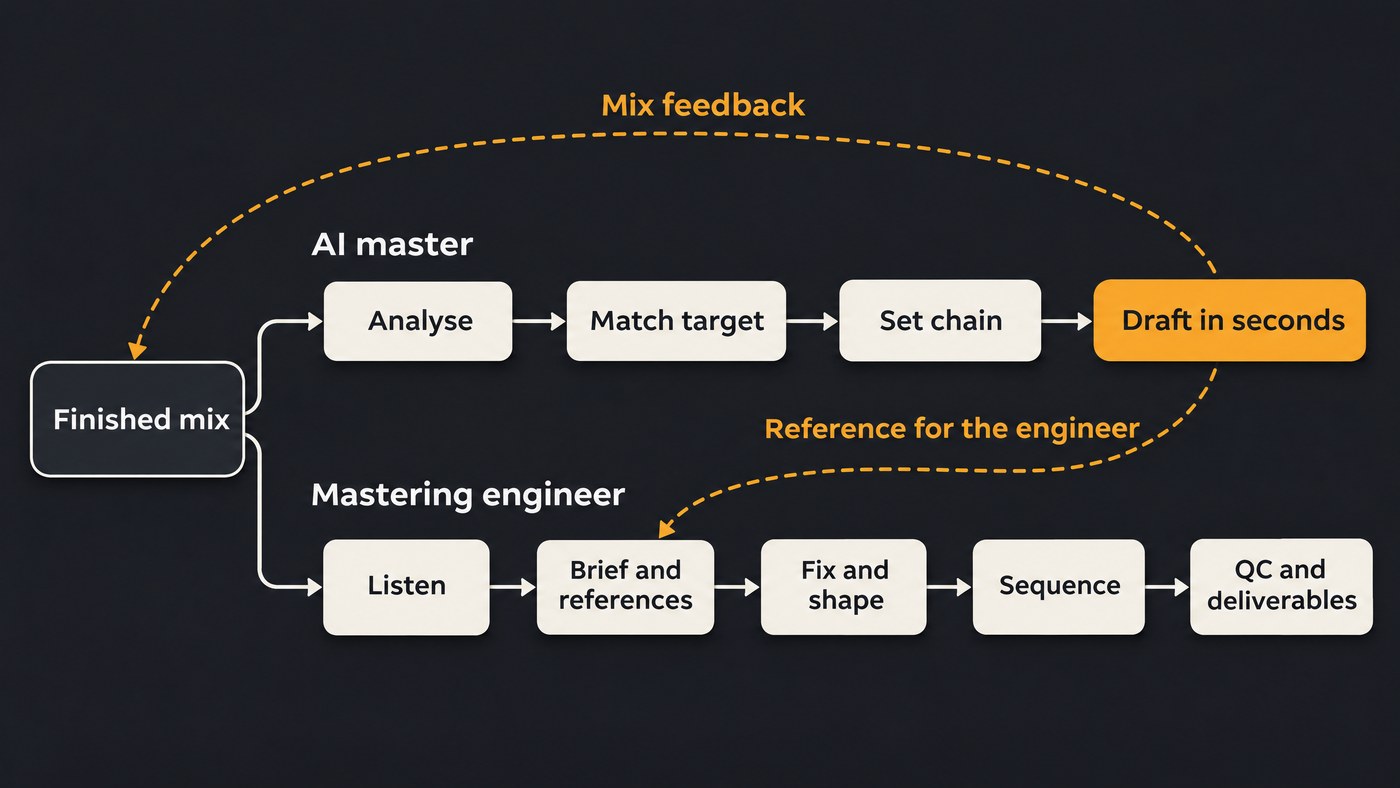
- Finish the mix with headroom. Bypass any limiter on the mix bus before you bounce.
- Run an AI master as a draft. Pick the closest genre and destination target, play the chorus while it analyses, and note what it changed.
- Compare at matched loudness. Turn the master down to the mix's level and switch. Louder tends to sound better at first.
- Use the draft as feedback. If it added a lot of low end or pulled the highs back, fix that in the mix and run it again.
- Decide by release. For demos, content and most singles, refine the AI master's macros and confirm loudness and true peak on a meter. For an album, vinyl or a high-stakes single, send an engineer the unmastered mix, your references and notes, and the AI draft labelled as a reference for what you liked.
- Check the final file on headphones, a phone and a car, and meter the exported file rather than the session.
Where Soundverse fits
Soundverse is an AI music platform that takes you from idea to audience, and its mastering tools cover the draft-and-refine half of this workflow. Mastering One sits on the master bus of every AI Studio project and starts switched off. Pick one of seven genre targets and a loudness target from Club / DJ −7 to Broadcast EBU R128 −23 LUFS, play the song and press ✦ Master: it listens for two seconds, sets five macros, and leaves seven chain sections you can bypass one by one.
Its page is clear that it masters the whole mix, not stems, and can't repair problems inside the mix; Mix One places tracks by genre before it. Add Analysis One after it for gated LUFS, 4× oversampled true peak and an overs counter, since Mastering One's window meters are estimates. Free exports MP3; WAV needs Creator.
In this AI Studio walkthrough, Mix One places a project's stems by genre, then Mastering One goes on the master chain with a chosen target, and the raw, mixed and mastered versions are compared.
FAQ
Can listeners tell AI mastering from human mastering? Often not, on single tracks. In the 2021 Korean study, non-musicians couldn't distinguish them, while the 2025 comparison found engineers kept more dynamic range, especially in classical and jazz.
Is AI mastering good enough for a streaming release? For many singles, yes, if the mix is finished and you check the result at matched loudness and on a true-peak meter. Albums, vinyl and quiet, dynamic genres benefit more from an engineer.
Should I send my mastering engineer an AI-mastered file? Send the unmastered mix as the source, with headroom and no mix-bus limiter. An AI master can go along as a labelled reference for the tone or loudness you liked, together with your notes.
Will AI mastering replace mastering engineers? It already handles a lot of quick single-track work. The research points to critical listening, problem-solving, album flow and communication as the parts that stay human, and those are what you pay an engineer for.
Sign up for Soundverse free and try a Mastering One draft on your next mix. More mixing and mastering guides on the Soundverse blog.