How Does AI Manage Formant Shifting in Voice Synthesis?
How AI handles formant shifting in voice synthesis: what formants are, why pitch shifts move them, LPC, PSOLA, WORLD, DDSP and the settings to use.
AI manages formant shifting by keeping two things apart: the pitch the vocal folds produce and the resonances of the vocal tract, called formants. Signal-processing tools estimate the spectral envelope and hold it still while the pitch moves. Neural voice models learn pitch and timbre as separate inputs, so either can change without dragging the other.
This guide stays on formants. For how far a rendered AI vocal can be edited in general, see the limits of manipulating a synthetic voice after generation. Tool details come from each maker's documentation, checked on 19 November 2026.
What formants are: F1, F2, F3 and the spectral envelope
Think of a voice as a source and a filter. The vocal folds buzz at the note you sing and produce harmonics at whole-number multiples of that pitch. The throat, mouth and nasal cavity filter that buzz, boosting some frequency regions and damping others. The boosted regions are the formants.
Celemony's Melodyne 5 manual puts it precisely: "Formants are areas of emphasis or attenuation in the frequency spectrum of a sound that are independent of the pitch of the fundamental note but are found always in the same frequency ranges."
AutoTune's guide to formant shifting (1 September 2026) puts F1 roughly between 250 and 1,000 Hz, linked to how open the mouth is, and F2 between about 700 and 2,500 Hz, linked to tongue position. The ear tells vowels apart by how F1 and F2 relate. The guide counts F3 and up as well, but says F1 and F2 do most of the work for perceived vocal character. A larger vocal tract gives lower formants, which is why one voice sounds big and another small on the same note.
One spectrum holds two layers:
- Pitch sets the spacing of the harmonics. Sing higher and the lines spread apart.
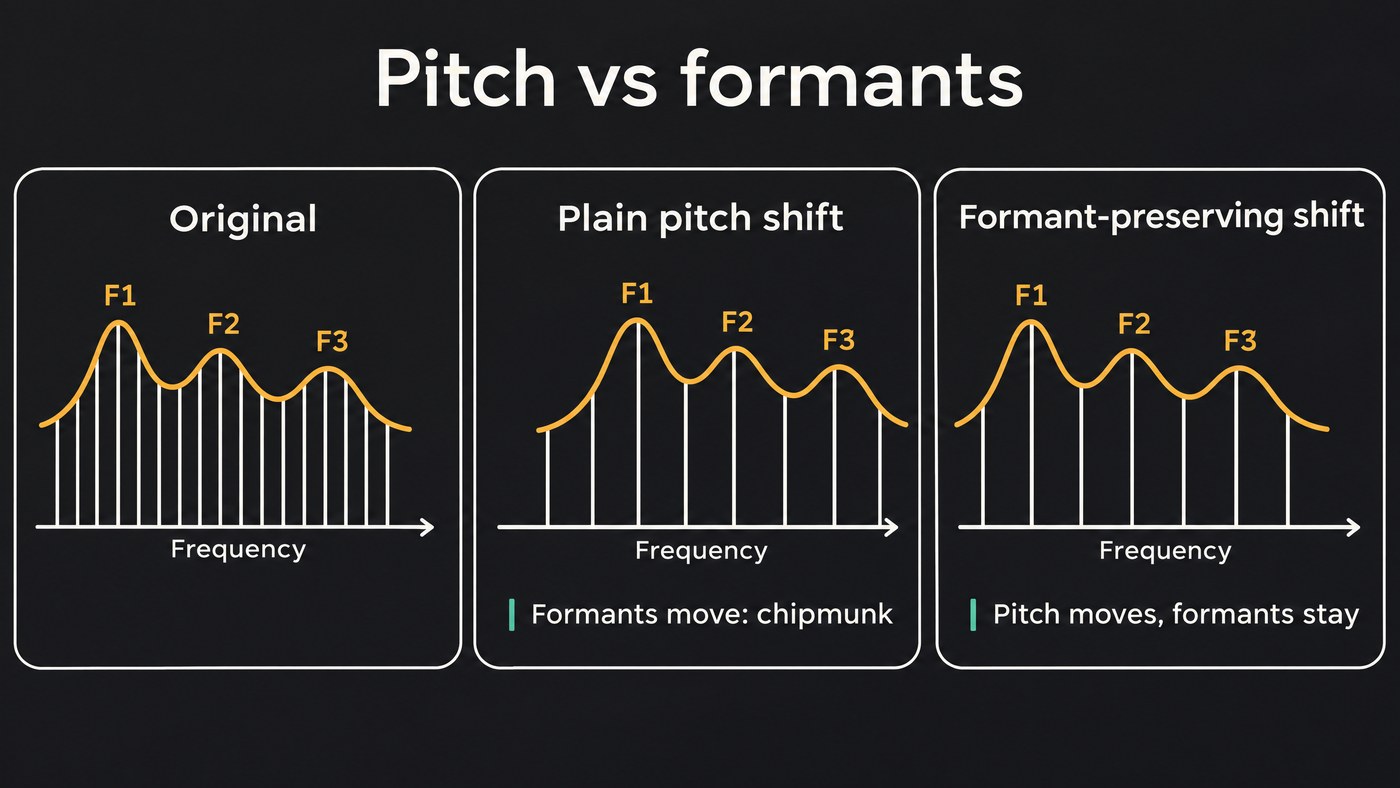
- The spectral envelope is the smooth curve over their tops. Its peaks are the formants, and it stays put while the vowel and the throat stay the same.
Pitch shifting moves the lines. Formant shifting moves the curve.
Why plain pitch shifting moves formants (the chipmunk effect)
The crudest pitch shift is a speed change: every frequency rises by the same ratio, envelope included. Double the speed and the note goes up an octave, but every formant doubles too, so the singer sounds half the size. That's the chipmunk sound.
Praat, the speech-analysis program, uses this side effect on purpose. Its Change gender command shifts frequencies by changing the sampling frequency, then restores pitch and duration with overlap-add synthesis. A formant shift ratio of 1.1 gives a male voice approximate female formant characteristics, and 1/1.1 does the reverse. A ratio of 1.1 is only about 1.65 semitones.
Classic formant-preserving methods
LPC and cepstral liftering: measure the envelope
Julius O. Smith III's Spectral Audio Signal Processing (Stanford CCRMA) describes two standard routes:
- Linear prediction (LPC) captures the spectral shape in the response of an all-pole filter. The filter stands in for the vocal tract, and what's left after removing it is the source.
- Cepstral smoothing, or liftering, low-pass filters the log-magnitude spectrum, keeping the envelope's slow curve and dropping the ripple of individual harmonics.
In a DAFx 2005 paper on pitch shifting with spectral envelope preservation in the phase vocoder, Axel Röbel and Xavier Rodet chose a cepstrum-based iterative "true envelope" estimator: slightly more computing than standard LPC, much better control over the envelope's shape.
Phase vocoder with envelope preservation
The phase vocoder works on short frames in the frequency domain. With envelope preservation, each frame goes through four steps:
- Measure the frame's spectral envelope.
- Divide it out, leaving flat harmonics.
- Move the harmonics to the new pitch.
- Multiply the original envelope back in.
The harmonics move; the formants stay. Röbel and Rodet also identify the main problems of this approach and propose a remedy, a reminder that "preserve formants" modes differ in quality between tools.
PSOLA: the time-domain route
Praat's documentation credits pitch-synchronous overlap-add to Moulines and Charpentier (1990), who called it TD-PSOLA. It cuts the voice into short windowed pieces centred on each glottal pulse and lays them down at a new spacing: closer raises the pitch, wider lowers it. Each piece carries the vocal tract's response to one pulse, so the formants stay roughly in place. It's fast and clean on a solo voice, but only as good as its pitch marks.
WORLD and STRAIGHT: analyse, edit, resynthesise
The WORLD README by Masanori Morise describes software that estimates fundamental frequency (F0), aperiodicity and spectral envelope, then generates speech from those parameters alone; its CheapTrick algorithm handles the envelope. Hideki Kawahara's STRAIGHT, released publicly as legacy-STRAIGHT in 2018, follows the same pattern. With the voice stored as parameters, change the F0 track for a clean pitch shift, or stretch the envelope along the frequency axis for a formant shift.
How neural synthesis and voice conversion separate pitch from timbre
DDSP: source and filter with a network at the controls. Magenta's January 2020 announcement of Differentiable Digital Signal Processing describes a harmonic additive synthesizer plus a noise synthesizer that filters white noise with time-varying filters, both driven by a neural network. The paper's abstract, by Jesse Engel, Lamtharn Hantrakul, Chenjie Gu and Adam Roberts, states the benefit: "combining interpretable modules permits manipulation of each separate model component, with applications such as independent control of pitch and loudness". It also lists transferring timbre between very different sources.
Speaker embeddings: timbre as a vector. In a NeurIPS 2018 paper, Ye Jia and ten co-authors conditioned a speech synthesizer on a fixed-length vector that a speaker encoder computes from a few seconds of reference speech. Words come from the text, voice color from the vector, so formants follow the chosen speaker, not the note.
Singing voice conversion. A converter keeps the content and pitch line of your take and renders them in a target voice's timbre. Transpose, and the formants don't ride up with the melody, because they come from the target model. Our explainer on how voice conversion alters timbre covers what's kept and what's replaced.
Formant controls in Melodyne, AutoTune, Synthesizer V, ACE Studio and VOCALOID
- Melodyne 5. The Formant Tool shifts formants per note, shown in cents (100 cents is a semitone), from a few cents for nuance to several thousand for drastic effects. Adjacent notes get adjustable formant transitions.
- AutoTune Pro 11 and Throat (Antares). AutoTune's guide says Pro 11's Graph Mode gives per-note formant control: positive values smaller and brighter, negative values larger. Throat models the vocal tract's length, cross-sectional area and wall stiffness.
- Synthesizer V Studio 2 Pro (Dreamtonics). Dreamtonics' site and manual blocked automated reading on 19 November 2026, so we read the Internet Archive capture of its Base Parameters page from 13 November 2026. Gender adjusts the vocal formant, or voice thickness: higher sounds more masculine, lower more feminine. Tone Shift moves the apparent register toward head or chest voice without changing pitch.
- ACE Studio. ACE documents a Formant parameter for its V1 models: higher sounds more like a female or child voice, lower heavier. Its V2 parameter page lists Air, Falsetto, Tension and Energy, with no formant control.
- VOCALOID (Yamaha). Yamaha's notes on VOCALOID 6.3, released on 25 December 2023, say a Character parameter replaced the older Gender Factor and gives various vocal tones within one Voice Bank.
To choose a vocal synth by these controls, see which voice synthesis tools allow pitch and timbre adjustment.
Practical formant shifting settings
- Preserve formants for every pitch move. In a vocal synth, edit notes instead of transposing rendered audio. On audio, use the formant-preserving mode and check long "ee" and "ah" vowels first.
- Use small moves for character. AutoTune's guide calls about 1 semitone a small shift, and says 2 to 3 semitones down on a tenor starts to give baritone color.
- Move pitch and formants together for a different singer. Praat's 1.1 ratio, about 165 cents, is a sensible formant starting point, but AutoTune's guide warns that formants alone won't make a male voice convincingly female.
- In Synthesizer V, try Vocal Modes before Gender. Dreamtonics' manual says they tend to sound more natural for timbre. Use Tone Shift when the register is wrong.
- In a voice converter, transpose by 0 or ±12 semitones and choose the voice model for its range.
- De-ess after big shifts. AutoTune's guide notes that larger shifts can make sibilants sound processed.
Where Soundverse fits
Soundverse is an AI music platform that takes you from idea to audience, built for independent artists who release music.
Voice Swap re-sings a vocal in another voice model and keeps your phrasing and timing. Its Pitch control shifts up to 24 semitones either way, and 12 semitones moves a part an octave in the new voice. To put your own voice on other vocals, Train Voice Model learns it from at least 10 minutes of clean, dry solo singing, on the Creator plan and above.
AI Autotune corrects pitch only; its page says the timing, the melody you sang and the voice itself stay as they were. AI Vocal Quantizer moves phrases onto the beat with Preserve formants on by default.
FAQ
What is the difference between formant shifting and pitch shifting? Pitch shifting changes the note. Formant shifting changes the resonances that tell the ear how big the singer is. A good pitch shifter holds the formants still, and a formant shifter holds the pitch still.
Why does my pitch-shifted vocal sound like a chipmunk? The formants moved with the pitch, usually because the shift was a plain resampling change or formant preservation was off. Switch on the formant-preserving mode, or re-sing the part in the new range with a voice converter.
Is formant shifting the same as EQ? No. AutoTune's guide explains that EQ raises or lowers fixed frequencies, while a formant shift moves the envelope's peaks to new ones. A boost at 800 Hz sounds like a tone change; a semitone of formant shift sounds like a different-sized singer.
Do AI voice models need formant correction? Less often than recordings. A converter takes formants from the target model, and a vocal synth renders each note with its own. Controls like Synthesizer V's Gender are for changing character on purpose.
Sign up for Soundverse free and try a Voice Swap pitch shift on one of your own vocals. More vocal production guides on the Soundverse blog.
