Explain the Process of Distributing Original Music for Use in Video Games
How distributing original music for video games works: work for hire or license, rights, stems and loops, OST release, ISRCs, PROs and Content ID.
Distributing original music for video games happens in two stages. First, the composer delivers the music into the game under a work-for-hire or license agreement that grants the studio in-game, marketing, platform and territory rights. Then the soundtrack is released to listeners through a distributor, Steam or Bandcamp, with ISRCs, PRO registrations and a Content ID plan.
Below are both stages in order, for studios and the composers they hire. We read every official page cited here on 23 November 2026. This is general information, not legal advice.
Two meanings of "distribution" for game music
- Getting the music into the game. The studio needs the right to put the music in its build, sell that build on every platform and use it in trailers. The contract decides this, and the game itself is the delivery vehicle.
- Releasing the soundtrack to listeners. An OST on streaming stores, a Steam soundtrack, a Bandcamp page, maybe vinyl. It needs its own rights, codes and metadata.
A contract that covers only the first job leaves the second stuck, so settle both before the composer writes a note.
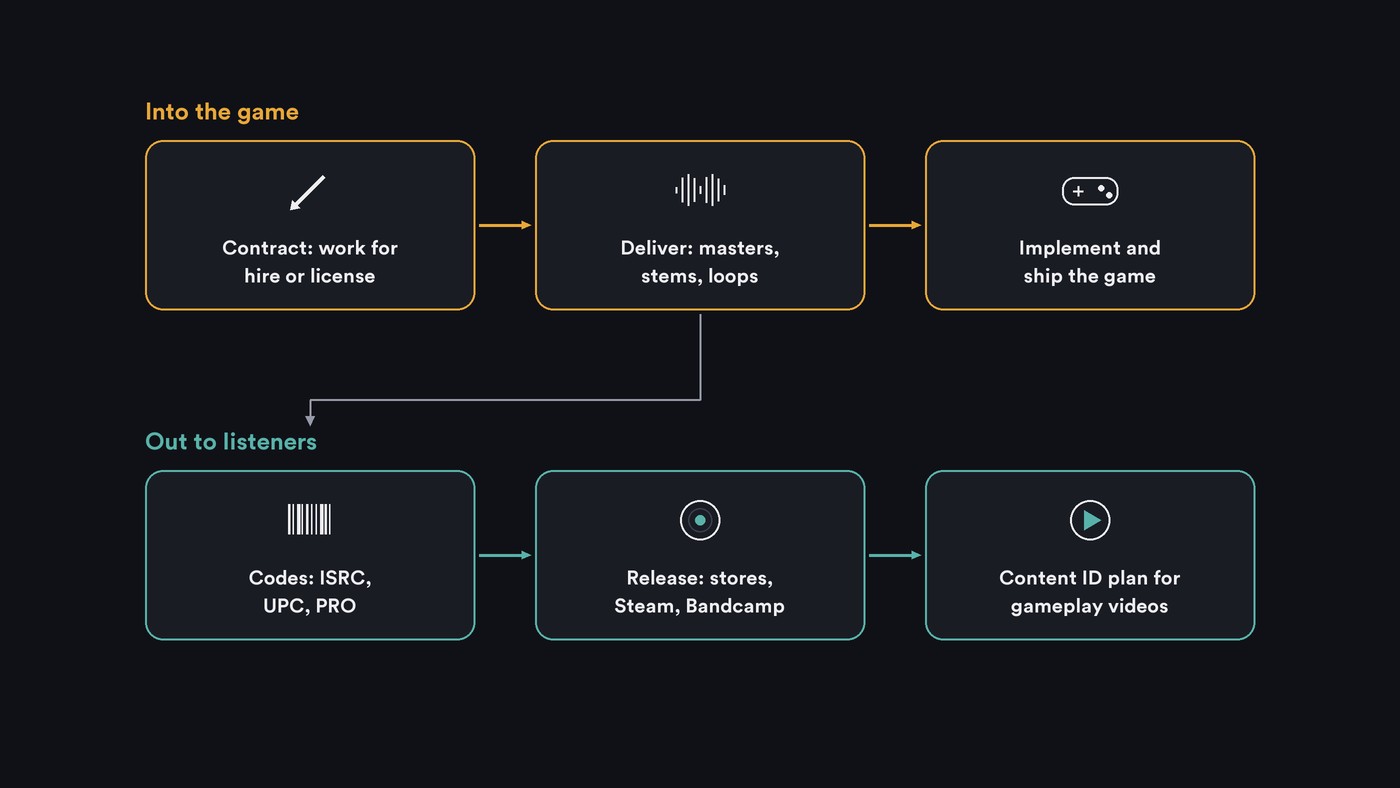
Step 1: Work for hire or a license
Work for hire. Under US law, a work made for hire is either work an employee does within the scope of the job, or a commissioned work in a short list of categories, including works made as part of a motion picture or other audiovisual work, when both parties sign a written agreement saying so (17 U.S.C. § 101). A game is an audiovisual work. The effect is spelled out in § 201(b): "In the case of a work made for hire, the employer or other person for whom the work was prepared is considered the author for purposes of this title". The studio then owns the music, including the soundtrack album, unless the contract says otherwise.
License. The composer keeps the copyright and grants the studio listed rights, sometimes for a lower fee in exchange for keeping album and reuse rights.
If either party is outside the US, ask a local lawyer how to word the transfer. Many contracts use an assignment of copyright as well as, or instead of, work-for-hire wording.
The rights a studio needs in the contract
Whichever model you pick, write each right down:
- In-game use (sync). Putting the music in the game, synchronized with play, in every version and update.
- Trailers and marketing. Trailers, gameplay reveals, ads, store pages, social clips and streams the studio runs itself. Say whether edits and remixes are allowed.
- Platforms. PC, consoles, mobile, cloud and any later ports or remasters.
- Territories. Worldwide, or a list. Our guide to territorial restrictions in music licensing explains why a missing country becomes a problem later.
- Term and exclusivity. Perpetual or fixed, and whether the composer may reuse the cues elsewhere.
- Soundtrack album. Who may release it, where, and how income is split.
- Content ID. Who decides whether the music is registered, and on whose account.
- Royalties, credits and AI. Whether the composer keeps the writer's share at their PRO, the credit line, and whether AI may be used on any cue.
Delivering original music for video games: formats, stems and loops
Game music is rarely one finished stereo mix: the audio team needs pieces it can control at runtime. Agree on a delivery spec before production starts.
- File formats. Unity's manual lists MP3, AIFF, WAV, Ogg Vorbis and FLAC as importable formats, with mono, stereo and multichannel files up to eight channels (Unity documentation). Most teams want uncompressed WAV masters at the spec their audio lead sets, and compress in the engine.
- Stems for vertical layering. For music that builds as tension rises, deliver each layer (drums, bass, pads, melody) as its own file, all the same length and starting on the same sample, so the game can fade layers in and out.
- Segments for horizontal sequencing. For music that changes section by section, deliver intro, loop, transition, stinger and ending pieces, cut on bar lines.
- Clean loops. Loop points exactly on the beat, with reverb tails rendered as separate files so the loop doesn't click. Our guide to looping music for smooth playback covers the edits.
- A cue sheet. One row per file: name, game state, tempo, key, time signature, bar count and loop points.
Middleware such as Wwise or FMOD, or the engine's own tools, then wires these files to game states. For library audio instead of a composer, see our guide to royalty-free audio platforms for gaming companies.
Step 2: Release the soundtrack to listeners
Once the music is locked, the soundtrack becomes a release of its own:
- A digital distributor to streaming stores. The owner of the masters uploads the OST, sets the game's launch date as the release date, and the distributor delivers it to Spotify, Apple Music and other stores.
- A Steam soundtrack. Valve's soundtrack documentation describes two types: one tied to your Steam game, treated as additional content for that game much like DLC, or an independent one. The minimum is an album cover image, one depot of MP3s and basic metadata, with a second depot recommended for lossless FLAC or WAV. Soundtracks sold as plain DLC can be converted, so people who don't own the game can buy them. A stand-alone soundtrack needs a "coming soon" page visible for at least two weeks first.
- Bandcamp or physical. Direct sales of downloads, vinyl and CDs. Check each outlet's policy on AI-assisted music if any cue used AI.
For a side-by-side look at distributors, game-music labels and these outlets, see our guide to music distribution services for gaming companies.
The rights side: ISRC, UPC and PRO registration
Three identifiers travel with a game soundtrack, and each one points at something different. IFPI's ISRC FAQ explains that ISRC identifies sound recordings and music videos, while ISWC identifies the compositions.
- ISRC per recording. Each released track gets one. The FAQ says only the recording rights owner, or an ISRC manager it appoints, may assign one, and the code stays the same if ownership later changes. Under work for hire, that owner is the studio.
- UPC per product. The FAQ adds that each different product needs its own UPC or EAN. A digital OST, a deluxe edition and a vinyl pressing are three products.
- PRO registration per composition. Whoever controls the publishing registers each work with the shares the contract sets, so performance royalties from broadcasts, streams and concerts can be paid. Our guide to registering music with performance rights organizations shows the steps.
Keeping gameplay videos free of Content ID claims
Streamers and YouTubers who play your game are free marketing, and their videos get claimed when your score sits in YouTube's Content ID.
- Only the publisher can register an original game score. YouTube's Content ID eligibility page says: "Original Video Game Soundtracks are only valid references when owned by the video game's publisher." They must be delivered under the publisher's own content owner account, and production loops and soundbeds are ineligible.
- Distributors apply the same rule. Ditto's eligibility page (updated 6 March 2026) lists video game audio and film or TV soundtracks among the music it cannot deliver to Content ID, unless you are the publisher. A composer who kept the album rights should leave Content ID off for the in-game score.
- Allowlist channels if you do register. YouTube's allowlist page exempts named channels from future claims. Existing claims aren't released automatically, only channels (not tracks) can be added, and every partner that owns an asset must allowlist the channel.
- Publish a music-use note on your store page or press kit: streamers may use the soundtrack, and here's how to report a mistaken claim.
The timeline from contract to OST release
- Pre-production: sign a work-for-hire or license contract listing every right above, the delivery spec and soundtrack terms.
- Music design: the audio lead maps game states to cues, layers, loop lengths and file names.
- Composition: sketches and approvals at agreed milestones.
- Delivery: masters, stems, segments, stingers and the cue sheet.
- Implementation: files go into middleware or the engine and get tested in play.
- Trailers: edits of in-game cues, under the marketing rights already signed.
- Music lock: freeze the track list; make album edits of short loops.
- Codes and registrations: ISRCs, a UPC per product, PRO registrations and metadata.
- Release setup: upload to the distributor with the launch date, and submit the Steam soundtrack for review.
- Content ID: apply the written decision, allowlist partners, publish the music-use note.
- Launch day: game and soundtrack go live together.
- After launch: vinyl, DLC soundtracks and concerts, each with its own UPC.
Where Soundverse fits
Soundverse is an AI music platform that takes you from idea to audience. Distribution, royalties and work registration stay with your distributor and PRO; Soundverse fits earlier, at making and preparing the music. AI Music Generator makes instrumentals with a Gaming theme and vibes such as Epic, Mysterious or Calm, one track per level or menu, and on Creator and above it can also make a track as a loop. Stem Separator splits a track into 2 or 6 stems as WAV, FLAC or MP3, a start for layered cues. In AI Studio, Creator and above export WAV at 44.1, 48 or 96 kHz and stems as one file per track in a ZIP, and Describe and Generate Audio can score a game trailer with music cues and effects in one run.
This video shows AI Studio scoring a video with music, sound effects and dialogue timed to the picture.
Licensing is set by plan: the Free plan is for personal use, and the Creator plan comes with a royalty-free license.
FAQ
Is work for hire or a license better for an indie game? Work for hire gives the studio full control, including the soundtrack and Content ID. A license can lower the fee because the composer keeps album and reuse rights. Either works if the contract lists every use you need.
Can the composer release the soundtrack? Yes, if the contract gives them album rights. Agree who owns the masters and how income is split, and keep Content ID off for the in-game score.
What should a composer deliver for adaptive music? WAV masters, stems that all start on the same sample, loops cut on bar lines with separate tails, transition and stinger pieces, and a cue sheet with tempo, key and loop points for every file.
Sign up for Soundverse free to make and prepare your game's music. More guides on the Soundverse blog.