Which Audio Platforms Provide the Best Royalty-Free Assets and Editing Tools for Gaming Companies?
Royalty-free game audio for small studios: asset sources, the license terms to check, Wwise and FMOD costs, DAWs and AI tools for music and SFX.
For royalty-free game audio, most small and mid-size studios combine three layers: asset sources such as Epidemic Sound, Soundsnap, Sonniss GDC bundles, the Unity Asset Store, Fab and Freesound; middleware such as Wwise or FMOD to make sound interactive; and a DAW like REAPER or Audacity for editing. AI generators fill the gaps.
We read each vendor's own license or pricing page on 23 November 2026. Terms change, so re-check before you buy, and treat this as general information rather than legal advice. If you're planning to release your soundtrack as an album, that's a separate job covered in our guide to music distribution services for gaming companies.
The audio a game actually needs
Before you compare platforms, list the asset types, because no single source is strong at all of them:
- Music loops and adaptive stems. Menu, exploration and combat cues that repeat cleanly, ideally split into layers (drums, pads, melody) that the game can fade in and out. Our guide to looping music for smooth playback covers loop points.
- Sound effects. Impacts, footsteps, weapons, creatures, foley. You'll want several variations of each so repeats don't sound mechanical.
- UI sounds. Clicks, hovers, confirms, errors, rewards. Short, dry and consistent in tone.
- Ambiences. Room tone, wind, rain, crowds, machinery: long beds that loop under everything else.
- Voice. Barks, narration, tutorial lines. These usually come from actors under their own contract, so treat voice as a separate rights question.
What to check in a royalty-free license for games
"Royalty-free" only means you don't pay per use. The scope still varies a lot. For a game, check these points on every license:
- Perpetual or subscription-bound. Does your right to ship the asset survive if you cancel? A game stays on sale for years.
- Worldwide. Your store page sells everywhere, so the license must too.
- In-game plus marketing. The license should cover the build itself, trailers, store-page videos and ads.
- Players' videos and streams. Ask whether the catalog is registered in YouTube's Content ID and how gameplay videos get cleared. A claim on a streamer's video is bad publicity for your launch.
- Seats and contractors. Who on the team may download and use the files, and whether a freelance sound designer needs a license of their own.
- Budget or revenue caps. Several licenses change tier above a production budget or yearly revenue.
- Redistribution. Most licenses forbid shipping sounds "as is" in a way that makes them a sound pack. Several also bar using the files to train AI models.
- Attribution. Some sources require a credit line in your game.
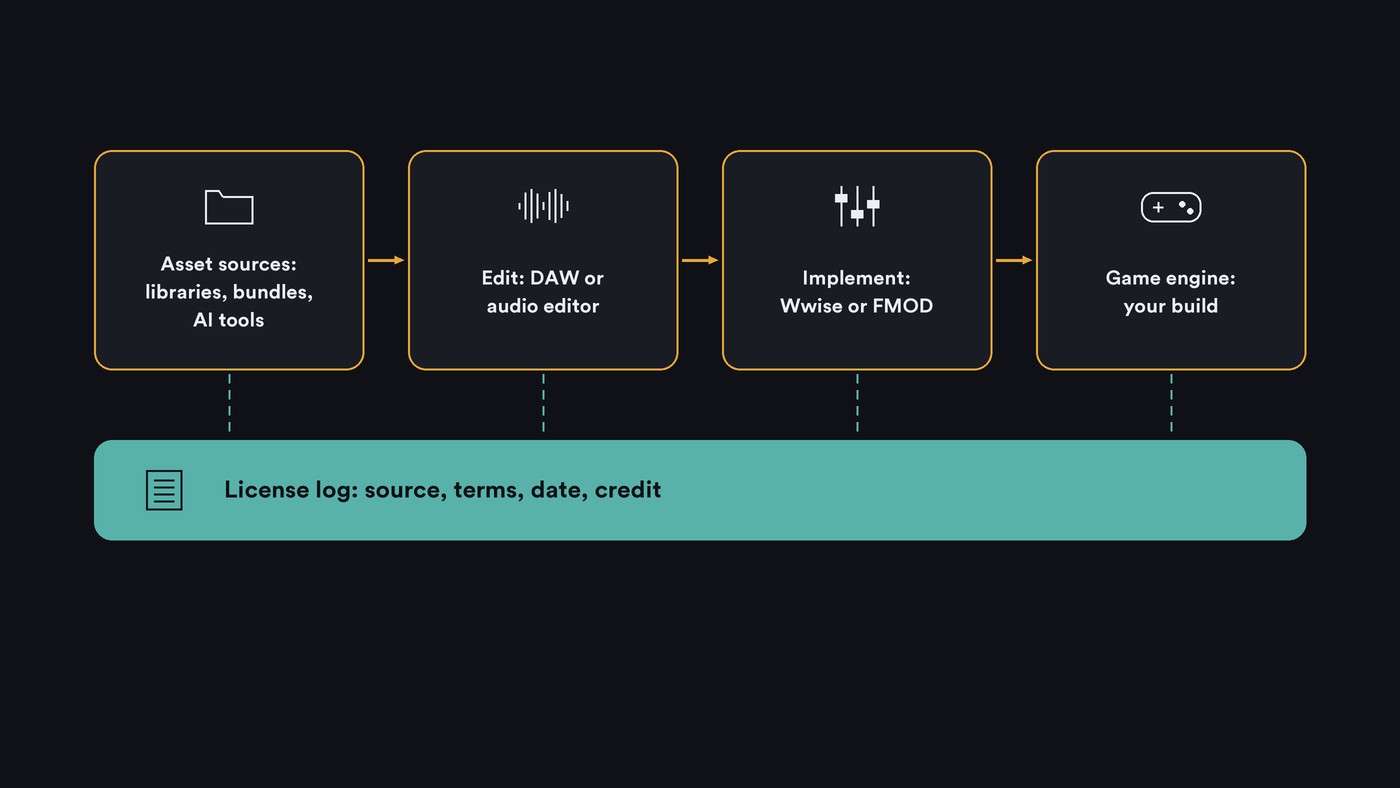
Keep a license log for every file: source, license, date downloaded, credit wording.
Royalty-free asset sources for games, checked 23 November 2026
Epidemic Sound. Its plans page offers over 55,000 tracks and 250,000+ sound effects and variations, and lists games and apps among the places you can publish. It says content published during a trial or an active subscription stays cleared after the subscription ends. The same page describes the music as intended for background use and rules out standalone use, and it sends publishers with yearly revenue over USD 5 million, or companies over USD 10 million, to Business plans. For pulling music into a build programmatically, its game development page says API music is cleared for commercial game releases on a paid Scale or Enterprise plan, and the free tier is for prototyping only.
Artlist. Its license, pricing and help pages blocked our automated check on 23 November 2026, so read the license page yourself before you rely on it for a game.
Soundsnap. The Soundsnap license is worldwide and perpetual for the duration of copyright. Its Pro subscription covers video games, films and trailers with budgets up to $500,000 USD; Pro+ covers games above that. Music loops must be used inside an original composition, and the sounds may not be used to train machine learning models.
Sonniss GDC Game Audio Bundles. Sound-effects bundles that Sonniss gives away for free in celebration of the Game Developers Conference. The bundle license is worldwide, non-exclusive and royalty-free, needs no attribution, extends to people in your team or organisation working on your projects, and forbids reselling the sounds or putting them in a library, sample pack or asset pack.
Unity Asset Store. The Asset Store EULA (last updated 4 December 2024) grants a non-exclusive, worldwide, perpetual license to embed assets in a product that has substantial original content of its own. Unless you buy a "multi-entity" tier, a contractor working on your project needs their own license. Some listings are Restricted Assets with their own terms.
Fab. Epic's Fab Standard License summary allows commercial use, modifying assets and sharing them with collaborators on the project, with any compatible tool rather than only Unreal Engine. Personal and Professional tiers grant the same rights, and you don't need to upgrade if you cross the revenue threshold after buying. Some listings use CC-BY instead.
Freesound. Each file carries its own Creative Commons license: CC0, Attribution or Attribution-NonCommercial. The Freesound FAQ is direct about it: "Some sounds you cannot use commercially, and many of the sounds you need to credit the author." Filter for CC0 or CC BY, and use its attribution list to build your credits. For the wider trade-offs of library audio, see the advantages of royalty-free audio libraries.
Editing and implementation tools
Wwise. Audiokinetic's pricing page sets the price of a Wwise license by the total production budget of your project. The price list we were served (for studios in Greater Asia; prices vary by region) showed the Indie plan free for budgets up to $250K, paid Pro, Premium and Platinum plans above that, a license per platform, and a separate DLC license for post-launch content that adds audio.
FMOD. The FMOD licensing page lists Indie as free or $2,000 per title for budgets under $600k, Basic at $6,000 per title for budgets under $1.8 million, and Premium at $18,000 per title above that. Its note: "Free Indie License available for developers with less than $200k revenue per year, on a small (under $600k) development budget." Projects must show an in-app credit line and the FMOD logo; Basic and Premium can waive the logo for a fee.
A DAW or editor. REAPER's purchase page lists two prices: $60 for a discounted license (personal use, or commercial use with yearly gross revenue up to USD $20,000) and $225 for a commercial license, with a 60-day free evaluation first. Audacity is a free, open-source audio editor and recorder, enough for trimming and cleaning one-shots.
A practical split: cut, layer and loudness-match in the DAW, then build randomized containers, music transitions and states in middleware.
Where AI tools help
AI generators earn their place when a library has nothing close: a creature that doesn't exist, a menu loop in your game's key, ten variations of one UI confirm. Read their terms with the same checklist above, because commercial rights usually depend on the plan. We compare AI music generators term by term in royalty-free AI music for commercial use, and cover adaptive scoring in the best AI music tools for gaming soundtracks.
This walkthrough tours every tool in Soundverse's Create category, including AI Music Generator, AI Sound Effects Generator and Video to SFX.
A starter stack by studio size
- Solo developer or a team under $200k revenue: Freesound CC0 files, a Sonniss bundle, FMOD's Free Indie license or Wwise Indie, REAPER's discounted license or Audacity, and AI for the gaps.
- Mid-size studio: a subscription library whose terms cover games at your budget, Fab or Unity packs for specific needs, a paid middleware tier matched to your production budget, and a REAPER commercial license per editor.
Where Soundverse fits
Soundverse is an AI music platform that takes you from idea to audience. For a game team, AI Music Generator makes instrumentals with no vocals, and its Gaming theme with vibes such as Epic, Mysterious or Calm is meant for menu, level and ambient tracks. On Creator and above, it also offers a Type control you can set to Loop. AI Sound Effects Generator turns a description of up to 450 characters into an effect from 0.5 to 30 seconds, from half-second UI clicks to rain ambience. Video to SFX (Creator and above) sounds up gameplay captures and trailers. Stem Separator splits a track you have rights to into 2 or 6 stems for layering. For browser games, Audio to JS turns a one-shot of up to 5 seconds into a JavaScript file that rebuilds it with the Web Audio API. AI Studio exports WAV and stems on Creator and above.
Licensing is set by plan: the Free plan is for personal use, and the Creator plan comes with a royalty-free license.
FAQ
Is royalty-free game audio free? Not always. Royalty-free means no per-use payments, but you may still pay a subscription or a one-time fee. Freesound's CC0 files and the Sonniss bundles cost nothing; most libraries and middleware tiers above a budget threshold do.
Can I keep shipping library sounds after I cancel a subscription? It depends on the vendor. Epidemic Sound says content published during an active subscription stays cleared, and Soundsnap's license is perpetual. Check the termination clause of any other source before you build around it.
Will streamers get copyright claims for my game's music? Usually only when the music is registered in an automated claiming system such as YouTube's Content ID. Ask your music source how it handles gameplay videos before launch, and keep its answer in your license log.
Do I need Wwise or FMOD for a small game? Not always. Engines can play audio files directly. Middleware earns its cost when you need adaptive music, many randomized variations or a sound designer working without a programmer.
Can I use AI-generated sound effects in a commercial game? Check the plan. Each AI tool sets commercial rights by plan, so confirm yours covers a game, its trailers and its store page.
Sign up for Soundverse free to make music, loops and sound effects for your next build. More guides on the Soundverse blog.