Explain the Concept of Territorial Restrictions in Music Licensing
Territorial restrictions in music licensing explained: territory clauses, why rights split by country, Content ID, sync, samples and EU online rules.
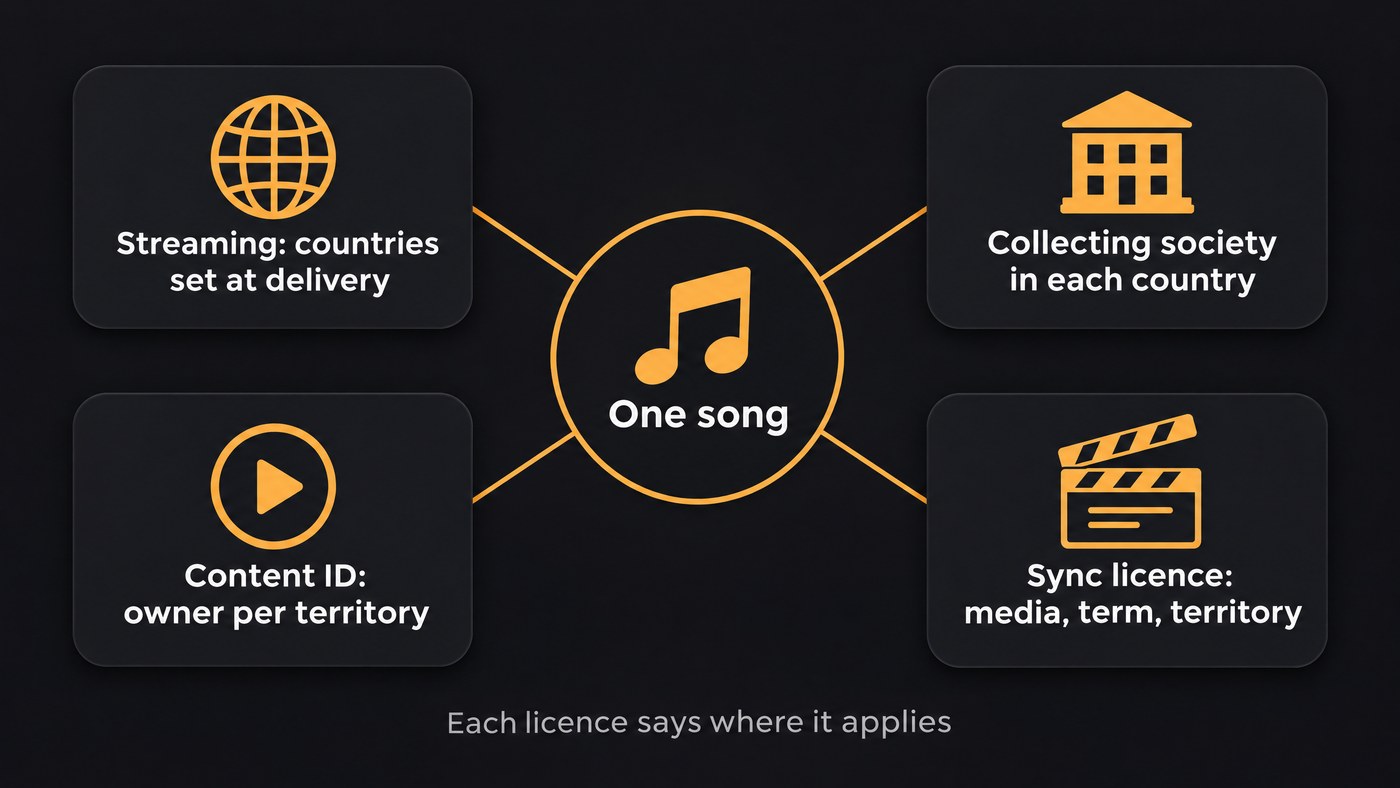
Territorial restrictions in music licensing are the terms that say where a licence applies: a list of countries, a region, "worldwide" or "the universe". Outside that territory you have no permission, even for the same song and the same use. They exist because copyright law, collecting societies and record and publishing deals are all organised country by country.
The territory clause decides where a release can go live, who collects in each country, where YouTube blocks or monetizes videos, and whether a sample or sync deal covers your whole campaign. We read the primary sources below on 19 November 2026. This is general information, not legal advice.
What territory means in a music licence
Every licence answers four questions: what rights you get, in which media, for how long, and where. The last one is the territory. It can be one country, a group such as "the European Union", or everywhere.
Distribution agreements show the range. DistroKid's agreement (dated 8 June 2021) says: "The “Territory” of this Agreement is the universe, except where noted with respect to certain territories outside of the United States." The same agreement says it distributes on a worldwide basis and that "you can't specify only certain countries or territories for particular Recordings."
CD Baby's Artist Agreement (last updated 14 August 2024) takes the other approach: "‘Authorized Territory’ means the universe, or more limited territories, to the extent so limited by you, during the CD Baby registration process."
"The universe" and "worldwide" both leave no country out. The words to read closely are the ones after them: "except", "excluding", or a list of countries that is shorter than you expected.
Why music rights are split by territory
Copyright is granted country by country
There is no single global copyright. Under the Berne Convention, as WIPO's summary explains, a work from one member country gets the same protection in each other member country "as the latter grants to the works of its own nationals", and protection is "independent of the existence of protection in the country of origin of the work". Berne sets a general minimum term of 50 years after the author's death, and countries may grant longer, so the same song can be protected for different lengths of time in different places.
Collecting societies work nationally
Performance royalties, and in many countries mechanical royalties, are collected by a local society in each country, which passes the money back to your home society. CISAC, the confederation of authors' societies, puts it this way on its collective management page: "A single cultural product such as a music CD can involve the different author’s rights of numerous creative contributors and many of these rights will be exercised on behalf of different parties in different territories around the world."
PRS for Music's international page says its representation agreements with societies abroad let it support members' works "wherever they're used", and that "Each international society sets its own distribution rules and overseas admin rates." It also warns that overseas earnings may face withholding tax in the country where they're earned. If you haven't joined a society yet, start with our guide to registering your songs with a performance rights organization.
Publishers, sub-publishers and labels license by region
A publisher may appoint a sub-publisher to collect and pitch your songs in another country, and a label may license a record to a partner for one market. Each contract names its own territory, so one recording can have different rights holders in different countries.
How territorial restrictions in music licensing show up for artists
Streaming availability by country
Where a release is available is set when your distributor delivers it. Some distributors let you include or exclude countries; DistroKid doesn't. Its agreement adds that stores "may choose not to carry one or more of your Recordings at all or in certain territories", so a gap in one country isn't always your distributor's doing.
You'd limit territories when you hold rights only in some countries, for example when a sample was cleared for one region. Availability also affects income, because a stream's value depends on where the listener is; our explainer on how streaming platforms calculate payouts covers why.
YouTube Content ID and geo-blocking
Content ID tracks ownership per territory. YouTube's help page on how policies are applied says: "If different partners own rights to the same asset in different territories, the policy of the partner who owns the asset in that country is applied." Its example has one partner blocking matching videos in the United States, Canada and Mexico while another monetizes them in the United Kingdom, and no policy applies in the rest of the world. If an asset has no ownership data for a country, YouTube applies a Track (owner missing) policy there.
If a label owns your recording in some countries and you own it elsewhere, the Content ID asset has to say so, or you can lose income in a market. For how distributors register tracks, see our guide to how distributors handle Content ID and social video income.
Sync licences
A sync licence for a film, game or ad names the media (TV, online, cinema), the term and the territory. A song licensed for a UK broadcast campaign isn't automatically licensed for a US online rerun. Both the composition and the master usually need their own sync licence, and each can carry a different territory, so check that they match.
Sample clearances
A sample cleared for one country only restricts where the finished track can be released. Tracklib's guide to sample clearance (18 August 2025) lists "whether you need worldwide rights or specific territories" among the factors that change the price, and says: "If you plan on using or distributing the song worldwide, you need to ensure you get worldwide exploitation rights."
The EU's rules on cross-border online licensing
Collective licensing in Europe grew up country by country, and recital 38 of Directive 2014/26/EU says the online market for music services in the Union "is still fragmented". The Directive sets rules for collecting societies that license songs across borders. EUR-Lex and legislation.gov.uk didn't load for us on 19 November 2026, so we read the Official Journal text (L 84, 20 March 2014) as published on WIPO Lex.
Recital 40 states the problem: "In the online music sector, where collective management of authors’ rights on a territorial basis remains the norm, it is essential to create conditions conducive to the most effective licensing practices by collective management organisations in an increasingly cross-border context."
The main provisions:
- Definition: Article 3(m) defines a "multi-territorial licence" as "a licence which covers the territory of more than one Member State".
- Your choice of society and territory: Article 5(2) gives rightholders the right to authorise a society of their choice "for the territories of their choice".
- Standards for cross-border licensing: Article 24 requires societies that grant multi-territorial licences to identify works and rights accurately, including "with respect to each relevant territory".
- Representation: under Article 30, a society that doesn't offer multi-territorial licences can ask one that does to represent its repertoire, and that society has to agree if it already does this for other societies.
- A way out: under Article 31, if your society didn't offer or arrange multi-territorial licensing by 10 April 2017, you can withdraw your online rights for multi-territorial licensing without withdrawing them for licensing in a single country.
Title III covers authors' rights in musical works, meaning songs and lyrics. Master recordings are licensed by labels and distributors under their own contracts.
How to check a territory clause before you sign
- Find the definition. Search the contract for "Territory" and read the full definition, including every "except" and "excluding".
- Match it to your plan. List the countries where you'll release, run ads, tour and pitch. Each one has to sit inside the territory of every licence the release depends on.
- Check every input. Samples, beats, featured vocals and sync deals each carry their own territory. The narrowest one sets the limit for the whole track.
- Ask for worldwide when you can. It's simpler to hold one worldwide licence than to patch countries in later.
- Check who already holds a territory. A label, publisher or sub-publisher may already control a market, and your Content ID ownership and delivery settings should match the contracts.
- Set availability at delivery. If you can't release everywhere, use a distributor that lets you exclude countries. Keep a dated copy of every licence.
For any deal involving an advance or a long term, get a music lawyer in the relevant country to read it.
Where Soundverse fits
Soundverse is an AI music platform that takes you from idea to audience. It doesn't license music for you or deliver releases to stores.
In Release Planner you choose a Main Region of US, UK, EU, India, Latin America, Asia or Global, and the timing research follows that region. Copyright Checker fingerprints a sample or a master and, on a match, shows the title, artist, label and ISRC where known, so you know whom to ask for permission; Soundverse calls it a recognition check, not legal clearance. After release, Music Business Agent can check stores such as Spotify, Apple Music, JioSaavn and Amazon Music and list where your release is live, missing or mislabeled.
Licensing is set by plan: the Free plan is for personal use, and the Creator plan comes with a royalty-free license.
This walkthrough shows Release Planner turning a track and a few release details into a day-by-day, platform-split rollout plan.
FAQ
Is "worldwide" the same as "the universe" in a licence? For an artist they work the same: both cover every country. The part that changes the meaning is any exception that follows, such as DistroKid's "except where noted with respect to certain territories outside of the United States".
Why is my song live in one country but missing in another? Usually it either wasn't delivered for that country or a store chose not to carry it there. Check the territories your distributor delivered first, then ask the distributor to contact the store.
Does the EU Directive mean one licence now covers all of Europe? Not automatically. It sets rules for societies that choose to grant multi-territorial licences for online rights in songs, and lets songwriters and publishers move those rights if their society doesn't. Recordings are still licensed separately.
Sign up for Soundverse free and plan your next release around the regions you hold. More release and rights guides on the Soundverse blog.