AI Music and Transparency Standards: Building Trust in 2026’s Creative AI Era
Explore AI music transparency, ethical AI, and Soundverse’s framework redefining creative integrity in 2026.
AI Music and Transparency Standards
Artificial intelligence has reshaped the soundscape of modern music production faster than any previous technological wave. By 2026, the conversation has evolved beyond innovation toward responsibility. The rise of AI-generated music has prompted an unprecedented demand for accountability — not only in how AI systems create, but also in how they disclose data sources, manage artist consent, and uphold integrity. At the center of this ongoing transformation stands one pivotal concept: AI music transparency.
Why is AI music transparency vital in 2026?
AI music transparency refers to a set of ethical and technical standards that ensure visibility into every stage of music generation. In the early days of AI art (2024–2025), platforms relied heavily on unverified datasets or scraped content, often ignoring consent or compensation. As lawsuits and public outcry intensified, regulators and creators demanded frameworks for creative data disclosure and AI content accountability.

By 2026, the music industry has established that transparency is not simply a moral preference — it’s a compliance requirement. Music labels, AI developers, and policymakers now recognize that transparency fosters trust and innovation simultaneously. Transparent data disclosure, as highlighted in Transparency in AI Music Training Data: Why It Matters in 2026, creates a virtuous circle of trust and innovation, encouraging collaboration between rights holders and technology developers.
What makes AI-generated music different from traditional production?
The distinction lies in authorship and data lineage. Traditional recordings rely on human intent, clearly documented production credits, and known sample sources. In contrast, AI-generated music can replicate styles, timbres, or melodies that mimic real artists. Without transparent audit trails, it becomes impossible to determine which human works contributed to the AI’s knowledge base.

When music professionals ask, “Who gets paid when AI makes a hit track?”, the answer depends on how transparent the underlying system is. Ethical AI in music thus demands that all participants — humans, models, and institutions — are traceable in the creative pipeline. Recent developments, like Spotify Strengthens AI Protections for Artists, Songwriters, and ..., demonstrate how industry leaders are enforcing accountable data practices.
How have transparency standards evolved across 2024 to 2026?
Between 2024 and 2025, government agencies across the EU, UK, and the U.S. began drafting transparency directives for generative AI platforms. Those policies matured in 2026, now requiring that AI models in creative domains disclose their data origins, attribution systems, and compensation protocols. These shifts parallel how the film industry once regulated sampling and royalties. As cited in Dean, Moran Introduce Bipartisan Bill to Protect Creators from ..., U.S. lawmakers are implementing robust disclosure laws to protect creators from unauthorized AI use.
In the private sector, transparency also became a competitive advantage. Start-ups promoting music generation tools began publishing dataset licenses, audit logs, and attribution metadata. Tools such as Soundverse have been fundamental in shaping this responsible ecosystem. Similar initiatives can be observed across multiple domains covered in How AI-generated music is transforming the music industry, where transparency is emerging as a foundational layer of creative trust.
What does creative data disclosure mean in AI music?
Creative data disclosure is the process of revealing how, and from whom, an AI system learned. For example, when an enterprise deploys an AI to compose background scores, disclosure ensures stakeholders know whether the model used licensed stems, public domain compositions, or label agreements.
Disclosure standards protect both creators and developers. Artists can verify that their material is handled respectfully, while companies mitigate legal risks. It’s a system where transparency equals sustainability.
Learn more about how these standards influence new-age workflows in Navigating the world of royalty-free and copyright-free music using Soundverse AI.
Why does ethical AI in music require standardization?
While each organization can voluntarily publish datasets, true ethical AI in music depends on industry-wide consensus. Without common benchmarks, disclosures could be inconsistent or even misleading. That’s why governing bodies and innovation labs in 2026 are collaborating on shared metadata taxonomies and transparency seals — similar to “organic” certifications in food industries. The Schiff and Curtis Bipartisan CLEAR Act illustrates how policymakers are unifying safeguards for transparency across creative sectors.
These consistent frameworks make sure that when a listener streams an AI-generated track, they can trust that the artists’ contributions were acknowledged and, where applicable, compensated.
How to make AI music transparency actionable with Soundverse The Ethical AI Music Framework
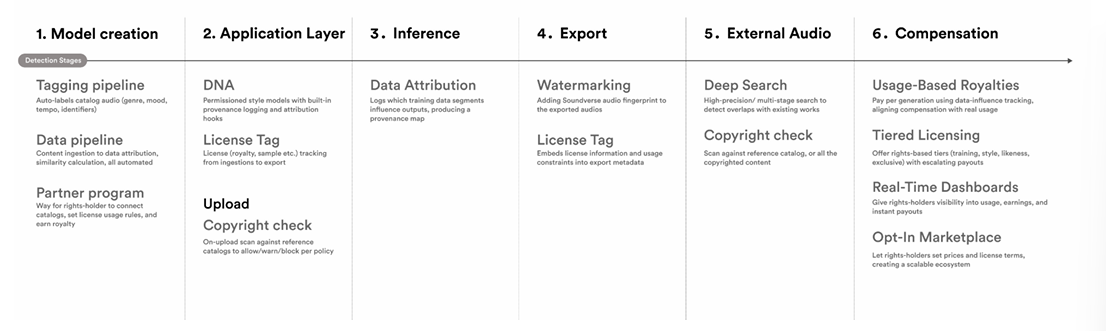
Soundverse’s Ethical AI Music Framework has emerged as a benchmark for creative transparency across the industry. Designed as a complete end-to-end infrastructure, it bridges the gap between innovation and artist integrity while addressing long-standing issues of consent, attribution, and compensation.
This transparent six-stage pipeline eliminates black-box workflows and replaces them with explainable, auditable processes:
- Stage 1: Licensed Data Sourcing (No Scraping) – Every dataset used in Soundverse is legally verified and fully licensed. This ensures models only learn from sources that have granted explicit permission.
- Stage 2: Permissioned Models (DNA) – Soundverse employs permission-controlled model DNA so its AI systems only access data from consenting sources.
- Stage 3: Explainable Inference (Attribution) – Users can trace each portion of generated output back to its licensed training components through explainable inference.
- Stage 4: Traceable Export (Watermarking) – All exported tracks embed invisible attribution watermarks, securing ownership and authenticity.
- Stage 5: Deep Search (External Scanning) – The system automatically scans the internet and music databases for matching outputs to ensure compliance.
- Stage 6: Recurring Compensation (Partner Program) – Rights-holders participating through the Content Partner Program receive ongoing royalties whenever their data contributes to generated works.
These core capabilities give enterprise clients, labels, and individual artists the ability to monitor data usage life cycles in full detail — a cornerstone of AI content accountability. For example, when artists contribute sound libraries through the Content Partner Program, the framework guarantees recurring royalty distribution, as described in Join the Soundverse Affiliate Program. For a deeper dive into these workflows, watch our Soundverse Tutorial Series - 9. How to Make Music.
How Soundverse Trace strengthens music industry standards
The Soundverse Trace solution acts as a complementary trust layer connecting training data to final audio exports. By embedding watermarking and attribution metadata directly into each file, it prevents copyright confusion and encourages long-term asset tracking.
Such mechanisms make it easier for musicians and policy auditors to inspect the lineage of an AI-created composition, aligning directly with 2026’s push for measurable transparency. For those seeking sustainable AI composition workflows, exploring Soundverse AI Magic Tools provides an additional gateway into automated creation under ethical oversight. To learn more about applying Trace to electronic genres, view our Soundverse Tutorial Series - 10. Make Deep House Music.
What role do policymakers and developers play?
Both communities play pivotal yet distinct roles. Policymakers are now specifying disclosure and audit requirements while developers integrate them within design architectures. The ideal state is one where transparency is built in — not added as an afterthought. In that respect, Soundverse’s Ethical AI Music Framework exemplifies the shift toward traceable design principles.
What lies ahead for AI music transparency beyond 2026?
Beyond 2026, transparency will evolve through interoperability — connecting different AI ecosystems under a unified disclosure protocol. The next frontier lies in machine-readable licenses, blockchain-backed attribution systems, and open royalty exchanges. The music industry is moving toward an architecture of shared truth, where creativity and accountability coexist.
Start Creating Transparent AI Music Today
Harness the power of AI to produce original music while maintaining full transparency about your creative process. Join Soundverse to explore innovative tools built for ethical and creative excellence.
Create with Soundverse
Related Articles
- How AI-Generated Music Is Transforming the Music Industry: Discover how AI tools are reshaping professional music production and empowering creators worldwide.
- The Role of AI Music in Film and Television: Learn how filmmakers and producers are integrating AI-generated compositions into modern storytelling.
- AI Music Generator and Human Composers: A Future Together: Examine how AI and human creativity can coexist to shape the next generation of music production.
- Navigating the World of Royalty-Free and Copyright-Free Music Using Soundverse AI: Understand how to use Soundverse to ethically source and create music that respects licensing boundaries.
Here's how to make AI Music with Soundverse
Video Guide
Here’s another long walkthrough of how to use Soundverse AI.
Text Guide
- To know more about AI Magic Tools, check here.
- To know more about Soundverse Assistant, check here.
- To know more about Arrangement Studio, check here.
Soundverse is an AI Assistant that allows content creators and music makers to create original content in a flash using Generative AI. With the help of Soundverse Assistant and AI Magic Tools, our users get an unfair advantage over other creators to create audio and music content quickly, easily and cheaply. Soundverse Assistant is your ultimate music companion. You simply speak to the assistant to get your stuff done. The more you speak to it, the more it starts understanding you and your goals. AI Magic Tools help convert your creative dreams into tangible music and audio. Use AI Magic Tools such as text to music, stem separation, or lyrics generation to realise your content dreams faster.
Soundverse is here to take music production to the next level. We're not just a digital audio workstation (DAW) competing with Ableton or Logic, we're building a completely new paradigm of easy and conversational content creation.
TikTok: https://www.tiktok.com/@soundverse.ai
Twitter: https://twitter.com/soundverse_ai
Instagram: https://www.instagram.com/soundverse.ai
LinkedIn: https://www.linkedin.com/company/soundverseai
Youtube: https://www.youtube.com/@SoundverseAI
Facebook: https://www.facebook.com/profile.php?id=100095674445607
Join Soundverse for Free and make Viral AI Music

We are constantly building more product experiences. Keep checking our Blog to stay updated about them!