Transparency in AI Music Training Data: Why It Matters in 2026
Explore why transparency in AI music training data is reshaping ethics and creativity in 2026.
Transparency in AI Music Training Data
In 2026, transparency in AI music training data has emerged as one of the most critical topics at the intersection of creativity, ethics, and artificial intelligence. As generative models continue to revolutionize how music is composed, produced, and distributed, questions of consent, attribution, and fairness have taken center stage. For AI researchers, music industry professionals, and policy makers, understanding and implementing AI music training data transparency is no longer optional—it is foundational for trust and sustainable innovation.
Why is transparency in AI music training data so important in 2026?

The past few years have shown intensive debates on how AI models are trained for music generation. From 2024 to 2025, numerous systems faced criticism for scraping copyrighted works or using datasets without proper permissions. By 2026, the industry is pivoting toward accountability. Transparency ensures that artists’ rights are respected, creative integrity is upheld, and audiences can trust the provenance of AI-generated works.
AI music training data transparency means disclosing what kinds of audio were used to train models, who owns them, and under what permissions they were integrated. Without this, artists risk losing control over their intellectual property, while AI-generated outputs risk ethical and legal challenges. Governments and ethical AI boards now require enterprises to maintain clear data disclosure reports—an essential practice for compliance and reputation protection. For instance, California's AI Training Data Transparency Law mandates this disclosure as a matter of policy.
How does transparent data disclosure improve the AI music ecosystem?

Transparent data disclosure creates a virtuous circle of trust and innovation. It encourages collaboration between rights holders and technology providers, while mitigating the risks of plagiarism and unauthorized reuse. Here are the key benefits:
- Ethical AI development – Transparency aligns with global ethical AI standards, ensuring algorithms evolve with fairness and inclusivity.
- Source transparency – Clear disclosure of sources helps users understand what influences an AI composition, allowing deeper creative analysis.
- Regulatory compliance – As AI governance frameworks mature, companies embracing transparency safeguard themselves against legal scrutiny.
- Artist compensation – When models disclose their training data, systems can directly attribute and compensate creators.
These principles now underpin the next generation of music AI systems—turning transparency from a theoretical goal into tangible workflows powered by frameworks like Soundverse. For a deeper dive, watch our guide on how to make music with Soundverse or learn through the Explore Tab walkthrough.
What are the challenges with opaque AI training data?
Opaque or unverified data training pipelines lead to several challenges:
- Ethical ambiguity: When creators don't know if their works were used, consent and fairness are compromised.
- Legal exposure: Opaque training data invites copyright infringement claims and undermines licensing standards.
- Creative dilution: Lack of attribution erodes the connection between artistic inspiration and AI output.
In contrast, transparent pipelines foster responsible innovation—balancing creativity with accountability.
How have global standards evolved around data ethics in AI music?
By 2026, international organizations and research communities have developed clearer standards on ethical AI. The European AI Act and similar initiatives across Asia and North America demand that developers disclose the nature and origin of training datasets. Music industry groups have also collaborated to build registries linking song metadata, rights ownership, and AI usage disclosures. This aligns with global legislation such as the bipartisan AI Transparency Bill introduced in 2026, exemplifying formal commitments to transparency.
This convergence signals that transparency is not just about compliance—it’s about redefining creative trust. Ethical AI aims for systems that both innovate and preserve cultural heritage. AI music training data transparency is now considered a measure of how responsibly a platform treats creators and consumers alike.
How to make AI music training data transparency actionable with Soundverse The Ethical AI Music Framework
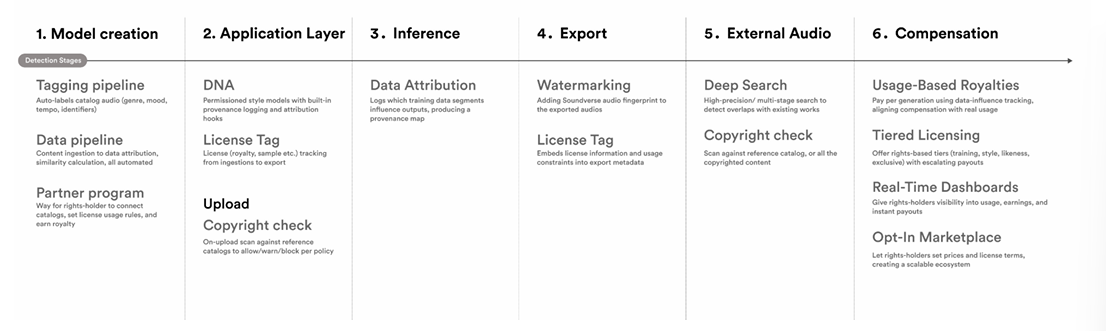
The Ethical AI Music Framework by Soundverse represents a milestone in responsible creative AI design. It offers a comprehensive end-to-end infrastructure bridging innovation and artist integrity. Instead of using opaque black-box models, Soundverse deploys a six-stage pipeline focused on consent, attribution, and recurring compensation.
The Six Stages of Transparent AI Music Development
- Licensed Data Sourcing (Stage 1) – Soundverse ensures all input datasets come from licensed sources, not scraped content, empowering ethical and legal AI operations.
- Permissioned Models (DNA) (Stage 2) – Each contributor’s creative “DNA” is registered so models are aware of ownership and consent boundaries.
- Explainable Inference (Stage 3) – AI outputs disclose which data influences were used, allowing traceable attribution for every generated track.
- Traceable Export (Stage 4) – Embedded watermarking ensures continuous tracking of AI-generated files post-export.
- Deep Search (Stage 5) – External scanning engines verify if a dataset or generated file overlaps with existing copyrighted material.
- Recurring Compensation (Stage 6) – Through the partner program, rights-holders receive royalties every time their licensed data contributes to an AI-generated composition.
Together, these stages transform transparency from a concept into a daily operational standard. Enterprises adopting Soundverse gain compliant, ethical, and traceable AI workflows. Artists benefit from reliable attribution. Consumers experience creative trust.
For those exploring advanced ethical AI integration, Soundverse Trace extends these capabilities as a trust layer embedding deep search and rights protection throughout the music lifecycle. Through the Content Partner Program, creators can opt-in to share data for training and earn recurring, usage-based royalties. This collaborative ecosystem strengthens transparency while monetizing innovation. For hands-on learning, check out our tutorial on making Deep House music.
How does transparency reshape the relationship between creators and AI?
Transparency encourages a reciprocal relationship between artists and technology. Instead of treating datasets as disposable inputs, transparent frameworks treat them as creative partnerships. Musicians gain visibility into how their material contributes to new works, resulting in emotional and financial connections between creators and AI outputs.
Ethical AI transforms music generation from imitation to collaboration. When models acknowledge influences and return value to rights holders, innovation becomes sustainable. Transparency thus redefines authorship—not by replacing human creativity, but by expanding its reach through responsible augmentation.
What trends show the rise of ethical AI in music by 2026?
The current year brings decisive transformation in the music and AI ecosystem:
- Artist-centered governance models are emerging, where creators maintain dashboards tracking usage of their licensed works.
- Corporate adoption of transparent AI frameworks is accelerating, with major labels partnering to ensure fair compensation models.
- Public demand for ethical AI certifications has increased, making transparency a market differentiator.
These trends mark the beginning of AI systems where transparency isn’t a feature—it’s the foundation.
Related Reading
To explore more about how AI shapes modern music creation, see How AI-generated music is transforming the music industry, Generate AI music with Soundverse Text-to-Music, and Soundverse AI Magic Tools: Create content quickly with AI. For those researching platform comparisons, read Best AI Music Generator: Top Picks and Review.
Explore Transparent AI Music Creation Today
Join Soundverse and create music with full visibility into how AI models are trained and mapped. Gain creative freedom and confidence through ethical, transparent AI music generation.
Start Creating with AI Transparency
Related Articles
- How AI-Generated Music Is Transforming the Music Industry: Discover how AI music tools are reshaping how artists and producers create, distribute, and think about sound innovation.
- AI Music Generator and Human Composers: A Future Together: Explore the evolving collaboration between AI and human talent in generating emotionally rich, ethically crafted music.
- Navigating the World of Royalty-Free and Copyright-Free Music Using Soundverse AI: Learn how transparent AI music creation helps you legally and confidently use royalty-free tracks for your content.
- The Role of AI Music in Film and Television: Understand how AI-driven transparency ensures ethical integration of machine-generated compositions in visual storytelling.
Here's how to make AI Music with Soundverse
Video Guide
Here’s another long walkthrough of how to use Soundverse AI.
Text Guide
- To know more about AI Magic Tools, check here.
- To know more about Soundverse Assistant, check here.
- To know more about Arrangement Studio, check here.
Soundverse is an AI Assistant that allows content creators and music makers to create original content in a flash using Generative AI. With the help of Soundverse Assistant and AI Magic Tools, our users get an unfair advantage over other creators to create audio and music content quickly, easily and cheaply. Soundverse Assistant is your ultimate music companion. You simply speak to the assistant to get your stuff done. The more you speak to it, the more it starts understanding you and your goals. AI Magic Tools help convert your creative dreams into tangible music and audio. Use AI Magic Tools such as text to music, stem separation, or lyrics generation to realise your content dreams faster. Soundverse is here to take music production to the next level. We're not just a digital audio workstation (DAW) competing with Ableton or Logic, we're building a completely new paradigm of easy and conversational content creation.
TikTok: https://www.tiktok.com/@soundverse.ai
Twitter: https://twitter.com/soundverse_ai
Instagram: https://www.instagram.com/soundverse.ai
LinkedIn: https://www.linkedin.com/company/soundverseai
Youtube: https://www.youtube.com/@SoundverseAI
Facebook: https://www.facebook.com/profile.php?id=100095674445607
Join Soundverse for Free and make Viral AI Music

We are constantly building more product experiences. Keep checking our Blog to stay updated about them!