How Billboard Credits Songwriters, Producers, and Contributors in 2026
Explore how Billboard credits songwriters, producers, and contributors in 2026, and how Soundverse Trace enhances music attribution transparency.
How Billboard Credits Songwriters, Producers, and Contributors
Introduction
In 2026, the music industry's recognition system has evolved to ensure fair acknowledgment of every creative force behind a track. From songwriters and producers to mixing engineers and featured artists, credits have become more than just a formality—they're essential data points that impact royalties, chart rankings, and the professional visibility of contributors. Understanding how Billboard songwriter and producer credits are determined is crucial for music professionals, especially as AI-generated music and metadata-driven systems reshape the way attribution works.
This comprehensive guide unpacks how Billboard classifies and displays songwriter, producer, and contributor credits in 2026, how these credits influence chart performance, and what tools like Soundverse Trace are doing to create transparency and trust in music attribution.
What Are Billboard Songwriter and Producer Credits?
Billboard songwriter and producer credits refer to the detailed attribution data assigned to every song on the Billboard charts. These include the names of all creative contributors—songwriters, composers, lyricists, producers, mixers, and in some cases, data scientists involved in AI-assisted creation. These credits define who is acknowledged for a song’s commercial and creative success and who receives associated royalties.
In previous years, Billboard primarily relied on publisher and label submissions to compile credit data. However, starting from 2025 and continuing through 2026, automation and blockchain-based verification systems have strengthened how Billboard validates this information. Each track now carries verified metadata that ties individual roles to specific contributions.
How Does Billboard Collect and Verify Songwriter and Producer Data?
Billboard collects songwriting and production data through several trusted channels:
- Industry Databases: Billboard integrates information from databases such as ASCAP, BMI, SESAC, and other Performing Rights Organizations (PROs), which maintain songwriter and publisher data.
- Label and Publisher Submissions: Record labels and publishers submit metadata for new releases. This includes ISRC (International Standard Recording Code) and ISWC (International Standard Musical Work Code) identifiers.
- Direct Artist Verification: Artists and producers can directly verify or request corrections to their credits through designated verification portals.
- Technology-Based Validation: Since 2025, machine-learning systems have been adopted to match song data, ensuring that every contributor listed can be verified through cross-referenced metadata.

Why Are Billboard Songwriter and Producer Credits So Important in 2026?
In today’s AI-augmented creative environment, accurate music industry credits are more than symbolic—they represent digital identity, earning potential, and legal authorship. Here's why they matter:
- Royalty Distribution: Streaming platforms depend on verified credits to route royalties to the right stakeholders.
- Career Credibility: Songwriters and producers use Billboard credit visibility to attract collaborations and grow their portfolios.
- AI Collaboration Recognition: With AI increasingly embedded in the creative process, Billboard's 2026 credit system includes both human and AI-assisted contributions, signaling accountability and transparency.
- Chart Data Precision: Billboard chart data directly links songwriting and production credits with rankings, giving analytics firms and labels more accurate performance insights.
You can also get insights from Billboard Charts to Increase Streaming Weight in 2026 - Relix for more about how streaming now impacts chart metrics.
What Roles Are Recognized in Billboard's Credit System?
Billboard’s modern credit structure goes beyond traditional authorship categories. The following roles are typically recognized:
- Songwriters and Lyricists: Individuals who craft the lyrics or melodies.
- Producers: Responsible for shaping the overall sound, recording, and arrangement of the track.
- Engineers and Mixers: Audio specialists ensuring sonic quality and balance.
- Featured Performers: Guest artists or collaborators prominently credited.
- AI Contributors: Systems or datasets acknowledged when AI generative tools influence final compositions.
- Composers and Arrangers: Those contributing orchestration or musical structure.
This granular approach ensures transparency for artist teams and helps track detailed analytics across multiple platforms.
How Does Billboard Handle AI-Generated and Collaborative Music in 2026?
The surge of AI-generated music from 2024 onward created a new frontier for credit assignment. Billboard responded by introducing disclosure requirements in its submission protocols. If a track includes AI-generated components, such as melodies derived from AI models, producers must disclose this and identify the AI system used.
Credits now include designations such as "AI-assisted composition" or "Generated with Soundverse Trace-linked data," ensuring that every creative input has an auditable trail.
Tracks utilizing recognized ethical frameworks—such as the Soundverse Ethical AI Music Framework—are automatically assigned an integrity tag. This allows Billboard’s data systems to differentiate between ethically licensed AI contributions and unauthorized dataset use. Explore prediction trends via What's Next in the Music Industry for 2026? Billboard Predicts Trends.
How Does Transparent Credit Data Influence Billboard Chart Rankings?
Unlike in previous years when chart performance metrics were limited to sales and streams, 2026 Billboard charts factor in validated metadata. Verified songwriter and producer attribution now helps:
- Confirm eligibility for specific chart categories (e.g., songwriter charts, producer charts, and AI-collaboration charts).
- Prevent fraudulent entries or misattributed works.
- Improve algorithmic tracking of creative trends across global releases.
Accurate track contributor listing ensures that analytics from Billboard chart data feed seamlessly into royalty collection systems, reducing payment discrepancies and legal disputes. Read more about updates in streaming equivalence via Billboard Cuts Streams Needed for Chart Success in 2026.
Current Challenges in Maintaining Accurate Music Industry Credits
While technology has simplified metadata collection, several challenges persist:
- Metadata Inconsistency: Different platforms use varying standards for credit formats, causing mismatches in royalty reporting.
- AI Attribution Complexity: As AI models become collaborative partners, differentiating between human and AI creative contributions remains a gray area.
- Lack of Universal Adoption: Not all labels and distributors globally adhere to identical data submission policies.
Solutions are now emerging to address these issues, and among the leading innovations is Soundverse Trace.
How to Improve Billboard Songwriter and Producer Credits with Soundverse Trace
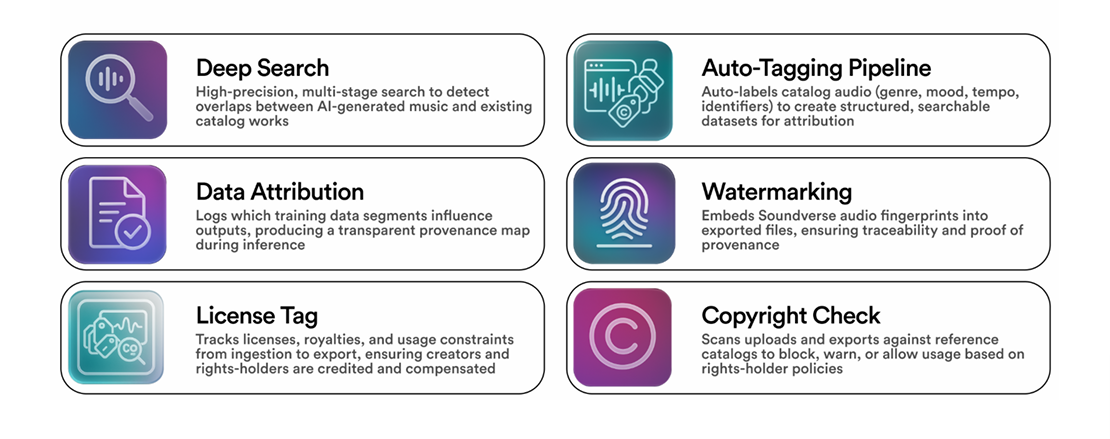
Soundverse Trace is a comprehensive trust layer for AI music that ensures every contributor—human or AI—is correctly credited throughout the creative process. The feature embeds attribution, deep search, and rights protection across the entire music lifecycle, making it easier for artists, producers, and distributors to maintain integrity when submitting data to Billboard.
Key Capabilities of Soundverse Trace
- Deep Search: High-precision scanning to detect overlaps and similarities across tracks. This is essential when confirming originality before sending metadata to Chart Partners or Billboard.
- Data Attribution: Logs which training data or musical influences contributed to the final output. This provides a verified map of influence, ideal for copyright validation.
- Audio Watermarking: Embeds inaudible fingerprints into the exported track. These ensure that songs are traceable in Billboard submissions and streaming platforms.
- License Tagging: Maintains rights metadata from the dataset ingestion phase to final export, simplifying the credit transfer process.
With these built-in safeguards, Soundverse Trace supports accurate songwriter recognition, producer attribution, and track contributor listing while aligning with Billboard’s evolving metadata standards. For additional technical insight, watch the Soundverse Tutorial Series - 9. How to Make Music.
Integration with Ethical Music Practices
Soundverse Trace functions within the Ethical AI Music Framework, which reinforces fair compensation, consent, and transparency. By optimally linking attribution data to Billboard credit requirements, Soundverse empowers authentic creativity in a responsible digital ecosystem. Furthermore, rights-holders who join the Content Partner Program can license their audio for AI training in exchange for recurring royalties based on real usage—strengthening sustainability in AI-driven music creation.
Related Reading for Music Professionals
To deepen your understanding of current credit trends and AI’s influence, check out these insightful resources:
- How AI-Generated Music Is Transforming the Music Industry
- Music Industry Trends
- Soundverse Introduces Stem Separation AI Magic Tool
- Mubert Alternatives: Soundverse Overview
Streamline Your Music Creation with Soundverse AI
Effortlessly generate, arrange, and refine tracks using advanced AI tools built for modern artists and producers. Experience how Soundverse can transform your creative workflow—from songwriting to mixing.
Start Creating with AI
Related Articles
- How AI-Generated Music Is Transforming the Music Industry — Explore how artificial intelligence is reshaping music creation, distribution, and the roles of songwriters and producers today.
- The Role of AI Music in Film and Television — Discover how AI-driven composition is revolutionizing soundtrack creation and empowering content creators across media platforms.
- What Are Song Stems and Why Do You Need Them — Learn what song stems are, how they impact music production, and why they’re essential for remixing and collaboration.
- AI Music Generator and Human Composers: A Future Together — Examine how AI and human creativity can coexist, giving rise to exciting new forms of collaborative music production.
Here's how to make AI Music with Soundverse
Video Guide
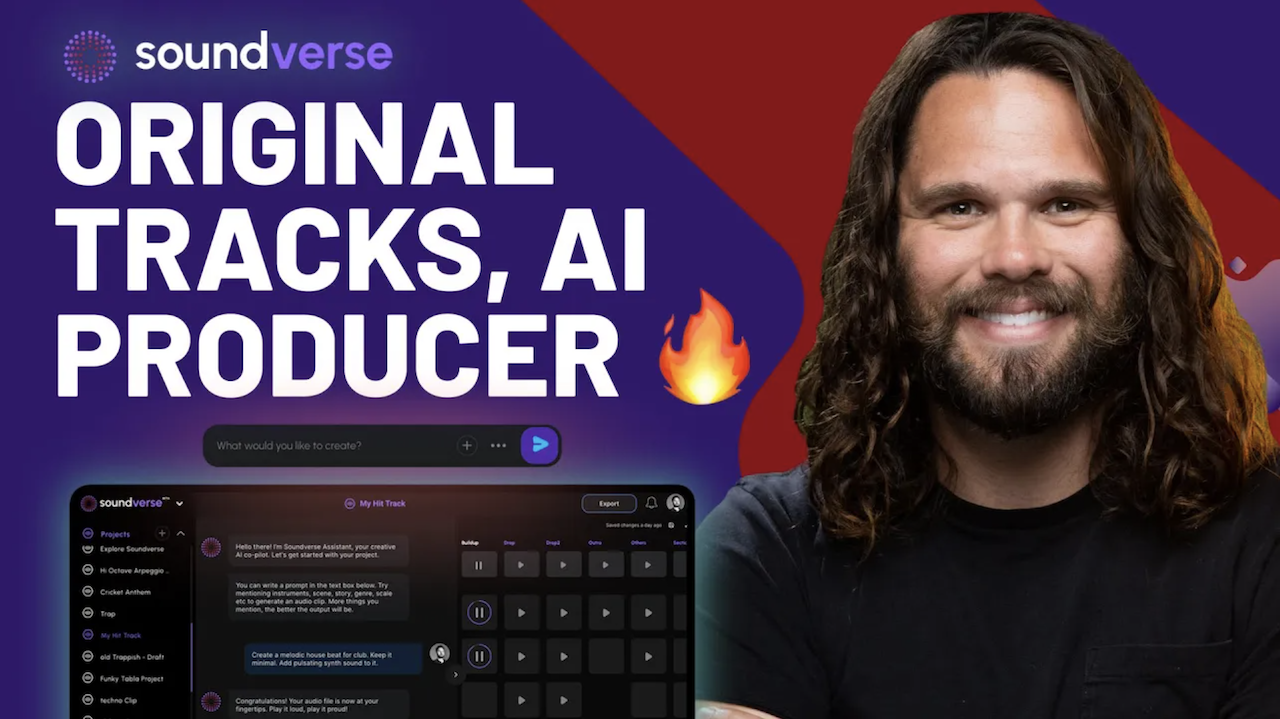
Here’s another long walkthrough of how to use Soundverse AI.
Text Guide
- To know more about AI Magic Tools, check here.
- To know more about Soundverse Assistant, check here.
- To know more about Arrangement Studio, check here.
Soundverse is an AI Assistant that allows content creators and music makers to create original content in a flash using Generative AI. With the help of Soundverse Assistant and AI Magic Tools, our users get an unfair advantage over other creators to create audio and music content quickly, easily and cheaply. Soundverse Assistant is your ultimate music companion. You simply speak to the assistant to get your stuff done. The more you speak to it, the more it starts understanding you and your goals. AI Magic Tools help convert your creative dreams into tangible music and audio. Use AI Magic Tools such as text to music, stem separation, or lyrics generation to realise your content dreams faster. Soundverse is here to take music production to the next level. We're not just a digital audio workstation (DAW) competing with Ableton or Logic, we're building a completely new paradigm of easy and conversational content creation.
TikTok: https://www.tiktok.com/@soundverse.ai
Twitter: https://twitter.com/soundverse_ai
Instagram: https://www.instagram.com/soundverse.ai
LinkedIn: https://www.linkedin.com/company/soundverseai
Youtube: https://www.youtube.com/@SoundverseAI
Facebook: https://www.facebook.com/profile.php?id=100095674445607
Join Soundverse for Free and make Viral AI Music

We are constantly building more product experiences. Keep checking our Blog to stay updated about them!