Why Is Temporal Consistency a Challenge in AI Video Generation?
Why temporal consistency in AI video is hard: flicker, drift, occlusion and memory costs, how research tackles them, and what it means for music videos.
Temporal consistency in AI video is hard because a model must keep every face, texture, light and movement stable across dozens of frames while each frame begins as random noise. Small frame-to-frame differences read as flicker, errors compound into drift, and remembering a whole clip costs compute that grows faster than the clip's length.
Below: each cause, then how researchers have attacked it since 2022. Sources were checked on 21 November 2026.
What temporal consistency means in AI video
A video is temporally consistent when whatever should stay the same from frame to frame does, and whatever changes, changes smoothly and for a reason: the singer's face keeps its shape, her jacket its weave, the key light its place.
It breaks at three scales:
- Frame to frame: flicker, boiling textures, shimmering edges.
- Within a shot: slow drift in identity, colour or detail over a few seconds.
- Across shots: continuity between separate clips, which our guide to keeping faces, clothes and locations consistent covers.
This article is about the first two.
Describe the difference between frame-by-frame generation and temporal consistency in video AI
Frame-by-frame generation is a method: an image model makes each frame separately, sometimes guided by a source video. Temporal consistency is a result: whether those frames hold together as one moving picture. The method rarely delivers the result, because nothing ties one frame's random sample to the next.
Picture 24 painters each painting one frame of the same second from one brief. Every painting can be excellent, yet played in sequence, each detail the brief didn't fix, such as hair, a wall pattern or a reflection, changes 24 times a second.
NVIDIA's project page for Video LDM (Blattmann and colleagues, April 2023) shows the same thing while turning an image model into a video model: "Initially, different samples of a batch synthesized by the model are independent. After temporal video fine-tuning, the samples are temporally aligned and form coherent videos."
- Frame-by-frame: each frame is its own draw. Sharp stills, flicker in motion, unlimited length.
- Video generation: the model denoises a block of frames together, comparing each frame with its neighbours. Smoother, but far more compute and a capped length.
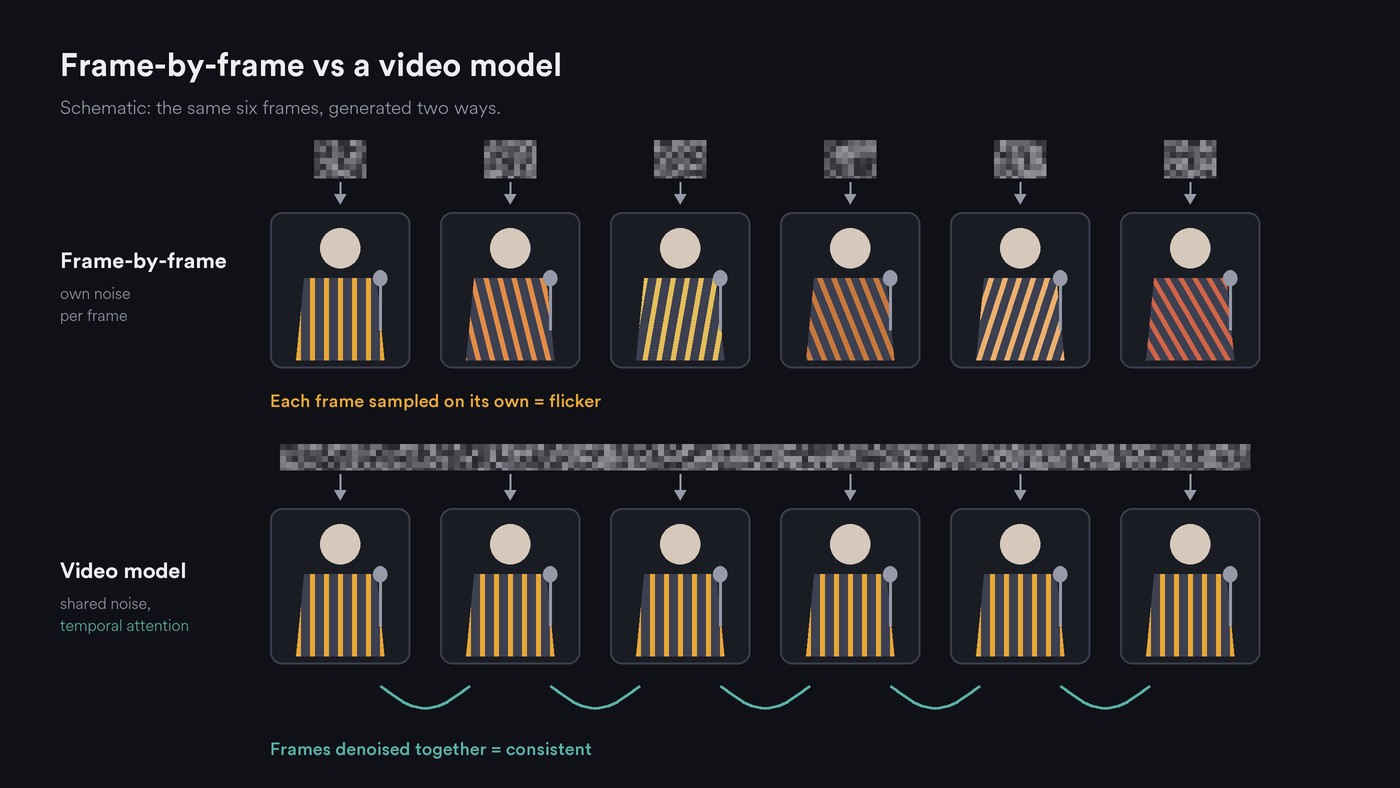
Why temporal consistency in AI video is so hard
1. Every frame starts from noise
Diffusion models turn random noise into an image step by step. A prompt fixes what its words describe and leaves countless details open, and different noise settles them differently, frame after frame, unless something links the frames. The authors of Rerender A Video (Yang and colleagues, June 2023) say that keeping frames temporally consistent is still a major challenge when text-to-image models are applied to video.
2. Small errors compound into drift
Models that build a video piece by piece feed their own output back in. The Self Forcing paper (June 2025) calls this exposure bias: trained to continue real footage, the model must continue its own imperfect frames. The FramePack authors (Zhang and colleagues, April 2025) name two failures of next-frame models: forgetting, where memory of earlier content fades, and drifting, where quality degrades as errors pile up. They describe a trade-off: stronger memory carries errors forward, while cutting off error propagation weakens memory.
3. Motion and physics
A video model learns what motion looks like, not the rules behind it. OpenAI's Sora technical report (15 February 2024) says the model doesn't accurately model the physics of many basic interactions, such as glass shattering. When physics fails, objects change shape mid-move. Bodies are the hardest case, as our post on why AI video struggles with human motion explains.
4. Occlusion and re-appearance
When a guitarist walks behind a pillar, the model has to remember him and bring him back unchanged. The Sora report says its model was frequently, but not always, able to keep people, animals and objects when they were hidden or left the frame, and it lists objects appearing spontaneously among common failures.
5. Long-range memory and the cost of attention
The same report puts the core problem plainly: "A significant challenge for video generation systems has been maintaining temporal consistency when sampling long videos."
Part of the reason is arithmetic: transformer video models turn a clip into tokens and compare them with each other. The Wan technical report (March 2025) gives its sequence length as (1 + T/4) × H/16 × W/16, and notes that compute grows quadratically with sequence length while GPU memory grows linearly. For the 81-frame 1280 × 720 clips it calls typical, that is 21 × 45 × 80 = 75,600 tokens. Double the clip to 161 frames and you get 147,600 tokens: about 1.95 times as many, and roughly 3.8 times the work in the attention term.
So models cap clip length or attend to a window of recent frames, and whatever falls outside it is forgotten. FramePack's authors note that simply encoding more frames quickly becomes computationally intractable.
6. Latent compression and decoding
Video models work on a compressed copy of the footage. Wan's VAE compresses by 4 × 8 × 8: after the first frame, each latent step stands for four frames, and each position for an 8 × 8 block of pixels. A decoder rebuilds the detail, and a decoder that rebuilds each frame on its own can invent fine texture differently every time. That is why Video LDM also fine-tuned its decoder on video, to keep reconstructions coherent across frames.
7. Training data
The Stable Video Diffusion paper (Blattmann and colleagues, November 2023, released by Stability AI) notes that the field had yet to agree on a strategy for curating video data, and shows that a well-curated pretraining set is necessary for high-quality video. What a model treats as normal motion depends on what survives that curation.
How researchers attack temporal consistency
- Temporal layers (2022 to 2023). Video Diffusion Models (Ho and colleagues, April 2022) extended the image diffusion architecture to video. Video LDM inserted temporal layers, built from temporal attention and 3D convolutions, into a pretrained image model so each frame can look at its neighbours.
- Whole-clip transformers (2024 to 2025). The Sora report describes compressing video in space and time into spacetime patches that act as transformer tokens; CogVideoX (August 2024) and Wan also use 3D VAEs.
- One pass instead of keyframes. Lumiere (Bar-Tal and colleagues, January 2024) generates the whole duration in one pass with a Space-Time U-Net. Its authors contrast this with generating distant keyframes and filling in between, an approach they say inherently makes global temporal consistency difficult.
- Keyframes plus interpolation. Video LDM generates sparse keyframes, then interpolates twice to reach full frame rate. First-and-last-frame tools use the same idea; our explainer on frame interpolation shows where it ghosts.
- Optical flow and feature propagation. For frame-by-frame editing, Rerender A Video translates key frames under cross-frame constraints, then spreads them with patch matching and frame blending. TokenFlow (July 2023) carries diffusion features along matches between frames, and FlowVid (December 2023) uses optical flow from the first frame as an extra reference.
- Reference conditioning. Starting from an image, pinning first and last frames, or supplying reference pictures gives every clip the same anchor, so identity doesn't rely on memory alone.
- Training on its own output (2025). Self Forcing trains a model on its own rollouts, so training matches what happens at generation time, and FramePack compresses older frames by importance so long histories fit a fixed context.
What temporal consistency means for music videos
- Keep shots short. Drift and forgetting grow with length, and compute grows faster. Two bars at 120 BPM is 4 seconds; generate that plus a little handle, then start the next shot fresh.
- Cut on the beat. Viewers accept change at a cut and read change inside a shot as a mistake. A cut every bar or two also retires each clip before drift builds.
- Reuse references. Start related shots from the same approved image, so each clip is anchored to a picture instead of a memory.
- Pick forgiving subjects. Fine repeating patterns, small text and objects that leave and re-enter the frame show inconsistency first. Haze, silhouettes and moving light hide it.
- Use flicker on purpose. Frame-by-frame image-to-image gives a hand-painted, boiling look that can suit a breakdown for a few bars.
For the step-by-step version, from style bibles to handoff frames, see our guide to improving the coherence of AI video sequences.
Where Soundverse fits
Soundverse is an AI music platform that takes you from idea to audience, and its video tools favour short clips anchored to images you choose. AI Video Generator can start a clip on an image as its first frame, travel between a first and a last frame, or follow reference media, in clips of 3 to 30 seconds depending on the model, at up to 1080p. Multi-Scene Video Builder plans up to 10 scenes of 4 to 15 seconds, each with optional first and last frames, and suggests starting several scenes on images of the same character so they look alike from shot to shot. Choose Multiple videos to cut each scene to your song in AI Studio, on downbeats from Section Analysis, which runs on the Free plan. The video tools need Creator or above.
This walkthrough shows a song, a character image and a prompt becoming a full music video, with planned scenes, a lip-synced performance and cuts to the music.
FAQ
What causes flickering in AI-generated video? Fine details that get decided separately for each frame, either because each frame is its own sample or because a decoder rebuilds texture frame by frame. Video models that denoise frames together, and flow-guided editing methods, reduce it.
Is temporal consistency the same as character consistency? They overlap. Temporal consistency is about the frames of one clip holding together; character consistency is about one person looking the same across separate clips. A smooth clip can still show a different face from the shot before.
Why do AI videos get worse the longer they run? Errors build up as the model continues from its own frames, earlier content fades from memory, and attention cost grows quadratically, so models limit how far back they look. Short shots sidestep all three.
Will newer models solve temporal consistency? They keep improving, but even OpenAI's Sora report listed incoherencies that develop in long samples. Plan music videos as short shots cut together.
Sign up for Soundverse free and build your next video from short, anchored shots. More guides on the Soundverse blog.

