Where Can I Register to Start Distributing My Band's Latest EP to Online Stores?
Where to register to distribute an EP as a band: verified sign-up pages, then account names, member splits, credits, ISRCs, one UPC and PRO steps.
To distribute an EP as a band, register one account on a distributor's own sign-up page, such as DistroKid, TuneCore, CD Baby, Ditto Music or Amuse, and enter the band name as the artist. One member, or the band's company, holds the account. Everyone else is paid through royalty splits, credited on each track and registered as a songwriter.
We opened every page below on 19 November 2026. To compare plans first, see our guide to buying a distribution subscription for an EP. This post covers what's different for a band.
Where to register to distribute an EP
- DistroKid. Its pricing page counts plans in artists or bands: Musician covers one, Musician Plus two. Splits come with every plan.
- TuneCore, linked from its homepage's Sign Up button. Every plan includes free splits, and PRO+ manages four more artists, handy if members also release solo.
- CD Baby. The account is free; you pay per release.
- Ditto Music. The form warns that a royalty share won't link to an account registered with a different email, so members should sign up with the email their split invite goes to.
- Amuse. Get Started on amuse.io or in its app. On Artist Pro, the owner can add up to 20 team members.
- UnitedMasters. Join at unitedmasters.com; its FAQ lets you release to an existing Spotify and Apple Music page or to new profiles.
Use one distributor for the EP. Ditto's help centre warns that delivering the same music to the same stores through two aggregators can get it removed.
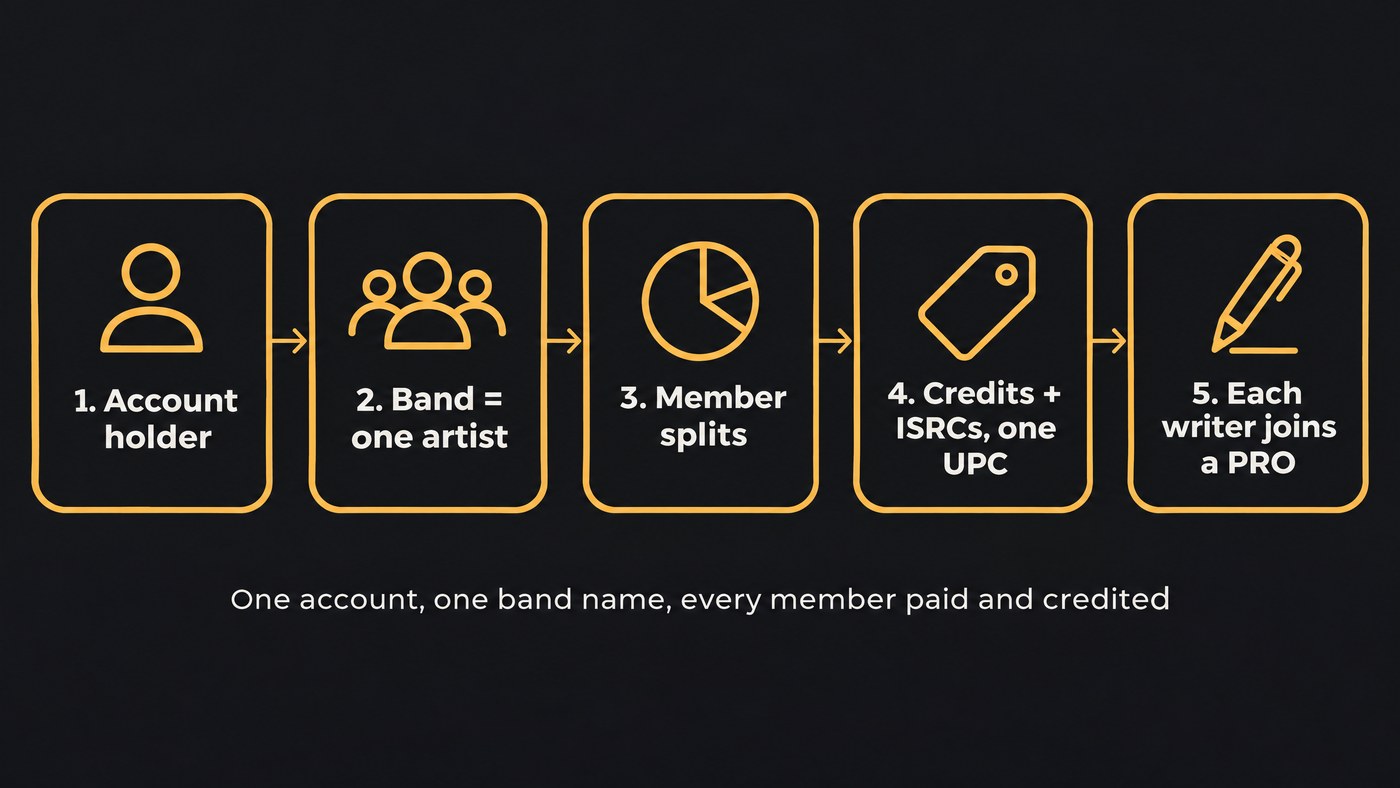
Whose name goes on the account
A distributor account belongs to one person or one company, who accepts the terms and receives the money.
- Choose the member who does the admin, or the band's company. Amuse offers business accounts for tax-registered companies in the US, UK and Sweden.
- Match the name to the bank account. Amuse's Wallet guide (15 October 2026) warns that mismatched details can make withdrawals fail.
- Use an email the band controls, not one member's personal inbox.
- Know how ownership moves. Amuse allows one owner per artist team, changed only through support (Team article, 19 October 2026).
- Write a short band agreement first: who owns the recordings, each track's split, and what happens if someone leaves.
Enter the band as one artist and keep its profiles clean
The band name is the primary artist on every track, and members are not added as extra primary artists. The Apple Music Style Guide says acts generally listed together as a band must be listed together (section 2.4), that artist names carry nothing extra such as an instrument or a former band (2.1), and that band members are credited at track level by instrument or role rather than as Primary (2.14). Amuse's help centre gives the same advice: a permanent duo or band uses one compound artist name on one account.
Mix-ups happen when another act shares your name, because stores match each release to an existing profile or create a new one. Before you upload:
- Search the band name on Spotify, Apple Music and YouTube Music. If another act uses it, change yours before the EP comes out.
- Pick the right profile in the upload form: new artist for a first release, the band's Spotify and Apple Music artist IDs after that. Spotify's page on music mixed up with another artist says its preferred and recommended distributors let you deliver with a specified artist ID, and Ditto lets you correct a wrong profile by entering the right Spotify Artist ID (help article, 8 September 2026).
- Turn on Artist Profile Protection. Since 17 November 2026 every Spotify artist can get an email when music is delivered under their name and remove themselves from releases that aren't theirs. For common names, Spotify suggests the Block releases setting, which holds releases until you approve them.
- Invite every member to Spotify for Artists. Spotify's help page says it plainly: "Add bandmates, managers, and other trusted team members to your Spotify for Artists team." Make two members Team Admins, since only Team Admins can invite or remove people and only Admins can add payment methods.
- Keep solo work separate. A member's solo single goes out under their own name, so it never lands on the band's page.
Add each member and their royalty splits
Agree each track's master split in writing, then enter it in the split tool so every member is paid directly.
- DistroKid's Splits page lists bandmates among the people it can pay, with zero commission and percentages you can change at any time.
- TuneCore includes splits on all plans, and its priority payouts can repay recording costs before the percentages start.
- Ditto's royalty splits guide names band members among the people you can split with, and they need only a free account. Splits are added once the release is approved; until a member accepts, that track's royalties stay with the account holder.
- Amuse sends split invites when the release is approved. Members must accept before release day or their share defaults back to the release owner, and collaborators without a subscription may pay a 15% commission, depending on the owner's plan.
For fees and payouts compared, see which music distributors offer the best royalty splits.
Payee details and tax forms
Each member who receives a split sets up their own payout profile. Amuse's Wallet guide says split recipients can do this too, and Ditto's payout partner may run an identity check before a withdrawal (help article, 23 April 2026).
Tax follows the money: each payee answers for their own share. Amuse, a Swedish company, says it doesn't handle tax forms outside Sweden and that declaring royalties is up to the artist. Have each member enter their own tax and bank details, and keep the signed split sheet for whoever does the band's accounts.
Credits for every member
Credits are separate from splits. On every track, list each member as a performer with their instrument or vocal role, every songwriter by full legal name, and any member who produced or mixed it.
Spotify's song credits page says it shows the credits your distributor sends, and that some distributors don't support credits yet, so check before you pay. Naming rules and a release sheet are in what to prepare before uploading music for distribution.
ISRCs per track, one UPC for the EP
Each recording gets its own ISRC, and the EP as a product gets one UPC. IFPI's ISRC FAQ says every different product needs its own UPC/EAN, an ISRC stays with a track for its lifespan even if ownership changes, and a code is never reused. Ditto assigns both free if you don't have them (help article, 21 July 2026).
If one of the songs already came out as a single, enter that single's ISRC on the EP. Ditto's split tool matches the same track across releases by ISRC and offers to copy its splits.
If a member leaves
- Leave released credits alone. They played on those recordings.
- Follow the band agreement on old splits. On Ditto, a changed share goes to the member as a pending request. They keep earning the current share until they respond, and if they reject it, the original stays.
- Remove their access from the Spotify for Artists team and any distributor team.
- Move the account if they held it. On Amuse, an owner change goes through support.
- Don't change songwriting shares on your own. ASCAP says it may require signed correspondence from a writer before it reduces their share or removes them from a work.
Register each writer with a PRO
Distributors pay the recording side; songwriting royalties come through a performing rights organisation, which signs up writers, not bands. ASCAP's membership FAQ is direct: "Each member of the group must complete a separate writer application and each member of the group must meet the eligibility criteria." A band that wants a single publisher membership must be set up as a partnership, corporation or LLC.
Each writer joins one PRO (ASCAP allows one society at a time per writer in the US), the writers agree splits that add up to 100%, and each song is registered with every co-writer's name, PRO and share, ideally before it's uploaded anywhere, as ASCAP's splits guide advises. Country-by-country steps are in our guide to registering music with performance rights organizations.
Where Soundverse fits
Soundverse is an AI music platform that takes you from idea to audience. It doesn't deliver music to stores; your EP reaches Spotify and Apple Music through the distributor you register with.
Release Planner turns the EP's focus track and your release date into a day-by-day, platform-split rollout with pre-save, smart link and playlist pitch deadlines. It writes the plan and doesn't post or submit anything.
Music Business Agent works on real sites while you watch. It can check your access to Spotify for Artists and Apple Music for Artists and start a claim where you lack it, search stores such as Spotify, Apple Music and Amazon Music for where the EP is live, missing or mislabeled, and register works with your PRO using the details you provide. Its workflows ask for missing ISRCs, writers and splits and are instructed never to invent them.
This walkthrough shows Release Planner turning a finished song into a day-by-day rollout plan.
FAQ
Can our whole band share one distributor account? Not as co-owners: an account has one holder, and Amuse, for example, allows one owner per artist team. Members get access through team features, such as Amuse's team roles or a Spotify for Artists team, and get paid through splits.
Do all band members need to pay for the distributor? No. Ditto collaborators need only a free account, and DistroKid's Splits page says you can add non-members. On Amuse's Artist plan, splits to collaborators without a subscription may carry a 15% commission.
Should each member be listed as a primary artist? No. The band is the primary artist, and Apple's style guide credits members at track level by instrument or role. That keeps the EP on the band's profile.
What if another act already uses our band name on Spotify? Change the name before your first release if you can. If you keep it, deliver with your own artist ID, claim the profile and switch on Artist Profile Protection.
Sign up for Soundverse free and plan the rollout for your band's EP. More release guides on the Soundverse blog.