Reliable Services for Uploading Your Tracks to All Major Streaming Platforms
How to upload music to streaming platforms through a reliable distributor: store lists, support, payouts, transfers and fraud rules, plus four picks.
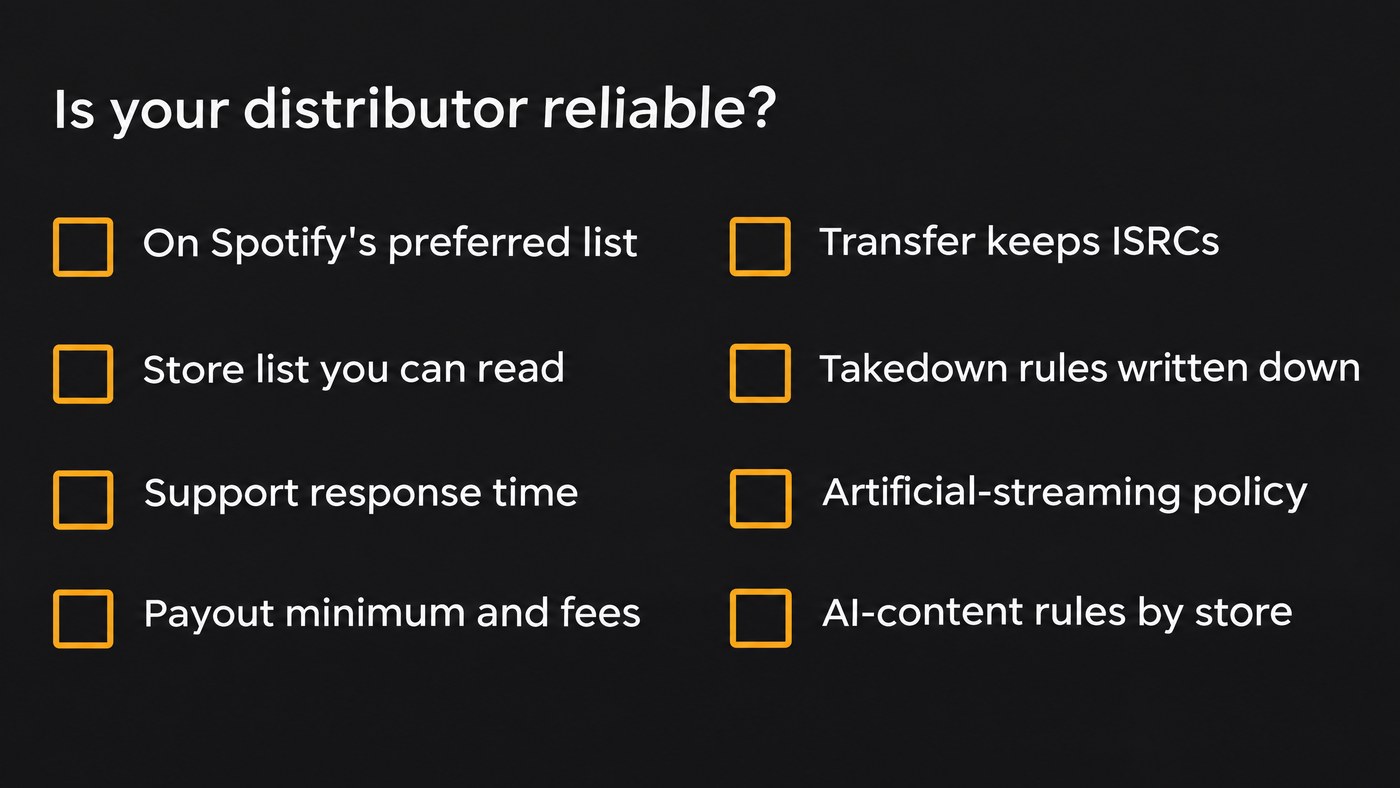
To upload music to streaming platforms reliably, start with Spotify's list of preferred distributors, then compare what each one documents about support, payouts, transfers and takedowns. If you want a reliable service for uploading your tracks to all major streaming platforms, CD Baby, TuneCore and Amuse are strong picks, with Ditto Music close behind; each has one catch to check.
We read each company's own pages on 19 November 2026. Prices and budget picks are in our guide to the best platforms for independent musicians to distribute music, and the basics are in how digital music distribution works. This post is about reliability: what happens when something goes wrong.
Delivery accuracy and speed
A reliable distributor delivers the right audio and metadata to the right artist profile on the right date. Spotify says every company in its Provider Directory meets its standards for delivering music. On 19 November 2026, DistroKid, CD Baby, Amuse, RouteNote, TuneCore and LANDR carried the preferred tag; Ditto Music was listed without it. Spotify's help page on music mixed up with another artist adds that its preferred and recommended providers let you deliver with a specified artist ID, which keeps releases off the wrong profile.
Apple keeps its own Preferred Distributors list, for partners that meet what it calls its highest standards. Of the services in this post, only TuneCore was on it that day.
Then look at how a release is tracked. Amuse reviews every release before delivery and shows each one as Received, In Review or Delivered. TuneCore offers a Release Tracker from submission to stores, and Ditto shows which stores each release went to. For how long each step takes, see music distribution turnaround times.
Store coverage: read the list, not the headline
For most artists, all major platforms means Spotify, Apple Music, Amazon Music, YouTube Music, Deezer, TIDAL and TikTok at a minimum, and all four of our picks cover them. The gaps show up in the long tail.
- TuneCore and CD Baby both headline more than 150 stores and services; Ditto says hundreds.
- Amuse's Stores page headlines 120+ stores in its network, while its searchable list showed 59 named stores, with Beatport marked for Artist & Label Services clients only. Its help centre suggests another distributor for stores Amuse doesn't deliver to, naming Beatport.
- Amuse's store guide marks Boomplay as Africa only and Pandora as US only, adding that Pandora reviews content, so delivery there isn't guaranteed.
Write down the stores you can't do without, such as Beatport for DJs or JioSaavn for India, and find each one by name before you pay.
Customer support you can reach
When a release goes live on the wrong profile two days before launch, response time matters more than features. TuneCore's homepage promises replies within one business day, but its pricing grid lists 3 business days on CORE and 1 on PRO and PRO+. The grid is what applies to your plan.
Amuse handles support through a chat bubble in its help centre and dashboard, won't take release questions on social media, and lists Priority Support on Artist Pro. Before you commit, send a pre-sales question through the channel you'd use for a broken release and time the reply.
Payout schedule and minimums
Spotify pointed out on 21 November 2023, in its royalty system update, that labels and distributors usually require $2 to $50 per withdrawal. Compare the actual terms:
- Ditto: a £25 minimum and a £0.75 fee on bank withdrawals in the UK, US and most of Europe, per its withdrawal guide (7 September 2026). A separate help article sets £30 for SWIFT transfers.
- Amuse: stores pay two to three months after the streams; Amuse processes them at month end; bank transfers take up to 10 business days. It suggests waiting for $10 before withdrawing, and a withdrawal always takes your whole balance.
- CD Baby: its cost page promises weekly payments and keeps 9% of digital distribution revenue.
- TuneCore: its homepage FAQ says payments are processed monthly.
Takedowns and transfers without losing streams
Moving distributors is where catalogs lose their numbers. Spotify's rule is short: "You can re-upload music without losing your play count through a process called track-linking. Make sure the audio and metadata of the old and new versions is the same (including duration, title, and artist name)."
- Ditto's takedown article (1 September 2025) says a takedown loses your streams and playlist placements and can take up to a month; re-uploading with the same ISRC, metadata and audio lets some services, including Spotify, link your stats.
- Amuse's Release Importer pulls in a live release's ISRCs, titles and original date. Amuse says to keep everything matching, leave the old version up until stream counts match, and accept that track-linking is never fully guaranteed.
- TuneCore advertises transfers that keep play counts, playlist placements and release dates, with step-by-step support. That result depends on the matching data Spotify describes.
Ditto and Amuse both warn against two distributors delivering the same track to the same store, apart from the short overlap during a move.
Artificial-streaming and AI rules that can pull a release
Fake streams now cost distributors money. Spotify announced that "beginning early next year we will start charging labels and distributors per track when flagrant artificial streaming is detected on their content." The policies went live on 1 April 2024, and some distributors pass the cost on.
- Amuse (help article, 29 May 2026) deducts $10 per track named in Spotify's report from your wallet. A Spotify takedown can't be contested, and redelivery waits 30 days. Its Stream Check tool reports flagged Spotify activity monthly, two months behind.
- Ditto (3 July 2025) lists removal of music, unpaid royalties and account closure, even if you were inadvertently involved, and says never to pay for guaranteed streams or playlist placements.
A promoter's bot campaign can pull your release, so vet anyone you pay to promote it.
AI rules vary by store as well as by distributor. Amuse allows AI music but excludes Qobuz, Meta and YouTube Content ID, and rejects tracks imitating well-known artists and AI covers (18 May 2026). Ditto allows it within platform rules (no infringement, no voice cloning, no bulk spam) and lists stores that may reject fully AI releases, including Apple Music, Beatport, Pandora and YouTube Content ID (4 August 2026). If any part of your track used AI tools, read your distributor's current policy before uploading.
Track record and ownership
Age is a signal, not a guarantee. CD Baby's homepage says it has paid independent artists since 1998. RouteNote's Spotify directory entry says it has served artists since 2007. Amuse says it was founded in Stockholm.
Ownership changes can bring new terms, so read the update emails from your distributor rather than archiving them.
How to read user reviews critically
- Discount the homepage. Testimonials there are chosen by the company.
- Sort review sites by newest and look for repeated specifics: failed withdrawals, releases on the wrong profile, support that never answered.
- Read the takedown complaints closely. If the reviewer mentions a promotion campaign, the takedown probably followed a published artificial-streaming policy.
- Check the plan. A slow-support complaint on a 3-business-day plan says less about a 1-day plan.
- Look for replies. A company that answers specific complaints in public usually has a working support queue.
Reliable services to upload music to streaming platforms: our picks
- CD Baby. Strengths: operating since 1998, Spotify preferred, a one-time fee per release with no annual fee to lapse, and weekly payments. Catch: it keeps 9% of your digital distribution revenue on every release.
- TuneCore. Strengths: on both Spotify's preferred list and Apple's Preferred Distributors list, a Release Tracker and transfer support. Catch: CORE's support response time is 3 business days, and the pricing page lists a 20% fee on TikTok, Facebook, Instagram and YouTube earnings.
- Amuse. Strengths: Spotify preferred, every release reviewed before delivery, and the most detailed transfer and artificial-streaming documentation here. Catch: Beatport isn't on its DIY plans, flagged tracks cost $10 each, and you can't make partial withdrawals.
- Ditto Music. Strengths: payout minimums, fees and takedown effects spelled out plainly, and a non-exclusive deal. Catch: the £25 withdrawal minimum, and no preferred tag in Spotify's directory.
DistroKid and RouteNote are also Spotify preferred providers; put them through the same checks.
Where Soundverse fits
Soundverse is an AI music platform that takes you from idea to audience. It doesn't deliver music to stores; Spotify, Apple Music and the rest are reached through your distributor. It helps you check that the delivery went right.
Music Business Agent runs a store-by-store release check across stores such as Spotify, Apple Music, JioSaavn and Amazon Music and lists where your release is live, missing or mislabeled. It can also search YouTube, SoundCloud and Audiomack for re-uploads and fake artist profiles of your songs.
With the Soundverse for Chrome extension, Agent One can go through your distributor dashboard or the stores you name and report which ones show the release, and upload a track to SoundCloud or a visualizer to YouTube as Private for you to review.
This video shows Agent One handling a single's release chores, from research to a Private YouTube upload in your own Chrome.
FAQ
Which music distributor is the most reliable? No single one wins on every check. CD Baby has the longest track record of our picks, TuneCore is on both Spotify's and Apple's preferred lists, and Amuse documents transfers and fraud handling in the most detail. Pick the one whose catch matters least to you.
Can I use two distributors at the same time? Yes, for different releases. Ditto and Amuse both allow it but warn against sending the same track to the same store twice, which can get it removed.
Will I lose my streams if I switch distributors? Not if the tracks link. Keep the same ISRCs, audio, titles and artist names, and leave the old release up until the new one is live with matching play counts.
Can my music be taken down for fake streams I didn't buy? It can. Ditto warns that the consequences of artificial streams can apply even if you were inadvertently involved, and Amuse says a Spotify takedown for artificial streaming can't be contested. Vet any promoter before you pay them.
Sign up for Soundverse free and check your next release store by store. More release guides on the Soundverse blog.