What Are the Advantages of Using Royalty-Free Audio Libraries?
Royalty-free audio libraries save money and time, but each license sets limits. The advantages, Content ID, attribution, banned uses and a checklist.
The main advantages of royalty-free audio libraries are a cost you can predict, speed, and no per-use royalties: you pay once per track or through a subscription, then use the music without paying for each play or view. The trade-off is that every library's license sets its own limits on where, how long and for whom.
Below are the real advantages, the limits each library's own license states (all read on 21 November 2026), and a checklist to run before you download.
What "royalty-free" actually means
- You buy a license, not the song. You pay once per track or by subscription, and you don't owe a royalty each time the video is watched. The composer or library keeps the copyright: AudioJungle's Music Standard License says the author retains ownership and you can't claim it, even after editing.
- It isn't "free". Pixabay and the YouTube Audio Library cost nothing, but most libraries charge per track or per month.
- It isn't copyright-free either. The Free Music Archive FAQ explains that most of its free music sits under Creative Commons licenses, so it's copyright protected and conditions apply. Our guide to copyright-free vs royalty-free music covers the difference.
- Performance fees can still exist. Some library tracks are registered with a performing rights organisation (PRO). AudioJungle's license is direct about it: "Nothing in this license acts as a waiver of any P.R.O. fees." A broadcaster or venue may still owe performance fees on those tracks.
The advantages of royalty-free audio libraries
- Predictable cost. A flat fee or subscription doesn't grow with your audience. AudioJungle's Music Standard License puts no limit on views or impressions of an online video; its cap applies to copies of downloaded or physical products.
- Speed. You search instead of commissioning. The YouTube Audio Library filters by genre, mood, vocals, BPM, duration and attribution, and adds new releases twice a month.
- No per-use royalties for most online uses. Epidemic Sound pitches its subscription as covering your content without royalties or additional fees, and says it can offer a direct license with all rights included, globally, because it owns the rights to its music.
- A broad catalog, with sound effects alongside. One account covers background beds, stingers and transitions.
- Stems and alternate versions on some services. Epidemic's plans page lets you use complete tracks and separate stems such as bass, instrumental and vocals, handy for dropping the vocal under narration. AudioJungle lets you edit, loop or stretch a track to fit the cut.
- Client work written into the license. AudioJungle lets you make one end product for a client and transfer the license with it. Epidemic's Pro plan includes sublicensing, and you add the client's published video URLs to clear claims.
- A paper trail. The license record or certificate is what you show when a claim lands.
If you edit in a DAW or browser editor, some come with sound libraries built in; see our guide to intuitive audio editors that include royalty-free sound libraries.
The limits each library's license states
Artlist's, Pond5's and Envato Elements' license pages returned an access error (HTTP 403) to our reader on 21 November 2026, so we don't summarize their terms here. Read them on their sites before you subscribe.
Subscription vs perpetual coverage
- Epidemic Sound: its safelisting page says content published during a trial or active subscription stays covered after you cancel, but once the subscription expires you can't publish new content with its music, even tracks you've already downloaded.
- Musicbed: its License Terms (last updated 13 August 2025) say perpetual rights apply only to the project in the license; paid media rights aren't perpetual unless stated, and reusing the track in a new campaign needs a new license.
- AudioJungle: an ongoing license per end product. A second video needs a second license.
Platform, audience and client limits
- AudioJungle Music Standard: one end product; most web uses, YouTube included; no TV, radio or streaming-TV broadcast; up to 10,000 copies of a downloaded or physical product; indie films yes, theatrical release no. Broadcast licenses are sold separately, tiered by audience size.
- Epidemic Sound: the Creator plan covers sponsored content on your own channels but not ads for a brand; Pro covers online ad campaigns and up to three channels per platform, and excludes cinema, TV shows and TV ads. Publishers with yearly revenue over USD 5 million, or companies over USD 10 million, are pointed to Business plans.
- Musicbed: one audiovisual project, and no material editing, combining or lifting of the track without written approval. That matters if you planned to cut it into a loop.
Territory can be limited too; our explainer on territorial restrictions in music licensing shows where to find that clause.
Content ID claims and allowlisting
YouTube's claims page explains that a claim is generated automatically when your upload matches a reference in Content ID, and the owner can block, monetize or track the video. Shorts of one to three minutes with an active claim are blocked.
Licensed library music can still match. AudioJungle's license FAQ says YouTube will occasionally show a copyright notice on videos using licensed AudioJungle music, and that you clear it by letting YouTube know you've licensed the music. YouTube's own Content ID eligibility rules treat library music with care, listing "So-called ‘royalty free’ production music libraries typically licensed for use in game, film, TV or other soundtracks" among content whose matches must go to manual review before anyone claims.
- Allowlist before you publish. Epidemic calls it safelisting and notes others call it whitelisting, clearing or allowlisting: you connect your channels to your account before the video goes live.
- Free music is no exception. Free Music Archive says some of its artists use Content ID and it can't handle claims itself, so contact the artist.
- Dispute only with the license in hand. YouTube warns that a dispute without a valid reason can lead to a removal request and a copyright strike.
No exclusivity
Library licenses are non-exclusive (AudioJungle and Musicbed both say so), so a competitor can use the same track in their ad. You also can't register the music in Content ID yourself: AudioJungle's license names "ContentID" as a claim you can't make, and Musicbed bars claiming revenue from platforms. If a brand needs a sound nobody else has, commission it.
Attribution rules
- YouTube Audio Library: Creative Commons tracks must be credited in the video description; a filter shows tracks that don't need credit.
- Free Music Archive: any license with BY needs credit (title, author, source and license), and NonCommercial licenses rule out commercial use.
- Pixabay and AudioJungle: credit isn't required, though both welcome it.
Our roundup of easy platforms for royalty-free background tracks compares attribution rules across AI generators and stock libraries.
Prohibited uses
- Standalone use or resale. Epidemic bars using its music on a standalone basis, such as in samples, sound libraries or music beds. Pixabay's terms (last updated 20 October 2026) bar selling or distributing content on a standalone basis, meaning no creative effort applied. AudioJungle bars redistributing a track as stock, or adding lyrics and selling it as your own song.
- AI training. Musicbed's license bars using its content for artificial intelligence, machine learning or any algorithmic training or development. Pixabay's terms prohibit scraping or data mining its service for unauthorised purposes, including machine learning.
- Merchandise, NFTs and sensitive content. Musicbed bars merchandise and NFTs; AudioJungle bars defamatory, obscene or sensitive-subject uses.
Libraries vs commissioning music vs AI-generated music
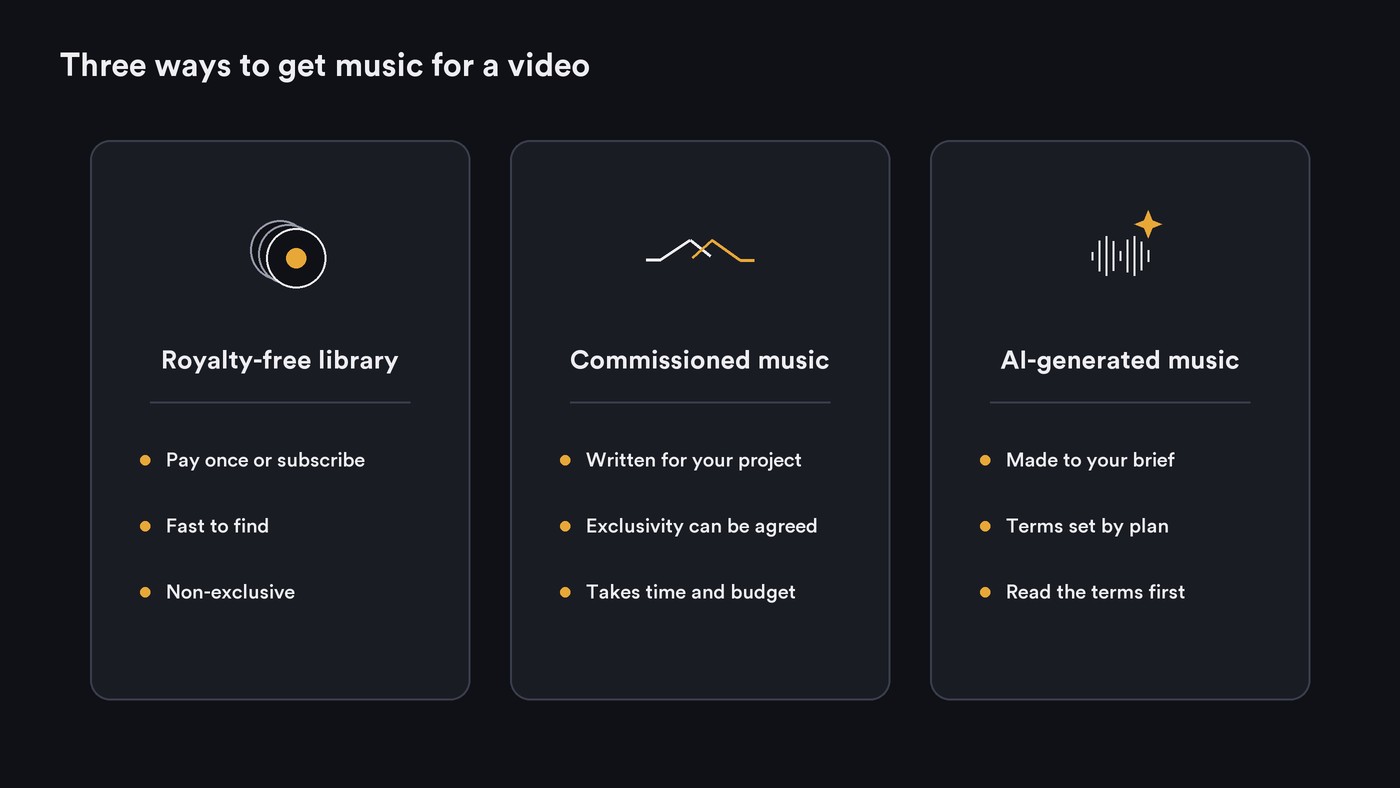
- A library is fast and predictable, but non-exclusive, and the terms follow your plan.
- Commissioned music is written for your cut and can be exclusive, with ownership, territory and term negotiated in writing. It takes longer and costs more.
- AI-generated music is made to your brief in minutes and can be edited to length. Its terms come from the service's plan, so read them as you would a library license: commercial use, what happens when you cancel, Content ID registration. Our comparison of AI music generators for royalty-free commercial use quotes each service's terms.
A pre-download checklist
- Name the use: platform, organic or paid ad, your channel or a client's, online or broadcast.
- Match the plan or license tier to that use.
- Check what happens after you cancel, and whether you must publish while subscribed.
- Connect or safelist every channel before the video goes live, including client channels.
- Check attribution and copy the credit text now.
- Check editing rules: cuts, loops, stems.
- For broadcast or venue use, check whether the track is PRO-registered.
- Save the license, track ID, plan name and a dated copy of the terms.
- Upload as private first and check YouTube Studio's Claims filter before you publish.
Where Soundverse fits
Soundverse is an AI music platform that takes you from idea to audience, built for independent artists who release music. When a library doesn't have the cue you need, AI Music Generator makes an original instrumental with no vocals from a prompt, so it sits under narration, and you can generate it straight onto the AI Studio timeline to cut it to length. AI Sound Effects Generator makes effects from 0.5 to 30 seconds from a description. Before you build on audio someone sent you, Copyright Checker fingerprints the file and names a matching released recording, with title, artist, label and ISRC where known; Soundverse describes no match as a recognition result, not clearance. Licensing is set by plan: the Free plan is for personal use, and the Creator plan comes with a royalty-free license.
FAQ
Is royalty-free music free? Usually not. Royalty-free means you pay once or subscribe and then owe no per-use royalty. Some libraries, such as Pixabay and the YouTube Audio Library, are free, with their own conditions.
Will royalty-free music get my YouTube video claimed? It can. Connect your channel to the library before publishing, keep the license, and resolve a claim with it. YouTube says music downloaded from its own Audio Library won't be claimed through Content ID.
What happens to my videos if I cancel a library subscription? It depends on the library. Epidemic Sound keeps content published during the subscription covered but blocks new uploads with its music, and Musicbed's perpetual rights cover only the licensed project.
Can I use library music in a song I release? Generally no. AudioJungle bars adding lyrics and selling a track as your own song, and Epidemic bars standalone use. For a release, make your own music or license a beat with release rights.
Sign up for Soundverse free and make a cue when the library runs dry. More guides on the Soundverse blog.