Where Do I Buy a Subscription for an All-in-One Music Distribution App for My New EP?
Where to buy a music distribution app subscription for a new EP, what each plan really includes, and how EP pricing works on yearly or per-release plans.
You buy a music distribution app subscription on the distributor's own website, or for some, such as Amuse, inside its iOS or Android app. For a new EP, DistroKid, TuneCore, Ditto Music, Amuse and UnitedMasters sell yearly plans with unlimited releases; CD Baby charges once per release, and RouteNote has a free tier and per-release Premium pricing.
Prices below are in US dollars from each company's own pricing or help page, checked on November 19, 2026. They change often, so confirm them at checkout. For a wider comparison of where to release, see our guide to the best platforms for independent musicians to distribute music. This post sticks to one job: buying the right plan for an EP.
Where to buy a music distribution app subscription
Buy straight from the distributor, so the account, the royalties and the cancel button stay with you.
- Shortlist on features. The next two sections show what each plan includes and what an EP costs on it.
- Draft the EP before you pay. Amuse's pricing page says you can build releases for free and need a plan only to distribute.
- Pay where you'll manage the plan. Amuse sells plans on the web and in its iOS and Android apps, bills them yearly only, and has you cancel in the same app you bought from.
- Pay close to upload day. Yearly plans bill annually, so paying months early uses up part of the year.
What "all-in-one" really covers in a music distribution app
On a distributor's pricing page, "all-in-one" usually means some mix of six things:
- Delivery to stores: audio, artwork and metadata sent to Spotify, Apple Music, Amazon Music, TikTok and the rest. Every plan below includes it.
- Royalty splits: the service pays your producer, co-writer or featured artist directly.
- Pre-saves: a link fans click before release day so the EP lands in their library.
- Publishing administration: collecting songwriting royalties, which DistroKid's Publishing page separates from the recording royalties a distributor pays.
- Analytics: streams, listeners and trends by store and country.
- Promo tools: playlist submissions, social assets, ad tools, sync pitching.
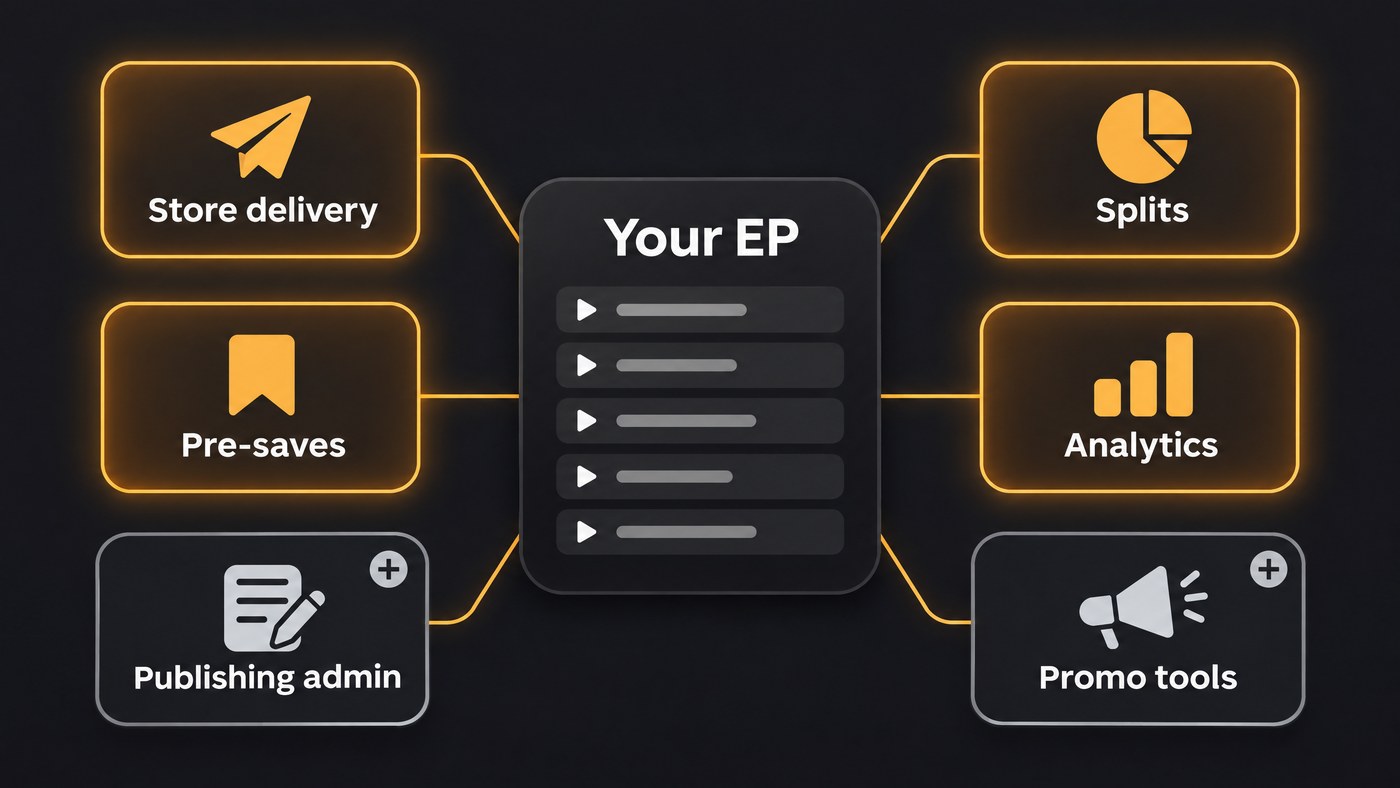
Delivery, splits, pre-saves and basic analytics are common on entry plans. Publishing admin and sync usually cost extra or need a higher tier.
What each app includes, and what an EP costs on it
- DistroKid. Musician costs $24.99 a year for one artist; Musician Plus, $44.99, adds a second artist, daily stats and customizable release and preorder dates; Ultimate, from $89.99, adds advanced analytics and playlist contact search. Every plan includes royalty splits and free promo tools, including the HyperFollow page for Spotify pre-saves. DistroKid Publishing costs a $75 one-time setup fee per songwriter and keeps 20% of publishing royalties; fully AI-generated music isn't eligible.
- TuneCore. CORE costs $22.99 a year with analytics, scheduled release dates, revenue splits and YouTube Content ID. PRO, $43.99, adds a custom label name and faster support; PRO+, $84.99, covers five artists. Pay per release instead and a single is $24.99 a year, an album $44.99 for year one and $56.49 after; there's no separate EP price. Social and YouTube earnings carry a 20% fee, and publishing is a separate service.
- CD Baby. $9.99 per single or $14.99 per album, once, and CD Baby keeps 9% of digital distribution revenue. It includes YouTube Content ID, a free UPC and ISRCs, and free marketing tools it says help drive pre-saves. Publishing royalty collection and sync licensing come with its CDB Boost add-on.
- Ditto Music. Starter costs $19 a year with 100% of royalties, free pre-save smartlinks, analytics and fan data, auto-split royalty payments and playlist submissions. Pro, $59, adds a second artist, sync pitching, publishing royalty collection, YouTube Content ID and exact release times.
- Amuse. Artist costs $23.99 a year, Artist Plus $39.99 and Artist Pro $59.99. All include pre-saves, smartlinks and streaming insights, and music stays live if you cancel, with a 25% commission while you have no plan. On Artist, splits with collaborators outside Amuse carry a 15% fee. Fan email collection comes with Plus and Pro, and no publishing admin is listed.
- UnitedMasters. DEBUT+ costs $19.99 a year with 100% of royalties, analytics, Split Pay for collaborators and MasterLinks for pre-saves. SELECT, $59.99, adds access to sync and brand deals. Content ID is an add-on, and mastering costs $4.99 a track.
- RouteNote. Free distribution has no fees and pays you 85% of revenue. Premium pays 100% of streaming and download revenue for $20 per EP of 2 to 6 tracks, then $9.99 a year from year two. That March 6, 2026 article covers prices, not tools, so check splits and pre-saves in the dashboard.
How EP releases are priced: per release or yearly unlimited
On a yearly unlimited plan, the EP costs nothing extra: the fee covers it, the singles before it and anything else you release that year.
On per-release pricing, track count sets the bill, and an EP rarely gets its own price. CD Baby's DIY Musician guide, updated November 3, 2026, says: "Projects with two or more tracks use an album submission, even if a streaming platform ultimately displays the release as a single or EP." TuneCore lists only single and album prices; RouteNote is the exception, with an EP tier.
The same guide notes that Spotify shows 4 to 6 tracks under 30 minutes as an EP and 1 to 3 as a single, and Ditto's help center uses the same 4-to-6 count. A three-song "EP" under 30 minutes will show as a single on Spotify.
Take a five-song EP with two lead singles first, three releases in all:
- CD Baby: $9.99 + $9.99 + $14.99 = $34.97 once, plus 9% of digital revenue.
- RouteNote Premium: $10 + $10 + $20 = $40 in year one, then $29.97 a year.
- TuneCore pay-per-release: $24.99 + $24.99 + $44.99 = $94.97 for year one.
- One yearly plan: $19 on Ditto Starter, $19.99 on DEBUT+, $22.99 on TuneCore CORE, $23.99 on Amuse Artist or $24.99 on DistroKid Musician covers all three.
If the EP is your only release for a while, a one-time fee is simplest. If singles lead into it and more music follows, a yearly plan costs less from year one. For five-year math on a longer project, see the most affordable ways to distribute an album.
Pre-purchase checklist for your EP
Some of these decide which plan you need, so check them before you pay.
- Release date and lead time. Pick a date three to four weeks out. Spotify's pitching guide says a song pitched at least 7 days before release reaches your followers' Release Radar, and you pitch one song at a time, so choose a focus track. Amuse needs 14 days' notice on Artist (10 on Plus, 7 on Pro), and DistroKid lists custom release dates on Musician Plus.
- Pre-saves. Spotify's help page says: "Only new and original albums and EPs are eligible for Countdown Pages. Singles aren't eligible." You need at least 3,000 monthly active listeners; below that, use your distributor's pre-save link.
- Track count. Four to six songs if you want Spotify to show an EP.
- ISRC and UPC. The EP needs its own UPC; CD Baby's pricing page says every submission does. Each track needs an ISRC, and a song already out as a single keeps its ISRC on the EP, as CD Baby's guide advises.
- Audio. Stereo WAV or FLAC. Amuse asks for 16- or 24-bit at 44.1 kHz up to 192 kHz.
- Artwork. A perfect square; Amuse accepts 1400 x 1400 to 6000 x 6000 pixels in PNG or JPEG.
- Credits and splits. Full names for every writer, producer and featured artist, with percentages agreed in writing. Our guide to distributors with the best royalty splits compares how each pays collaborators.
The full metadata, credits and artwork list is in what to prepare before uploading music for distribution.
Where Soundverse fits
Soundverse is an AI music platform that takes you from idea to audience. It doesn't deliver music to stores; your EP reaches Spotify and Apple Music through the distributor you choose. Soundverse helps with the rollout around it.
Release Planner takes one track and your release date and writes a day-by-day, platform-split rollout of 1 to 12 weeks, with pre-save, smart link and playlist pitch deadlines. For an EP, run it on the focus track. It writes the plan and doesn't post or submit anything, and it runs on every plan, including Free.
Asset Studio turns a track into square cover art, story backgrounds and a YouTube thumbnail in one look. The images carry no text, so you add the EP title yourself.
Licensing is set by plan: the Free plan is for personal use, and the Creator plan comes with a royalty-free license.
This walkthrough shows Release Planner turning a finished song into a day-by-day rollout plan.
FAQ
Can I buy a music distribution subscription in a phone app? With some services. Amuse sells its plans on the web and in its iOS and Android apps, and you cancel in the same app you bought from. For the others, start on their website's pricing page.
Is a yearly plan or a per-release fee cheaper for one EP? For the EP alone, CD Baby's $14.99 one-time album fee beats every yearly plan here, and RouteNote Premium's $20 plus $9.99 a year pulls ahead from year two. With two lead singles, a $19 to $24.99 yearly plan costs less than CD Baby's $34.97 in year one, though CD Baby never renews.
Which all-in-one apps include publishing administration? Ditto collects publishing royalties on Pro, and CD Baby offers it through CDB Boost. DistroKid and TuneCore sell it separately. Amuse's and UnitedMasters' pages didn't list it when we checked.
Do I need a new UPC if some EP songs were already singles? Yes. The EP is a new release with its own UPC. Reuse each released song's ISRC and keep its audio and title identical.
Sign up for Soundverse free and plan the rollout for your EP's focus track. More release guides on the Soundverse blog.