Which Music Distributors Offer the Best Royalty Splits for Independent Artists?
Music distributor royalty splits compared for 2026: who passes on 100%, who keeps 9 to 15%, and which pay collaborators automatically, with fee math.
The best music distributor royalty splits for independent artists come from flat-fee services that pass on all of your streaming royalties and pay collaborators automatically: DistroKid and Ditto Music on every plan, TuneCore on its unlimited plans, UnitedMasters on SELECT, and Amuse on Plus or Pro. CD Baby keeps 9% but charges once per release, which suits small catalogs.
"Royalty split" means two different things when you compare distributors, and both affect what lands in your account. We checked each distributor's own pricing and help pages on 7 November 2026. Prices change often, so confirm on the distributor's site before you sign up.
Two kinds of royalty split
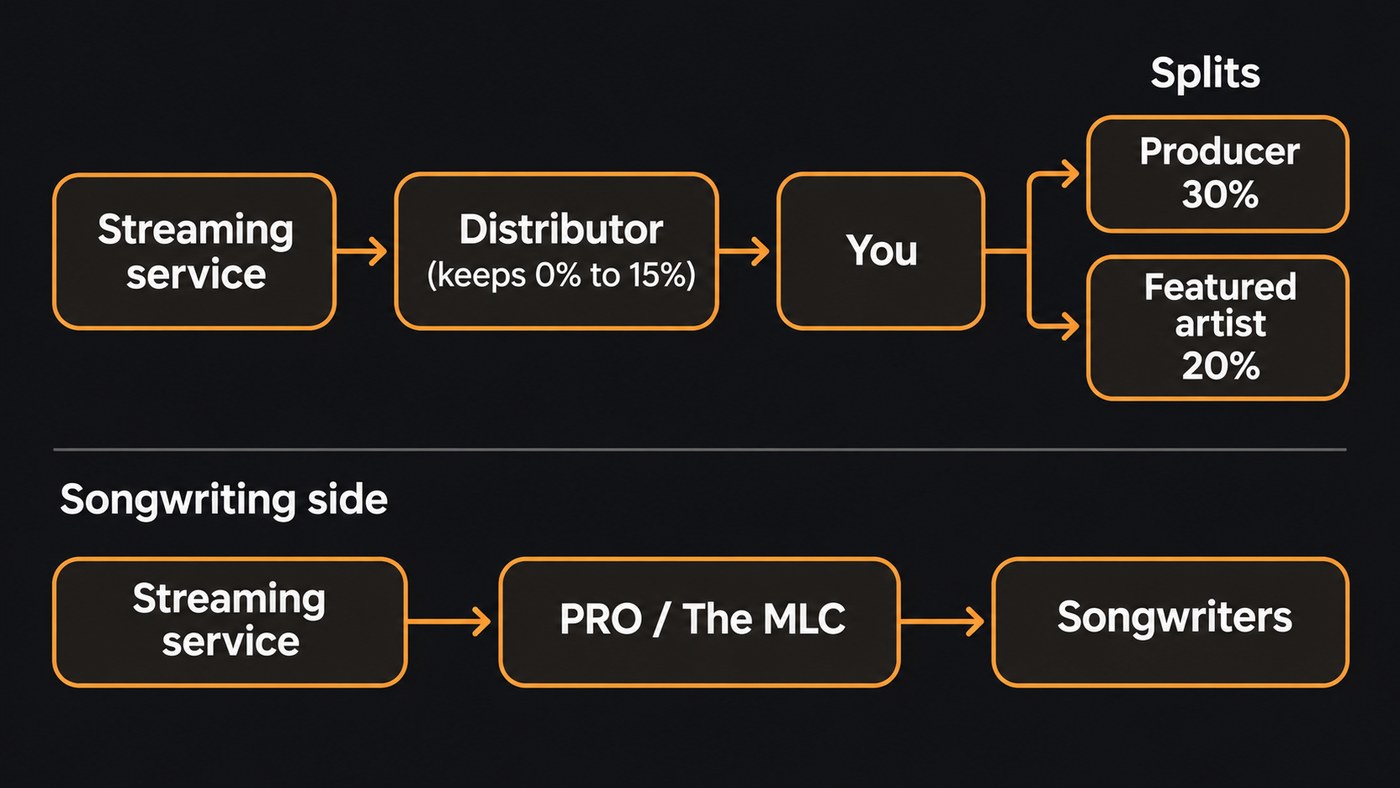
- The distributor's cut. Stores and streaming services pay your distributor, and the distributor passes the money on minus its share. Some charge a yearly fee and keep nothing, some take a percentage instead, and some do both.
- Collaborator splits. You set a percentage of a track's earnings for your producer, a featured artist or bandmates, and the distributor pays each of them directly. Without this, you collect everything and send bank transfers yourself every month.
The best deal for you depends on how much your catalog earns, how often you release and how many people share each track.
Music distributor royalty splits compared (checked 7 November 2026)
- DistroKid. Annual plans start at $24.99 (Musician), with Musician Plus at $44.99 and Ultimate at $89.99. Every plan lets you keep 100% of earnings and includes royalty splits. DistroKid's Splits page says splits are free for all members with zero commission, can be edited any time, and that non-members you add get a discount coupon to join. Best for artists who release often and collaborate a lot.
- TuneCore. Unlimited plans start at $24.99 a year (Rising Artist), then Breakout Artist at $44.99 and Professional at $54.99. TuneCore says all its plans include free splits and no additional commissions, and its Splits tool can pay a chosen person first so recording costs are recovered before everyone else gets paid. Its pricing page lists a 20% fee on money earned from TikTok, Facebook, Instagram and YouTube. Best for artists who want recoupment built into their splits.
- Ditto Music. Starter costs $19 a year, Pro $59 and Labels $109. Ditto says 100% of your streaming income is yours on every plan, and splits are automatic: collaborators create a free account and withdraw their share. Publishing and sync royalties on Pro and Labels carry a 15% commission. Best for the lowest entry price with splits included.
- Amuse. Artist costs $23.99 a year, Artist Plus $39.99 and Artist Pro $59.99. You keep all your earnings after currency conversion and service fees. Royalty splits are free on Plus and Pro, while the Artist plan charges a 15% fee for collaborators who aren't on Amuse. If you cancel, your music stays live and you receive 75% of earnings. Best for bands where everyone uses Amuse.
- UnitedMasters. DEBUT+ and SELECT both give you 100% of your masters and royalties. Its automatic Split Pay feature needs SELECT. Best for artists who also want the sync opportunities SELECT advertises.
- CD Baby. A one-time fee of $9.99 per single or $14.99 per album, no annual fees, and CD Baby keeps 9% of digital distribution revenue, so you get 91%. Its pricing pages don't describe a collaborator payout feature, so ask CD Baby before you rely on one. Best for a small catalog you release once and leave up.
- RouteNote. Free distribution pays you 85% with no fees. Premium pays 100% for an upfront fee per release plus $9.99 a year from the second year, and you can move a release from Free to Premium. Best for testing a release at zero cost.
- AWAL. The standard deal takes a 15% share of the revenue AWAL collects, with no upfront or annual fees and a 30-day rolling term, but AWAL only partners with a select group of artists. Best for artists AWAL approaches or accepts.
Fee or percentage: which costs you less?
Do the maths on your real numbers, because "100%" with a fee can cost more than 91% without one.
- Low earners pay less with a percentage. CD Baby's 9% only costs more than DistroKid's cheapest $24.99 plan once your catalog earns about $278 a year ($24.99 divided by 0.09). Below that, the percentage is cheaper, though you still pay CD Baby's one-time fee per release.
- Frequent releasers pay less with a subscription. Six singles a year on CD Baby is $59.94 in setup fees alone. A $19 to $25 annual plan covers unlimited releases.
- RouteNote's switch point is about $66.60 a year per release: above that, the $9.99 Premium renewal costs less than the 15% Free share.
- Very small tracks may earn nothing on Spotify either way. Since April 2024, Spotify's rule is that "tracks must have reached at least 1,000 streams in the previous 12 months in order to generate recorded royalties," according to Spotify for Artists (announced 21 November 2023). For a brand-new artist, the yearly fee often matters more than the percentage.
For context on how much of Spotify's payouts reach self-releasing artists, see our breakdown of how half of Spotify royalties go to independent artists.
How to set up collaborator splits without arguments
- Agree the percentages in writing before release. A simple split sheet with names, roles, percentages and signatures saves friendships. Agree the master split (the recording) separately from the songwriting split.
- Check that your plan includes splits. UnitedMasters needs SELECT for Split Pay, and Amuse's Artist plan charges 15% for collaborators outside Amuse.
- Decide who recoups first. If you paid for the studio or the mix, TuneCore's priority payouts let you get that money back before the percentages kick in. On other services, settle it in the split sheet.
- Enter splits per track at upload and make sure each collaborator accepts the invite, or their share may sit unpaid.
- Register the song for publishing separately. Distributor splits cover the recording only.
Royalties your distributor doesn't collect
Your distributor collects money for the sound recording. The songwriting side is paid through different organisations, and many independent artists leave it unclaimed.
- Performance royalties for the composition go through a performing rights organisation such as ASCAP or BMI in the US, PRS for Music in the UK or IPRS in India.
- Mechanical royalties from US streaming are handled by The MLC, which administers blanket mechanical licences for eligible streaming and download services in the United States. In its own words: "Anyone entitled to receive digital audio mechanical royalties for use of their music in the U.S. should become a Member of The MLC."
- Digital performance royalties for the recording from US services such as Pandora, SiriusXM and iHeartRadio are collected by SoundExchange.
Some distributors also collect publishing royalties as an add-on, and that service carries its own commission. Ditto, for example, takes 15% on publishing and sync royalties for Pro and Labels members.
If your music was made with AI
Each distributor sets its own rules for AI-generated and AI-assisted music, and they change. Read the current policy before you upload, keep your project files, and be ready to explain how the track was made. Our guide to whether DistroKid allows AI-generated music and the AI music distribution checklist walk through what to check.
Where Soundverse fits
Soundverse is an AI music platform that takes you from idea to audience. It isn't a distributor and doesn't replace one: you still choose from the services above to get your music into stores.
Soundverse helps around the release. Release Planner turns your track into a dated, day-by-day rollout with pre-save, smart link and playlist pitch deadlines. With the Soundverse for Chrome extension, Agent One can go through your distributor dashboard or the stores you name and report which ones show the release, or upload a track to SoundCloud as Private for you to check. The Music Business Agent can read the latest statement on each dashboard you sign in to and build one per-song royalty table, and search The MLC's unmatched works and SoundExchange's unregistered lists for your songs.
If you make the music on Soundverse, licensing is set by plan: the Free plan is for personal use, and the Creator plan comes with a royalty-free license.
FAQ
Which music distributors let me keep 100% of my royalties? DistroKid, TuneCore, Ditto Music, UnitedMasters (DEBUT+ and SELECT), Amuse with an active plan and RouteNote Premium all pass on your full streaming royalties in exchange for a fee. Watch for exceptions such as TuneCore's 20% fee on social platform earnings.
Is CD Baby's 9% worth it? It can be if your catalog is small, rarely changes and earns under a few hundred dollars a year, since you never pay a renewal. If you release several singles a year, an annual plan usually costs less.
Do my collaborators need an account with my distributor? It depends on the service. Ditto collaborators create a free account to withdraw their share, DistroKid emails non-members a discount coupon to join, and Amuse's Artist plan charges 15% for collaborators who aren't on Amuse.
Do distributor splits cover songwriting royalties? No. Distributor splits cover the recording's earnings. Songwriting royalties come through your PRO, The MLC in the US, or a publishing administrator, and those splits are registered separately.
Can I change a royalty split after release? On DistroKid and TuneCore, yes: DistroKid says splits can be edited any time, and TuneCore lets you edit existing splits. Agree the numbers before release anyway, so nobody is surprised by a change later.
Sign up for Soundverse free and plan your next release with Release Planner.
More guides on the Soundverse blog.