What Are Stems Used For? Understanding Audio Stems in Modern Music Production
Learn how audio stems power mixing, mastering, and remixing in 2026.
What Are Stems Used For?
In 2026, the term audio stems has become one of the most frequently discussed concepts among music producers, sound engineers, and remix artists. Whether you're working in a professional production studio or creating beats from your bedroom, understanding what stems are and how they’re used can drastically improve your workflow and creative control.
What are audio stems in music production?
Audio stems are individual track components of a song that have been grouped or isolated from the full mix. Instead of working with a single stereo mixdown, producers can manipulate separate elements—such as vocals, drums, bass, guitar, and accompaniment—as independent files.
Stems are essentially submixes. For instance, instead of dozens of raw multitrack recordings, a song might be represented by four or six stems: vocals, drums, bass, harmony instruments, and effects. This allows producers to mix and master more efficiently while maintaining the core structure of the production. Learn more from What Are Audio Stems? | Using Stems In Music Production and What Are Audio Stems? (Mixing & Exporting Audio).

Why are stems so important in 2026?
The demand for music production stems has surged in recent years as artists embrace interactive and remixable content. Streaming services, social media platforms, and AI-assisted creation tools now allow users to remix, sample, and reinterpret songs with autonomy. This cultural shift—supported by improvements in AI-powered audio separation—has made stems the backbone of modern production workflows, as described in What Are Stems in Music Production: Complete Guide for 2026.
Producers use stems because they offer flexibility and control:
- They provide cleaner audio editing environments.
- They allow for deeper mixing and mastering processes.
- They enable easier collaboration among multiple artists.
- They simplify stem separation for remixes and karaoke versions.
In other words, stems make previously locked-down audio accessible at an elemental level.

What’s the difference between stems and multitrack recordings?
Multitrack recordings are the original, individual tracks captured during a recording session—such as separate mic captures for each drum, vocal, guitar, or synth. Audio stems, on the other hand, are groups of these tracks consolidated into single mixed files. More context from Stems and multitracks: What's the difference?.
For example:
- Multitrack: Kick.wav, Snare.wav, HiHat.wav, and Cymbals.wav.
- Stem: Drums.wav (a mixdown of all drum tracks).
This distinction matters because stems are ideal for downstream use in remixes and live performance applications, while multitracks are better suited for deep reengineering of the original song.
How are stems used in mixing and mastering?
Stems bridge the gap between flexibility and efficiency during a mixdown. Instead of tweaking every individual track from scratch, engineers can use stems to fine-tune balance, EQ, compression, and stereo enhancement.
During mastering, stems give mastering engineers the ability to apply finishing touches on specific layers without altering others. For example, if the vocals need slight brightness but the drums are already well-balanced, adjusting the vocal stem alone achieves the desired polish without influencing percussion frequencies.
In 2026, this workflow has become increasingly common among hybrid artists who handle mixing and mastering across multiple genres—from electronic to orchestral, pop to ambient.
How do stems power remixing and sampling?
One of the most popular uses for audio stems is remixing. Having separate vocals, basslines, and instrument layers allows DJs and producers to reshape existing tracks creatively. A remix artist can replace drum patterns, layer new synth textures, or drop the vocal into an entirely different tempo or genre without quality loss.
Similarly, sampling from stems creates cleaner sound extraction. Instead of cutting from a flattened stereo file where instruments overlap, stems let you sample clean vocal phrases or instrumental loops without interference.
This has greatly influenced AI-driven music tools, as discussed in Soundverse introduces Stem Separation AI Magic Tool, which explores how advanced audio models now make detailed stem extraction accessible to everyone. For a deeper dive, watch our guide on creating Deep House music.
How does stem separation technology work?
Stem separation refers to the process of dissecting a mixed recording into distinct isolated elements. Traditionally, it required manual access to project files or complex filtering techniques. However, as AI and machine learning matured through 2024 and 2025, automated stem separation became remarkably accurate.
Modern AI systems can detect frequency ranges, harmonic interactions, and transient patterns that distinguish vocals from drums or bass. These systems effectively rebuild the mix’s architecture, delivering editable individual stems. Check out What Are Stems (Trackouts) In Music Production? [2026] for an in-depth look.
How are audio stems used in performance and education?
In live settings, stems allow performers to modify backing tracks dynamically. DJs can adjust a vocal stem’s volume or swap drum elements mid-set. Bands and solo artists use stems for karaoke performances or interactive concert experiences where audience members remix songs in real time.
In music education, stems help learners analyze production structure. A student can isolate the bass line of a jazz track or the drum groove of a hip-hop beat and study the arrangement. This application enhances understanding of rhythmic layers, arrangement decisions, and mixing theory.
For more on creative usage, watch our Soundverse Tutorial Series - "Explore" Tab and How to Make Music.
What are the best practices for stem management?
Organizing stems efficiently ensures creative agility. Best practices include:
- Keep consistent naming conventions (e.g., songname_vocals.wav).
- Maintain identical sample rates and bit depths across all stems.
- Align start points to ensure synchronization during playback.
- Use lossless formats like WAV or FLAC for high-quality audio editing.
Following these principles enables smooth workflow transitions when shifting between production tools or collaborating remotely.
How to make audio stem separation effortless with Soundverse Stem Separator
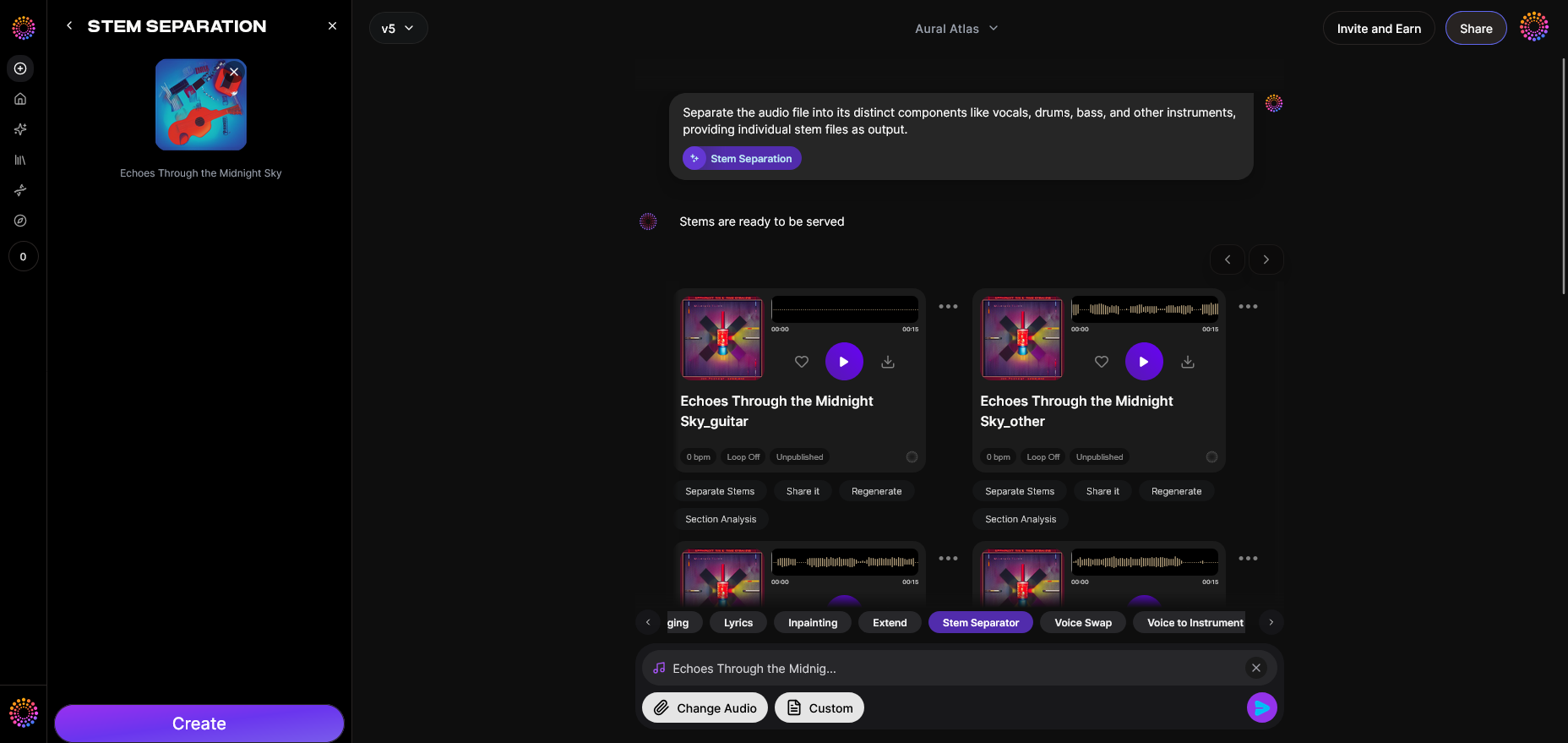
Now that you understand what audio stems are and how they function in music production, here’s how you can instantly create editable stems using Soundverse.
The Soundverse Stem Separator is an advanced tool that dissects mixed audio into up to 6 individual editable stems—vocals, drums, bass, guitar, accompaniment, and others. It supports URL uploads, file imports, and direct recordings, enabling creators to isolate high-quality parts of any track.
Main capabilities:
- Six-stem separation: Extract vocals, drums, bass, guitar, accompaniment, and more.
- Flexible input support: Upload from a file, paste a URL, or record directly.
- High-quality isolation: Provides studio-grade clarity even on complex mixes.
Primary use cases:
- Remixing and sampling: Perfect for electronic artists and DJs looking to reimagine songs.
- Backing track creation: Enable karaoke or live performance adaptability.
- Mix education: Ideal for teaching production structure analysis.
- Audio cleanup: Remove interfering sounds before editing or mastering.
Once stems are generated, users can open them in the Arrangement Studio, Soundverse’s collaborative environment for section rearrangement and compositional refinement. To identify song parts quickly, Soundverse’s Section Analysis tool can label each region (Intro, Verse, Chorus, Bridge, Outro), helping refine song flow and remix potential.
For more on AI-powered music tools and emerging production workflows, explore articles such as How AI-generated music is transforming the music industry, Soundverse AI revolutionizing music creation for new-age content creators, and Mubert alternatives: Soundverse.
Start Creating with Audio Stems Today! Unlock the full potential of your tracks by using Soundverse’s AI-driven stem separation tool. Whether remixing, mastering, or experimenting, your creative possibilities expand instantly. Try Soundverse for Free
Related Articles
- What Are Song Stems and Why Do You Need Them — Discover the importance of stems in music creation and how they redefine flexibility for producers and composers.
- Soundverse Introduces Stem Separation AI Magic Tool — Learn how Soundverse’s AI technology effortlessly extracts perfect audio stems from any song.
- Soundverse AI Magic Tools: Create Content Quickly with AI — Explore how Soundverse’s suite of AI Magic Tools accelerates music creation, editing, and production.
- What Is Soundverse Arrangement Studio and What Does It Do — Get to know the Soundverse Arrangement Studio and how it brings professional precision to your creative projects.
Here's how to make AI Music with Soundverse
Video Guide
Here’s another long walkthrough of how to use Soundverse AI.
Text Guide
- To know more about AI Magic Tools, check here.
- To know more about Soundverse Assistant, check here.
- To know more about Arrangement Studio, check here.
Soundverse is an AI Assistant that allows content creators and music makers to create original content in a flash using Generative AI.
With the help of Soundverse Assistant and AI Magic Tools, our users get an unfair advantage over other creators to create audio and music content quickly, easily and cheaply.
Soundverse Assistant is your ultimate music companion. You simply speak to the assistant to get your stuff done. The more you speak to it, the more it starts understanding you and your goals.
AI Magic Tools help convert your creative dreams into tangible music and audio. Use AI Magic Tools such as text to music, stem separation, or lyrics generation to realise your content dreams faster.
Soundverse is here to take music production to the next level. We're not just a digital audio workstation (DAW) competing with Ableton or Logic, we're building a completely new paradigm of easy and conversational content creation. TikTok: https://www.tiktok.com/@soundverse.ai Twitter: https://twitter.com/soundverse_ai Instagram: https://www.instagram.com/soundverse.ai LinkedIn: https://www.linkedin.com/company/soundverseai Youtube: https://www.youtube.com/@SoundverseAI Facebook: https://www.facebook.com/profile.php?id=100095674445607
Join Soundverse for Free and make Viral AI Music

We are constantly building more product experiences. Keep checking our Blog to stay updated about them!