Voice Cloning for Building Audio-First Brands in 2026
Learn how voice cloning is shaping audio-first branding in 2026 with AI audio technology and Soundverse Voice Swap.
Voice Cloning for Building Audio-First Brands
Introduction
In 2026, voice cloning has evolved from a futuristic experiment into a mainstream branding tool. For creative directors, marketing strategists, and sound designers, the ability to shape and replicate voices with precision has unlocked a new era of audio-first branding. As more brands pivot toward sonic experiences—through podcasts, virtual assistants, and immersive digital content—voice cloning has become the cornerstone of digital identity and sonic branding strategy.
In this guide, we’ll explore how voice cloning technology empowers modern brands to create consistent, recognizable sound identities, and how platforms like Soundverse Voice Swap revolutionize the process with ethical, creative, and AI-driven precision.
What Is Voice Cloning and Why Does It Matter for Brands in 2026?
Voice cloning refers to the process of training an AI model to replicate or simulate a specific human voice. Instead of hiring multiple voice actors or dealing with scheduling constraints, brands can now craft a unique brand voice—one that’s authentic, dynamic, and scalable across platforms.
By 2026, consumers interact with brands primarily through audio interfaces—smart speakers, interactive ads, and voice-guided apps. A distinctive voice isn’t just a feature; it’s a brand signature. Just as logos define visual identity, voice cloning defines auditory identity.
For example, a travel brand might have a warm, comforting voice that evokes trust, while a gaming brand might choose an energetic, stylized character tone. The consistent use of this cloned voice across media reinforces recognition and emotional connection.
How Does Voice Cloning Fit Into Sonic Branding and Audio Marketing?
Sonic branding encapsulates every sound tied to a brand experience—from jingles to notification tones to spoken messages. In 2026, the trend extends further: personalized synthetic voices serve as an auditory fingerprint across all customer touchpoints.
Integrating AI audio technology and voice cloning allows companies to maintain message consistency, even across localized or multilingual campaigns. With global audiences accessible through voice interfaces, brands no longer rely solely on text or visuals—they talk and sound recognizably human.
For instance:
- Smart campaigns now feature cloned spokespersons interacting with users.
- Digital assistants maintain uniform tone and pronunciation across updates.
- Podcasts and branded audio content keep their vocal identity without scheduling live hosts.
For creators looking to make AI-powered music for brand content, watch our guide on creating Deep House music or learn how to make music using AI in the Soundverse Tutorial Series.
The strategic use of cloned voices ensures long-term brand coherence in both marketing and functional applications.

What Are the Ethical and Creative Advantages of AI Voice Cloning?
Earlier debates about AI-generated voices centered on authenticity and consent. However, 2024–2025 developments led to better regulation and transparent licensing models, paving the way for ethical implementations in 2026.
Modern systems, like those developed by Soundverse, prioritize ethical data use and licensed voice models. Brands can either create their own “Personal DNA” voices or work with licensed “Public DNA” voices whose creators are compensated. This mechanism ensures creativity doesn’t infringe on real individuals’ rights.
Creative advantages include:
- Speed & flexibility: Adjust tone, pacing, and emotion post-production without rerecording.
- Localization: Translate voices into multiple languages while maintaining vocal identity.
- Consistency: Synchronize voice tone across campaigns and years.
By integrating AI responsibly, brands ensure that their sonic expansion aligns with both innovation and integrity.
How to Build an Audio-First Brand Strategy with Voice Cloning
In today’s digital landscape, audio is no longer secondary—it’s foundational. To establish a dynamic audio-first presence, brands follow these four principles:
- Define Your Sound Identity: Decide what emotions and values your audio should represent. Is your voice confident? Playful? Authoritative?
- Create a Signature Voice: Either record a spokesperson and build an AI clone or choose an existing licensed voice that aligns with brand personality.
- Integrate Across Channels: Use your cloned voice in product videos, podcasts, advertisements, and interactive systems.
- Evolve Through Data: Track audience engagement and refine your brand voice using analytics on tone performance and audience perception.
This holistic approach ensures that every audible interaction feels consistent and emotionally resonant.
How to Make Voice Cloning Work for Brand Voice Creation with Soundverse Voice Swap
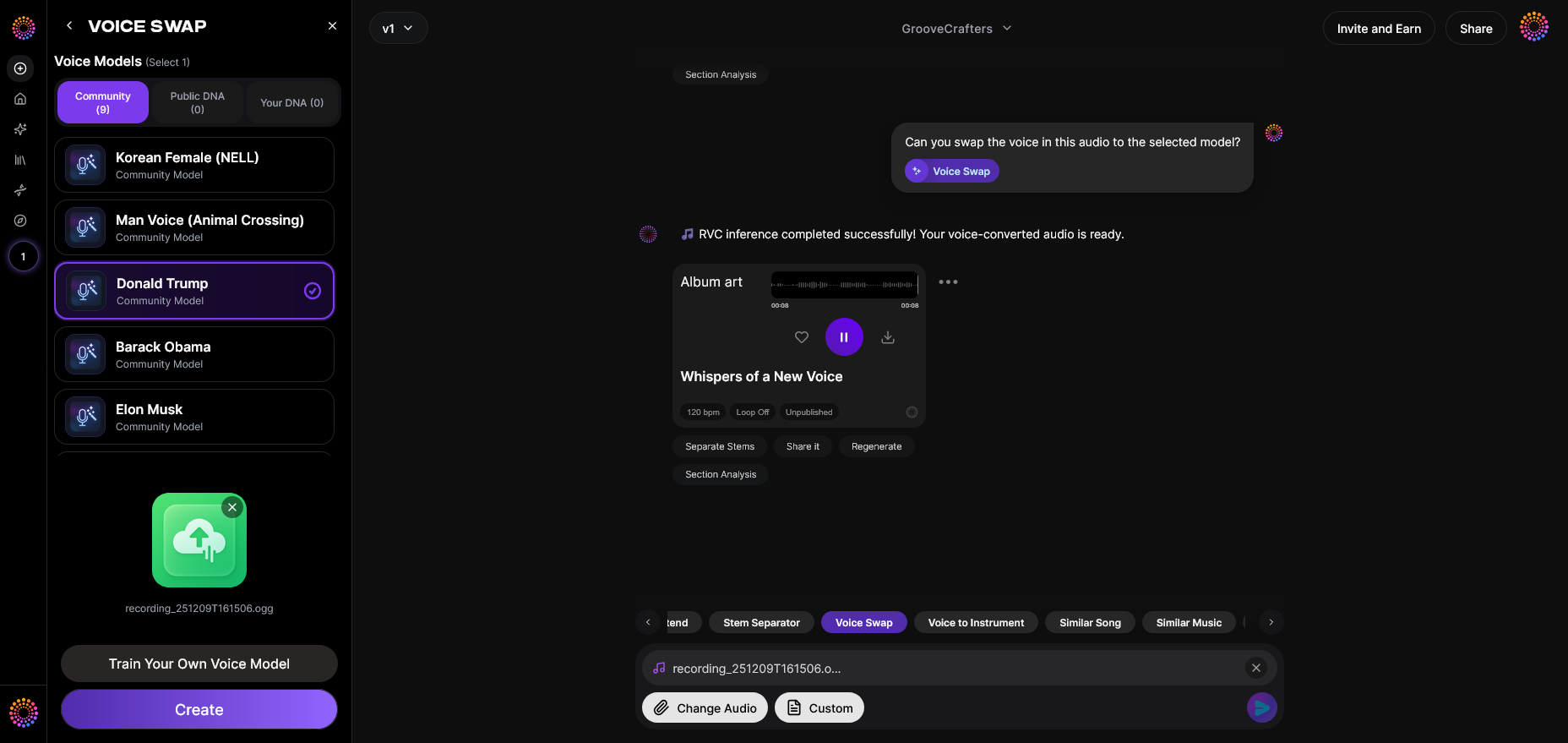
Soundverse’s Voice Swap feature transforms how creators and brands design voices for audio-first marketing. It allows you to replace the vocal identity in an audio track while maintaining the original performance and timing—capturing subtle human nuances that make content feel authentic.
Key Capabilities:
- Community Voices: Replace your voice with celebrity or character models for entertainment, parody, or thematic experiments.
- Public DNA & Personal DNA: Clone licensed voices or craft custom brand voices using ethically sourced training data.
- Voice-to-Voice Conversion: Maintain delivery and emotional expression while changing the vocal identity.
Primary Use Cases:
- Testing different vocal tones for ad campaigns or explainer videos.
- Building branded voices for game characters or digital assistants.
- Producing demo vocals or multilingual adaptations for music and content creation.
By adopting Voice Swap, brands gain control over their digital identity, ensuring sound consistency across every medium while exploring endless creative possibilities.
Why Is 2026 the Pivotal Year for Audio-First Branding?
Trends in 2026 reveal a clear shift: consumers now perceive sound-based interactions as more personal and trustworthy than text-based engagement. AI-generated voices no longer sound robotic or sterile—they convey human emotion and dynamic tone.
Here’s why this year marks the turning point:
- Mainstream adoption of generative audio: As adopted across marketing, corporate, and entertainment sectors.
- Expansion of AI licensing ecosystems: Artists monetize their vocal DNA securely.
- Integration into the metaverse and spatial audio: Immersive environments demand consistent brand audio.
For deeper analysis of how AI music evolved to this point, explore how AI-generated music is transforming the industry and what AI can generate in 2026.
How Soundverse Fits Into the Audio Branding Ecosystem
Soundverse doesn’t stop at Voice Swap. The platform’s ecosystem connects every stage of AI music and voice creation:
- Soundverse DNA: Enables artists and brands to create consistent, copyright-safe music aligned with custom sonic identities.
- Similar Singing Generator: Produces new vocal performances in the tone of a reference voice—ideal for keeping a consistent character sound.
- Soundverse Trace: Embeds transparent attribution and ensures ethical rights management across all media.
Together, these features offer a 360° AI audio toolkit that helps branding teams scale creative output while protecting rights and authenticity. Learn how these tools simplify workflows in Soundverse AI Magic Tools and streamline content generation protocols in Soundverse Assistant.
Start Building Your Audio-First Brand Today
Leverage Soundverse’s cutting-edge voice cloning tools to craft a unique sound identity for your brand. Transform voices into powerful storytelling instruments that captivate audiences worldwide.
Related Articles
- Soundverse SAAR: AI Voice Assistant — Discover how SAAR, Soundverse’s AI voice assistant, redefines creative collaboration between humans and machines.
- Soundverse AI Revolutionizing Music Creation for New Age Content Creators — Learn how AI-powered voice and music tools are shaping the future of creative production for digital creators.
- AI Ranks Soundverse’s AI Singer #1: The Ultimate AI Singing Platform Dominating 2025 — Explore how Soundverse’s AI Singer is leading the voice technology revolution for artists and brands alike.
- Soundverse Assistant: Your AI Music Co-Producer — Experience the future of music making with Soundverse Assistant, your creative companion for voice and audio generation.
Here's how to make AI Music with Soundverse
Video Guide
Here’s another long walkthrough of how to use Soundverse AI.
Text Guide
- To know more about AI Magic Tools, check here.
- To know more about Soundverse Assistant, check here.
- To know more about Arrangement Studio, check here.
Soundverse is an AI Assistant that allows content creators and music makers to create original content in a flash using Generative AI. With the help of Soundverse Assistant and AI Magic Tools, our users get an unfair advantage over other creators to create audio and music content quickly, easily and cheaply. Soundverse Assistant is your ultimate music companion. You simply speak to the assistant to get your stuff done. The more you speak to it, the more it starts understanding you and your goals. AI Magic Tools help convert your creative dreams into tangible music and audio. Use AI Magic Tools such as text to music, stem separation, or lyrics generation to realise your content dreams faster. Soundverse is here to take music production to the next level. We're not just a digital audio workstation (DAW) competing with Ableton or Logic, we're building a completely new paradigm of easy and conversational content creation.
TikTok: https://www.tiktok.com/@soundverse.ai
Twitter: https://twitter.com/soundverse_ai
Instagram: https://www.instagram.com/soundverse.ai
LinkedIn: https://www.linkedin.com/company/soundverseai
Youtube: https://www.youtube.com/@SoundverseAI
Facebook: https://www.facebook.com/profile.php?id=100095674445607
Join Soundverse for Free and make Viral AI Music
We are constantly building more product experiences. Keep checking our Blog to stay updated about them!