Voice Cloning and the Future of Digital Performers in 2026
Explore how voice cloning technology is transforming virtual performers and digital entertainment in 2026.
Voice Cloning and the Future of Digital Performers
In 2026, the boundary between human expression and artificial intelligence is thinner than ever. Among the most fascinating developments in digital entertainment is voice cloning technology, a fusion of machine learning, synthetic media, and artistic creativity that’s redefining how we perceive performance. Once confined to research labs and sci-fi scripts, it’s now a commercial reality shaping industries from music to film, gaming, and virtual events.
What is Voice Cloning Technology and Why Does It Matter in 2026?
Voice cloning technology uses deep learning to analyze and replicate the nuances of a person’s voice—tone, pitch, breathing, and emotion—with remarkable precision. By 2026, this technology has matured beyond simple speech replication. It now powers complex singing performances, audiobooks, and even AI companions that can express emotion with striking realism. For definition clarity, see What is voice cloning? and Exploring Transformations in Voice Cloning Technology.
The appeal is clear: imagine being able to generate a vocal performance that sounds like your favorite artist's style—but with your own lyrics—or produce consistent character voices for your next film or video game. For creative professionals and AI developers, this innovation reduces time, cost, and creative friction.
In digital entertainment and music production, creators are already pairing voice cloning with AI-generated voices to produce new virtual performers. These virtual identities are capable of singing, talking, and engaging with audiences worldwide—all without a human stepping in front of a microphone.
How Are Virtual Performers Changing the Music and Media Landscape?
Virtual performers, powered by AI-generated voices and advanced motion synthesis, are no longer experimental novelties. They’re concert headliners and major streaming sensations. Following the growth in virtual concerts between 2024 and 2025, 2026 has introduced hybrid entertainment spaces where digital and human talent coexist seamlessly.
These performers embody the convergence of art and technology: they can release songs in multiple languages, adapt to global fan demographics, and maintain a consistent style over time. Deepfake audio—once a controversial topic—has evolved into a responsible creative tool, thanks to transparent frameworks and ethical AI protocols like Soundverse’s Ethical AI Music Framework.
For music producers, the concept of a virtual artist presents powerful advantages:
- Flexibility to explore new vocal aesthetics without long studio sessions.
- Ability to iterate and experiment freely with different tones and lyrical styles.
- Enhanced collaboration with AI tools that understand mood, tempo, and genre.
For reference, Soundverse has discussed similar transformations in its analysis of AI-generated music trends and how AI-assisted music tools accelerate creation.
What Ethical Challenges Come with Synthetic Media and Deepfake Audio?
The same capabilities that make voice cloning revolutionary also raise serious ethical and legal concerns. Synthetic media and deepfake audio can easily be misused for impersonation or misinformation. However, the 2026 creative ecosystem is much more self-regulated than in previous years.
Tools like Soundverse’s Ethical AI Music Framework ensure that every synthetic voice or generated piece of vocal content complies with transparent consent, attribution, and compensation models. This ensures that when an artist’s vocal DNA is used, they are credited and rewarded appropriately.
This balance between innovation and integrity is the foundation of sustainable AI artistry—a shift from the opaque systems of 2023 toward transparent, fair creative partnerships.
How Does Voice Cloning Empower Digital Content Creators?
For digital creators, YouTubers, and filmmakers, voice cloning technology represents a paradigm shift in productivity and storytelling. Instead of relying on voice actors for multiple takes, creators can generate dialogue or singing in a cloned voice that perfectly fits their desired tone. For a deeper dive, watch our guide on creating Deep House music or How to Make Music from the Soundverse Tutorial Series.
Imagine a multilingual content creator using cloned voices to localize videos into different languages, each with the same vocal timbre. Or music producers using cloned vocals to test harmonies or chorus effects before recording a final version. The implications stretch across fields—training data for AI assistants, narration for podcasts, and character-based content across genres.
Ever since platforms like Soundverse introduced tools that automate complex vocal generation tasks, creators have been able to deliver projects faster and with creative precision. For comparison, see how quickly you can build songs using the Soundverse AI Text-to-Music Generator, or explore how AI creates genre-specific compositions.
How to Make Voice Cloning Magic with Soundverse Similar Singing Generator
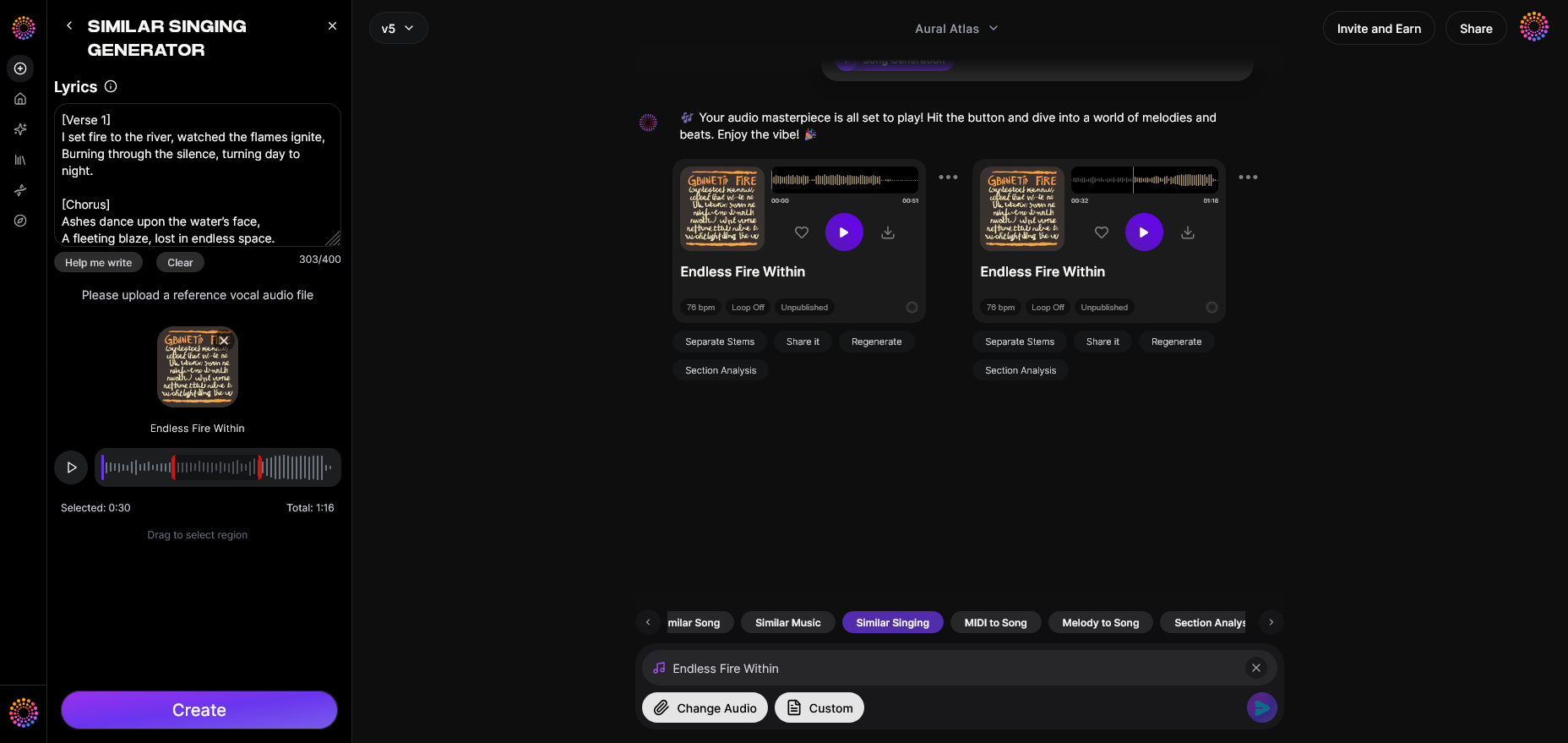
Soundverse’s Similar Singing Generator is a specialized AI feature designed to help creators achieve unmatched vocal authenticity. It generates vocal performances that capture the tone, emotion, and stylistic delivery of a reference voice, singing new lyrics created by the user.
What Can It Do?
- Vocal Tone and Timbre Matching: It accurately mirrors the tonal identity of the reference singer, maintaining natural human warmth.
- Lyric Input: Upload your lyrics, and the AI interprets their meaning and phrasing based on your chosen reference.
- Acappella Output: You receive a clean vocal track that can be mixed or processed further in your DAW.
What Are the Main Use Cases?
- Creating consistent character voices for animation projects.
- Producing songwriter demos in a specific vocal style.
- Exploring different vocal aesthetics before professional recording.
This feature becomes especially powerful when used alongside other Soundverse tools:
- Voice Swap: Transform existing vocals into new vocal identities while preserving performance nuances.
- Soundverse DNA: Generate tracks in your favorite artist’s sonic style without infringing copyright, thanks to licensed training data.
- Ethical AI Music Framework: Ensure that every generated output aligns with artist consent and compensation.
Together, these tools form an ecosystem that bridges creative expansion and ethical responsibility.
How Will Voice Cloning Shape the Future of Digital Performance?
By 2026, we are witnessing the normalization of synthetic media and AI-driven artistry. Virtual idols now perform live using digital projection and adaptive voice cloning systems. Film post-production has simplified the dubbing process with cloned voices that perfectly sync with actors’ lip movements. Educational platforms have begun deploying voice replicas of historic figures for immersive learning experiences.
Beyond entertainment, fields like accessibility and language preservation also benefit. Voice cloning allows visually impaired users to interact with familiar AI voices or helps communities preserve endangered languages by digitally encoding authentic speech patterns.
But the most profound shift is psychological: humans are learning to emotionally connect with AI expressions. This is pushing the boundaries of storytelling, empathy, and performance authenticity.
The Road Ahead: A Balanced Human-AI Collaboration
The true promise of voice cloning lies not in replacing artists but enhancing their creative reach. In the next few years, hybrid performances featuring human and AI singers will likely dominate concerts, synchronized through immersive holographic environments.
Soundverse’s technology acts as a bridge between imagination and execution—a co-creator that captures your creative intent while handling the technical heavy lifting. For creators who want to continue exploring innovative methods, tutorials such as How to Create EDM with Soundverse AI or How to Create Country Music with Soundverse AI offer detailed workflows to start producing instantly.
Bring Your Creative Vision to Life with Soundverse
Experiment with AI-driven tools to design unique voices, clone vocal styles, and produce professional-quality music faster than ever. Start exploring the future of digital performance today.
Related Articles
- Soundverse Saar: The AI Voice Assistant — Discover how Soundverse Saar uses AI voice replication to assist artists in voice generation and performance design.
- AI Music Generator and Human Composers: A Future Together — Explore how AI tools complement human creativity, bridging the gap between machine learning and artistic emotion.
- Soundverse AI: Revolutionizing Music Creation for New-Age Content Creators — Learn how Soundverse empowers digital creators to produce high-impact audio content with AI-powered precision.
- The Role of AI Music in Film and Television — Understand how artificial intelligence is reshaping sound design and voice performance in visual storytelling.
Here's how to make AI Music with Soundverse
Video Guide
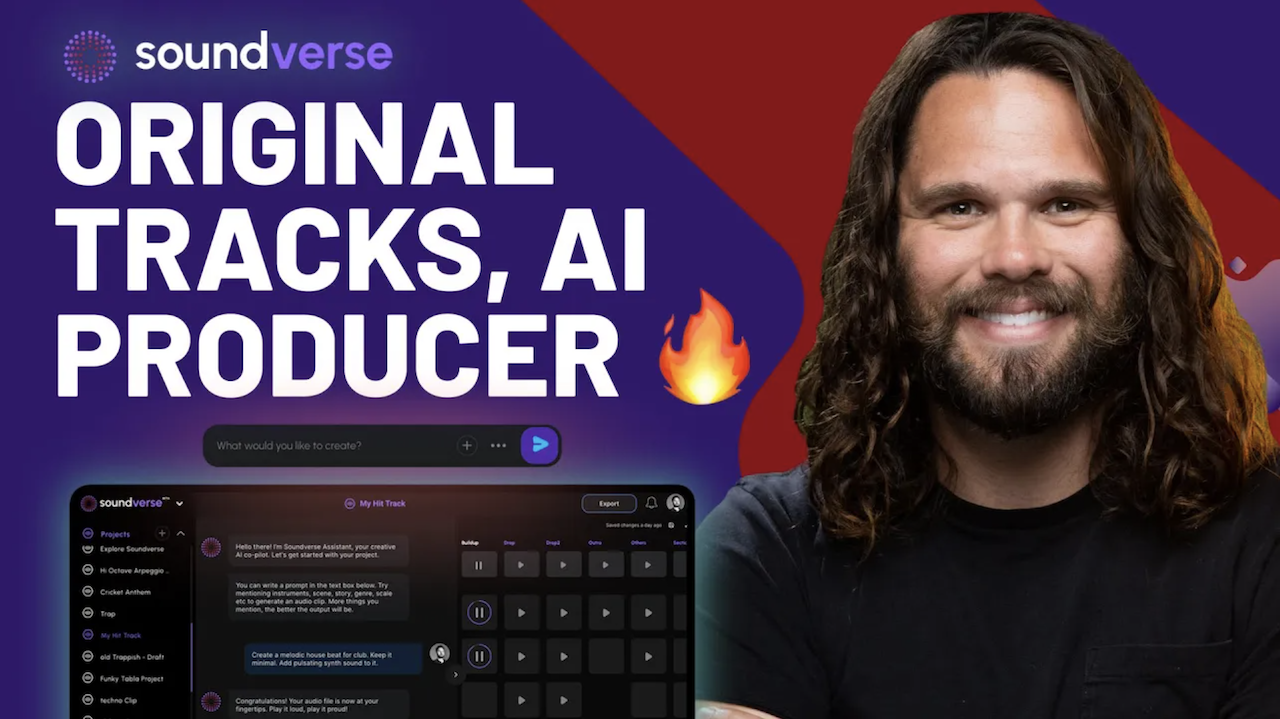
Here’s another long walkthrough of how to use Soundverse AI.
Text Guide
- To know more about AI Magic Tools, check here.
- To know more about Soundverse Assistant, check here.
- To know more about Arrangement Studio, check here.
Soundverse is an AI Assistant that allows content creators and music makers to create original content in a flash using Generative AI. With the help of Soundverse Assistant and AI Magic Tools, our users get an unfair advantage over other creators to create audio and music content quickly, easily and cheaply. Soundverse Assistant is your ultimate music companion. You simply speak to the assistant to get your stuff done. The more you speak to it, the more it starts understanding you and your goals. AI Magic Tools help convert your creative dreams into tangible music and audio. Use AI Magic Tools such as text to music, stem separation, or lyrics generation to realise your content dreams faster. Soundverse is here to take music production to the next level. We're not just a digital audio workstation (DAW) competing with Ableton or Logic, we're building a completely new paradigm of easy and conversational content creation.
TikTok: https://www.tiktok.com/@soundverse.ai
Twitter: https://twitter.com/soundverse_ai
Instagram: https://www.instagram.com/soundverse.ai
LinkedIn: https://www.linkedin.com/company/soundverseai
Youtube: https://www.youtube.com/@SoundverseAI
Facebook: https://www.facebook.com/profile.php?id=100095674445607
Join Soundverse for Free and make Viral AI Music
We are constantly building more product experiences. Keep checking our Blog to stay updated about them!