Top Music MCP Servers in 2026
The top music MCP servers in 2026, checked on each maker's page: Soundverse, Splice, ElevenLabs, fal, Ableton, REAPER, MIDI and Spotify, with their limits.
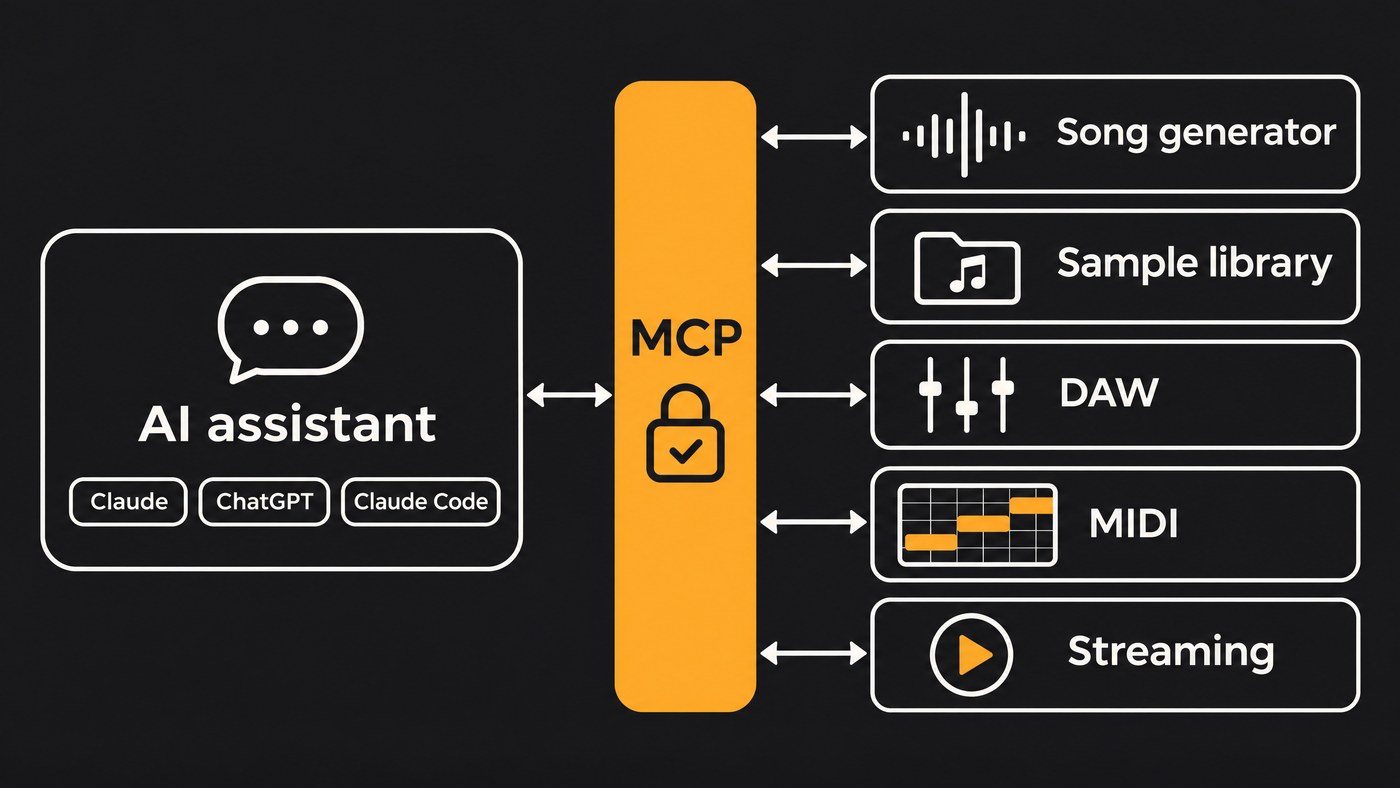
The top music MCP servers in 2026 are Soundverse for making songs, ElevenLabs and fal for music models, Splice for samples, Ableton, REAPER and Logic Pro servers for DAW control, Strudel, Sonic Pi and MIDI servers for code and notes, and Spotify for listening. The DAW, code and MIDI servers are community projects; the rest are official.
We checked every entry on its maker's page or GitHub README on 18 November 2026. We make Soundverse, so it sits first, with its limits spelled out like everyone else's.
What is an MCP server, in plain words?
MCP, the Model Context Protocol, is an open standard Anthropic introduced on 25 November 2024 as "a new standard for connecting AI assistants to the systems where data lives" (Anthropic).
Your assistant (Claude, ChatGPT, Claude Code, Cursor) is the client. An MCP server hands it tools: generate a song, search samples, add reverb to track 3, write a MIDI clip. You ask in plain words, the assistant calls a tool, and the result comes back as a file, a link or a change in your project.
- Hosted (remote): you paste a URL into your assistant and sign in. Nothing to install.
- Local: it runs on your computer, launched by Claude Desktop, Claude Code or Cursor from a short config entry. Servers that control a DAW work this way.
"Official" means the company behind the product built it; "community" means independent open-source developers did.
1. Soundverse MCP (official, hosted)
Soundverse is an AI music platform that takes you from idea to audience. Per the Soundverse MCP page, its connector lets Claude or ChatGPT write and generate songs, pull stems and swap vocals from a conversation, or turn an attached hum into a full song. It carries many tools, from song generation to stems and voice cloning.
- Works with: Claude on any plan (Free allows one custom connector) and ChatGPT on the web, on a plan that lets you add custom MCP servers. Claude Code gets it too: per Anthropic's Claude Code MCP docs, connectors you add on claude.ai appear automatically when you sign in to Claude Code with the same claude.ai account.
- How to connect: add it as a custom connector. In Claude: Customize → Connectors → Add → Add custom connector, URL
https://mcp.soundverse.ai/mcp(no trailing slash), "Use your own OAuth client", Client IDjt7cp9hv4m9idkuyv2gt0, secret left empty. In ChatGPT: Plugins → Add → Add custom MCP server, same URL and client ID. Full walkthrough: Soundverse MCP in Claude and ChatGPT. - Who it's for: artists and songwriters who already write lyrics in an assistant and want the audio there too.
- Where it stops: songs don't play inside the chat; they land in your Soundverse Library under Audios. Generations run on your Soundverse account, so your plan decides what you can make; Soundverse v9, the newest song model, comes with Pro and Max. Licensing is set by plan: the Free plan is for personal use, and the Creator plan comes with a royalty-free license.
Once connected, try:
Write lyrics for a slow indie-folk song about leaving my hometown, with two verses, a chorus and a bridge. Then make it with Soundverse using a warm male vocal and fingerpicked acoustic guitar, and pull the stems when it's done.
This video shows the full Claude setup, then a song made from one message and its stems.
2. ElevenLabs MCP (official, hosted)
ElevenLabs runs a hosted server at https://api.elevenlabs.io/v1/mcp with OAuth sign-in. Its MCP server docs name Claude, ChatGPT and Cursor as clients and list tools for speech, images, video, sound effects and music, on an editable Flow you can reopen in their app.
- The catch: the ElevenLabs connector in Claude's directory can't generate music. For music, add the full server as a custom connector by URL.
- Who it's for: artists and video makers who want voiceovers, effects and music beds in one place.
- Where it stops: file links expire about two hours after the assistant gets them, and every generation spends credits, retries included. The older local server on GitHub is deprecated.
3. Splice MCP (official, in Claude's directory)
Splice's connector page (Anthropic verified, added April 2026) lists describe_a_sound, create_stack, prompt_to_stack, share_stack and download_asset. Describe a sound, get matching royalty-free samples, and build stacks of layers that play together.
- Works with: Claude, Cursor, Windsurf and VS Code, at
https://mcp.splice.com/mcp. Splice's getting-started article says ChatGPT isn't supported at this time. - Who it's for: producers who build from samples and loops.
- Where it stops: it's in beta. Free accounts can search and build stacks; downloads need a Sounds+, Creator or Creator+ subscription and use credits. You preview samples in the browser.
4. fal MCP (official, hosted model gateway)
fal hosts music models such as MiniMax Music 2.0, Google's Lyria 2 and ElevenLabs Music. Its MCP server at https://mcp.fal.ai/mcp-relay lets the assistant search models, check schemas and pricing, upload inputs and run jobs.
- Works with: ChatGPT (fal plugin), Claude (custom connector), Claude Code, Codex CLI and Cursor, with OAuth sign-in.
- Who it's for: developers and technical artists comparing music models.
- Where it stops: raw model calls, with no song library or editor. fal's sample prompts ask the assistant to show the cost and wait for approval, but fal notes that isn't a server-side gate.
5. AbletonMCP (community) and Ableton Knowledge (by Ableton)
AbletonMCP, an open-source project (MIT license) by developer Siddharth (ahujasid on GitHub), updated September 2026, lets Claude Desktop or Cursor create MIDI and audio tracks, load instruments and effects from Ableton's library, write MIDI clips, build arrangement sections and run the transport.
- How to connect: locally. Install
uv, adduvx ableton-mcpto your client, install its Remote Script and select AbletonMCP as a control surface in Live 10 or newer. The README says it isn't made by Ableton. - Who it's for: Live users who want an assistant to sketch and edit sets.
- Where it stops: per its README, complex arrangements may need smaller steps, it's built around Live's default devices, and you should save first. Anonymous telemetry is on by default (an environment variable turns it off); sharing your prompts and MIDI for a dataset is opt-in.
Ableton Knowledge, made by Ableton and in Claude's directory since July 2026, searches manuals, release notes, knowledge-base articles and tutorial transcripts for Live, Push, Move, Note, Link, Cloud and Max for Live. It answers questions but can't touch your set, and Ableton marks it as an experimental prototype.
6. REAPER MCP and Logic Pro MCP (community)
REAPER MCP by bonfire-systems (MIT license, updated October 2026) covers a REAPER project: tracks and sends, MIDI chord progressions and drum patterns, FX parameters, automation, rendering including stems, a mastering chain, and loudness and clipping checks. It needs REAPER 7+, Python 3.10+ and a short ReaScript that turns on REAPER's distant API.
Logic Pro MCP (MIT license, updated November 2026) creates tracks, writes MIDI, runs transport and mixer moves, loads instruments and reads back the live project. Logic has no first-party API for this, so it drives macOS channels like Accessibility and AppleScript, and destructive steps need explicit confirmation.
- Works with: Claude Desktop and Claude Code, running locally; Logic Pro MCP also lists Cursor.
- Who they're for: producers who already work in REAPER or Logic.
- Where they stop: no AI audio generation of their own; they write MIDI, arrange, mix and render what's in your project.
7. Strudel and Sonic Pi live-coding servers (community)
live-coding-music-mcp (formerly strudel-mcp-server, updated November 2026) drives Strudel.cc in a browser it opens: it writes and plays patterns, detects tempo and key, and saves your work. It works from Claude; its README calls it an unofficial beta, not ready for production.
Sonic Pi MCP works from Cursor or Claude Desktop: the model writes Sonic Pi code and the server sends it over OSC, with tools like queue_segment and stop_all, while a queue-runner buffer runs in Sonic Pi v4.
- Who they're for: live coders, teachers and the curious.
- Where they stop: sound plays in your browser or Sonic Pi; recording it is up to you.
8. MIDI MCP Server (community)
MIDI MCP Server has two tools, create_midi and parse_chord. It takes note or chord names like Cmaj7, writes a .mid file, and in clients that support MCP Apps shows a piano-roll preview with playback in the chat. Run it locally, or add the author's remote URL in claude.ai.
- Who it's for: songwriters who want a progression or melody to drag into any DAW.
- Where it stops: notes only, no sounds, and the remote copy is the author's own deployment.
9. Spotify (official, in Claude and ChatGPT)
Spotify's Claude connector (added April 2026) offers search, playlist creation, now-playing and library tools, and Premium listeners can describe a vibe and get a matching playlist. In ChatGPT, the Spotify app has been live since 6 October 2025, and Spotify's announcement says it won't share music with OpenAI for training.
- Who it's for: building reference playlists before a session.
- Where it stops: it makes and analyses nothing; playback opens in Spotify.
How to choose a music MCP server
- Start from the job. A finished song: Soundverse, or ElevenLabs and fal for raw model calls. Samples: Splice. Edits to a session: AbletonMCP, REAPER MCP or Logic Pro MCP. Notes and code: MIDI MCP, Strudel or Sonic Pi. Listening: Spotify.
- Check your assistant. ChatGPT adds custom servers by URL on the web (OpenAI's guide), so local DAW servers are simplest from Claude Desktop, Claude Code or Cursor.
- Know where files land: your Soundverse Library, expiring ElevenLabs links, your Splice library, or your DAW project.
Is it safe? Permissions and approvals
The assistant decides when to call a server's tools. OpenAI's guide says: "Only connect to MCP servers you trust." Anthropic's directory pages warn that it doesn't control which tools developers make available.
- Claude: set each tool to Needs approval (Soundverse's default), Always allow or Blocked. Keep paid tools on Needs approval.
- ChatGPT: write actions ask for confirmation by default. Let it remember an approval only for apps you trust.
- Local servers run with your computer's permissions. Read the README, check telemetry, and save your project before an assistant edits it.
- Public links: Splice's shared stacks can be opened by anyone.
How we picked
- Music had to be the point, and community projects needed an update in 2026.
- Left out: MiniMax's official server (speech, voices, images and video, but no music tool) and Mureka's official server (songs and lyrics, but no GitHub update since May 2025).
Where Soundverse fits
Pick Soundverse MCP when the goal is a finished song from a conversation: the assistant writes, Soundverse makes the audio, and it's saved in your Library. From there, split a mix with the Stem Separator, re-sing a vocal with Voice Swap, or turn a hummed tune into a song with Melody to Song.
It won't drive Ableton or REAPER or search a sample catalogue, so DAW-based producers may pair it with Splice or a DAW server. To skip the outside assistant, Agent One plans and runs the same tools inside Soundverse; see the best AI music agents. See also our top audio MCP servers and the top AI music tools of the year.
FAQ
What is a music MCP server?
A server that gives an AI assistant music tools through the Model Context Protocol. Some make songs or find samples, some control a DAW, and some write MIDI or search a streaming catalogue.
Do music MCP servers work in ChatGPT?
Some do. Soundverse, ElevenLabs and fal connect in ChatGPT on the web, and Spotify has its own ChatGPT app. Splice doesn't support ChatGPT yet, and local DAW servers are simplest from Claude Desktop, Claude Code or Cursor.
Can Claude Code use music MCP servers?
Yes. Local servers like REAPER MCP add straight to Claude Code, and connectors you add on claude.ai, Soundverse included, appear automatically when you sign in with the same claude.ai account.
Will the assistant play the music in the chat?
Usually not. Soundverse saves tracks to your Library, Splice sends you to the browser and Spotify opens its app. MIDI MCP Server and ElevenLabs can preview inline in clients that support MCP Apps, such as Claude.
Sign up for Soundverse free to connect it to Claude or ChatGPT. More guides on the Soundverse blog.