Top Audio MCP Servers in 2026
The top audio MCP servers in 2026 for speech, transcription, podcast edits, stems and file chores, with each one's tools, setup and limits checked.
The top audio MCP servers in 2026 are ElevenLabs for speech and sound effects, Descript for podcast and video audio, AssemblyAI for transcription, Soundverse for music, stems and voice swap, Cartesia for voices, and local servers built on Audacity and FFmpeg. Each one lets Claude, ChatGPT or Cursor do real audio work from a chat.
We checked every server below on its maker's docs or GitHub page on 18 November 2026. We make Soundverse, so its limits are listed like everyone else's.
What is an audio MCP server?
MCP, the Model Context Protocol, is the open standard Anthropic released on 25 November 2024. In its announcement: "The Model Context Protocol is an open standard that enables developers to build secure, two-way connections between their data sources and AI-powered tools."
An audio MCP server gives your assistant audio tools, such as text_to_speech or submit_transcript. You ask in plain words; the assistant picks the tool and reads back the result.
- Hosted servers live at a URL. You add them as a connector in claude.ai, ChatGPT, Claude Code or Cursor and sign in, usually with OAuth. Files come back as links.
- Local servers run on your computer from a config file in Claude Desktop, Claude Code or Cursor. They read your files directly and often need an API key.
In Claude Code, connectors you added in claude.ai show up automatically when you log in with that account, per Anthropic's docs.
1. ElevenLabs MCP server: speech, transcription and sound effects
Official and hosted at https://api.elevenlabs.io/v1/mcp, with OAuth sign-in (docs). It replaces the older local server on GitHub, now archived.
- Tools: speech in any voice in your workspace (two takes per request), transcription, sound effects and music through Flow nodes, voice design from a description, plus image, video and agent tools.
- Works with: Claude, ChatGPT and Cursor. Claude's connector directory has a restricted version (speech, voices, transcription, agents); add the custom connector for music, images and video.
- For: voiceovers, character voices and sound effects for video.
- Where it stops: generations spend credits, and retrying one that's still running charges a new generation. File links expire after about two hours.
2. Descript MCP: podcast and video audio
Official and hosted (docs). It signs in with your Descript login and is scoped to one Drive.
- Tools: import media, transcribe, edit with Underlord (Studio Sound, Remove Filler Words, captions), search and organize your Drive, publish to a Descript web link, and export transcripts (SRT included).
- Works with: Claude (in the Anthropic connector directory), ChatGPT (app directory), Cursor, and Claude Code through
https://api.descript.com/v2/mcp. - For: podcasters and video editors who already cut in Descript.
- Where it stops: no rendered file download without publishing to a web link first, and YouTube URLs don't work as imports. Imports use media minutes; Underlord edits can use AI credits.
3. AssemblyAI MCP: transcripts, summaries and speakers
Official and hosted at https://mcp.assemblyai.com/mcp (docs). Sign in, or send an API key as a Bearer token.
- Tools:
submit_transcript,get_transcript,summarize_transcript,understand_transcript(translation or speaker identification, for example) anddelete_transcript. - Works with: Claude Code, claude.ai as a custom connector, Cursor and any Streamable HTTP client.
- For: interviews, sales calls, meetings and lectures.
- Where it stops: audio must be at a public URL, because the server can't read your computer's files; use AssemblyAI's upload endpoint first. Usage bills at your normal API rates, and deletes are permanent.
4. Soundverse MCP: music, stems and voice swap
Official and hosted. Soundverse is an AI music platform that takes you from idea to audience, and the Soundverse MCP lets Claude or ChatGPT write and generate songs, pull stems and swap vocals from a conversation.
- Tools: song generation, stems, voice cloning and more, per Soundverse's Claude setup page. Try "Turn this hum into a full song" with the audio attached.
- Works with: Claude on any plan as a custom connector (it isn't in Claude's connector directory), and ChatGPT on the web as a custom MCP plugin, on a plan that allows custom MCP servers. Server URL
https://mcp.soundverse.ai/mcp(no trailing slash), OAuth client IDjt7cp9hv4m9idkuyv2gt0, client secret empty. Claude Code gets it through the same claude.ai account. - For: artists, producers and songwriters who want songs and stems without leaving the chat.
- Where it stops: tracks land in your Soundverse Library under Audios and don't play in the conversation. Generations run on your Soundverse plan, and Voice Swap only takes voices that are yours or that you have permission to use. Licensing is set by plan: the Free plan is for personal use, and the Creator plan comes with a royalty-free license.
This video shows Soundverse making music inside Claude through the MCP connector.
5. Cartesia MCP: voices, TTS and STT
Official, hosted at https://mcp.cartesia.ai/mcp or run locally with uvx and CARTESIA_API_KEY (docs).
- Tools:
text_to_speech,speech_to_text, voice tools includingclone_voiceandlocalize_voice, pronunciation dictionaries anddownload_file. - Works with: Cursor (one-click install), Claude Code and other MCP clients.
- For: developers building voice products, and anyone who needs names pronounced consistently.
- Where it stops: the hosted server can't see your disk, so inputs must be Cartesia file IDs. Speech is saved to Cartesia's cloud with a 24-hour link unless you set
save=falseon a local run.
6. AudacityMCP: hands-on editing in Audacity
Community (Apache-2.0) and local (GitHub). It drives Audacity through mod-script-pipe, with no cloud service or API key for audio processing.
- Tools: 144 tools across effects, cleanup, mastering, editing, labels and experimental offline transcription, plus one-click pipelines, including one for ACX audiobook requirements.
- Works with: Claude Desktop (its installer sets this up), Claude Code and Cursor.
- For: podcasters, audiobook narrators and anyone cleaning up voice recordings.
- Where it stops: Audacity 3.x only, since Audacity 4 removed mod-script-pipe. Pipelines never raise loudness, so you normalize afterwards.
7. fal MCP server: many audio models behind one connector
Official and hosted at https://mcp.fal.ai/mcp-relay, with browser sign-in (docs). It opens fal's model catalog, text-to-speech included.
- Tools:
search_models,recommend_model,get_model_schema,get_pricing,run_model, job tools andupload_file. - Works with: ChatGPT, Claude, Claude Code, Codex CLI, Cursor, Grok Bot and Replit.
- For: people who want to compare speech or audio models and see the price before running one.
- Where it stops: generations use fal credits, and
run_modelwaits up to 45 seconds before handing back a request ID to check later.
8. ffmpeg-mcp-lite: conversion, trimming and extraction
Community (MIT) and local (GitHub). You install FFmpeg yourself.
- Tools:
ffmpeg_get_info,ffmpeg_convert,ffmpeg_compress,ffmpeg_trim,ffmpeg_merge,ffmpeg_extract_audio,ffmpeg_extract_framesandffmpeg_add_subtitles. - Works with: Claude Desktop, Claude Code, Cursor, VS Code, Windsurf and Dive.
- For: anyone who pulls audio out of video, converts formats or trims files in batches.
- Where it stops: it edits files and generates nothing. Outputs go to
~/Downloadsunless you setFFMPEG_OUTPUT_DIR.
9. MiniMax MCP: speech, voice cloning and voice design
Official and local through uvx, or an SSE server you deploy (GitHub). It needs MINIMAX_API_KEY and MINIMAX_API_HOST.
- Tools:
text_to_audio,list_voices,voice_cloneandvoice_design, plus video and image tools. - Works with: Claude Desktop, Cursor, Windsurf and OpenAI Agents.
- For: multilingual voiceovers and designing a voice from a text prompt.
- Where it stops: the key and host must come from the same region, or calls fail with an invalid-key error. Calls cost money, and the README now points to MiniMax's CLI for its newest models.
10. MCP Server Whisper: OpenAI transcription and TTS
Community (MIT) and local (GitHub); OpenAI doesn't make it. It needs OPENAI_API_KEY and an AUDIO_FILES_PATH folder.
- Tools:
transcribe_audio(whisper-1, gpt-4o-transcribe, gpt-4o-mini-transcribe),transcribe_with_enhancement,chat_with_audioandcreate_audio(gpt-4o-mini-tts). - Works with: Claude Desktop and Claude Code.
- For: transcribing a folder of recordings on your own machine.
- Where it stops: it reads only the folder you set, compresses files over 25 MB to fit the API, and bills your OpenAI account.
Chaining two audio MCP servers in one request
With AssemblyAI and ElevenLabs both connected in Claude, one message covers both jobs:
Transcribe the interview at [public link] with AssemblyAI, summarize it in five bullet points, then have ElevenLabs read the summary as a calm 40-second voiceover.
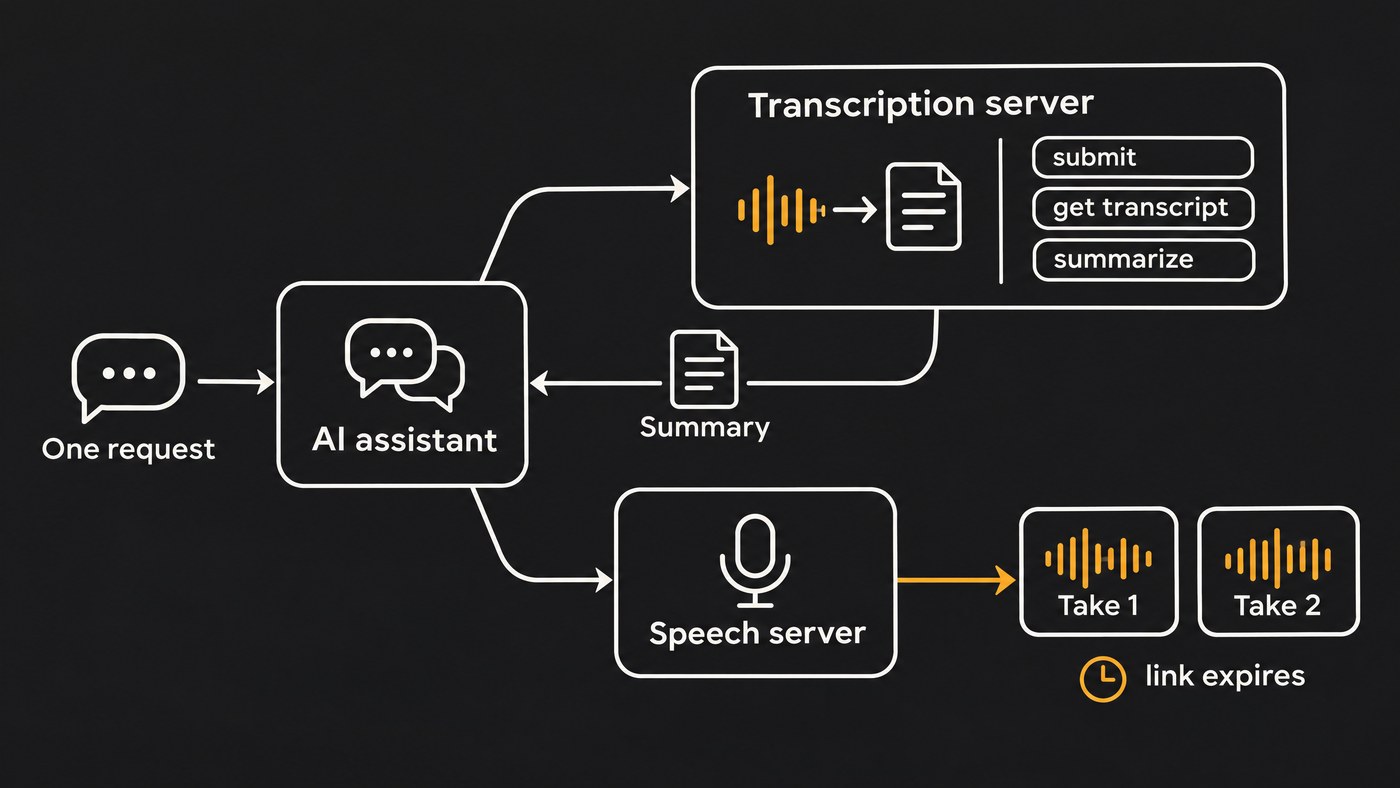
- Claude calls AssemblyAI's
submit_transcriptwith the link and gets a transcript ID. - It polls
get_transcriptuntil it's ready. - It calls
summarize_transcriptin bullet format. - It sends the summary to ElevenLabs' speech tool, which returns two takes as links.
- You pick a take and download it within about two hours.
Note that Claude's Free plan allows one custom connector, per Anthropic's help center.
How to choose an audio MCP server
- Voiceovers: ElevenLabs, Cartesia or MiniMax; fal to compare models.
- Transcripts: AssemblyAI for files at a URL, MCP Server Whisper for files on your disk, Descript when the transcript is also your edit.
- Podcast cleanup: Descript in the cloud, AudacityMCP on your machine.
- Format chores: ffmpeg-mcp-lite.
- Music, stems and voice swap: Soundverse. Our list of top music MCPs goes deeper on music.
Then check where outputs land (expiring links, a cloud library or a local folder) and who maintains the server.
Keys, costs and permissions
- Sign-in: official hosted servers mostly use OAuth, so no key sits in your client. Local servers that call an API need a key in a config file; keep it out of git.
- Costs: connecting is free; calls spend credits, minutes, API usage or your Soundverse plan. Check each vendor's pricing page.
- Approvals: in Claude, set generation and delete tools to ask first; that safeguard lives in your client. fal's docs say of their sample prompts: "These prompts ask the assistant to request approval; they do not add a server-side approval gate."
- Voice consent: clone or swap only voices you own or have permission to use. ElevenLabs' cloning adds a voice verification step; Soundverse's Voice Swap bans impersonating real people. Cartesia and MiniMax have clone tools too.
- Trust: connect only servers you trust, as Anthropic advises, and read community code before running it.
How we picked
We read each server's docs or README on 18 November 2026 and preferred maintained official servers. Community servers made it only when they fill a gap and had 2026 updates.
Left out:
- Deepgram:
dg mcponly searches Deepgram's docs (docs). - ElevenLabs' local server: archived, replaced by the hosted one.
- Freesound: the community servers we found were last updated in mid-2025.
- Speechmatics: we found only third-party wrappers.
Soundverse sits fourth because for speech and transcripts, the three above it do more.
Where Soundverse fits
Soundverse covers the music side of audio work: through the MCP connector, Claude or ChatGPT can generate a song, turn a hum into a track, swap a vocal or split stems, with results saved to your Library. The Stem Separator gives 2 stems (vocals and backing), 6 stems, or, on Creator and above, a maximum split with a MIDI file per part. Voice Swap re-sings a vocal in a Community, Public or your own trained voice while keeping the performance. Setup is in our Soundverse MCP guide, and the best AI music agents compares it with other music agents.
FAQ
What is the best MCP server for text-to-speech?
For most people, ElevenLabs' hosted server: it signs in with OAuth, works in Claude, ChatGPT and Cursor, and returns two takes per request. Developers wanting pronunciation dictionaries or a local option should try Cartesia.
Can Claude transcribe audio through MCP?
Yes. AssemblyAI, ElevenLabs, Cartesia and Descript transcribe through hosted servers, and MCP Server Whisper does it locally with your OpenAI key. AssemblyAI needs the file at a public URL.
Is the Soundverse MCP in Claude's connector directory?
No. Add it as a custom connector with https://mcp.soundverse.ai/mcp and client ID jt7cp9hv4m9idkuyv2gt0, secret empty. Claude Code picks it up when you log in with the same claude.ai account.
Are audio MCP servers free?
Connecting is free, and the community servers here are open source. Hosted servers bill credits or minutes, and local servers that call an API bill your key; AudacityMCP and ffmpeg-mcp-lite need no paid API.
Sign up for Soundverse free to try the MCP connector, and find more guides on the Soundverse blog.
