Top-Rated AI Voice Cloning Software for High-Fidelity Character Voices
AI voice cloning software for game, animation and audio drama characters: designed voices, emotion control, singing, 48 kHz export and consent.
The top-rated AI voice cloning software for high-fidelity character voices right now is ElevenLabs for designed and cloned speech, Respeecher and Altered Studio for actor-driven performance, and ACE Studio, Synthesizer V, Kits.ai or Soundverse when a character also sings. Pick by consistency, emotion control, export quality and consent, not by demo reels.
This guide is for game developers, animation teams, audio drama producers and artists building a music persona. We checked every tool on its own pages on 21 November 2026; Dreamtonics' site blocked our reader that day, so its details come from an Internet Archive capture of 15 November 2026. For prices, see AI voice cloning subscription costs, compared.
What a high-fidelity character voice needs
A character voice is judged over hundreds of lines recorded months apart. Check seven things:
- Consistent timbre. The same voice ID and model version should give the same character in the tutorial and the final scene.
- Emotion and style control. Whispers, shouts, laughs and fear on demand, through tags, styles or an actor's performance.
- Designed voices. Goblins, robots and narrators that copy no real person. Our guide to making AI voices sound distinct covers the shaping side.
- Singing as well as speech, for a bard, a villain's anthem or a virtual idol.
- 48 kHz WAV export when that's your project rate, with no effects baked in.
- Batch workflows: an API or SDK that renders a whole dialogue sheet.
- Engine or DAW integration, or clean files for Wwise, FMOD, Unity, Unreal or your DAW.
Underneath all seven sits consent: your own voice, an actor whose contract covers AI use, or a designed voice.
The top-rated AI voice cloning software for spoken character voices
ElevenLabs: Voice Design and Professional Voice Cloning
Voice Design builds a voice from a text prompt covering age, gender, accent, pacing, emotion and character type, from an ogre to a godlike being. Each run returns three options; you save one to a voice slot. ElevenLabs is candid about the trade-off: "Voice Design is best for quick exploration and iteration, and output quality can vary depending on your prompt and use case." Designed voices support audio tags on Eleven v4 and v3, though the docs say they may be less performative on v4.
For a lead cast, Professional Voice Cloning trains on at least 30 minutes of speech, ideally 2 to 3 hours, in one speaking style. It clones only your own voice after verification, so an actor creates and verifies the clone on their own account, then shares it with you privately. It doesn't sing. Pin the model per project: the docs warn the same clone can sound substantially different on Eleven v4 and v3.
ElevenLabs' API reference (checked 21 November 2026) lists WAV and PCM output up to 48 kHz, noting that 44.1 kHz WAV and PCM need Pro or above, and its Python and TypeScript SDKs make batch rendering a short script. We didn't find an official engine plugin in its current docs.
Respeecher: an actor's performance in another voice
Respeecher offers speech-to-speech and text to speech with what it calls emotion transfer, an API, and a Voice Marketplace with a Pro Tools plugin. Its games page targets long-running franchises: "Keep characters consistent across sequels, downloadable content (DLC), and live-service updates, under clear consent with the actor or estate." It also covers keeping a child character sounding young in a sequel. Respeecher's ethics page says every voice replication needs a mutually signed agreement.
Altered Studio: one performer, a whole cast
Altered Studio is built around performance-to-performance voice morphing: you act the line, then switch the voice, so one performer can drive a multi-character production. It runs online or locally on Windows and Mac, its text to speech has styles including whispering and shouting, and Altered asks for 60 to 90 minutes of clean audio for a Custom Voice. Two caveats: its ethics page says it deliberately doesn't open its technology through an API, so no batch rendering, and parts of its site still carry a 2022 to 2023 copyright line, so confirm current features in the free trial.
Resemble AI and Replica Studios
Resemble AI's product notice says it has stopped offering voice generation as a commercial product and now focuses on detection; the voice models it built remain free to use for research and development. Replica Studios' domain didn't resolve when we checked on 21 November 2026, so we couldn't verify anything about it.
Tools for characters who sing
ACE Studio: a cloned singer you write for, plus dialogue
ACE Studio clones your own voice as a Vocal Synth voice that sings from MIDI and lyrics, from 30 to 100 minutes of dry singing at 44.1 or 48 kHz. It accepts speech samples too, but warns that speaking timbre can differ from singing. For a character with several moods or registers, the docs suggest training separate voices. Clones stay private unless you authorize someone.
ACE recommends 24-bit WAV at 44.1 or 48 kHz for masters, one file per track, and ACE Bridge 2 streams into your DAW as a VST3, AU or AAX instrument. Its Speech Generator writes multi-speaker dialogue with pre-made, described or reference-based voices on third-party models (SeedAudio or ElevenLabs V3), so one app covers a character's spoken and sung lines.
Synthesizer V Studio 2 Pro: designed singers with deep control
Synthesizer V isn't a cloning tool. Dreamtonics' page says its voices come from licensed recordings of professional singers who consented and are compensated. For stylised characters it's the most controllable option here: pitch deviation, vibrato, gender, breathiness, mouth opening and phoneme timing, plus granular synthesis, pitch bends and hybrid timbres to go beyond the human vocal range. It runs offline as a VST3, AU, AAX or ARA plugin and exports WAV, FLAC or MP3. Check each voice's license terms before you ship.
Kits.ai: a singing voice from a description
Kits' Voice Designer creates a singing voice without any recordings: pick a base voice type, then adjust tone, vibrato and breathiness. That's a clean route to a fictional singer nobody else owns. Voice Variants saves edited versions of a voice, each in its own voice slot, and Kits' Speaking Voices page lists video game dialogue among its uses. Custom voices freeze if you cancel, so plan to keep the subscription for the life of the project.
Can you recommend AI voice cloning tools that offer high-fidelity speech synthesis?
For speech alone, three stand out: ElevenLabs Professional Voice Cloning on Eleven v4, which its docs position for character voiceovers; Respeecher, when an actor performs every line; and Altered Studio's Custom Voices, when one performer voices many roles. ElevenLabs and Altered both treat instant clones from short clips as prototyping tools. For how pitch and timing work differently in talking and singing models, see speech synthesis vs singing synthesis.
A character-voice bible checklist
Keep one page per character with the project files, filled in before the first line ships.
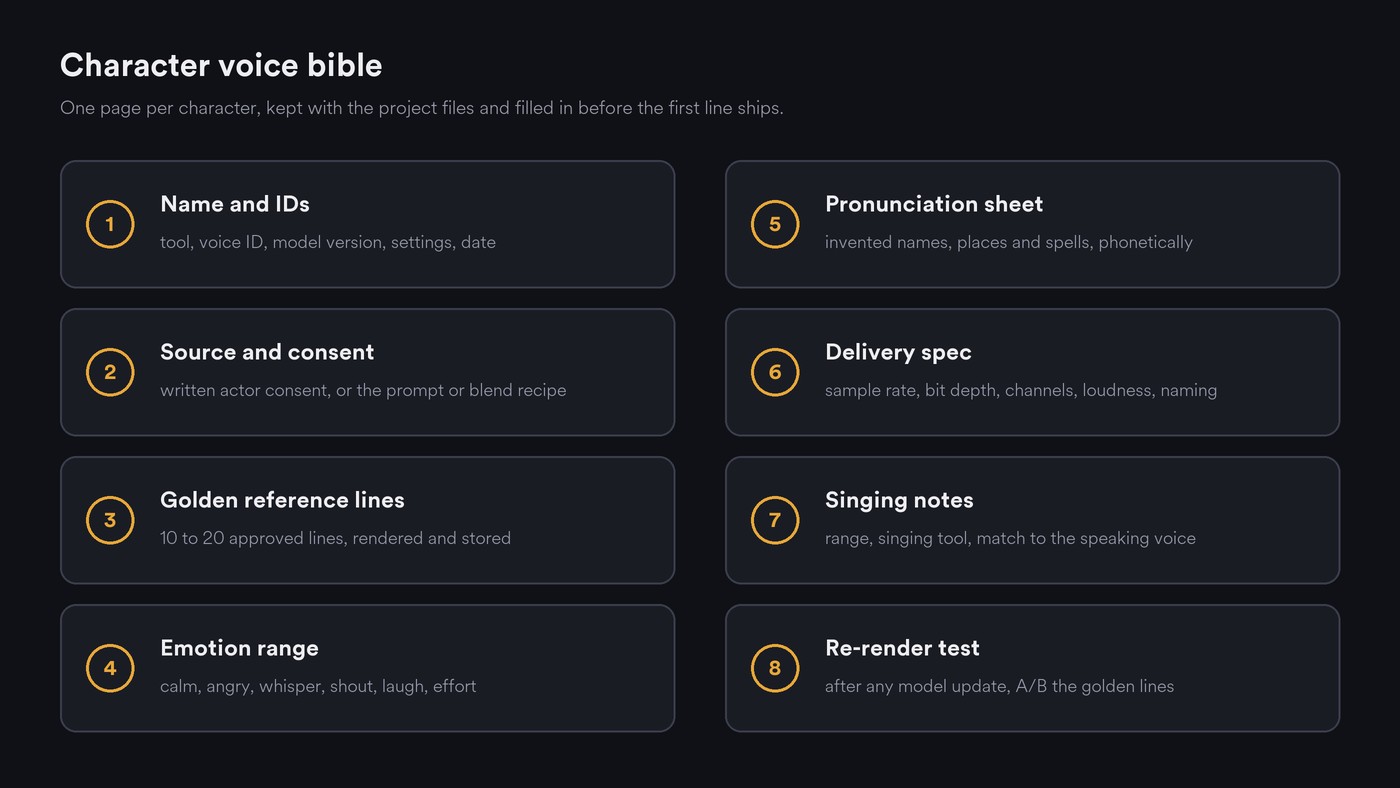
- Name and IDs. Character name, tool, voice ID or model name, model version and every setting, with the date.
- Source and consent. For an actor: written consent covering AI use, media, territory, term, sequels and DLC, plus what happens if they withdraw. Rules differ by country; see voice cloning consent laws by country. For a designed voice: the exact prompt or blend recipe.
- Golden reference lines. Ten to twenty approved lines that cover the character's range, rendered and stored.
- Emotion range. The states the character uses (calm, angry, whisper, shout, laugh, effort), the tag or direction that produces each, and the off-limits ones.
- Pronunciation sheet. Invented names, places and spells, written phonetically.
- Delivery spec. Sample rate, bit depth, channels, a loudness target and a naming scheme such as CHAR_scene_line_take.wav.
- Singing notes, if the character sings: range, the singing tool and how it matches the speaking voice.
- Re-render test. After any model update, render the golden lines again and A/B them.
For directing emotion in sung lines, our comparison of vocal expression control goes deeper.
Where Soundverse fits
Soundverse is an AI music platform that takes you from idea to audience, built for independent artists who release music, and it covers a character's sung side with consent built in. Train Voice Model, on the Creator plan and above, trains a model of a singing or speaking voice from 10 minutes or more of clean, dry solo recordings; Voice Swap then re-sings an existing vocal in that voice while keeping the performance. Training won't start until you confirm the voice is yours or that the singer has given explicit consent, and new models start Private. The AI Singing Generator sings lyrics a cappella in styles from pop to choir, and the AI Speech Generator voices game character lines in its built-in voices, one run per character; it doesn't clone. AI Studio exports WAV at 44.1, 48 or 96 kHz on Creator and up, but doesn't load VST or AU plugins.
Licensing is set by plan: the Free plan is for personal use, and the Creator plan comes with a royalty-free license.
This walkthrough of Soundverse's Create tools reaches the AI Singing Generator at 0:31 and the AI Speech Generator at 0:39.
FAQ
Can I clone a voice actor for a game character? Only with the actor's explicit written consent and a contract covering AI use, media, term and sequels. ElevenLabs has the actor verify a Professional Voice Clone on their own account and share it, and Respeecher works under a mutually signed agreement.
What's the best AI tool for monster, robot or other non-human voices? Start from a designed voice: ElevenLabs Voice Design takes character types in the prompt, Altered morphs an actor's performance into another voice, and Synthesizer V pushes a singing voice past the human range. Finish with pitch, formant and distortion effects in your DAW.
Which AI voice tools handle both singing and speech? ACE Studio pairs its Vocal Synth with a Speech Generator, Kits.ai has singing voices and Speaking Voices, and Soundverse has the AI Singing Generator, the AI Speech Generator and Train Voice Model. ElevenLabs' Professional Voice Clones are speech only.
How do I keep a character's voice the same across a sequel? Save the voice ID, model version and settings, keep approved golden lines, and render them again after any update before you swap anything. Pin the model version, since a clone can change between model generations.
Sign up for Soundverse free and try the AI Singing Generator on your character's theme. More voice and vocal guides on the Soundverse blog.