Voice Cloning Consent Laws by Country: Understanding Global Voice Rights in 2026
Learn about global voice cloning consent laws and international AI voice rights in 2026.
Voice Cloning Consent Laws by Country
Voice cloning technologies have matured rapidly between 2024 and 2026, transforming creative industries, personalized entertainment, and digital communication. As AI models can now reproduce human voices with striking authenticity, legal systems worldwide have responded by developing frameworks that define clear consent requirements, usage boundaries, and ethical protections. This article explores voice cloning consent laws by country, examining international voice rights, AI voice regulations, and synthetic media legislation emerging in this new digital era.
What are voice cloning consent laws and why are they critical in 2026?
Voice cloning consent laws regulate when and how a voice can be digitally replicated using machine learning models. They determine whether explicit permission is required from individuals, how long consent lasts, and what penalties apply when synthetic voices are misused.
In 2026, the need for these laws primarily arises from the proliferation of generative AI tools capable of mimicking human tone, timbre, and emotional resonance. Without consent mechanisms, cloned voices can lead to identity theft, defamation, or unlicensed commercial exploitation. Thus, global lawmakers are prioritizing digital voice protection as part of broader AI ethics frameworks.

How do different countries approach voice cloning consent laws?
Voice rights vary depending on regional legal traditions. Below are some countries actively shaping voice cloning consent laws as of 2026.
1. United States
The U.S. approach centers around publicity rights and voice identity protection under state law. California and New York have pioneered updates extending likeness rights to digital voice reproduction. The Federal AI Voice Act (proposed in 2025, enforced 2026) requires explicit written consent for any commercial use of synthetic voice models derived from real individuals. Violations can attract significant civil penalties. The U.S. FCC also classifies AI voice calls as robocalls under TCPA, requiring prior written consent and facing $1,500 per violation fines according to AI Calling Illegal? January 2026 Laws, Compliance & Global Guide.
2. European Union
The EU has integrated voice cloning under the Artificial Intelligence Regulation (AIR), which complements GDPR. The AIR requires user consent for the creation, storage, and public dissemination of cloned voices, emphasizing transparency and purpose limitation. Voice models must maintain traceability – ensuring users can identify whether audio has been synthetically generated. This forms part of broader efforts to prevent misinformation and deepfake abuse.
3. United Kingdom
After leaving the EU, the UK established independent AI ethics guidelines through the Digital Media and Voice Integrity Act (2025). It mandates consent for training AI on voice datasets and demands disclosure when synthetic voices appear in broadcast or commercial distribution. The act also introduced an Intellectual Property extension recognizing voice as a form of creative asset.
4. Japan
Japan’s AI Sound Representation Law (2025) covers both voice cloning and synthetic singing models. Consent from original artists is mandatory before their vocal characteristics are used in training sets. The country strongly supports traceability—ensuring that any derivative work credits the source voice while enabling artists to monetize through approved licensing networks.
5. South Korea
As a technology leader, South Korea implemented strict consent-based digital identity policies. Under the AI Identity Protection Act (2025), companies must store verifiable consent logs and allow users to revoke voice usage authorization. Synthetic media in advertising must clearly display identity disclaimers.
6. India
India’s draft Synthetic Media Bill (2026) introduces data ethics aligned with broader IT reforms. It emphasizes rights of individuals regarding their voice and prohibits unauthorized replication for entertainment or informational purposes. Consent is the legal cornerstone with criminal penalties for impersonation or harmful intent.
7. Australia
Australia’s privacy-centric approach focuses on accountability. The Digital Voice Rights Framework (2026) integrates cloned voice usage within existing privacy and copyright statutes. Disclosure requirements for AI-generated content help maintain transparency across entertainment and technology platforms.
8. Canada
Canada recognizes voice likeness as personal biometric data. The Artificial Representation Rights Act (2025) demands explicit, informed consent before using voice datasets commercially and incentivizes ethical AI models through collaborative industry certifications.
What global patterns are emerging around AI voice regulations?
Across jurisdictions, several trends characterize voice cloning consent laws in 2026:
- Explicit Consent: Nearly all legal systems require documented permission before cloning or training on an individual’s voice.
- Transparency Mandates: Disclosure of synthetic content is mandatory to counter deception and misinformation.
- Traceability Technology: Watermarking and attribution standards are increasingly required.
- Penalties for Misuse: Unethical or non-consensual voice cloning can lead to steep fines and reputational damage.
- Cross-Border Frameworks: International organizations now push for harmonized standards, integrating voice identity within broader privacy and biometric protections.
These patterns shape not only legislation but also enterprise compliance mechanisms. AI developers and digital content creators must ensure traceable models and consent verification before deployment.
How do voice cloning laws impact digital creators and AI developers?
In practice, these regulations redefine workflows for synthetic music and voice platforms. Developers must use transparent datasets and verifiable consent structures. Enterprises operating globally must embed legal compliance within their AI architecture—an area where specialized frameworks such as Soundverse lead innovation. For a deeper dive, watch our Soundverse Tutorial Series - 9. How to Make Music.
How to ensure ethical and compliant voice cloning with Soundverse The Ethical AI Music Framework
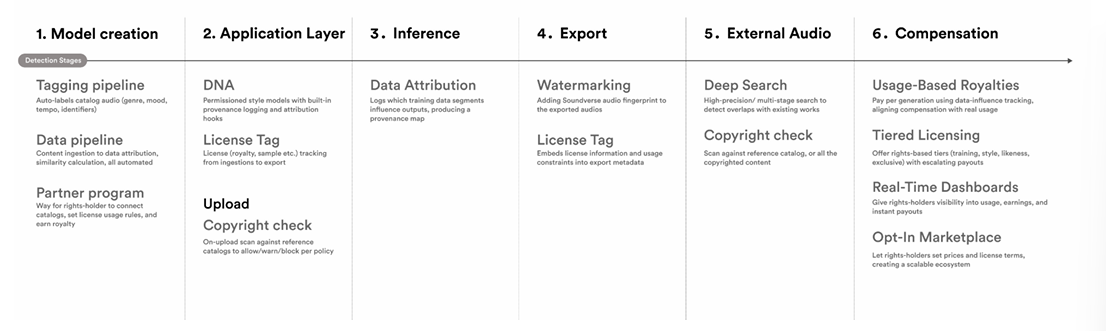
The Ethical AI Music Framework by Soundverse offers a transparent solution that aligns directly with emerging voice cloning consent laws. This end-to-end infrastructure replaces opaque black-box systems with a six-stage pipeline that bridges innovation and artist integrity.
Core Capabilities Include:
- Stage 1: Licensed Data Sourcing: Every dataset is permission-based, rejecting scraping or unverified samples.
- Stage 2: Permissioned Models (DNA): Training only on licensed artist catalogs ensures voice ethics and monetization opportunities.
- Stage 3: Explainable Inference (Attribution): AI outputs can be traced to their authorized source.
- Stage 4: Traceable Export (Watermarking): Synthetic audio embeds transparent voice identity.
- Stage 5: Deep Search (External Scanning): System-wide scans ensure generated voices don’t breach external rights.
- Stage 6: Recurring Compensation: Artists receive periodic royalties for approved usage.
This framework helps AI developers remain compliant with international standards while fulfilling consent and transparency mandates critical under 2026 global voice rights law.
For example, enterprise users who integrate Soundverse DNA can safely generate artist-styled audio without breaching likeness rights, while Soundverse Trace provides ongoing verification of proper attribution across production chains. Related innovations also extend into broader AI music applications such as text-to-music generation and stem separation tools, all adhering to rigorous ethical standards.
If you are exploring the evolving role of AI music and voice synthesis, complementary reads like how AI-generated music is transforming the music industry or Soundverse AI revolutionizing music creation for new age content creators provide additional insight into ethical technology applications.
What does the future hold for international voice rights and synthetic media legislation?
In 2026 and beyond, several developments are anticipated:
- International Harmonization: Countries may adopt unified frameworks similar to global copyright treaties.
- Stronger Artist Monetization Models: Consent-based voice training opens new avenues for revenue and licensing.
- AI Transparency Platforms: New registries may document consent at dataset and output levels to assure authenticity.
- Integration in Entertainment: Ethical AI voice generators will underpin film dubbing, music creation, and interactive media with verified licensing.
Soundverse’s model already embodies these goals by integrating transparency and ongoing compensation, positioning it as the blueprint for ethical AI deployment under new cloning laws.
Explore AI Voice Creation Responsibly
Discover how Soundverse empowers you to generate and customize voices ethically with full user consent. Stay compliant while embracing innovation in voice and sound generation.
Start Creating with Soundverse
Related Articles
- AI Music in the USA: Uncover how AI technology is reshaping American music production and copyright regulations.
- Copyright-Free vs. Royalty-Free Music: What Creators Should Know: Learn the key differences between copyright-free and royalty-free music and how to use each legally.
- Navigating the World of Royalty-Free and Copyright-Free Music Using Soundverse AI: Find out how Soundverse helps creators access and generate legally safe music for all types of content.
- The Role of AI Music in Film and Television: Explore how AI-generated music and voice tools are transforming soundtracks and storytelling on screen.
Here's how to make AI Music with Soundverse
Video Guide
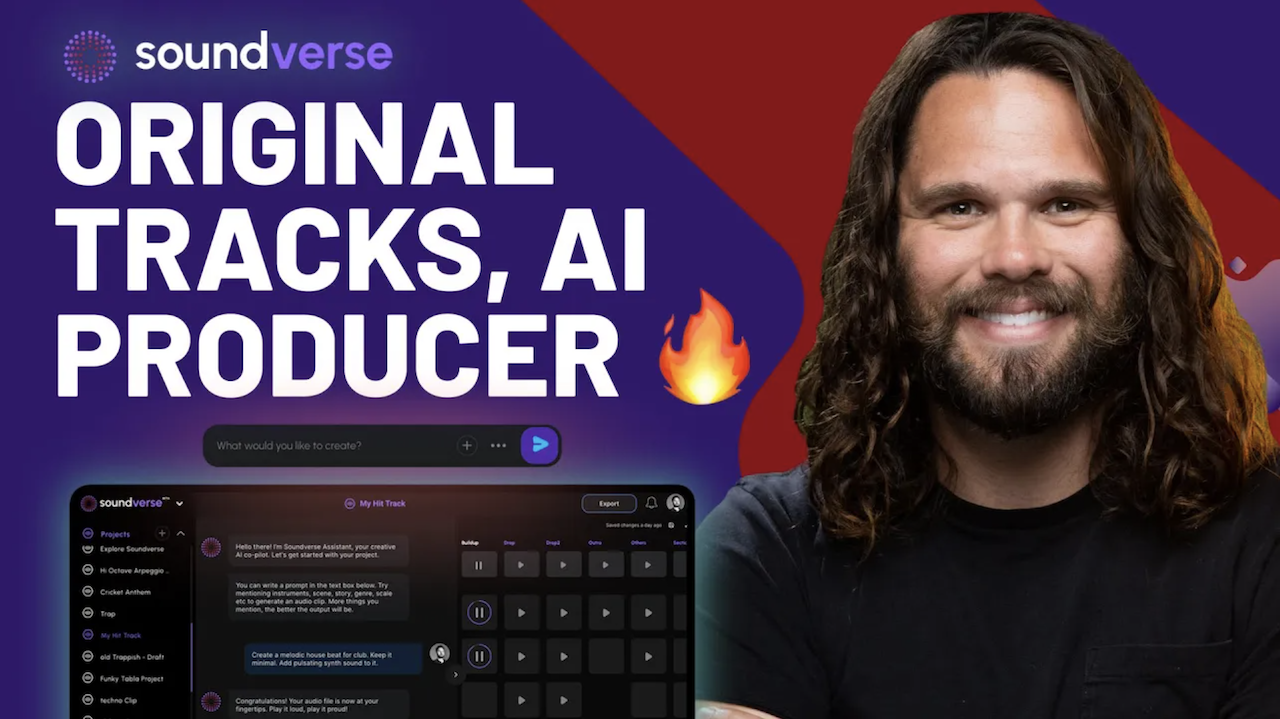
Here’s another long walkthrough of how to use Soundverse AI.
Text Guide
- To know more about AI Magic Tools, check here.
- To know more about Soundverse Assistant, check here.
- To know more about Arrangement Studio, check here.
Soundverse is an AI Assistant that allows content creators and music makers to create original content in a flash using Generative AI. With the help of Soundverse Assistant and AI Magic Tools, our users get an unfair advantage over other creators to create audio and music content quickly, easily and cheaply. Soundverse Assistant is your ultimate music companion. You simply speak to the assistant to get your stuff done. The more you speak to it, the more it starts understanding you and your goals. AI Magic Tools help convert your creative dreams into tangible music and audio. Use AI Magic Tools such as text to music, stem separation, or lyrics generation to realise your content dreams faster. Soundverse is here to take music production to the next level. We're not just a digital audio workstation (DAW) competing with Ableton or Logic, we're building a completely new paradigm of easy and conversational content creation.
TikTok: https://www.tiktok.com/@soundverse.ai
Twitter: https://twitter.com/soundverse_ai
Instagram: https://www.instagram.com/soundverse.ai
LinkedIn: https://www.linkedin.com/company/soundverseai
Youtube: https://www.youtube.com/@SoundverseAI
Facebook: https://www.facebook.com/profile.php?id=100095674445607
Join Soundverse for Free and make Viral AI Music

We are constantly building more product experiences. Keep checking our Blog to stay updated about them!