What Are the Primary Differences Between Speech Synthesis and Singing Synthesis?
Speech synthesis vs singing synthesis: how pitch, note length, sustained vowels, vibrato, timing and training data differ, plus the main models and tools.
The main difference in speech synthesis vs singing synthesis is who sets pitch and timing. A text-to-speech model invents its own intonation and rhythm from the words. A singing model follows a score: exact pitches and note lengths, long sustained vowels, vibrato, a wider range, breaths placed by the phrase and syllables that land on the beat.
The inputs, training data, model designs and tools all follow from that. Research details below come from the linked papers and docs, checked on 14 November 2026.
Speech synthesis vs singing synthesis at a glance
- Input. Speech: text, sometimes with markup or a style prompt. Singing: lyrics plus a score, meaning note pitches, note lengths and tempo.
- Pitch. Speech: predicted by the model and free to wander. Singing: fixed by the notes and judged on being in tune.
- Duration. Speech: set by a natural speaking rate. Singing: each syllable has to fill its note at the song's tempo.
- Vowels. Speech: short. Singing: sustained, often for a beat or more.
- Expression. Speech: emphasis and intonation. Singing: vibrato, scoops, overshoot and held tone on top of the notes.
- Breath and timing. Speech: pauses fall at punctuation. Singing: breaths fit between phrases, and onsets sit on a beat grid.
- Training data. Speech: models train on up to tens of thousands of hours. Singing: public corpora run from under an hour to about 80 hours, with notes annotated.
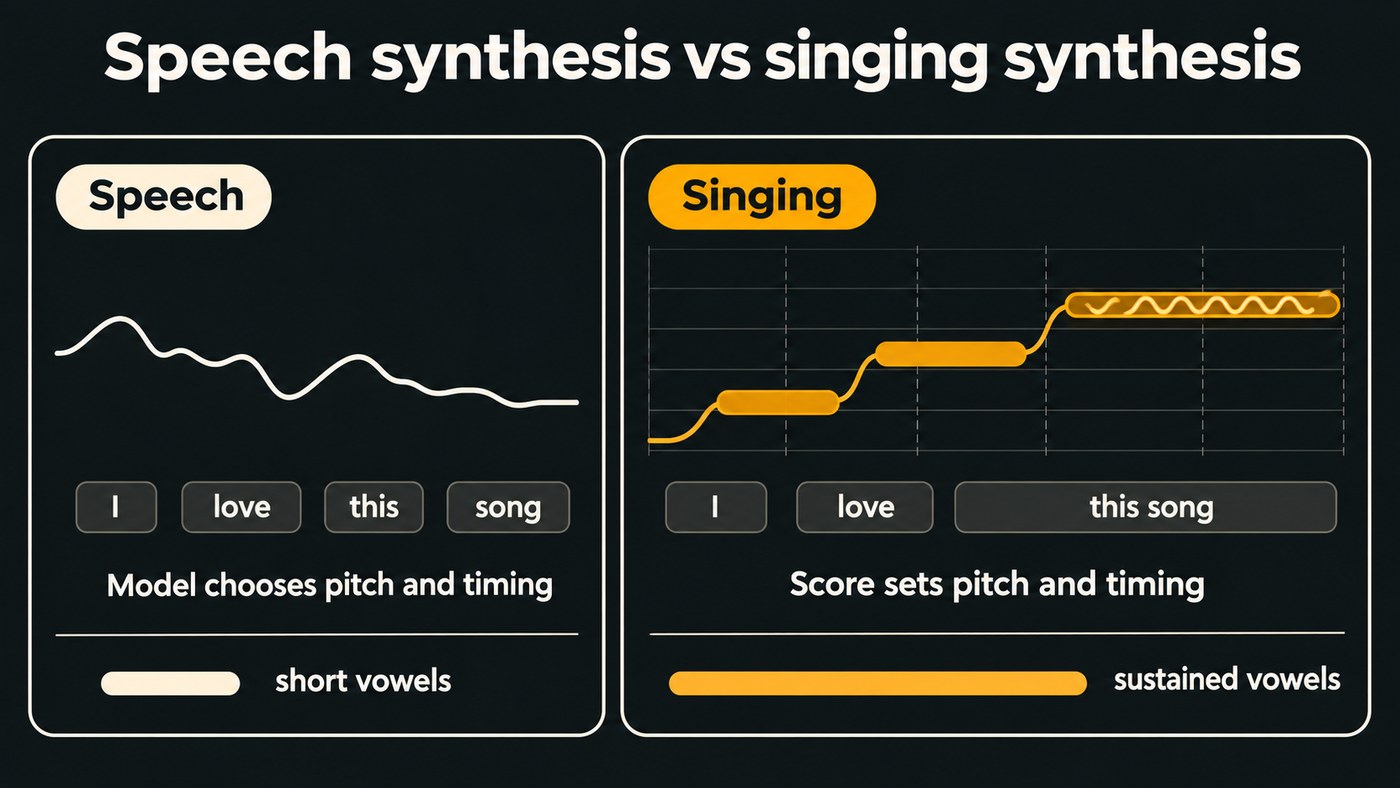
Pitch and duration: predicted by the model vs written in a score
A modern text-to-speech model decides intonation and timing itself. FastSpeech 2 (Yi Ren and colleagues, ICLR 2021) is a clear example: during training it extracts duration, pitch and energy from real recordings, and at synthesis time it uses its own predicted values. You can steer the result, but only loosely. The W3C's SSML 1.1 specification, a Recommendation since 7 September 2010, says: "The prosody element permits control of the pitch, speaking rate and volume of the speech output." Those controls are hints such as "high", "x-slow" or a relative change in hertz, and the spec leaves the curve between pitch targets to each synthesizer.
Singing synthesis has the opposite job. The Sinsy paper by Yukiya Hono and colleagues, published in IEEE/ACM Transactions on Audio, Speech and Language Processing and posted to arXiv on 5 August 2021, states it directly: "SVS systems are required to synthesize a singing voice with pitch and timing that strictly follow a given musical score." Its score features include lyrics, note keys, note lengths, tempo, dynamics and slurs.
You can see the shift in XiaoiceSing (Peiling Lu and colleagues, June 2020). It takes FastSpeech, a speech architecture, and adds three things for singing: note pitch and length as inputs, a residual connection in pitch prediction to reduce off-key notes, and a syllable-level duration loss so the phonemes inside a note add up to that note's length. A speech model can stretch a word however it likes. A singing model's syllables have to fit the bar.
Sustained vowels, vibrato and range
The clearest evidence comes from people who both spoke and sang the same words. In the NHSS database (Bidisha Sharma and colleagues at the National University of Singapore, accepted by Speech Communication, arXiv v2 dated 5 August 2021), 10 singers sang and read the lyrics of 100 English pop songs, 7 hours of audio in all. Their measurements:
- Vowels last far longer. The average vowel was 830.5 ms sung against 148.0 ms spoken, more than five times longer. Every class of sound stretched, and vowels stretched most.
- Pitch sits higher. Mean F0 on vowels was 268.67 Hz in singing against 170.73 Hz in speech.
- Pitch clusters on notes. In their pitch histograms, singing shows sharp peaks at the song's notes, while speech is relatively flat.
- Pitch moves in singer-specific ways. The authors list vibrato, overshoot and preparation as fine pitch variations that make singing sound natural.
Long vowels are a stress test. Any buzz, wobble or lifeless steadiness a short spoken vowel would hide is exposed across a held note, which is why singing models put so much work into pitch curves and vibrato. Sinsy's authors, for example, separate vibrato from the underlying pitch line and model it with its own parameters so it can be reproduced and controlled. Range matters for the same reason: a song asks for notes near the top and bottom of a voice, where speech rarely goes and where voices change character. For the pipeline behind this, see how AI voice synthesis generates singing vocals.
Breath and timing to a beat
Speech has no beat. A synthesizer can pause for as long as a comma feels natural. Singing hangs on a tempo, and sung notes don't always start exactly where the score puts them. Sinsy includes a separate time-lag model just to predict how far each sung note starts from its written position, and the authors argue that end-to-end designs borrowed from TTS aren't enough on their own because the voice has to stay locked to the score.
Breaths follow the music too. A singer breathes where the phrase allows, and on an exposed vocal the breath is part of the performance. Whether AI can reproduce that is covered in can AI replicate breathiness and subtle vocal artifacts.
Training data: hours of speech vs hours of annotated singing
Speech data is plentiful. VALL-E, described by Chengyi Wang and colleagues in January 2023, was trained on 60,000 hours of English speech, which its authors say is hundreds of times more than earlier systems, and it imitates an unseen speaker from a 3-second recording.
Singing data is small by comparison. The Synthetic Singers review by Changhao Pan and colleagues, accepted at IJCNLP-AACL 2025 and posted on 20 January 2026, lists public singing datasets: Opencpop has 5.3 hours from one singer, M4Singer 29.8 hours from 20 singers, and the largest in its table, GTSinger, 80.6 hours across nine languages. The review explains why: compared with speech, singing synthesis needs higher-quality recordings and finer-grained annotation, which makes collection much harder.
The same review notes that TTS has largely moved to end-to-end models, while singing synthesis still has many strong cascaded systems that predict a spectrogram first and render audio second, partly because that design holds up better when data is scarce.
Main model families and tools on each side
Speech synthesis
- Sequence-to-sequence plus vocoder: Tacotron 2 (ICASSP 2018) turned text into spectrograms, then a neural vocoder into audio.
- Non-autoregressive with prosody predictors: FastSpeech 2 predicts duration, pitch and energy.
- Codec language models: VALL-E treats speech as tokens and clones a voice from seconds of audio.
- Tools: cloud services such as Amazon Polly and Google Cloud Text-to-Speech, which both accept SSML, plus voiceover apps. Soundverse's AI Speech Generator sits here.
Singing synthesis
- Score-based vocal synths: Yamaha's VOCALOID6 uses an AI engine, VOCALOID:AI, that sings the melody and lyrics you enter, in Japanese, English and Chinese from a single voicebank. Synthesizer V and ACE Studio are also note-based.
- Research models: Sinsy, XiaoiceSing and diffusion models such as DiffSinger.
- Singing voice conversion: you sing, and the model changes the voice but keeps your performance.
- Song generators: lyrics and a style prompt in, a full song with vocals out, as with Soundverse v9 on the Pro and Max plans.
The difference between text-to-speech and AI-based vocal synthesis
Text-to-speech is one branch of AI vocal synthesis. In music, "AI vocals" usually means one of four things:
- Text-to-speech: text becomes spoken audio. Use it for spoken intros, skits and narration.
- Score-based singing synthesis: lyrics plus notes become singing. Use it when you've written the melody and want control of every note.
- Singing voice conversion: your sung take comes back in another voice. Use it when you can sing the part but want a different voice.
- Song and vocal generators: lyrics and a style become a sung vocal or a whole song, with the melody written for you.
Pitch-correcting a TTS voice is the shortcut people try first. The vowels stay speech-length, so it sounds like tuned talking rather than singing. Our guide on how to make text-to-speech sing covers what works.
This walkthrough of Soundverse's Create tools shows AI Singing Generator from 0:31 and AI Speech Generator from 0:39, the singing and speaking sides of this comparison.
Where Soundverse fits
Soundverse is an AI music platform that takes you from idea to audience, built for independent artists who release music, and it has tools on both sides. AI Speech Generator reads up to 3,000 characters per run in one of 18 built-in voices. AI Singing Generator sings your lyrics as an a cappella vocal in a style such as pop, rap, rock or choir, or in a voice similar to a reference of at least 30 seconds. The speech tool's own page puts the line simply: use the speech generator when the words should be spoken, and the singing generator when they should be sung.
To sing a melody you wrote, MIDI to Song Generator builds a sung song that follows 5 to 60 seconds of a .mid file with your lyrics. Voice Swap is the conversion route: it re-sings your take in another voice and keeps the performance. Soundverse has no vocal synth for drawing pitch and vibrato curves note by note, so for that level of control use a score-based vocal synth.
FAQ
Is singing synthesis just text-to-speech with a melody added? They share a lot: phonemes, acoustic models and vocoders, and many singing models started from speech architectures. Singing adds a score, so pitch and duration are fixed rather than predicted, along with sustained vowels and vibrato that speech models never had to learn.
Why is a singing voice harder to clone than a speaking voice? There's far less training data, and it needs note-level annotation. A clone also has to hold up across long vowels and a wider range, where flaws are easier to hear. For what makes expressive AI singing hard, see the common challenges of expressive AI vocals.
Can I use a TTS voice for the spoken parts of my song? Yes. Spoken intros, skits and spoken-word bridges suit text-to-speech. Put each line on its own track and time it to the beat by hand.
Which AI singing tool should a singer-songwriter start with? If you have the melody, use a score-based synth or a MIDI-to-song tool. If you can sing it, voice conversion keeps your phrasing. Our comparison of the best AI singing generator platforms goes through the options.
Sign up for Soundverse free and hear the same lyrics spoken and sung. More vocal guides on the Soundverse blog.
