AI Voice Synthesis Explained: How It Works for Generating Singing Vocals
AI singing voice synthesis explained: how lyrics become phonemes, notes set pitch and timing, and acoustic models and vocoders turn them into a vocal.
AI singing voice synthesis turns lyrics and a melody into singing in four stages: words become phonemes, notes set each sound's pitch and length, an acoustic model predicts how the voice should sound, and a vocoder renders it as audio. Newer models merge stages, but that is still how AI voice synthesis works for generating singing vocals.
Knowing the stages tells you which input fixes which problem. A mispronounced word points to the phoneme step, a robotic held note to the pitch step, a metallic edge to the stages that render sound. Research details below come from the linked papers, checked on 7 November 2026.
The four stages of AI singing voice synthesis
Many singing voice synthesis (SVS) systems follow what researchers call a cascaded pipeline. "Synthetic Singers", a review by Changhao Pan and colleagues accepted at IJCNLP-AACL 2025 and posted to arXiv on 20 January 2026, sums it up: "In this cascaded approach, an acoustic model predicts intermediate acoustic features from the score, after which a vocoder converts these features into the waveform." Here is what that means in plain language.
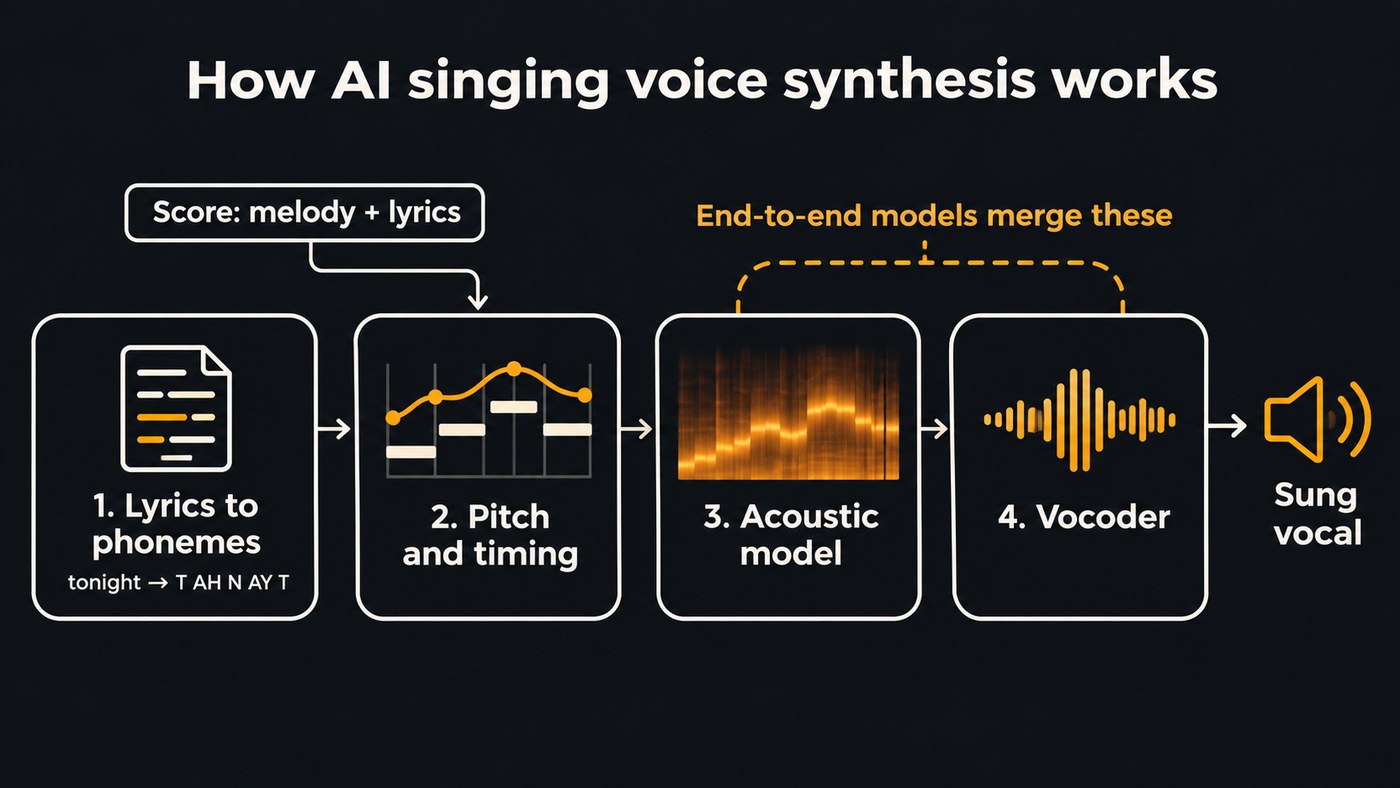
1. Lyrics become phonemes
The model doesn't sing letters. It sings phonemes, the individual sounds of a language, so a grapheme-to-phoneme (G2P) step converts your spelling into sounds, usually from a pronunciation dictionary with a fallback guess for words it doesn't contain. In the CMU Pronouncing Dictionary, a standard open resource for North American English, "tonight" is T AH0 N AY1 T: five sounds, with the main stress on "night".
When an AI singer mangles a name, a slang word or a number, this is often where it went wrong. Respell the word the way it sounds.
2. Notes set pitch and timing
Next, every phoneme gets a pitch and a place in time. The review describes this layer as deciding what to sing and when, by combining the phonemes with score information such as MIDI pitch and note length. It has two jobs:
- How long each sound lasts. Hold "tonight" over two beats and the consonants stay short while the vowel takes most of the note. Duration models decide this, including melisma, where one syllable spreads over several notes.
- The pitch curve. Singers never sit flat on a note. They scoop in, drift and add vibrato. Many systems predict a continuous pitch curve, called F0, on top of the written notes.
In the tools you use, this stage is fed by the melody: notes drawn in a piano roll, a MIDI file, a hummed tune, or a melody the model writes itself.
3. The acoustic model creates the voice
The acoustic model is the singer. Given phonemes, timing and pitch, it predicts a mel-spectrogram, a picture of which frequencies sound at each moment. This is where the voice's character, its timbre, comes from, learned from recordings of singing labelled with lyrics, phoneme timings and notes.
DiffSinger, presented at AAAI 2022 by Jinglin Liu and colleagues, is a well-known example. Its authors note that earlier acoustic models trained on simple error measures suffered from over-smoothing, which sounds averaged and blurry. DiffSinger uses a diffusion model instead, building the spectrogram out of noise over many small steps, and the review credits it with markedly better spectral detail.
4. The vocoder renders the audio
A spectrogram still isn't sound. The vocoder turns it into a waveform you can play. Older vocoders used signal-processing algorithms; according to the review, the most widely adopted neural vocoders today are GAN-based, such as HiFi-GAN, introduced at NeurIPS 2020.
A metallic buzz or a smeared "s" in an AI vocal can come from this last step, or from a spectrogram that was already missing detail.
The technology behind realistic singing voice generation
The hardest problem in singing synthesis is that one score can be sung many good ways. The review calls it the one-to-many mapping from score to waveform. A model trained to minimise average error lands between all the good performances, and the result sounds smooth and lifeless. Recent progress comes from four directions:
- Models that commit to one performance. Diffusion and flow-matching models generate one plausible take rather than an average of many.
- Better pitch modelling. Dedicated pitch models produce more natural pitch curves, the scoops and vibrato listeners notice first.
- End-to-end generation. Systems such as VISinger generate the waveform directly, with no separate vocoder, so errors don't pile up between stages. The review notes that cascaded systems still give a higher floor when training data is limited, while end-to-end models have a higher ceiling but need more data.
- Style and technique control. Research systems increasingly take a text prompt or reference audio describing the singing style or technique you want.
The same review says current systems already get lyrics and pitch right, but a substantial gap remains between their output and what listeners expect, with expressiveness, style and realism the next targets.
Singing voice synthesis vs voice conversion vs full-song generators
Most AI singing tools are built on one of three approaches, and each needs a different input from you.
Singing voice synthesis: you write the notes
Score-based synthesis is the pipeline above. You supply the melody and lyrics, usually in a piano roll, and the model sings exactly that. You get the most control and do the most work. For which tools sound most natural on an exposed vocal, see the most realistic AI vocal synthesis for singer-songwriters.
Voice conversion: you sing, the AI changes the voice
Voice conversion starts from a real performance. The model separates what is sung, and how, from who sings it, then re-renders the take in another voice. The review describes the usual approach as splitting a recording into factors such as content, rhythm and timbre, then recombining them. Because your phrasing and timing carry through, conversion often sounds the most human.
Its weak spot is likeness. The Singing Voice Conversion Challenge 2023 compared 26 submissions in a large crowd-sourced listening test, and the organisers report that "although human-level naturalness was achieved by the top system, no team was able to obtain a similarity score as high as the target speakers." Sounding natural and sounding identical are different targets. Soundverse's Voice Swap is a conversion tool: it re-sings a vocal in another voice model and keeps the original performance. For tools aimed at matching one particular voice, see which AI tools clone a specific vocal timbre best.
Full-song generators: the voice and the band at once
Full-song generators take lyrics and a style description and return a finished track, so the melody, phrasing and arrangement are generated along with the voice. YuE, an open model family described on arXiv in March 2025, shows one design: built on the LLaMA2 language-model architecture, it predicts music as a sequence of tokens, much as a chatbot predicts text, and generates songs of up to five minutes while keeping the lyrics aligned.
Soundverse's AI Song Generator is this kind of tool. In Custom mode it sings your lyrics word for word over a full arrangement, and on Pro and Max it starts on Soundverse v9.
Some tools sit in between. Soundverse's AI Singing Generator takes your lyrics and a vocal style, with no melody to supply, and returns only the voice: an a cappella vocal, or one sung in a voice similar to a reference recording of at least 30 seconds. For a side-by-side of singing tools, see the best AI singing generator platforms for independent artists.
This demo shows AI Singing Generator turning lyrics into an a cappella vocal with no instrumental, guided by a vocal reference.
What you control at each stage
- Phonemes: your spelling. Write words as they're sung, and numbers as words.
- Pitch and timing: your melody. Draw it, play it as MIDI or hum it. Soundverse's Melody to Song Generator follows 5 to 60 seconds of a hummed, sung or played tune, and MIDI to Song Generator follows a .mid file.
- Timbre: your voice model or reference. Clean, dry recordings across your range give a model the most to learn from. Soundverse's Train Voice Model page notes that background music, noise, reverb and takes that stay on a few notes all lower quality.
Where Soundverse fits
Soundverse is an AI music platform that takes you from idea to audience, built for independent artists who release music, and it covers each route above. AI Singing Generator sings your lyrics a cappella, Voice Swap re-sings a take you recorded in another voice while your phrasing stays, and AI Song Generator makes full songs with vocals, on Soundverse v9 for Pro and Max.
To sing new songs in your own voice, Train Voice Clone works from one take with at least 15 seconds of singing, on the Creator plan and above. Training won't start until you confirm the voice is yours or that the singer has given explicit consent.
If you want to draw every pitch bend and breath yourself, a note-based vocal synth is built for that job.
FAQ
Is AI singing just text-to-speech with a melody? They're close relatives. The review notes that early singing systems were largely built on text-to-speech frameworks, with music-specific parts such as score encoders and pitch predictors added. Singing brings fixed pitches and note lengths, much longer vowels and vibrato, which is why singing models are trained on singing.
How much audio does an AI need to sing in my voice? It depends on the method. Soundverse's Train Voice Clone needs one take with at least 15 seconds of singing, while Train Voice Model, which builds a higher-fidelity model for Voice Swap, needs at least 10 minutes of clean, dry solo recordings. Use only your own voice or one you have consent to use.
Do I need to read music to use AI singing voice synthesis? No. Note-based synths use a piano roll, but you can also hum a melody, give a MIDI file, or let a song generator write the melody for you.
Why do AI vocals still sound synthetic sometimes? Most often it's the performance: dead-flat held notes, identical vibrato, no breaths. Giving the model a human melody or a sung take to follow is the most reliable fix.
Sign up for Soundverse free and hear your lyrics sung. More vocal guides on the Soundverse blog.
