Explain the Concept of Royalty-Free AI Music Generation
Royalty-free AI music generation explained: what the license covers, who owns AI output, PRO and Content ID limits, and how to read vendor terms.
Royalty-free AI music generation means making music with an AI tool whose license lets you use the output without paying a royalty each time it's played, streamed or broadcast. You pay for the plan instead. It doesn't make the music free, copyright-free or automatically yours, and each vendor's terms decide what you can do with it.
Below: what the term means in licensing, how it changes when a model writes the music, where copyright law draws the line, and how to read any vendor's terms. Sources were read on 23 November 2026. This is general information, not legal advice.
What "royalty-free" means in a license
A royalty is a running payment: a fee per copy, per stream or per broadcast. A royalty-free license swaps it for a fixed price, paid once or as a subscription. Soundraw's license page gives the plain version in its FAQ: royalty-free means using a track without paying royalties for each use, and subscribing gets you a license, meaning permission, to use the tracks you download.
Three things the term doesn't mean:
- Free of charge. You pay through the plan, and free tiers often leave out commercial use.
- Copyright-free. Someone may still own the track; you hold permission to use it. Stock libraries work the same way, as our guide to the advantages of royalty-free audio libraries explains.
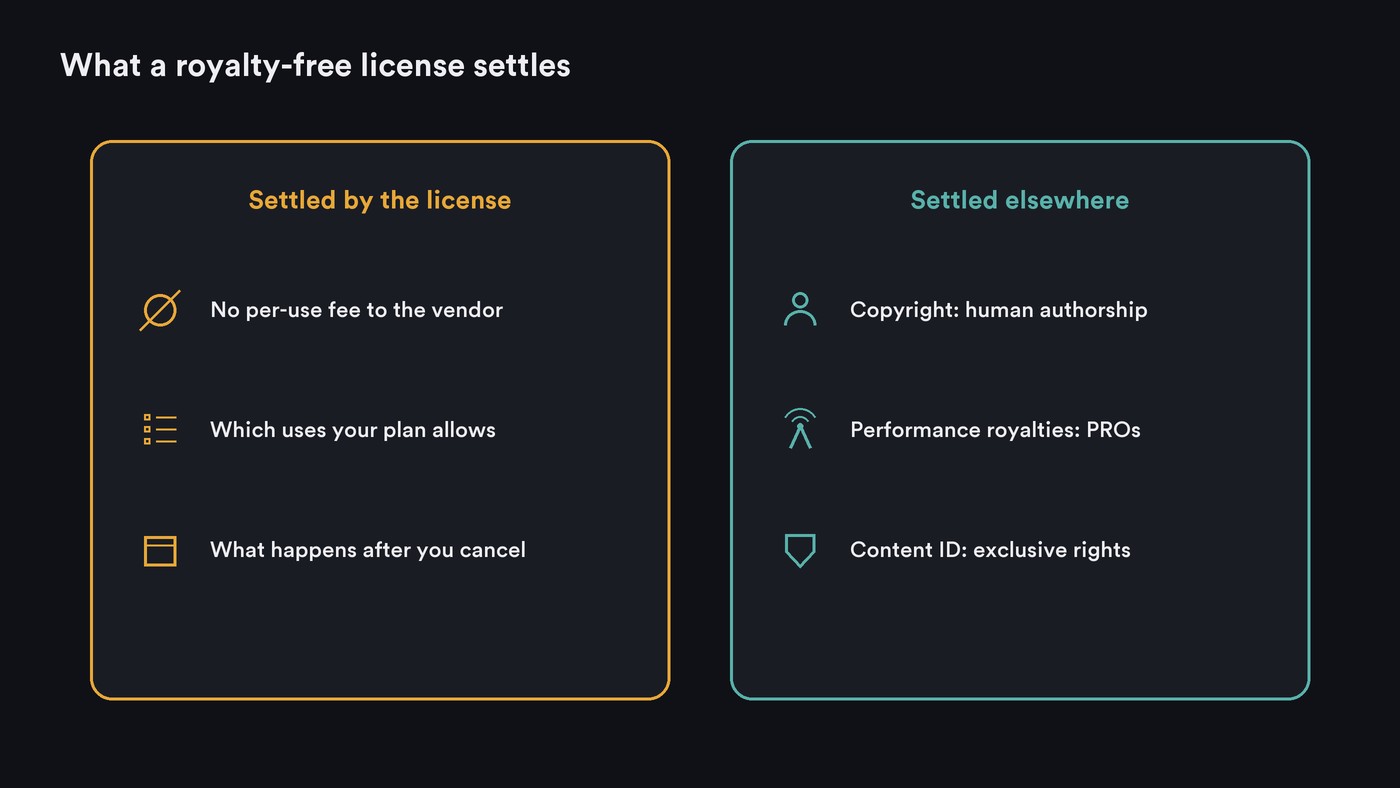
- Free of performance royalties. The license settles what you owe the licensor. Performing rights organizations (PROs) license broadcasters, venues and streaming services separately and pay the songwriters of registered compositions. That system runs alongside any royalty-free deal, and for AI music it runs into the authorship question below.
How royalty-free works when an AI generates the music
In a stock library, a composer wrote the track and the library licenses it to you. With AI generation there's no composer in the usual sense, so the vendor's terms do the work. They take one of two routes:
- The output goes to you. Suno's Terms of Service (effective 3 September 2026) assign Suno's rights in output to Pro and Premier subscribers, while free and basic users may use output only for personal, non-commercial purposes. ElevenLabs' Music Terms (last updated 9 October 2026) say that, as between you and ElevenLabs, you keep all rights in your input and output.
- The vendor keeps it and licenses use. Mubert's license page states that Mubert owns all rights to the tracks generated, and its sync license covers videos, podcasts, apps and games.
Either way, "royalty-free" describes the payment, not the ownership. A vendor also can't hand over rights that may not exist, and Suno's terms say so directly: "Due to the nature of machine learning, Suno makes no representation or warranty to you that any copyright will vest in any Output." ElevenLabs puts the checking on you: its terms make you responsible for reviewing output for clearance before you use, publish or distribute it.
Who owns AI-generated music: the human-authorship limit
Copyright, where it exists, comes from the law, not from the license. Three official sources set the current position.
- The U.S. Copyright Office. In Part 2 of its report on copyright and AI, released on 29 January 2025, the Office concluded that "the outputs of generative AI can be protected by copyright only where a human author has determined sufficient expressive elements." That can include human-authored material perceptible in the output, or creative arrangements or modifications of it, "but not the mere provision of prompts." Using AI to assist doesn't bar protection.
- U.S. courts. In Thaler v. Perlmutter, decided on 18 March 2025, the D.C. Circuit held that the Copyright Act of 1976 requires all eligible work to be authored in the first instance by a human being. The Supreme Court denied review on 2 March 2026 (docket No. 25-449).
- The United Kingdom. UK law has protected "computer-generated" works since 1988, for 50 years from creation, treating as author whoever made the arrangements needed to create the work. The government's Report on Copyright and Artificial Intelligence, published on 18 March 2026, proposes removing that protection in the absence of evidence of its ongoing value, while keeping protection for works made with AI assistance. It notes that under that option, AI-generated music could still be protected as a sound recording.
For a US track generated from a prompt alone, that means the track may have no copyright at all, whatever your plan says. Your royalty-free license still governs what you and the vendor owe each other, but it may not let you stop someone else from copying the track. The protectable part is what you add: lyrics, a topline, an arrangement, a performance, edits. Our guide to how AI tools handle copyright and ownership goes deeper.
Royalty-free AI music and performance royalties
If you release a song with AI parts and want performance royalties as its writer, the PRO's rules apply, not the vendor's. On 28 October 2025, ASCAP, BMI and SOCAN announced aligned policies: each now accepts registrations of partially AI-generated works, defined as combining AI-generated musical content with human authorship, while compositions created entirely with AI tools aren't eligible with any of the three. Outside North America, check your own society's rules. Our walkthrough of registering music with performance rights organizations covers the steps.
So the two questions stay separate. The royalty-free license settles what you owe the vendor; PRO registration settles what you might collect as a songwriter.
What a royalty-free license on an AI music tool typically allows and forbids
Every vendor words it differently, but six clauses decide most uses. The examples come from each vendor's own pages, read on 23 November 2026; our comparison of AI music generators for royalty-free commercial use goes vendor by vendor.
- Commercial use. Usually paid plans only. Suno limits free and basic users to personal, non-commercial use, and Mubert's license page calls Free and Creator non-commercial and points monetized videos to Pro or Ultra.
- Streaming release. This is where vendors differ most. ElevenLabs' rights table prohibits music streaming distribution on Free and Starter and permits it from Creator up. Soundraw allows it on Artist plans only once you've modified the beat, for example by adding your own vocals. Mubert doesn't allow it on any plan.
- Client work. Mubert covers freelance and agency work on Ultra. Soundraw lists client work on all plans but asks you to check with it first for video content you don't own, such as ads. ElevenLabs ties eligibility to headcount: Free to Pro are for individual use only, Scale is for organizations under 10 employees and Business for under 50.
- Resale of raw tracks. Banned almost everywhere. ElevenLabs bars using output to build a music library for others; Mubert bars reselling tracks or putting them on stock sites; Soundraw bars selling even a modified beat on stock audio platforms.
- Content ID registration. Mubert and Soundraw forbid it. YouTube's Content ID rules require exclusive rights in the material you claim, and royalty-free licenses are normally non-exclusive, so expect this clause to say no.
- After you cancel. Suno says commercial rights in tracks you've downloaded are perpetual and unaffected by cancellation. ElevenLabs says that if a self-serve user downgrades or leaves, each track stays under the plan in effect when it was made. Soundraw says meditation, lo-fi and relaxation content that uses its tracks as downloaded stays published only while you subscribe.
Voices add one more layer, the singer's consent. See what royalty-free means for an AI voice model.
How to read any vendor's royalty-free terms: a checklist
- Ownership. Is the output assigned to you, kept by you, or owned by the vendor and licensed?
- Copyright warranty. Does the vendor promise that copyright exists? Expect not, for the reasons above.
- Plan at generation. Which tier grants commercial use, and does the plan on the day you generate decide it?
- Named uses. Streaming release, ads, broadcast, games, client delivery: is each allowed, excluded or "ask us"?
- Who may subscribe. Look for headcount or revenue caps.
- Resale and libraries. Any ban on stock sites, sample packs or music libraries.
- Content ID. Allowed, forbidden or not mentioned? Silence isn't permission.
- Cancellation. Are downloads covered for good, or only while you subscribe?
- Your inputs. You need the rights to any audio, lyrics or reference you upload.
- Your own authorship. If you want copyright or PRO registration, plan what you'll write, play or sing yourself.
- Proof. Save a dated PDF of the terms, your invoice and each track's ID or certificate.
Where Soundverse fits
Soundverse is an AI music platform that takes you from idea to audience, built for independent artists who release music. AI Music Generator composes original instrumentals with no vocals from a prompt plus genre, theme, vibe, instrument and tempo tags. Generate in Studio places the track on an AI Studio timeline, where you can record your own vocals or parts over it.
Licensing is set by plan: the Free plan is for personal use, and the Creator plan comes with a royalty-free license. The Pricing page lists MP3 downloads on Free, and WAV and stem downloads on Creator, Pro and Max.
From 0:17, this walkthrough of Soundverse's Create tools shows AI Music Generator making an instrumental from a prompt.
FAQ
Is royalty-free AI music free? Not usually. Royalty-free means no per-use payments once you've paid for the plan. Free tiers often exclude commercial use; Suno, for example, limits free users to personal, non-commercial use.
Do I own the music I make with a royalty-free AI music generator? It depends on the terms and on the law. Some vendors assign or leave the output with you, others keep ownership and license its use. In the US, copyright needs sufficient human expressive input, and a prompt alone doesn't count.
Can I register a royalty-free AI track with a PRO? In the US and Canada, ASCAP, BMI and SOCAN accept partially AI-generated works that include human authorship, but not compositions created entirely with AI tools. The vendor's license doesn't change that.
Can I put royalty-free AI music into Content ID? Usually not. Content ID requires exclusive rights in the material you claim, and some vendors, including Mubert and Soundraw, forbid registering their tracks.
Sign up for Soundverse free and try AI Music Generator on the Free plan. More guides on rights and releasing on the Soundverse blog.