Can You Describe How AI Tools Handle Copyright and Ownership for Generated Music Tracks?
AI music copyright explained: what Suno, Udio, ElevenLabs and AIVA terms say about owning generated tracks, what the law says, and what to check first.
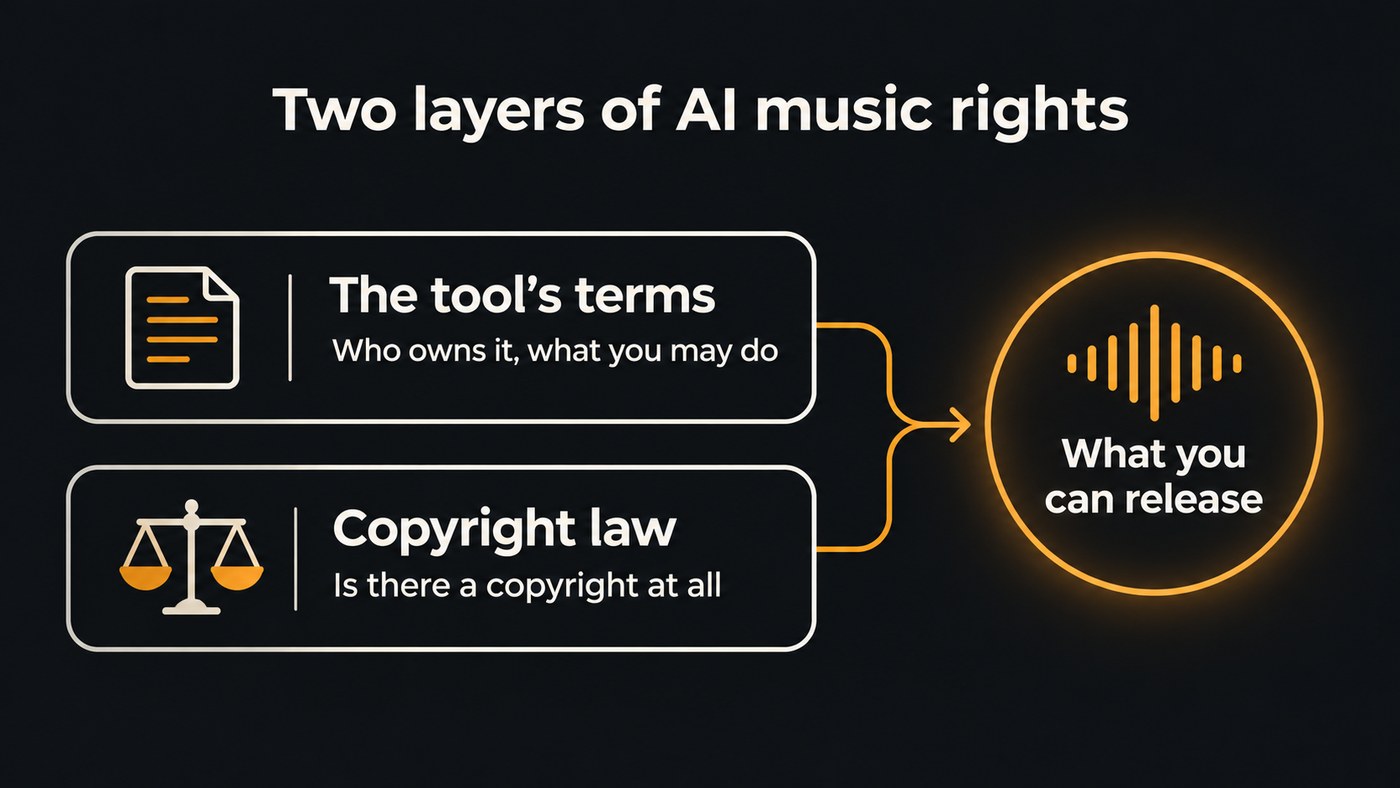
AI music copyright works in two layers. The tool's terms decide who owns a generated track and what you may do with it, and the law decides whether anyone holds a copyright in it at all. Paid plans often give you ownership or commercial rights, but in the US a track with no human authorship isn't protected by copyright.
Below are the terms of Suno, Udio, ElevenLabs and AIVA, taken from each company's own pages and checked on 7 November 2026, followed by what US and UK law say about human authorship and a checklist to run before you release anything.
Ownership and copyright are two separate questions
Ownership is a contract question. A tool can assign its rights in a track to you, let you keep the output but limit how you use it, or keep ownership itself and give you a narrow permission.
Copyright is a legal question. In the US it only exists where a human author made the expressive choices. If nobody did, a contract can hand you "ownership" of something with little or no copyright inside it. Suno's own terms say so plainly: "Due to the nature of machine learning, Suno makes no representation or warranty to you that any copyright will vest in any Output."
What you write and perform yourself is a different matter. Your lyrics, your melody and your sung vocal are your work wherever you record them, though most terms also give the company a license to whatever you upload, so read that clause too.
How do different AI music platforms handle copyright for generated songs?
Each summary below comes from the company's own terms or pricing page, with the date that page shows.
Suno
Suno's Terms of Service, effective 3 September 2026:
- Pro and Premier: Suno assigns you all of its right, title and interest in output it owns that was generated from your submissions, still subject to its terms and commercial use restrictions.
- Commercial use applies only to tracks you've downloaded within your tier's monthly download allowance. Those rights are perpetual and survive cancellation or a downgrade.
- Free and Basic: lawful, personal and non-commercial use only. Suno's ownership help article adds that Suno keeps ownership of songs made on Basic.
- Remixes other users make from your songs are jointly owned and limited to non-commercial use.
- No warranty that your use won't infringe someone else's rights, and you may not remove Suno's fingerprint, watermark or metadata.
Udio
Udio's Terms of Service, last revised on 12 November 2025, are the most restrictive here:
- Udio and its licensors own all right, title and interest in the output, and if ownership ever vests in you, you assign it to them.
- You may use output only for personal, non-commercial purposes, you may not download copies, and you may not distribute it on streaming or user-generated platforms such as Spotify, YouTube or SoundCloud. Sharing links to some outputs may be allowed.
Under these terms, a Udio track isn't something you can release.
ElevenLabs (Eleven Music)
The ElevenLabs Music Terms, last updated on 9 October 2026, say that as between you and ElevenLabs, you keep your rights in your input and output. What you may do with it depends on the plan:
- Free: no downloads, streaming distribution prohibited, and you must credit Eleven Music when distributing.
- Starter: streaming distribution still prohibited.
- Creator and above: streaming distribution permitted.
- Below the Enterprise Music tier, media rights exclude film, TV, radio and commercial games that don't qualify as indie games.
If you downgrade or cancel, each track stays under the plan you were on when you made it. Prompts may not name artists, songwriters, songs, albums, publishers or labels, and the terms make you responsible for checking output before you use it and for following each platform's AI disclosure rules.
AIVA
AIVA's pricing page states ownership per plan:
- Free: copyright owned by AIVA, no monetization, and you must credit AIVA.
- Standard: copyright owned by AIVA, with monetization limited to YouTube, Twitch, TikTok and Instagram.
- Pro: copyright owned by you, with full monetization.
Soundverse
Licensing is set by plan: the Free plan is for personal use, and the Creator plan comes with a royalty-free license.
The patterns
Three models show up. Some tools assign ownership on paid plans (Suno Pro and Premier, AIVA Pro). Some let you keep the output but limit use by plan (ElevenLabs). Others keep ownership and restrict use (Udio, AIVA Free and Standard, Suno Basic). In most cases, the plan you were on when you generated the track is what counts. Our guide to AI music terms of service covers the other clauses worth reading.
What the law says about human authorship
United States. On 29 January 2025 the U.S. Copyright Office released Part 2 of its report on copyright and AI. It concluded that AI outputs can be protected only where a human author has determined sufficient expressive elements, such as a human-authored work perceptible in the output or creative arrangements or modifications of it. Prompts alone don't qualify.
The courts agree. In Thaler v. Perlmutter, decided on 18 March 2025, the D.C. Circuit held that a work must be authored in the first instance by a human being, and added that "the human authorship requirement does not prohibit copyrighting work that was made by or with the assistance of artificial intelligence." The Supreme Court denied review on 2 March 2026.
Registration has its own rule. The Office's registration guidance of 16 March 2023 says applicants must disclose AI-generated content, briefly explain the human author's contributions, and exclude AI-generated material that is more than de minimis. You don't list the AI tool or its company as an author.
United Kingdom. UK law has protected computer-generated works with no human author since 1988, treating the person who made the arrangements for the work as its author. The government's Report on Copyright and Artificial Intelligence, published on 18 March 2026, proposes removing that protection while keeping copyright for AI-assisted works. The same report notes that sound recording copyright, which belongs to the producer, applies regardless of human creativity, including to recordings generated by an AI system.
What it means for you. Your lyrics, topline and recorded performance are yours. An unedited generated instrumental may have no US copyright even when the terms say you own it. You can often still release it if your plan allows, but stopping copies is harder, and YouTube's Content ID rules require exclusive rights to reference material, naming content licensed non-exclusively from a third party as an example of what doesn't qualify.
What to check before you release an AI-generated track
- Your plan on the day you generated it. Suno ties ownership to the plan you were on when you made a song, and ElevenLabs keeps tracks under their original plan if you downgrade or cancel, so note the plan with each track.
- Ownership or license. Find the clause that says who owns output, and the one that says what license you give the company over your uploads.
- Commercial and streaming rights. ElevenLabs' Starter plan prohibits streaming distribution, Suno requires a permitted download, and Udio rules out distribution entirely.
- Attribution. ElevenLabs Free and AIVA Free both require a credit.
- Prompts and inputs. Leave out artist names and other people's lyrics, and only upload audio or voices you have the rights to.
- A recognition check. Run the final master through a fingerprinting tool such as Soundverse's Copyright Checker and treat any match as a question to settle first.
- Your distributor's AI policy. Read it before upload and fill in any AI credit fields honestly. We've covered DistroKid's AI rules, TuneCore's AI policy and CD Baby's AI guidelines.
- Content ID. Only opt a track in if you hold exclusive rights to it.
- Records. Save a PDF of the terms page on the day you generate, your invoice, prompts, lyric drafts and project files. You'll need them if you register the song or a claim comes in.
This walkthrough covers Soundverse's Own tools, including Copyright Checker, which checks a track against known released recordings before you release or upload it.
Where Soundverse fits
Soundverse is an AI music platform that takes you from idea to audience, built for independent artists who release music. Licensing is set by plan: the Free plan is for personal use, and the Creator plan comes with a royalty-free license.
Copyright Checker runs on every plan, including Free. It fingerprints a track and tells you whether it matches a known, commercially released recording, with the title, artist, label and ISRC where known. Soundverse describes it as a recognition check, not legal clearance, so a clean result is a useful signal rather than permission.
If you want more of a finished track to be your own work, AI Studio lets you open a generated song on a multitrack timeline and record your own vocals, harmonies or ad-libs over it, or play parts on built-in instruments.
No tool can tell you whether a specific song is protectable. For a release with real money behind it, a music lawyer is worth the fee.
FAQ
Do I own the music I make with an AI music generator? It depends on the tool and your plan. Suno assigns its rights to Pro and Premier subscribers, AIVA gives copyright ownership on Pro, ElevenLabs lets you keep your output with plan-based limits, and Udio keeps ownership itself.
Can AI-generated music be copyrighted? In the US, only the parts a human authored, such as lyrics, melody, performance, or creative arrangement and editing of the output. The Copyright Office says prompts alone aren't enough, and the courts have upheld the human authorship requirement.
What happens to my rights if I cancel my subscription? Suno says commercial rights to tracks you downloaded while subscribed are perpetual and survive cancellation. ElevenLabs keeps each track under the plan you were on when you made it, and if you upgrade, it moves the tracks already in your account to the new plan.
Can I release AI-generated songs on Spotify? Usually, if your tool's plan allows streaming distribution and your distributor accepts the track. Spotify's AI policy allows AI-assisted music but requires permission from any artist whose voice is imitated, and it supports AI credits through distributors.
Sign up for Soundverse free and check your plan's license before you release. More guides on rights and releasing on the Soundverse blog.