What Does It Mean for an AI Voice Model to Be Royalty-Free?
A royalty-free AI voice model means no per-use fees to the licensor. What it covers, how vendors word it, which royalties still flow, and a checklist.
A royalty-free AI voice model is one you use under a license that charges no per-use royalties: you pay once or through a plan, then owe the licensor nothing for each stream, sale or download. It doesn't make the voice free, copyright-free or yours, and on its own it says nothing about the singer's consent.
Below: what the license covers, how five vendors word it, which royalties still flow when you release, and what to ask first. For a shortlist of tools, see our roundup of the best AI vocal synthesizers with royalty-free output. Vendor terms below were read on 20 November 2026. This is general information, not legal advice.
Royalty-free, defined precisely
A royalty is a running payment: a share of revenue, or a fee each time a work is used. A royalty-free license replaces it with a fixed price, paid once or as a subscription. Three things it isn't:
- Free. You still pay, through the purchase or the plan, and a free tier may not include the license at all.
- Copyright-free. The model and its software remain someone's property; you get permission to use them. Our explainer on royalty-free versus copyright-free covers the difference.
- Exclusive. A royalty-free voice is normally licensed to everyone on the same terms, so other artists can release songs in it too.
Also check which way the license runs. Kits.ai's terms grant you a royalty-free license to a custom voice model and its output, and have you grant Kits a royalty-free license to the voice files you upload, to provide and improve its services. Voice-Swap's terms (clause 9.1) do the same for your content and voice models.
Rights in the model vs rights in its outputs
A voice license covers two things, and vendors treat them differently.
The model. You usually get permission to use a model on the vendor's servers, not ownership of the file. Kits' Terms of Service, last revised on 2 October 2024, give you "a non-exclusive, royalty-free, worldwide, sublicensable license to access and use the Custom AI Voice Model" and state that the models are owned by the company, including custom ones you trained. Voice-Swap shows the exception: its RVC Export Service trains a model specifically for download, for use in compatible third-party software.
The outputs. This is the part a release depends on. For audio made with a custom model, the same Kits terms grant "a non-exclusive, irrevocable, royalty-free, worldwide license" to use it "for both personal and commercial use". The word to notice is irrevocable: as written, it's attached to the output license, not the access license, so the songs you've already made don't depend on keeping access to the model.
Model availability can still change. ElevenLabs' help page on Voice Actor Payouts says an owner withdrawing a shared voice sets a notice period, from immediate removal up to two years. Plan a series of releases around that.
What a royalty-free voice license covers, and what it doesn't
Usually covered, if the terms say so:
- Commercial use of outputs, often only on a paid tier. Voice-Swap's terms (clause 13.3) say its singing services on standard subscription plans are non-commercial unless the plan terms state otherwise, and that "Commercial use requires an appropriate licence or upgrade."
- Distribution and monetization, when the license names them. Kits' output license lists distributing and performing the output among the permitted uses.
Often limited, or not covered at all:
- Specific voices. A catalog can be royalty-free overall with exceptions. ACE Studio's License & Copyright page says: "While most voices are royalty-free, a select few require a direct license from the original provider for commercial use."
- Your inputs. The license covers the vendor's part, not the guide vocal, lyrics or instrumental you bring. ACE puts it plainly: "If input materials are provided without the necessary rights, ACE Studio cannot guarantee that the resulting outputs will be free from third-party claims."
- Exclusivity. Expect a non-exclusive license: other artists can release songs in the same voice, and you can't stop them.
- Attribution. Some licenses ask for a credit line; check before you write your credits.
- The voice owner's rights. The vendor licenses software; the voice belongs to a person. A royalty-free voice is only sound if the vendor secured that singer's consent and compensated them. Where a person's voice is protected, it's mostly through publicity and likeness laws, which vary by country and US state.
How vendors word royalty-free voice licenses
Five vendors, five different deals:
- Kits.ai. A royalty-free license to access a custom model, an irrevocable one to its output for personal and commercial use, and company ownership of the models.
- ElevenLabs. Its Voice Library, used mainly for spoken voices, shows the mechanism from the owner's side. The Voice Library Addendum, last updated 6 March 2026, says: "By sharing your User Voice Model in our Voice Library, you agree that, to the fullest extent permitted by law, ElevenLabs and all other users of the Services have discharged any obligations present or future, to pay royalties, equitable remuneration, or equivalent amounts for the use of the Content you have shared on the Voice Library." In return, owners may be eligible for Rewards paid by ElevenLabs, though the addendum says none are paid for use by free users.
- Voice-Swap.ai. Clause 13.4 of its terms splits voices into two groups: "Session Singers, being voices made available under a standard commercial buyout licence permitting commercial use without additional voice-specific licensing", subject to plan restrictions, and Featured Singers, "for which additional licences may be required for commercial use." A buyout is the royalty-free idea in one word.
- ACE Studio. Most pre-made voices are royalty-free, a button in each voice's profile generates a PDF license certificate, and a few voices carry a "third-party license required" tag.
- Synthesizer V Studio 2 Pro (Dreamtonics). Dreamtonics' site refused automated reading on 20 November 2026, so we read the Internet Archive capture from 15 November 2026. Its FAQ says all official Dreamtonics voices include commercial use licenses to release, distribute or monetize songs, subject to each voice's terms. The same page says the singers behind its voices "Are fully compensated for their contribution" and "Have given explicit consent for AI training and commercial use".
The pattern: royalty-free describes what you owe the vendor. What the singer is owed is settled with the vendor, through compensation, rewards or a separate license you buy.
What royalties still exist when you release the song
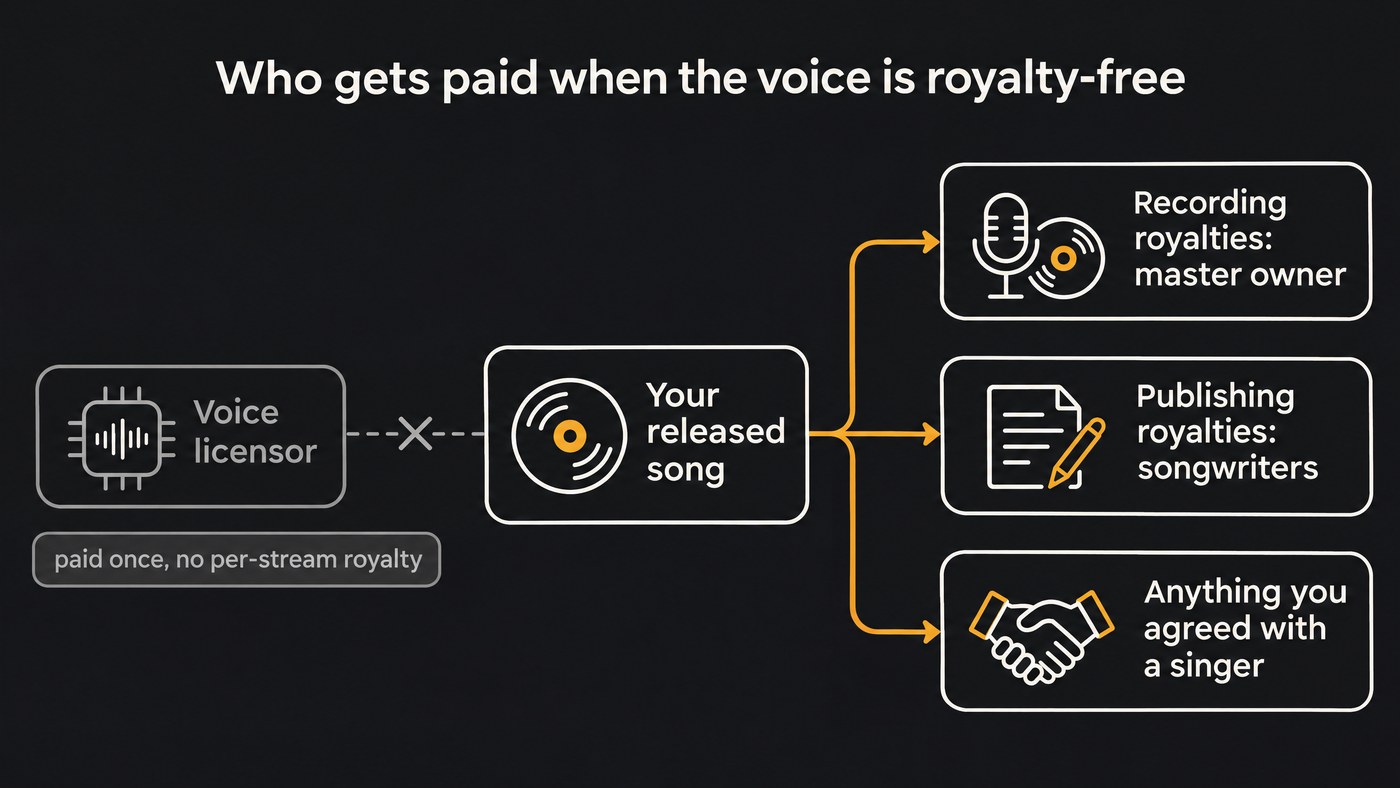
Royalty-free removes only the payment to the voice licensor. Spotify's royalties page explains that "Music on Spotify earns two kinds of royalties": recording royalties, paid to artists through the label or distributor that delivered the music, and publishing royalties, owed to the songwriters or owners of the composition and paid to publishers, collecting societies and mechanical agencies.
So for a song with a royalty-free AI vocal:
- Recording royalties go to whoever owns the master, which is you if you made and released the recording yourself.
- Publishing royalties go to the songwriters: performance royalties through your performing rights organization, and mechanical royalties through a mechanical agency, such as the MLC in the US.
- Contract payments still apply. If you agreed a royalty share with a singer whose voice you modeled, or licensed a featured voice on terms that include one, you owe it, whatever the tool's label says.
Whether the AI-made parts of a song are protected by copyright depends on your human contribution. Our guide to how AI tools handle copyright and ownership covers that.
Questions to ask before you use a royalty-free AI voice model
- Does the royalty-free license cover this specific voice, or does it carry its own terms?
- Does my plan include commercial use, distribution and monetization, and does that depend on the plan I'm on when I generate?
- Is the output license irrevocable, and what happens to my songs if I cancel or the voice is withdrawn?
- Is the license exclusive, and is a credit required?
- Did the person whose voice it is consent to training and commercial use, and does the vendor say so?
- Who owns the model, and can I export it?
- What license am I granting the vendor over my uploads, and can I opt out of training?
- Do I hold the rights to everything I put in: the guide vocal, the lyrics and the instrumental?
Save a PDF of the terms on the day you generate, with your invoice.
Where Soundverse fits
Soundverse is an AI music platform that takes you from idea to audience, built for independent artists who release music. The voice with the simplest rights is your own. Train Voice Clone and Train Voice Model both stay locked until you confirm the voice is yours or that the singer has given explicit consent. New voice models start Private; switch one to Public and anyone can pick it in Voice Swap, so keep a collaborator's model Private unless they agreed otherwise. Voice Swap's page adds that you need the rights to the vocal you convert and permission to use the voice you convert it into.
Licensing is set by plan: the Free plan is for personal use, and the Creator plan comes with a royalty-free license.
This walkthrough trains a voice model on your own clean vocals, then picks it in Voice Swap to re-sing a track in your voice.
FAQ
Is a royalty-free AI voice model free to use? No. It means no per-use payments to the licensor once you've paid for the product or plan, and free tiers often exclude commercial use.
Do I still earn royalties from a song that uses a royalty-free AI voice? Yes. Royalty-free only removes payments to the voice licensor. As the songwriter you can collect publishing royalties, and as the owner of the recording you collect recording royalties through your distributor.
Does a royalty-free license mean I own the voice model? Usually not. Kits' terms, for example, keep model ownership with the company and license you to use the model and its outputs.
Can I make a royalty-free voice model from a famous singer's voice? No. A vendor can only license what it has rights to, and a voice belongs to the person. Use your own voice, a singer who agreed in writing, or a library voice the vendor has licensed from its singer.
Sign up for Soundverse free and train a voice model on your own singing. More guides on vocals and rights on the Soundverse blog.