Compare Pricing Models for Music Distribution Services
Music distribution pricing compared: yearly plans, per-release fees, commissions, free tiers and label tiers, with 1, 3 and 5-year break-even math.
Music distribution pricing comes in five models: a yearly fee for unlimited releases, a fee per release, a commission on earnings, a free tier that keeps a bigger cut, and multi-artist label tiers. When you compare pricing models for music distribution services, count every release you'll put out over three to five years, then add the extras.
Every price below comes from the distributor's own pricing page, help article or agreement, read on 19 November 2026, in US dollars; confirm at checkout. Buying a plan for one EP? Our guide to buying an all-in-one distribution subscription for an EP covers that. This post compares the models across three kinds of artist.
The five music distribution pricing models
- Yearly fee, unlimited releases. You pay once a year and upload as much as you like. Entry plans cost $19 on Ditto Music Starter, $19.99 on UnitedMasters DEBUT+, $22.99 on TuneCore CORE, $23.99 on Amuse Artist and $24.99 on DistroKid Musician. TuneCore's plans are now called CORE, PRO ($43.99) and PRO+ ($84.99). Ditto, UnitedMasters and DistroKid say you keep 100% of royalties.
- Pay per release. You pay for each single or album. CD Baby charges $9.99 per single or $14.99 per album, once, and its DIY Musician guide says any project with two or more tracks goes in as an album. TuneCore also sells pay-per-release: $24.99 a year per single, and $44.99 for an album's first year, then $56.49 a year. RouteNote Premium charges $10 per single, $20 per EP of 2 to 6 tracks and $30 per album of 7 to 18 tracks, then $9.99 a year per release from the following year.
- Commission. The distributor keeps a share of what your music earns. CD Baby pairs its one-time fee with a 9% cut of digital distribution revenue, so you get 91%.
- Free tier with a bigger cut. RouteNote Free has no fees and pays you 85% of revenue, and you can upgrade a release to Premium later. Amuse has no free tier, but if you end your plan, your music stays live and Amuse takes a 25% commission until you subscribe again.
- Label and multi-artist tiers. Several artists on one bill. DistroKid Musician Plus ($44.99) covers 2 artists, and Ultimate starts at $89.99 for 1 to 100. TuneCore PRO+ includes 5 artist profiles, and PRO and PRO+ charge $14.99 for each extra artist. Ditto's Labels plan costs $109 a year for up to 5 artists, and Amuse Artist Pro costs $59.99 for 3.
Add-on fees that change the real price
The headline fee is rarely the whole bill. These extras appear on the same pages:
- YouTube Content ID and social platforms. DistroKid's distribution agreement says it deducts 20% from money earned through its Content ID service, such as YouTube Money. TuneCore lists a 20% fee on earnings from TikTok, Facebook, Instagram and YouTube. Amuse charges a 15% Content ID royalty fee on Artist and none on Plus or Pro. Ditto includes Content ID on Pro, CD Baby includes it with every release, and UnitedMasters sells it as an add-on.
- Publishing administration. DistroKid Publishing costs a $75 one-time setup fee per songwriter and keeps 20% of publishing royalties. CD Baby's CDB Boost costs $39.99 per release and registers your songs with The MLC and your recordings with SoundExchange. Ditto collects publishing royalties on Pro and Labels for what it calls a small commission.
- Collaborator splits. Included on DistroKid, TuneCore and Ditto. Amuse charges 15% on splits with collaborators outside Amuse on its Artist plan and nothing on Plus or Pro. Our guide to distributors with the best royalty splits goes deeper.
- New stores. Amuse's Store Sync, which delivers your releases to stores it adds later, costs $9.99 per release on Artist and is included on Plus and Pro.
- Renewals. The extra people forget: $9.99 a year per RouteNote Premium release and $24.99 a year per TuneCore single. None of the pricing pages we read listed a takedown fee.
What happens to your music if you stop paying
Pricing pages rarely say this out loud.
- DistroKid. Its distribution agreement runs for a year, renews automatically and is direct about the end: "After the end of the Term, we will notify all applicable Digital Stores to remove your Recordings and will have no further obligation to you other than to account and pay for monies earned during the Term." DistroKid's help centre blocked automated reading when we checked, so ask support whether any paid option keeps a release live after you cancel.
- TuneCore. Its help centre also blocked automated reading, and the pricing page doesn't say, so ask before you stop renewing.
- CD Baby. Nothing to stop paying: the fee is one-time, and CD Baby earns its 9% instead.
- Ditto Music. Its help article, dated 13 February 2024, says: "If you stop paying for your Ditto subscription, your releases will be at risk of removal from stores." Releases aren't taken down automatically, but you can't withdraw royalties while the subscription is out of date. Release Protection, free on Pro and Labels and available per release on Starter, keeps music in stores if you miss a payment.
- Amuse. Music stays live, and you receive 75% of earnings until you subscribe again.
- UnitedMasters. Its DEBUT+ FAQ says that if you resubscribe, releases are redelivered to Spotify, Apple Music and YouTube Music within 24 to 48 hours with their streams and saves intact, which suggests they come down while a plan is lapsed. Confirm before you let it expire.
- RouteNote. Premium renews at $9.99 a year per release to keep it on Premium, and RouteNote says a release removed at your request can usually be reinstated.
Break-even math for three artist profiles
Assumptions: one artist, every release stays live, fees only. "Yearly plan" means any of the five entry plans above, so $19 to $24.99 after one year, $57 to $74.97 after three and $95 to $124.95 after five, whatever you release. TuneCore lists only single and album prices, so the EP is priced as an album.
Profile 1: one single a year (after 1, 3 and 5 years)
- Yearly plan: $19 to $24.99, $57 to $74.97, $95 to $124.95
- CD Baby: $9.99, $29.97, $49.95, plus 9% of earnings
- RouteNote Premium: $10, $59.97, $149.90
- TuneCore pay-per-release: $24.99, $149.94, $374.85
- RouteNote Free: $0, plus 15% of earnings
Profile 2: a five-track EP plus two singles every year
- Yearly plan: unchanged
- CD Baby: $34.97, $104.91, $174.85, plus 9%
- RouteNote Premium: $40, $209.91, $499.70
- TuneCore pay-per-release: $94.97, $604.32, $1,539.55
- RouteNote Free: $0, plus 15%
Profile 3: a single every month
- Yearly plan: unchanged
- CD Baby: $119.88, $359.64, $599.40, plus 9%
- RouteNote Premium: $120, $719.64, $1,798.80
- TuneCore pay-per-release: $299.88, $1,799.28, $4,498.20
- RouteNote Free: $0, plus 15%
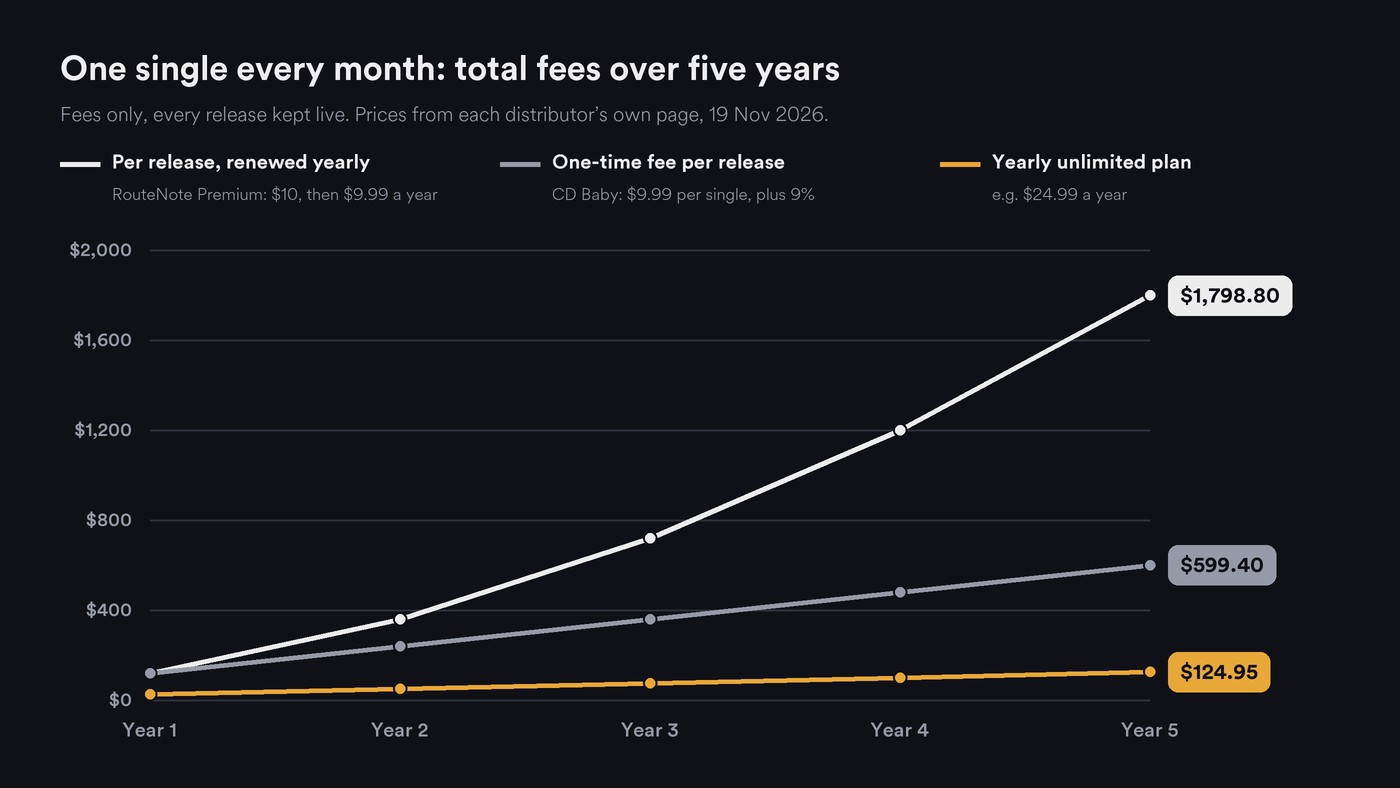
Renewed per-release fees compound, because each year's releases join the ones already renewing. For a single album kept up for five years, see the most affordable ways to distribute an album.
Where a commission still wins
Divide a yearly fee by a commission rate to find the break-even earnings.
- Free tier vs yearly plan. RouteNote Free's 15% costs more than Ditto Starter's $19 once your catalog earns about $127 a year, and more than DistroKid Musician's $24.99 above about $167. That holds for every profile, because the free tier charges nothing per release.
- CD Baby for the one-single artist. Over five years, CD Baby stays cheaper than Ditto Starter until the catalog has earned about $500 in total, and cheaper than DistroKid Musician up to about $833.
- CD Baby for profiles 2 and 3. Year-one release fees of $34.97 and $119.88 already exceed every yearly plan, before the 9%.
- Amuse after cancelling. The 25% commission costs less than renewing Artist at $23.99 only while your music earns under about $96 a year.
One more point for low earners: Spotify's track monetization eligibility page says a track needs at least 1,000 streams in the previous 12 months, plus a minimum number of unique listeners, to earn recording royalties there. A commission on a track that earns nothing costs nothing.
How to pick a pricing model
- List your releases for the next three years, counting singles, EPs and remixes separately.
- Estimate yearly earnings from your statements. With no history, assume low.
- One release a year and small earnings: a one-time fee or a free tier usually wins.
- More than two releases a year: a yearly plan, usually from year one.
- Price the extras you'll actually use: Content ID, publishing admin, collaborator splits, extra artists.
- Decide your exit before you sign. If you move later, redeliver with the same ISRCs and metadata; our guide on why ISRC codes matter for tracking streams explains why.
Where Soundverse fits
Soundverse is an AI music platform that takes you from idea to audience. It doesn't deliver music to stores or pay royalties; your releases reach Spotify and Apple Music through whichever distributor and pricing model you choose.
It helps with the work every model leaves to you. Release Planner turns a finished track and a release date into a day-by-day, platform-split rollout with pre-save, smart link and playlist pitch deadlines, so a monthly releaser can run it for each single. It writes the plan without posting or submitting anything, and it runs on every plan, including Free.
If you switch distributors or let a plan lapse, the Music Business Agent can run a store-by-store release check that lists where a release is live, missing or mislabeled. Its royalty sweep reads the latest statement on each dashboard you sign in to and builds one per-song table, handy while a catalog sits with two distributors.
Licensing is set by plan: the Free plan is for personal use, and the Creator plan comes with a royalty-free license.
FAQ
Which music distribution pricing model is cheapest? For one release a year and small earnings, a free tier or a one-time fee such as RouteNote Free or CD Baby. Release more than twice a year and a $19 to $24.99 yearly plan is usually cheaper from year one.
Is a commission better than a yearly fee? Divide the yearly fee by the commission rate. A $19 plan against a 15% cut breaks even at about $127 of earnings a year. Earn less and the commission is cheaper; earn more and the fee is.
Do label plans cost less per artist? Usually. TuneCore PRO+ works out at about $17 per artist for 5 profiles, against $22.99 for CORE, and DistroKid Musician Plus at $44.99 costs less than two Musician plans.
Sign up for Soundverse free and plan your next release with Release Planner. More release guides on the Soundverse blog.