The Most Affordable Ways to Distribute Your Album to All Major Streaming Services
How to distribute an album to Spotify, Apple Music and more for less: per-album fees, per-track pricing and what an album really costs over five years.
The most affordable ways to distribute an album to all major streaming services are RouteNote's free plan (no fee, 15% commission), CD Baby's one-time $14.99 album fee (9% commission) and a low yearly plan such as Ditto Music's $19 Starter. Over five years, a one-off fee usually costs least until the album earns a few hundred dollars.
Prices come from each company's own pricing or help page, checked on November 7, 2026, in US dollars; confirm them at checkout. Every route uses a distributor, which delivers your audio, artwork and metadata to Spotify, Apple Music, Amazon Music, YouTube Music and the other stores, then passes your royalties back.
How distributors price an album
An album changes the bill in four ways.
- Track count sets the price on per-release plans. CD Baby charges $9.99 for a single and $14.99 for an album. RouteNote Premium charges by size: $10 for a single, $20 for an EP of 2 to 6 tracks, $30 for an album of 7 to 18 tracks and $45 for an extended album of 19 tracks or more.
- Per-track pricing multiplies. Soundrop charges $4.99 per song and keeps 15%, with no subscription. That's cheap for a single and $59.88 for a 12-track album.
- Some yearly fees are per album. TuneCore offers a pay-per-release Album at $44.99 for the first year and $56.49 for each following year. Its Rising Artist plan, at $24.99 a year, covers unlimited releases instead.
- Keeping an album up after you leave can cost extra. DistroKid's Leave a Legacy extra keeps a release live if your membership lapses or you cancel. Its help centre lists it as a one-time $49 per album of two or more tracks, or $29 per single.
Yearly unlimited plans ignore track count. Ditto Music Starter ($19), Amuse Artist ($23.99), DistroKid Musician ($24.99) and TuneCore Rising Artist ($24.99) cost the same whether you upload one album or five.
The most affordable ways to distribute an album
Here are the routes, roughly from cheapest to most expensive over five years.
- Pay nothing upfront: RouteNote Free. There are no fees, and you receive 85% of the revenue the album earns, according to RouteNote's support article published March 6, 2026. Best when you have no budget or want to test how an album performs.
- Pay once per album: CD Baby. $14.99 per album and no annual fees. CD Baby keeps 9% of digital distribution revenue and includes a free UPC and ISRCs. Best for an album you'll release once and leave up for years.
- Pay for one year, then let a commission take over: Amuse. The Artist plan costs $23.99 a year. Amuse's pricing page says it keeps your music live if you end your subscription, with a 25% royalty commission while you have no active plan. Best if one busy release year will be followed by quiet ones.
- Pay once, then a small renewal: RouteNote Premium. $30 for a 7-to-18-track album, then $9.99 a year from the following year, and you keep 100% of streaming and download revenue. RouteNote lets you upgrade a release from Free to Premium, so starting free costs nothing if the album takes off.
- Pay for one year plus a legacy fee: DistroKid. Musician ($24.99) plus Leave a Legacy ($49) comes to $73.99, and the album stays on streaming services after you cancel. Ask DistroKid how payouts work after cancelling before you count on this route.
- Pay yearly for everything: Ditto, Amuse, DistroKid or TuneCore. $19 to $24.99 a year covers unlimited releases, and DistroKid and Ditto say you keep 100% of streaming earnings. Best when the album comes with lead singles, remixes or a follow-up within the year.
What one album costs over five years
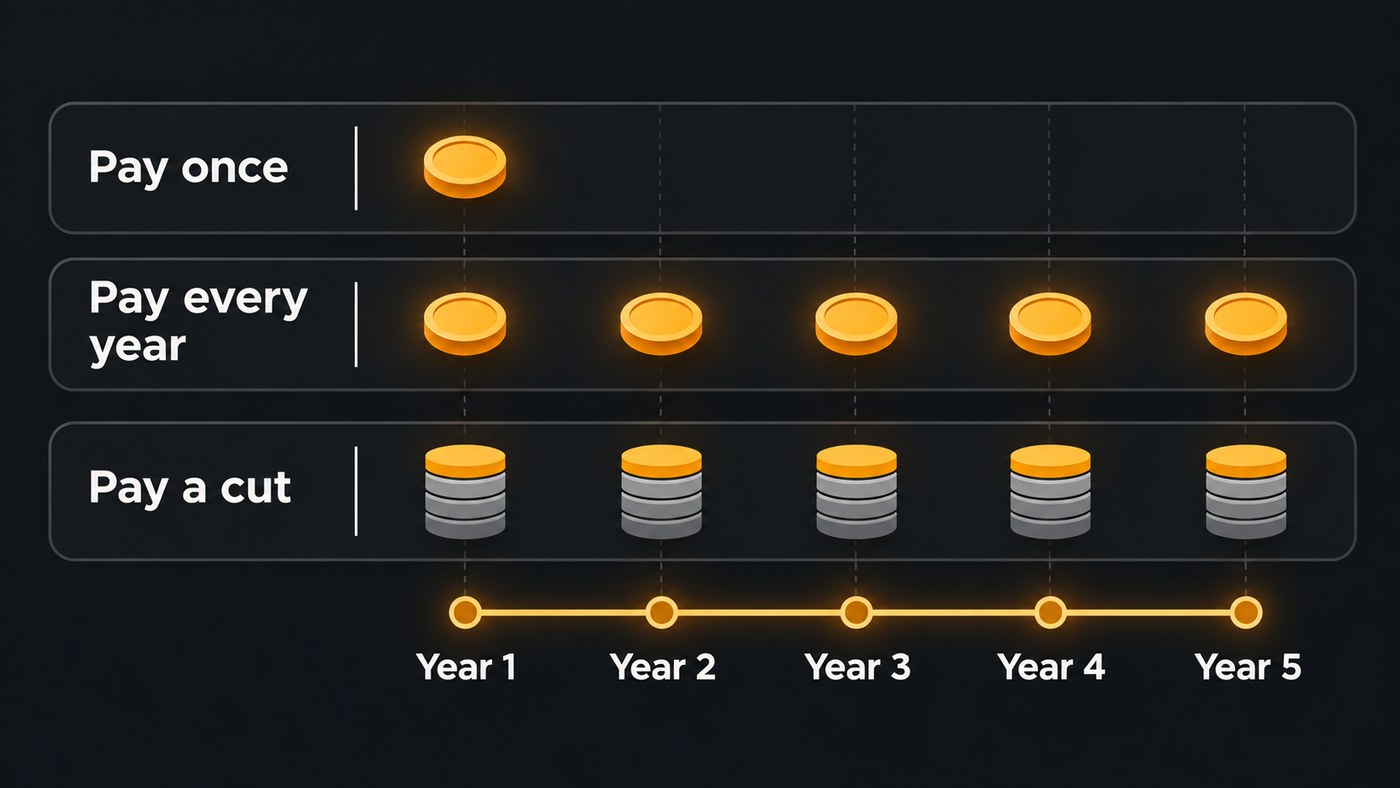
Take a 10-track album kept live for five years, with nothing else released. Fees alone:
- RouteNote Free: $0, plus 15% of earnings
- CD Baby: $14.99, plus 9% of earnings
- Amuse Artist for one year, then cancelled: $23.99, plus 25% of earnings from year two
- Soundrop: $49.90, plus 15% of earnings
- RouteNote Premium: $69.96 ($30 plus four renewals at $9.99)
- DistroKid Musician for one year plus Leave a Legacy: $73.99
- Ditto Music Starter for five years: $95
- DistroKid Musician or TuneCore Rising Artist for five years: $124.95
- TuneCore pay-per-release Album for five years: $270.95 ($44.99 plus four renewals at $56.49)
Commissions decide the rest. The break-even points over five years:
- RouteNote Premium beats RouteNote Free once the album earns more than about $466, because $69.96 is 15% of $466.
- RouteNote Premium beats CD Baby above about $611. Past that point, CD Baby's 9% costs more than the extra $54.97 you'd pay for Premium.
- Ditto Starter beats CD Baby above about $889, and that's for the album alone. Add singles and Ditto pulls ahead much sooner.
If you expect modest earnings, a free or one-off route wins. Once the album reliably earns more than a couple of hundred dollars a year, a flat fee costs less than a percentage.
Release singles first without paying twice
Spotify's rules reward lead singles. Its help page on pitching says: "You can only pitch one song at a time. Once your pitched song goes live, you can pitch another." An album dropped all at once gets one pitch. Two or three singles released a few weeks apart each get their own.
That changes the cost math:
- On a yearly unlimited plan, each single costs nothing extra.
- On per-release pricing, each single adds a fee. Three singles plus the album cost $44.96 on CD Baby, against $19 for a year of Ditto Starter. On RouteNote Premium, the same four releases cost $60 upfront, and each renews at $9.99 a year.
Reuse the singles' codes on the album to keep their streams. CD Baby's DIY Musician guide puts it plainly: "you can keep your play counts by using the same ISRC for the single and that same track on the album." The album still needs its own UPC, and a remix or radio edit needs a new ISRC.
If a single has to go out quickly, our guide to music distributors with fast-track releases explains the rush options and what they can't speed up.
Album costs that don't show on the pricing page
- Store coverage. Confirm your plan's store list includes every service you need. Spotify's provider directory, checked November 7, 2026, marks DistroKid, CD Baby, Amuse, RouteNote and TuneCore as preferred distributors and lists Ditto Music among its artist distributors.
- Social and YouTube cuts. TuneCore's pricing page lists a 20% fee on earnings from TikTok, Facebook, Instagram and YouTube. Amuse's Artist plan charges a 15% YouTube Content ID fee.
- Collaborators. Amuse's Artist plan charges 15% on royalty splits with collaborators who aren't on Amuse; splits are free on Artist Plus and Artist Pro.
- Staying live. Ditto's help centre says releases are at risk of removal if you stop paying, though they aren't taken down automatically. Its Release Protection, free on Pro and Label plans, keeps music in stores regardless.
- Artwork and mastering. Budget for square cover art and a master for every track before you compare distributor fees.
- AI-made tracks. If any track used AI tools, read the distributor's AI rules before paying for a year. We've covered CD Baby's AI upload rules, and our AI music distribution checklist walks through the rest.
How to pick the cheapest route for your album
- List every release for the next three years: the album, its lead singles, any deluxe edition or remixes.
- Estimate what the album will earn from what your current songs earn. With no history, assume low.
- If the album is your only release and earnings are uncertain, start on RouteNote Free or CD Baby.
- If singles come before it and more music after, take a yearly unlimited plan.
- Decide your exit now: keep renewing, buy Leave a Legacy, let Amuse take its 25%, or move to RouteNote Premium.
- Upload three to four weeks before release day, so there's time to fix a rejected file and pitch the focus track.
Where Soundverse fits
Soundverse is an AI music platform that takes you from idea to audience. It isn't a distributor: your album still reaches Spotify and Apple Music through one of the services above. It helps with the work around the release.
Release Planner takes one track and a release date and writes a day-by-day, platform-split rollout of 1 to 12 weeks, with pre-save, smart link and playlist pitch deadlines. Run it for each lead single and for the focus track. It writes the plan and doesn't post or submit anything, and it runs on every plan, including Free.
Asset Studio turns a track into a square cover image plus story backgrounds, a YouTube thumbnail, a tour poster and a merch mockup that share one visual identity. The images contain no text, so add your title and artist name yourself. For video ideas, see AI music videos for album and EP launches.
Licensing is set by plan: the Free plan is for personal use, and the Creator plan comes with a royalty-free license.
This video shows Asset Studio turning an uploaded track into a matching set of release visuals.
FAQ
Is it cheaper to release an album or the songs as singles? On a yearly unlimited plan it costs the same, so lead singles cost nothing extra and each gets a pitch. On per-release pricing they add up: ten singles on CD Baby cost $99.90, against $14.99 for the album.
Can I distribute an album for free? Yes. RouteNote's Free plan has no fees and pays you 85% of revenue. If the album starts earning, you can upgrade it to Premium and keep 100% of streaming and download revenue.
What happens to my album if I stop paying my distributor? DistroKid removes releases after a lapsed membership unless they have Leave a Legacy. Amuse keeps music live and takes a 25% commission, and Ditto says releases without Release Protection are at risk of removal. CD Baby has no annual fee to stop paying.
Do I need a UPC and ISRCs for an album? Yes. The album needs one UPC and each track its own ISRC. CD Baby includes both free; check what your distributor charges, and reuse the ISRC of any track already out as a single.
Sign up for Soundverse free and plan the rollout for your album's lead single. More release guides on the Soundverse blog.