AI Music Adapt Tools: Making Music Longer or Moodier
Discover how AI music adaptation tools help producers make music longer or moodier in 2026.
AI Music Adapt Tools: Making Music Longer or Moodier
In 2026, music production has taken a remarkable leap forward through the use of artificial intelligence. AI music adaptation tools are transforming how producers and creators extend, reshape, and emotionally tune their tracks for diverse applications—from games and films to social videos and immersive environments. Unlike the fully generative music AI of the past, which created songs from scratch, modern adaptation models work directly with pre-existing sound material, giving artists unprecedented control over how a piece evolves.
What are AI music adaptation tools and why do they matter in 2026?
AI music adaptation tools are software systems powered by advanced neural architectures designed to analyze an existing piece of audio and then intelligently generate new segments or modify parameters such as tempo, key, or tonal energy. The result is extended or mood-shifted music that fits perfectly into the creator’s need without manual remixing. For video editors, this means effortless synchronization with scene timing. For composers, it means exploring variations of the same composition across multiple moods. For music producers, it’s a way to experiment with track longevity and emotional color without spending hours in the studio.

The demand for adaptive music solutions accelerated between 2024 and 2025 as streaming content boomed and short-form videos multiplied. By 2026, AI-driven editing and music adaptation became standard practice among creators, similar to how auto-tuning became essential in vocal production years earlier. This shift parallels launches such as Epidemic Sound’s Adapt in late 2025, highlighting a growing ecosystem where music editing tools merge creative flexibility with AI precision.
How do AI music adaptation tools help make music longer or moodier?
These tools use deep learning models trained on large datasets of musical arrangements, transitions, and production styles. They understand how sections like intro, verse, chorus, bridge, or outro naturally connect and recreate that structure in new ways. If a user wants to make a lo-fi beat last three minutes instead of thirty seconds, the AI seamlessly generates additional measures consistent with the original tempo and tonal palette. On the mood side, the system can analyze harmonic content and energy progression to transform a track’s emotional tone—turning something upbeat into something cinematic or contemplative.

This capacity saves countless hours that would otherwise be spent arranging loops or recording new parts. The AI can expand existing tracks while maintaining coherence, which is vital for soundtracks, podcasts, advertisements, or meditation apps where mood continuity matters. For a deeper dive, watch our guide on creating Deep House music or learn how to make music with Soundverse’s YouTube tutorial series.
What makes 2026 unique for AI-powered music adaptation?
The biggest change is precision. In 2024, adaptation models often produced rough or repetitive extensions. By contrast, current-generation 2026 AI engines can perform stylistic continuation that preserves all original nuances—tone, spatial mix, and dynamic range. They interpret creative intent rather than just matching frequency or rhythm.
Beyond technical precision, 2026 is defined by integrated creative ecosystems. Tools like Soundverse unify music generation, adaptation, and editing into a single workflow. Creators no longer need multiple plugins or DAW scripts to achieve fluid transitions. Instead, one upload and one AI process gives them perfectly cut or extended audio layers ready for sync. This is part of the broader industry evolution seen in the Best AI Tools for Music Artists in 2026 reports and similar market analyses.
How to make AI music adaptation work for your creative projects
Before you start using adaptation tools, it's vital to define your creative goal:
- Length-based adaptation: For longer mixes, loops, or DJ sets.
- Mood-based adaptation: For emotional re-toning or cinematic transformation.
- Style-based adaptation: For remix-type reinterpretations.
Each use case leads the AI to a different generative pathway, allowing it to rebuild or extend the track according to mood or formulaic composition patterns. For example, if you have a short chillhop loop, AI can extend that into a full-length track suitable for background music in a study playlist. Alternatively, an energetic electro track can be softened for use in a documentary by toning down its mids and accentuating reverb tails.
If you’re new to adaptive audio, check related guides like How AI-generated music is transforming the music industry, Soundverse AI revolutionizing music creation for new age content creators, and How to make AI-generated music. These pieces show how adaptation tools complement text-to-music generation and advanced editing features available today. For exploration, review the “Explore” tab guide on Soundverse’s channel.
How to make music longer or moodier with Soundverse Extend Music
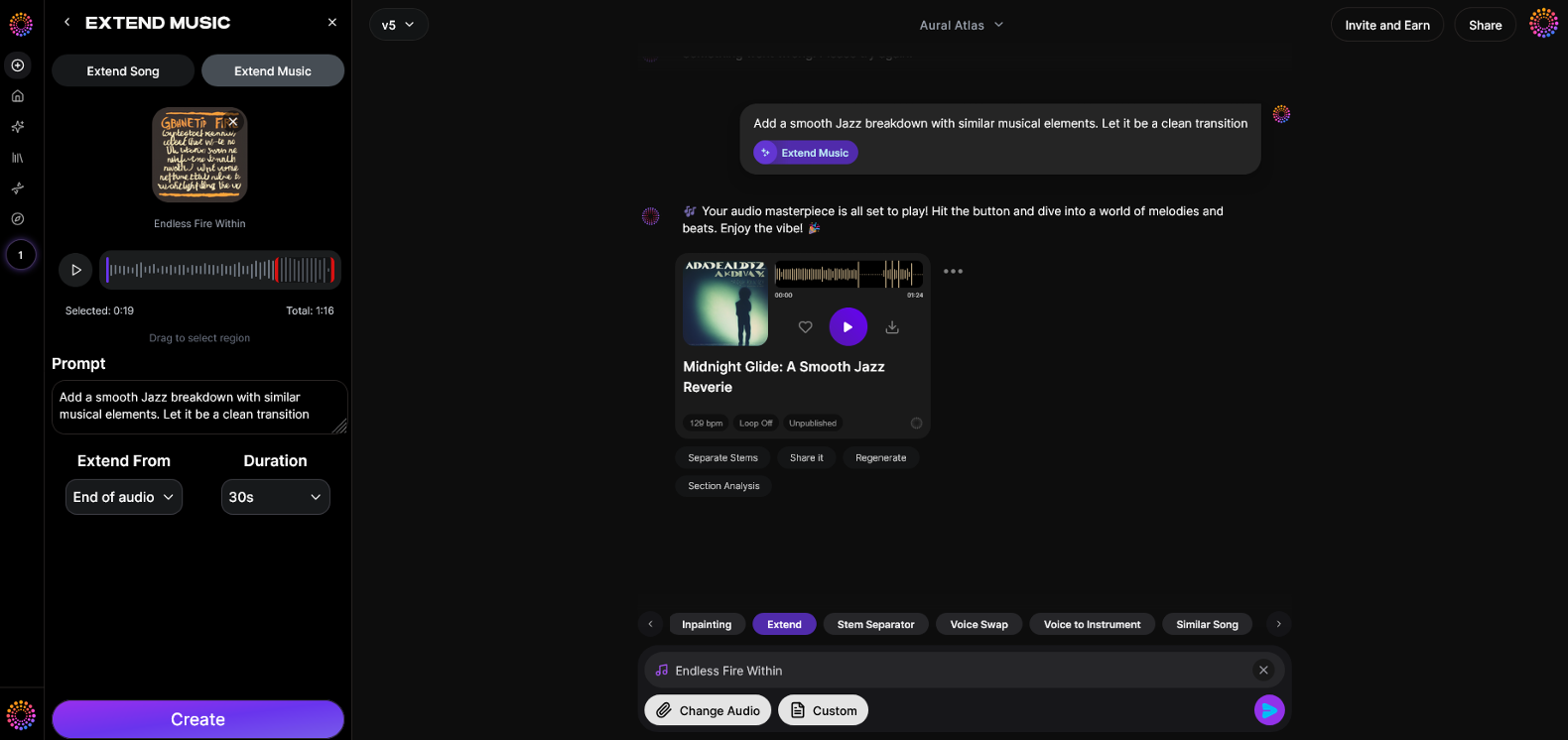
The flagship Extend Music feature from Soundverse was built precisely for this purpose. It doesn’t compose from scratch; it learns and expands from what you already have.
Official Feature Description: Extend Music seamlessly lengthens existing audio tracks by generating new material that matches the style, tempo, and key of the original. It supports both instrumental extension and full song continuation with lyrics.
Core Capabilities:
- Extend Song (Vocals + Music)
- Extend Music (Instrumental only)
- Duration control (15s to 3m per extension)
- Loop extension
This tool’s accuracy makes it invaluable for video producers tailoring music to fit exact lengths, DJs creating extended mixes, and game developers looping adaptive soundscapes. It enables perfect musical expansion without having to stitch or manually crossfade sections.
When combined with related Soundverse tools—like Similar Music Generator for creating instrumental compositions inspired by a reference track or Inpainting for surgical regeneration of certain segments—creators can fully control both structure and emotional quality. This trio of functions gives users a full adaptive composition environment inside one platform.
For example, a producer working on a film scene might generate a ‘similar’ composition to match the narrative vibe using the Similar Music Generator, then apply Extend Music to stretch that score further so it syncs with the scene’s duration. If later adjustments are needed (say, cutting down an overly bright bridge), Inpainting offers precision modification without altering the piece’s identity.
Why professionals are embracing AI adaptation over traditional remixing
Traditional remixing demands deep technical skill and manual experimentation within a digital audio workstation. AI music adaptation tools reduce that friction by understanding structural dynamics—what musical phrases should continue or fade—while maintaining human intent. This saves producers time, but more importantly, it opens creative possibilities. A content creator with zero musical training can now adapt a melody into multiple versions aligned with different moods or situations.
By 2026, adaptation-based workflows are not limited to experimental producers. They are standard in production houses managing multiple projects per week. Game developers adapt loopable audio cues; social media marketers rescale length for ads; podcasters use mood variation to maintain listener engagement.
The future of adaptive music in post-production and content creation
Looking ahead through 2026 and beyond, AI adaptation continues fusing music composition and editing into unified creative models. Expect integration where AI not only extends tracks but dynamically adjusts their sonic emotion in response to visuals or target audience profiles. As more creators rely on platforms like Soundverse, the line between music generation and adaptation will blur.
Interested professionals should also explore Soundverse AI Magic Tools and Soundverse Assistant for deeper integration into adaptive workflows.
Transform Your Music Instantly with AI
Discover how AI music adaptation tools can extend, remix, and reimagine your tracks in seconds. Experience creative control like never before and elevate your sound effortlessly.
Start Creating With AI Music Tools
- Soundverse Introduces Stem Separation AI Magic Tool: Explore how Soundverse’s new stem separation feature lets you isolate and refine individual parts of any track to create your ideal mix.
- Soundverse Assistant: Your AI Music Co-Producer: Meet your new AI collaborator that helps you select the right tools and settings for any music style or emotional tone.
- How AI-Generated Music is Transforming the Music Industry: Learn how AI music generation is reshaping production, creativity, and the future of music creation for artists worldwide.
- Generate AI Music with Soundverse Text-to-Music: Discover how to instantly turn text prompts into rich, royalty-free compositions with Soundverse’s Text-to-Music technology.
Here's how to make AI Music with Soundverse
Video Guide
Here’s another long walkthrough of how to use Soundverse AI.
Text Guide
- To know more about AI Magic Tools, check here.
- To know more about Soundverse Assistant, check here.
- To know more about Arrangement Studio, check here.
Soundverse is an AI Assistant that allows content creators and music makers to create original content in a flash using Generative AI.
With the help of Soundverse Assistant and AI Magic Tools, our users get an unfair advantage over other creators to create audio and music content quickly, easily and cheaply.
Soundverse Assistant is your ultimate music companion. You simply speak to the assistant to get your stuff done. The more you speak to it, the more it starts understanding you and your goals.
AI Magic Tools help convert your creative dreams into tangible music and audio. Use AI Magic Tools such as text to music, stem separation, or lyrics generation to realise your content dreams faster.
Soundverse is here to take music production to the next level. We're not just a digital audio workstation (DAW) competing with Ableton or Logic, we're building a completely new paradigm of easy and conversational content creation.
TikTok: https://www.tiktok.com/@soundverse.ai
Twitter: https://twitter.com/soundverse_ai
Instagram: https://www.instagram.com/soundverse.ai
LinkedIn: https://www.linkedin.com/company/soundverseai
Youtube: https://www.youtube.com/@SoundverseAI
Facebook: https://www.facebook.com/profile.php?id=100095674445607
Join Soundverse for Free and make Viral AI Music

We are constantly building more product experiences. Keep checking our Blog to stay updated about them!