Explain the Concept of Intelligent Audio Mixing
Intelligent audio mixing explained: how systems classify tracks, detect masking and set levels, EQ and compression, the research behind it, and its limits.
Intelligent audio mixing is software that listens to every track in a session, measures loudness, frequency content and how parts mask each other, then sets or suggests levels, EQ, compression, panning and space. It ranges from rule-based systems built on engineering practice to machine-learning assistants trained on real mixes, and most give you a draft to refine by ear.
Below: the research behind it, how it works step by step, what today's tools document (each maker's own pages, read on 19 November 2026), its limits and how to use one well. For assistant moves against hand EQ, see how automated audio mixing differs from manual equalization.
What intelligent audio mixing means
Researchers call it automatic mixing, part of a field they name intelligent music production. In their 2017 review, Ten Years of Automatic Mixing, Brecht De Man and Joshua D. Reiss of Queen Mary University of London and Ryan Stables of Birmingham City University sort these systems into four kinds:
- Black box. Fully automatic, with no controls.
- Assistants. Mostly automatic, with a few controls you adjust. They give a starting point, the way an assistant engineer would at a sound check.
- Interfaces. Ordinary processors driven in new ways, such as an EQ controlled with words like warm, crisp or full.
- Metering and diagnostics. Meters that warn you when an instrument is masked or a mix sounds boxy.
What makes these systems intelligent is that they're cross-adaptive: the setting for one track depends on what the other tracks are doing, just as a vocal's EQ depends on the guitars around it.
A short history: from speech automixers to neural networks
- 1975, speech. The review credits Dan Dugan with coining the term, for microphone gain handling in speech; his paper appeared in the Journal of the Audio Engineering Society in June 1975. The Waves Dugan Automixer manual on Dugan's site explains that the system works from the ratios of levels between channels, not their absolute levels: whoever talks gets the full automix gain and the other microphones are lowered.
- 2007 to 2010, music. Enrique Perez Gonzalez, working with Joshua Reiss, published a method that set both level and stereo panning of multitrack music, then moved on to EQ, unmasking and delay correction. The review dates the modern field from this work.
- The 2010s, more processors. Early systems mostly set levels; later ones automated compressors and reverb, and machine learning gained ground. The review concluded: "Automatic Mixing of multitrack music remains an unsolved problem, with several established research directions but none of them exhausted."
- 2018 onward, perception and deep learning. David Ronan and colleagues proposed a multitrack masking metric inspired by the MPEG psychoacoustic model (arXiv, March 2018); their evaluation suggested it can reduce masking and improve perceived quality and clarity. Christian Steinmetz, Jordi Pons, Santiago Pascual and Joan Serrà built a differentiable mixing console of neural audio effects (arXiv, October 2020) that learns mixing conventions from real multitracks, outputs human-readable settings you can adjust, and beat baseline approaches in a perceptual test with audio engineers.
How intelligent audio mixing works, step by step
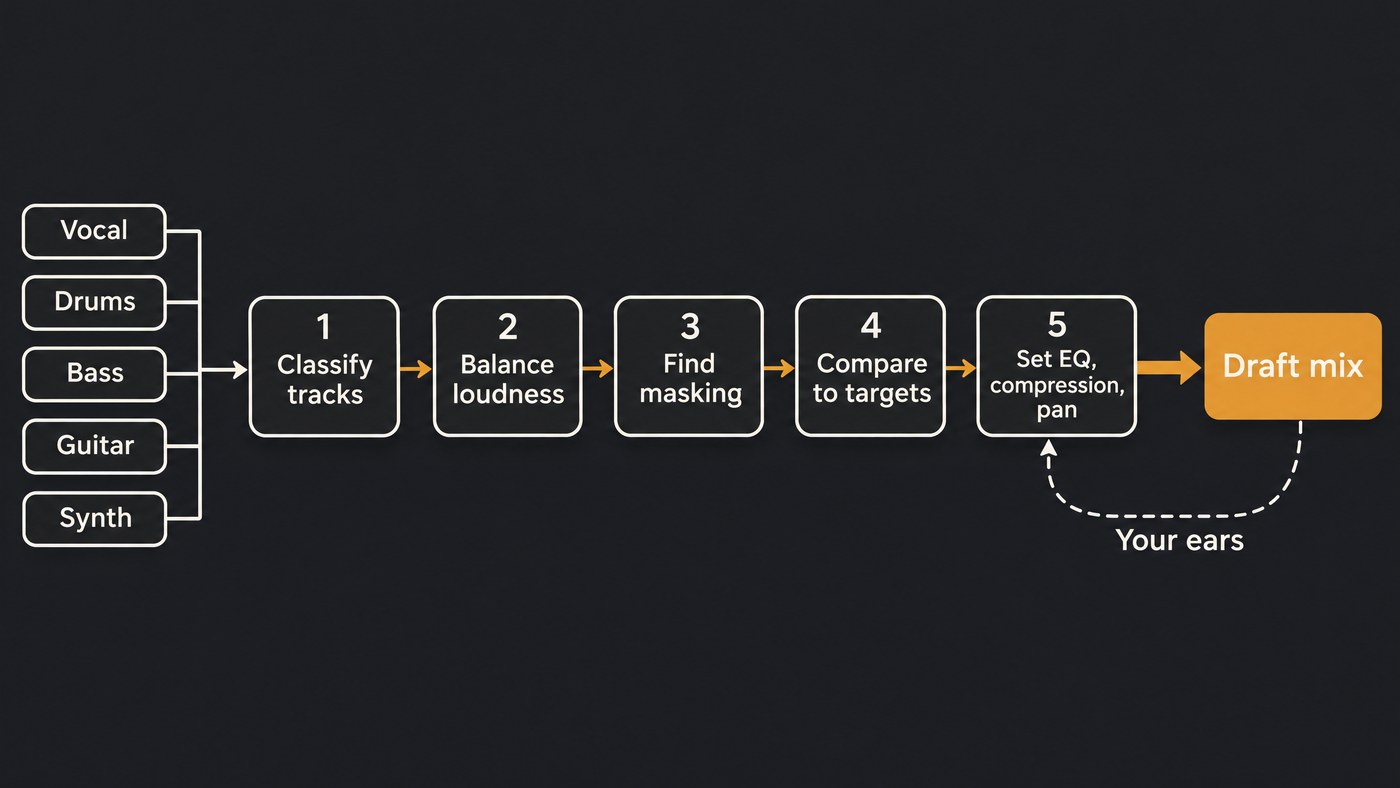
- Track classification. A kick drum and a lead vocal get opposite treatment, so the system has to know which is which. Neutron suggests an instrument target after it listens; RoEx Automix has you choose an instrument category for each stem; Soundverse's Mix One reads the type you set in each track header.
- Loudness balancing. Faders come first. Systems estimate each track's loudness (one 2012 paper in the review's list models partial loudness, how loud a part sounds with the rest of the mix playing) and balance toward a rule such as keeping the lead on top. iZotope's Neutron 5 Visual Mixer Assistant sets static levels and works best on raw stems with DAW faders at unity.
- Masking detection. Tracks are compared band by band. Where a lower-priority part puts strong energy into a range a higher-priority part needs, such as a pad over the vocal's presence range, the system flags a conflict and usually dips the lesser part, sometimes only while both play.
- Target curves. Each track's long-term spectrum is compared with a target for its instrument or genre. The Neutron 5 manual says its Sculptor targets come from analysis of thousands of professional mixes. The gap becomes an EQ curve, normally scaled back with an amount control.
- Dynamic processing. Compressor settings follow from features such as loudness and how peaky the signal is; the 2017 review notes that automating time constants and make-up gain was already common. sonible's smart:comp 3 maps musically viable compression settings for your audio onto a two-dimensional matrix, and its Input Riding acts as automatic pre-leveling toward a target level learned from your audio.
- Panning and space. Rules keep bass, kick and lead vocal central and spread similar parts apart. Reverb was among the last processors research automated.
A black box then applies everything; an assistant shows its moves as normal settings you can scale back or change.
Rule-based and machine-learning systems
Rule-based systems turn engineering practice into code: keep the low end centred, carve the lower-priority part, aim each track at a target. They're predictable, and you can see why each move happened.
Machine-learning systems learn from examples. In a May 2022 interview, sonible co-founder Alexander Wankhammer described how smart:EQ 3 (since replaced by smart:EQ 4) used a convolutional neural network, shown spectro-temporal representations of unbalanced audio with balanced audio as the target thousands of times, then combined with model-based methods for decisions that need a formal understanding of mixing. He put the goal simply: "I like to see our plug-ins as a kind of personal mixing assistant – a second, very experienced mixing engineer supporting you in your work."
The hard part is data. The 2017 review calls the shortage of reliable mix data a significant obstacle, and the Steinmetz model was designed to train on a limited number of examples.
What commercial intelligent mixing tools document
iZotope's product pages returned a rate-limit error (HTTP 429) on 19 November 2026, so its entry comes from the Neutron 5 manual, a PDF updated on 9 July 2026.
- iZotope Neutron 5. The Assistant suggests an instrument target, Sculptor shapes the track toward it, and Visual Mixer's Assistant sets static levels across the session.
- sonible smart:comp 3. Group Mode handles up to seven tracks from one window, and Spectral Compression and Spectral Ducking apply extra compression or ducking only where it's needed.
- RoEx Automix. You upload WAV stems and pick an instrument category for each and a musical style. The Automix help page says it then applies gain staging, panning, EQ, compression and reverb, and you preview and adjust levels.
- Logic Pro 13. Apple's intelligent assistant (beta) takes typed or spoken requests, such as rolling off some high end on the current track, and can adjust panning and volume, add and bypass effects and change plugin parameters. It needs an Apple Creator Studio subscription; in the review's terms, it's an interface.
Where intelligent mixing falls short
- Taste. It doesn't know which part the song is about, or that the last chorus should feel bigger.
- Genre conventions. Targets are averages. A lo-fi beat or a raw punk demo can measure as wrong against a pop curve and still be right for the song.
- Creative effects. A filtered intro or a distorted vocal looks like a problem to a meter.
- Arrangement clashes. Two parts playing the same notes in the same octave can't be EQ'd apart; one has to move.
- Moments. Static moves learned from one section won't catch a chorus that turns harsh.
- Source quality. Bleed, noise and artifacts in separated or generated stems throw off classification and masking estimates.
How to use an intelligent mixing assistant well
- Prepare and label tracks. Trim silence and set every track's type or category correctly; classification drives everything after it.
- Start neutral. Unity faders and centred pans, as iZotope recommends for Visual Mixer.
- Set priorities and an honest target. Tell it which part leads, and pick the closest genre or a reference with a similar arrangement.
- Feed it the right section. The densest chorus, or the whole song if it can.
- Compare at matched loudness. Louder always sounds better at first.
- Pull the amount back, then finish by ear. Ride levels with automation, as in our guide to balancing audio levels in a multi-track project.
- Check before mastering. Listen in mono, at low volume and against a reference.
Where Soundverse fits
Soundverse is an AI music platform that takes you from idea to audience, built for independent artists who release music. In AI Studio, Mix One is a rule-based intelligent mixer; its page describes it as analysis-driven mixing, not a generative model. While the song plays, it reads each track's spectrum, estimates masking and flags mud, harshness and sibilance, then places each typed track using genre templates such as Pop / Universal, Hip-Hop / Trap or Filmi / Bollywood, panning and carving lower-priority parts where they clash. Switching it off restores your pans.
It doesn't set fader levels, and its carve is a fixed EQ dip, so the judgment calls stay with you. If you'd rather ask in words, Agent One can set volume, pan, effects and EQ in your project. Mix One runs in your browser on every plan, including Free.
In this video, Mix One places a project's stems by genre, Mastering One finishes the master, and the raw, mixed and mastered versions are compared.
FAQ
Is intelligent audio mixing the same as AI mixing? Mostly. "AI mixing" usually means a product built on machine learning, while intelligent mixing also covers rule-based systems. Both analyse your tracks and set or suggest processing.
Can intelligent mixing replace a mix engineer? It can get a balanced draft close. Researchers still call automatic mixing unsolved, and calls that need taste, such as which part leads and how the chorus should lift, stay with a person.
Does intelligent mixing work on stems separated from a finished song? Yes, as a starting point, but bleed and artifacts can confuse it, so listen to each stem first. Our explainer on what makes audio stem separation effective covers what to listen for.
How is a speech automixer different from intelligent music mixing? A speech automixer such as Dugan's only manages gain, so whoever talks is heard. Music mixing also shapes tone, dynamics and space.
Sign up for Soundverse free and try Mix One on your next session. More mixing guides on the Soundverse blog.