Can You Explain How Streaming Platforms Calculate Payouts for Distributed Tracks?
How streaming platforms calculate payouts: streamshare pools by country, Premium vs free plays, Spotify's 2024 rules, Deezer's artist-centric model.
This is how streaming platforms calculate payouts: each month a service such as Spotify pools its net music revenue country by country, pays roughly two-thirds to rights holders, and splits that by each track's share of streams in that country. There is no fixed per-stream rate. Your distributor then passes your share on under your deal.
Below is the calculation step by step, from each platform's own pages, read on 19 November 2026. Spotify publishes the most detail, so it carries most examples. For who gets each slice after the money leaves the platform, see our breakdown of typical music distribution revenue splits.
How streaming platforms calculate payouts: the pro-rata pool
Most services use a pro-rata model, which Spotify calls streamshare. Its help pages describe five steps.
- Start with net revenue. Spotify's royalties help page says it distributes the net revenue from Premium subscription fees and ads. To get there, it subtracts money it collects but doesn't keep, such as taxes, credit card processing fees, billing costs and sales commissions.
- Keep each market separate. Spotify says it calculates a separate royalty pool for each of its 180+ markets.
- Set aside the rights holders' share. Spotify's royalties guide says roughly two-thirds of its music revenue goes to recording and publishing royalties, about four-fifths of that to the recording and one-fifth to publishing.
- Divide by streamshare. Spotify tallies the month's streams and works out each rights holder's proportion. In the guide's words, "if an artist accounts for 1% of all streams in a particular country, their selected rightsholder(s) receive 1% of the recording royalties we pay there."
- Pay the licensor. The money goes to whoever delivered the track, usually your distributor or label, which pays you under your agreement. Spotify says it has no knowledge of those agreements.
A worked example with made-up round numbers, not real rates: say a country's recording pool for one month is $1,000,000 and listeners there played 400 million eligible streams. A single with 40,000 of those streams holds 0.01% streamshare, so its rights holder receives $100. The same streams in a market with a smaller pool or heavier listening would earn less.
Why there is no fixed per-stream rate
Spotify's guide says no major streaming service pays a fixed rate per stream. The "per-stream rate" people quote is worked out after the fact: total payouts divided by total streams. If a service's listeners stream less, the figure rises; if they stream more, it falls, even while total payouts grow.
Apple Music describes the same mechanism from a different angle. Its Apple Music Insights page on royalties says royalties are calculated on a stream share basis but each play still has a value, which varies by subscription plan and country or region. Apple says that value averaged $0.01 for individual paid plans in 2020, including label and publisher royalties. Treat that as Apple's 2020 average, not a rate your track will earn. The same page says Apple pays the same 52% headline rate to all labels and doesn't ask anyone to accept a lower royalty rate in exchange for playlist features.
Why a stream's value depends on country and plan
- Country. Each market has its own pool, built from local subscription prices and ad sales and divided by local streams. A play in a market where subscriptions cost more and listeners stream less is worth more than a play where the opposite holds.
- Plan and volume. Spotify's guide says Premium streams contribute more to the pool than Free streams, which are funded by ads, and that payouts also vary with the listener's country and overall streaming volume.
- Your deal. Spotify's guide describes the range: traditional label deals where the label takes the majority share, 50/50 partnerships, and distribution models where artists keep nearly 100% after fees. Our comparison of distributors with the best royalty splits shows what each distributor keeps.
Spotify's royalty rules since April 2024
Spotify announced three changes on 21 November 2023 in Modernizing Our Royalty System, and they took effect on 1 April 2024.
A minimum annual stream threshold. Spotify's track monetization eligibility page says a track needs at least 1,000 streams in the previous 12 months, plus a minimum number of unique listeners that Spotify doesn't disclose, to be included in the recorded music royalty pool. The details that matter:
- Eligibility is checked monthly. A track earns for every stream from the first month it qualifies, but nothing for earlier months, and it can drop out and requalify.
- It applies to each unique recording, which in practice means each ISRC. Single and album versions should share one ISRC; our guide on why ISRC codes matter explains why that protects your count.
- Spotify says tracks under the threshold had averaged $0.03 a month, and that the money is reallocated so each eligible track earns 0.5% more.
- Publishing royalties are not affected. The rule applies only to recording royalties.
Artificial-streaming penalties. Spotify's guide says streams it detects as artificial earn no royalties, don't count toward public numbers or charts, and don't help recommendations. In worse cases the song can lose playlist placements, your distributor may warn you, charge a penalty fee or remove the music, and in the worst cases Spotify removes the track. Spotify also charges labels and distributors per track for flagrant artificial streaming.
Functional noise. White noise, nature sounds, machine noises, sound effects, non-spoken ASMR and silence recordings must be at least two minutes long to earn royalties. Spotify also said it would work with licensors to value noise streams at a fraction of music streams.
User-centric and artist-centric models
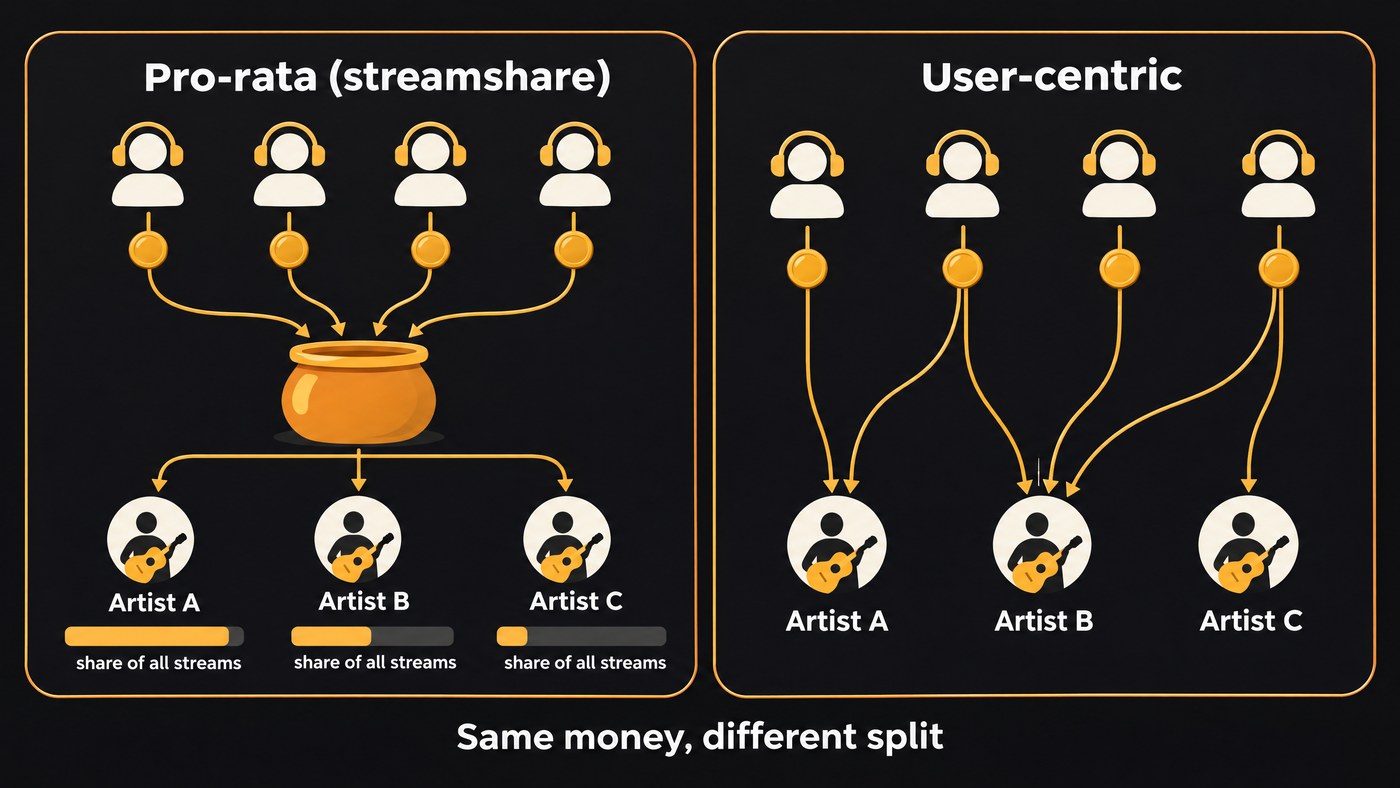
User-centric payouts send each listener's money only to what that listener played. SoundCloud's Fan-Powered Royalties is the best-known version. Its get-paid page contrasts the two: on most platforms everyone's subscription fees go into one pool and get split by total streams, while on SoundCloud a fan's subscription or ad revenue goes to the artists they actually listened to. An artist with a small, devoted audience can do better this way; one whose plays come from light, casual listeners may not.
Artist-centric keeps a shared pool but weights the streams. Deezer launched its version with Universal Music Group in France in late 2023 and extended it to publishing rights with Sacem on 15 January 2025. Deezer's artist-centric payment system (ACPS) has four parts:
- A user-centric cap on how much any one listener can affect the royalty split.
- A double boost. "Songs by artists with at least a 1,000 streams from 500 different subscribers each month are remunerated twice the amount per stream compared to artists who don't reach this goal." Songs fans actively search for, or find in non-algorithmic playlists, get the same boost.
- Noise out of the pool. Noise and functional sounds are replaced by Deezer's own catalog, which doesn't count in royalty calculations.
- Catalog cleaning that removes fraudulent content, noise and tracks unplayed for 12 months.
Deezer's FY25 results, published 18 March 2026, say 85% of its partners are on ACPS and that it plans to extend it to all of them. The same release says streams Deezer detects as fraudulent are removed from the royalty pool.
Not every service is convinced. Apple's royalties page says its analysis of alternative models found they would redistribute royalties in a limited way, with a varied impact on artists, without increasing what artists and songwriters earn from streaming overall.
What reaches the artist and what reaches songwriters
Every stream pays two sides, and the money travels separately.
- Recording royalties go to the licensor that delivered the track, typically your distributor or label, which pays you. This is the side the 1,000-stream rule affects.
- Publishing royalties go to publishers, collecting societies, performing rights organizations (PROs) and mechanical agencies, depending on the territory. Spotify's help page on PROs notes that the split between performance and mechanical royalties in a stream varies from country to country.
- In the US, mechanicals run through The MLC. The MLC says services send it usage data and royalties every month; it matches them to registered songs and pays members monthly. It doesn't replace PROs or SoundExchange. Apple's publishing help page says Apple Music has been an MLC licensee since January 2021.
- Registration decides whether you're paid. Spotify's guide tells songwriters to register songs with a PRO, mechanical agency or publisher, and warns that typos or missing details in titles, writer names and splits can delay or block payments. Our step-by-step guide to registering with a PRO walks through it.
If you wrote and recorded the song, you're owed both sides. A distributor doesn't collect publishing unless you add that service.
Where Soundverse fits
Soundverse is an AI music platform that takes you from idea to audience. It doesn't deliver tracks to streaming services or pay royalties; that runs through your distributor and, for songwriting income, your PRO, The MLC or a publisher.
It can help you follow the money. The Music Business Agent can search The MLC's unmatched works and SoundExchange's unregistered lists for your songs and your name and give you a list of what it found. Its royalty sweep reads the latest statement on each dashboard you sign in to and builds one per-song table, so stores and countries sit side by side. With the Soundverse for Chrome extension, Agent One can go through your distributor dashboard or the stores you name, using the sign-ins already in your Chrome, and report which ones show the release.
FAQ
How much does Spotify pay per stream? There's no fixed amount. Spotify pays rights holders by streamshare within each market, and any per-stream figure is total payouts divided by total streams over some period. Your own statement, broken down by country, is the only number that applies to you.
Why did my track earn nothing from Spotify? Usually because it didn't reach 1,000 streams in the previous 12 months or the unique-listener minimum. Streams flagged as artificial also earn nothing, and functional noise tracks under two minutes don't qualify. Spotify says your distributor's royalty report is the most accurate source.
Do free, ad-supported listeners generate royalties? Yes. Spotify pays rights holders for eligible plays from Premium and ad-supported listeners alike, but Premium streams add more to the pool because subscriptions bring in more revenue than ads.
Does the 1,000-stream rule apply to songwriting royalties? No. Spotify says the eligibility calculation applies only to recording royalties, and publishing royalties are calculated as before.
Sign up for Soundverse free and check where your releases are live with Agent One. More royalty and release guides on the Soundverse blog.