What Are the Typical Revenue Splits for Music Distributed Through Online Services?
Music distribution revenue splits explained: the store's share, recording vs publishing, distributor fees, and label, producer and collaborator splits.
Music distribution revenue splits start at the store. Spotify says roughly two-thirds of its music revenue goes to rights holders, about four-fifths of that for the recording and one-fifth for the song. Your distributor then takes a yearly fee or a commission, such as CD Baby's 9%, and the rest is shared under your label, producer and collaborator deals.
Below is the full waterfall for one stream and one sale, with each source named. We checked every page on 14 November 2026. Spotify publishes the clearest numbers, so it serves as the main example.
Music distribution revenue splits for one stream
Streaming services don't pay a fixed amount per play. Spotify's royalties guide says it pays rights holders based on streamshare, their share of total streams in a given month, and that no major streaming service pays a fixed rate per stream. It also says all streaming services pay essentially the same way, returning roughly two-thirds of music revenue to rights holders.
The same guide sets out the first split in one sentence: "Roughly two-thirds of Spotify’s music revenue (from Premium subscription fees and advertising) is allocated to recording and publishing royalties, with around four-fifths going to recording and one-fifth to publishing."
Here is what that means in dollars. Say your streams account for $100 of Spotify's music revenue in a month. Using Spotify's rounded fractions:
- The service keeps about $33.
- About $67 goes to rights holders.
- About $53 of that is the recording side, paid to the licensor that delivered your music, typically your label or distributor.
- About $13 is the publishing side, paid to publishers, performing rights organizations (PROs) and mechanical agencies depending on the territory.
- Your distributor or label takes its share of the $53 under your deal, and you receive the rest.
- You pay producers and collaborators their agreed shares out of what you receive.
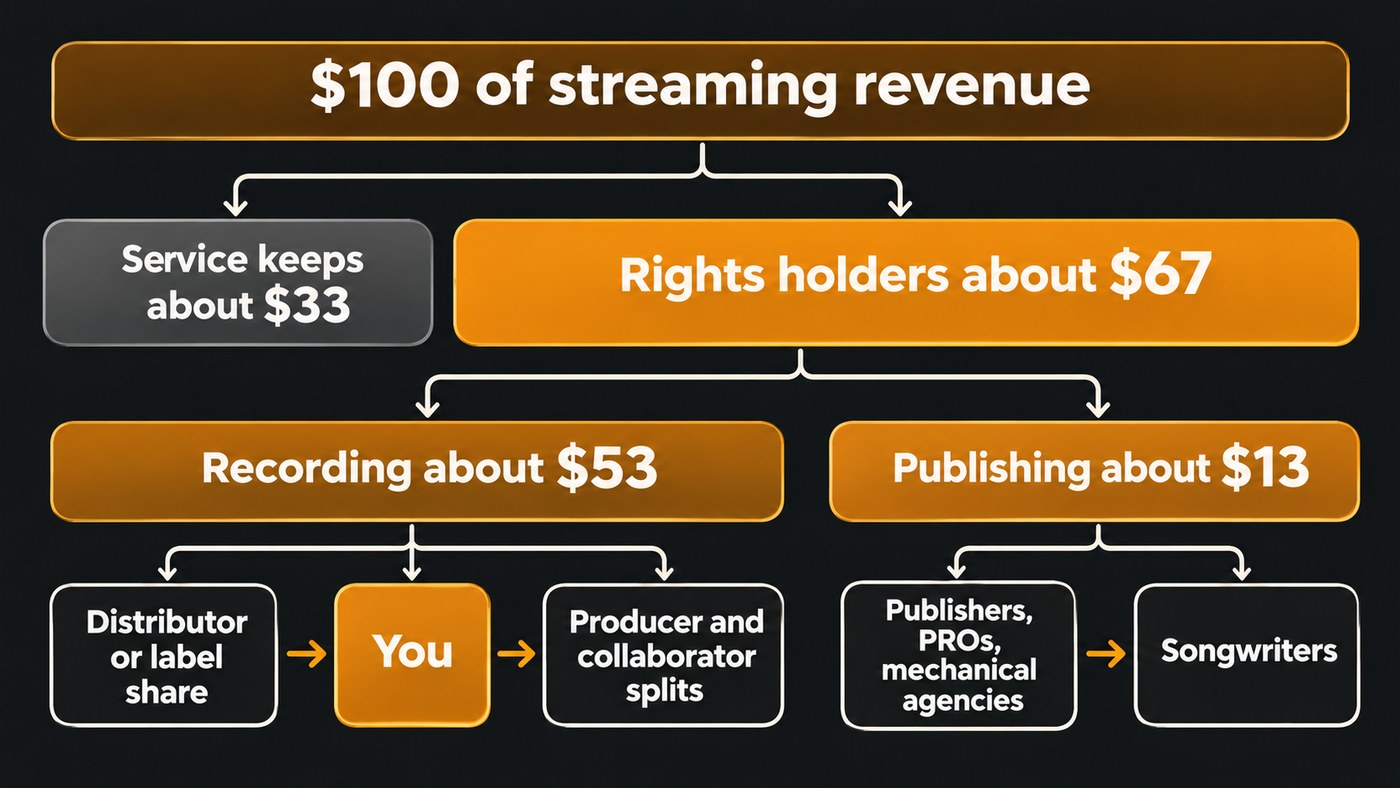
These are illustrative figures from Spotify's fractions, not a statement anyone will send you. Your real numbers depend on where listeners are, whether they pay for Premium and how much they stream in total.
Recording side vs publishing side
Every song online earns twice: once for the recording (the master) and once for the composition (the song itself).
The recording side is the larger pot. If you self-release, you usually own the master, and your distributor collects this money for you.
The publishing side belongs to the songwriters and their publishers. Spotify's guide says it covers both performance and mechanical rights. Two examples of how it's set in the US:
- Mechanical royalties for streaming follow rates set by the Copyright Royalty Board. Its Phonorecords IV determination, published in the Federal Register on 30 December 2022, sets a headline rate of 15.3% of service provider revenue for 2026, rising to 15.35% in 2027. The regulation sets other calculations alongside it, so treat the headline rate as the starting point, not the figure on your statement. The MLC administers the blanket mechanical licence for these services and says it distributes royalties to its members monthly.
- Performance royalties go through PROs such as ASCAP, BMI, PRS or IPRS, which pay writers and publishers.
Spotify's guide also describes the deals that decide how much of the publishing side a songwriter keeps: traditional publishing deals, where the publisher controls and licenses the songs in exchange for a share; co-publishing deals, which give you a larger share; and admin-only deals, where you keep full ownership and pay a small admin fee. It adds that collecting societies take an administrative fee before paying out.
Distributor commission vs flat-fee models
This is the cut taken from your recording royalties. Two models dominate for independent artists:
- Flat fee, you keep 100%. DistroKid's pricing page lists plans from $24.99 to $89.99 billed annually, and says every plan lets you keep 100% of earnings.
- Commission, sometimes with a setup fee. CD Baby's pricing page charges $9.99 per single or $14.99 per album once, then keeps 9% of digital distribution revenue, so you get 91%.
On the $53 recording share from the example, a flat-fee distributor passes on all $53 (you pay the yearly fee separately), and a 9% commission leaves about $48.50 (91% of the unrounded $53.33). The fee model suits frequent releasers; the commission suits a small catalog that earns little. Our breakdown of which music distributors offer the best royalty splits compares the main services and does the break-even maths.
Label splits
A label deal changes the waterfall at step 5. Spotify's royalties guide describes the range: traditional label deals, where the label typically takes the majority share in exchange for marketing, promotion and A&R support; 50/50 partnerships; and service or distribution models where artists keep nearly 100% of their earnings after fees.
Two things matter as much as the headline percentage:
- Advances and recoupment. If a label paid you an advance, your share usually goes toward paying it back before you see royalties. Spotify's guide tells artists to check whether they've taken an advance and where they stand on recoupment.
- What the share pays for. The guide suggests checking the percentage each partner takes, any administrative costs, and the benefits you get in return.
Producer splits
Producers are paid in one or more ways, set by agreement rather than by law: an upfront fee, a share of the master royalties (often called points), and a share of the publishing if they co-wrote the song. There is no single standard percentage, so agree it in writing before release.
On a self-release, the producer's master share comes out of your recording income. Many distributors can pay collaborators automatically through a splits tool, and our guide to choosing a distributor covers what to check.
US digital radio has its own route. SoundExchange's Letter of Direction lets a featured artist direct a percentage of their featured-artist share to producers, engineers, mixers and other creative participants.
Collaborator and featured-artist splits
Keep two split agreements per song, because the master and the composition can be owned differently. A co-writer may hold half the song but none of the master if you funded and own the recording.
For non-interactive digital radio in the US, such as Pandora, SiriusXM and webcasters, the law sets the split. SoundExchange says 45% of these performance royalties go directly to the featured artists and 5% to a fund for non-featured artists such as session players. "The other 50 percent of the performance royalties are paid to the rights owner of the sound recording." If you self-release and own the master, register for both the artist and the owner shares.
For everything else, write a split sheet before release: names, roles, legal names, master percentages, songwriting percentages and who recoups costs first. Our guide on what to prepare before uploading lists the songwriter and publishing details to gather.
Revenue splits on a download or direct sale
Sales split more simply than streams. On Bandcamp, its help article on fees (dated 10 June 2026) says Bandcamp takes 15% of digital sales, dropping to 10% once you reach $5,000 in sales, and 10% of physical sales. Payment processor fees are separate and typically 4 to 6%.
On a $10 digital album that means about $1.50 to Bandcamp, roughly 40 to 60 cents to the processor, and around $8 to you before your own collaborator splits. Downloads sold through stores via your distributor come back in the same statements as your streams.
Small fees that eat small payouts
Spotify's guide flags two costs that hit new artists hardest: labels and distributors usually require $2 to $50 before you can withdraw, and banks charge $1 to $20 per withdrawal. Since April 2024, a track also needs at least 1,000 streams in the previous 12 months to be included in Spotify's recorded music royalty pool. Let a balance build before you cash out.
Where Soundverse fits
Soundverse is an AI music platform that takes you from idea to audience. It isn't a distributor and doesn't collect your streaming royalties: delivery to Spotify, Apple Music and other stores, and the payouts that follow, run through your distributor.
What Soundverse does is help you plan and check the release. Release Planner turns a finished track into a dated, day-by-day rollout split by platform, with pre-save, smart link and playlist pitch deadlines, on every plan including Free. With the Soundverse for Chrome extension, Agent One can upload a track to SoundCloud or a visualizer to YouTube as Private for you to review, and go through your distributor dashboard or the stores you name to report which ones show the release.
If you make the music on Soundverse, licensing is set by plan: the Free plan is for personal use, and the Creator plan comes with a royalty-free license.
FAQ
What percentage of streaming revenue reaches the artist? It depends on your deal. Spotify pays roughly two-thirds of its music revenue to rights holders, and about four-fifths of that goes to the recording side. A self-releasing artist on a flat-fee distributor keeps all of that recording share, minus the yearly fee and any collaborator splits; a label deal leaves the artist less.
Is there a standard per-stream rate? No. Spotify says no major streaming service pays a fixed rate per stream. A per-stream figure is total payouts divided by total streams, so it moves with each service's prices and how much its listeners stream.
Do distributors take a cut of publishing royalties? Not by default, because they collect recording royalties. Songwriting income goes through PROs, mechanical agencies such as The MLC in the US, or a publisher. Some distributors sell publishing administration as an add-on with its own commission.
How should I split royalties with a producer? Agree it in writing before release and treat the master and the song separately. A producer who co-wrote can hold a songwriting share as well as master points. In the US, a SoundExchange Letter of Direction can route part of the featured artist's share to the producer.
Sign up for Soundverse free and plan your next release with Release Planner.
More release and royalty guides on the Soundverse blog.