Describe How Royalty Collection Works Through Distribution Channels
Royalty collection explained: what distributors collect, PROs and The MLC, SoundExchange and PPL, YouTube income, payment timing and what to register.
Here is how royalty collection works through distribution channels: your distributor collects recording royalties from streaming services and stores, keeps its fee or commission and pays you. Songwriting royalties travel separately through performing rights organizations, The MLC and publishers, while radio and broadcast plays of the recording pay through SoundExchange in the US or PPL in the UK.
Below, each channel runs from a listener's play to your account, with every rule taken from the organization's own page as it read on 21 November 2026. For the per-stream maths, see how streaming platforms calculate payouts. For India, our Hindi guide to music distribution royalties covers IPRS and ISRA. This is general information, not legal or tax advice.
One release, three sets of rights
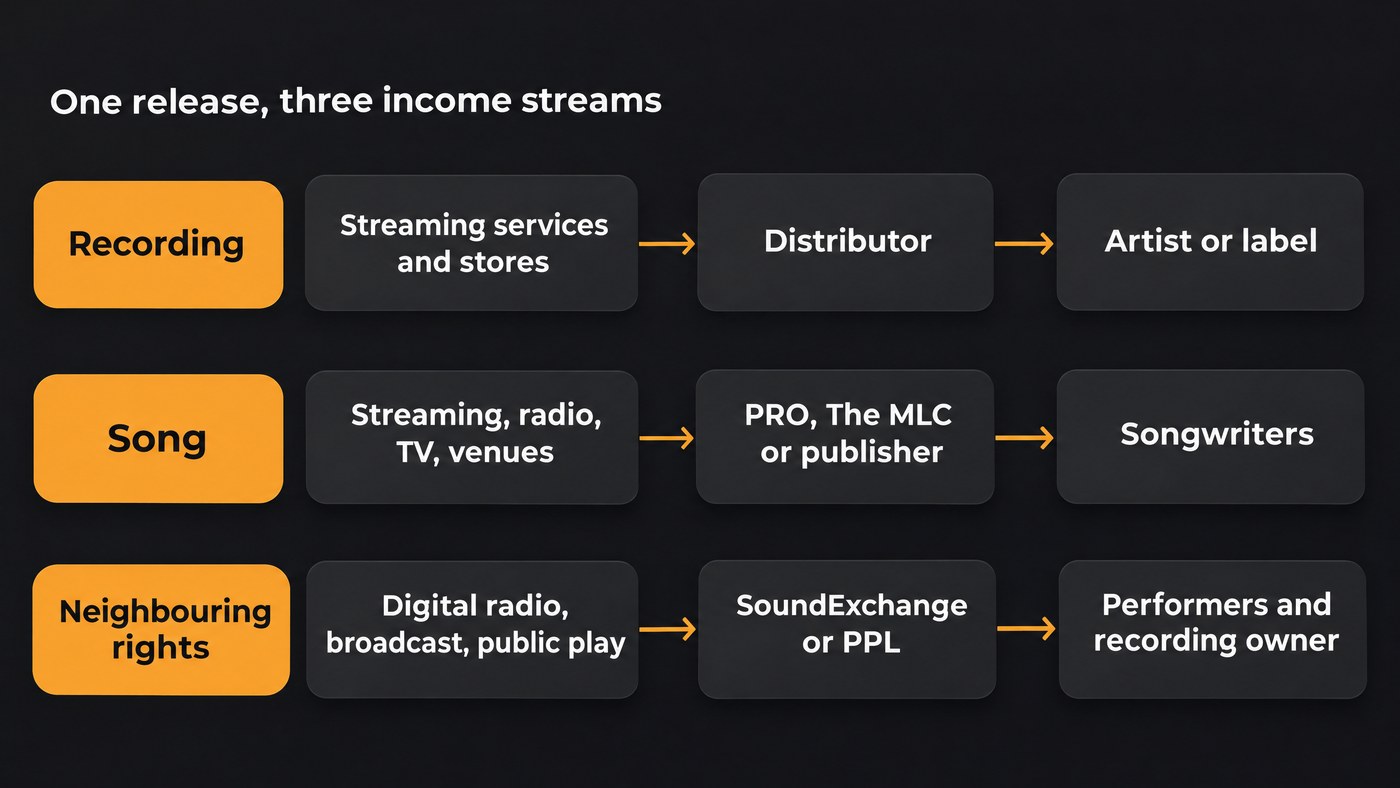
A released track carries three kinds of rights, and each pays through different organizations.
- The recording (master). Usually owned by whoever made and paid for the recording: you, if you self-release, or your label. Your distributor collects this money.
- The song (composition). The words and music, owned by the songwriters and any publisher. Performing rights organizations (PROs), mechanical collectors and publishers collect it.
- Performers' and recording owners' broadcast rights. Money from radio, TV, public play and non-interactive streams, collected by SoundExchange in the US and PPL in the UK. PPL notes that the international versions are sometimes called neighbouring rights royalties.
If you wrote, sang and paid for the record, you're owed all three. PPL puts it plainly: "If, for example, you are a rightsholder, composer, lyricist and performer on a recording, you may need to register with PPL and PRS for Music."
The master side: what your distributor collects
- The store reports and pays. Each service sends your distributor usage reports and money for the recordings it delivered. Amuse's payment page (updated 9 September 2026) says streaming services usually pay 2 to 3 months after the streams happen: a Spotify stream in February shows in April.
- The distributor posts it to your account. Commission models keep a percentage; flat-fee models charge a subscription and pass on what the stores paid. Our comparison of distributor royalty splits shows what each keeps.
- You withdraw once you hit a minimum. CD Baby's Artist Agreement (updated 14 August 2024) says it aims to pay within 15 business days of your balance reaching your "Pay Point".
- You check the statement. Statements break income down by store, country and track. CD Baby gives you 18 months to object to a statement before it becomes binding, so reconcile each one while the period is fresh.
- You pay collaborators, unless your distributor's split tool pays producers and featured artists directly.
DistroKid's help centre and TuneCore's help article on sales reports blocked automated reading for us on 21 November 2026, so check timing in their dashboards.
The publishing side: performance and mechanical royalties
Every stream also pays the song, and your distributor doesn't collect that money unless you've added a publishing service.
- Performance royalties go through a PRO such as ASCAP or BMI in the US or PRS for Music in the UK. You join as a writer and register each song; our guide to registering with a PRO walks through it.
- Mechanical royalties pay for reproducing the song. In the US, The MLC says services under the blanket licence send it usage data and royalties each month; it matches them to songs its members registered and distributes monthly. Its Public Work Search lets anyone check how a song is registered. In the UK, PRS for Music's join page says MCPS manages the right to copy your work, such as for CDs or digital downloads, as a separate membership.
- The publisher share. Without a publishing deal, you either collect it through your own publisher account where your PRO allows, or pay a publishing administrator a commission to register your songs with societies and collect it.
Neighbouring rights: SoundExchange, PPL and others
United States. SoundExchange collects for the recording when it's played on non-interactive services. Its page for artists and labels (updated 20 October 2026) is direct: "Recording artists and sound recording owners must be registered with SoundExchange in order to receive digital performance royalties for the use of their sound recordings on non-interactive platforms like SiriusXM, Pandora, and iHeart Radio." Registration is free. A self-releasing artist is usually both the featured artist and the recording owner, so register in both roles. Its FAQ says unclaimed royalties expire after three years.
United Kingdom. PPL licenses recorded music when it's played in public or broadcast on UK radio and TV, then pays performers and recording rightsholders. Its getting-started page (updated 16 April 2026) says registration is free, that PPL doesn't manage on-demand streaming of tracks on services like Spotify, and that agreements with collecting organizations abroad let it collect from over 50 countries.
Elsewhere. Ask your home society whether it collects abroad through reciprocal deals, as PPL does, before joining a second organization.
YouTube and social income
- YouTube. Plays of your tracks on YouTube Music, and Content ID claims on other people's videos, earn recording income that your distributor collects and adds to your statement. The song side goes to publishers and societies. Our Content ID guide covers claims and allowlists.
- Facebook, Instagram and TikTok. Distributors that offer these platforms license your recordings to their music libraries and pass on what the platforms pay. Not every plan includes every platform, so check yours.
How long royalty collection takes
Every payer waits for usage reports before it can match and pay, so lag is built in.
- Stores to distributor: usually 2 to 3 months, per Amuse.
- The MLC: monthly distributions.
- SoundExchange: its FAQ (updated 15 August 2022) says direct-deposit accounts are paid monthly once they reach $100, or quarterly from $10. Checks go out quarterly, at the ends of March, June, September and December, for balances of $100 or more.
- ASCAP: its payment page says each quarter's distribution covers US performances from two quarters earlier for publishers and three quarters earlier for writers. BMI's site blocked automated reading for us.
- PPL: pays four times a year. Its payment dates page (updated 10 August 2026) shows the main UK payment on 30 June 2026 covering UK broadcasts and public play during 2025.
So for a single released in January, recording income usually appears by spring, writer performance royalties from ASCAP about three quarters after the plays, and UK broadcast money in the June of the following year.
What an independent artist must register to collect everything
For an artist who writes, performs and owns the recording:
- Distributor account: payout method, tax form and split recipients.
- PRO membership as a writer, with every song registered with all writers and shares.
- The publisher share: your own publisher account or a publishing administrator.
- The MLC for US mechanicals, directly or through your administrator.
- MCPS in the UK if your songs are reproduced, for example on CD or vinyl.
- SoundExchange as featured artist and as sound recording owner.
- PPL in the UK as performer and recording rightsholder, with international collection switched on.
- YouTube Content ID through your distributor, only for recordings you own exclusively.
- Matching data everywhere: one ISRC per recording, and identical titles, writer names and splits.
Where Soundverse fits
Soundverse is an AI music platform that takes you from idea to audience. It isn't a distributor or a collecting society, and it doesn't collect or pay royalties.
Its Music Business Agent works on the sites where royalties are registered and reported. The Find My Money workflow runs PRO signup, work registration, a royalty sweep and unclaimed royalty claims. The sweep reads the latest statement on each dashboard you sign in to and builds one per-song table, and the agent can search The MLC's unmatched works and SoundExchange's unregistered lists for your songs and your name. It asks once for missing details such as ISRCs, writers and splits, and is instructed never to invent them. You sign in yourself, and its workflows ask for your OK before anything that costs money. Some sites block automated browsing, so results vary by site.
FAQ
Does my distributor collect my songwriting royalties? Not by default. Distributors collect for the recording. Performance and mechanical royalties for the song need a PRO membership, The MLC in the US or a publishing administrator, unless you've added a publishing service from your distributor.
Do I need SoundExchange if I already have a distributor? Yes, if your music plays on US non-interactive services such as SiriusXM or Pandora. SoundExchange says recording artists and sound recording owners must register to receive those royalties, and it pays them separately from your distributor.
Why does income show up months after the streams? Each payer waits for usage reports before it can match and pay. Amuse says services usually pay 2 to 3 months after the streams, and ASCAP pays writers for US performances three quarters later.
Can I still claim royalties from past years? Partly. SoundExchange says it collects as far back as three years and that unclaimed royalties expire after three years. Other societies set their own limits, so register before your first release.
Sign up for Soundverse free and let Agent One check your registrations with Music Business Agent. More royalty and release guides on the Soundverse blog.