How Does Prosody Modeling Function in AI Voice Generators?
How prosody modeling works in AI voice generators: pitch, timing, pauses and emphasis, how models predict them, and how podcasters can steer the read.
Prosody modeling is how an AI voice generator decides the melody and timing of speech: the pitch contour of each phrase, how long every sound lasts, how loud it is, where the pauses fall and which word carries the stress. Some models predict these values explicitly from the text; newer token-based models pick them up from context.
That is why the same script can sound read aloud in one tool and spoken in another. Below is what each part of prosody does, how models handle it, and what a podcaster can control. Papers and documentation were checked on 23 November 2026.
What prosody is, and why it decides "read" versus "spoken"
Prosody is everything about delivery that isn't the words themselves. Five parts matter most:
- Pitch contour. How the voice rises and falls across a phrase. A finished statement usually falls; a yes-or-no question in English often rises.
- Timing and duration. How long each syllable lasts. Speakers stretch the last word of a phrase and rush through filler.
- Loudness. Energy that swells on important words and drops on asides.
- Pauses. Where breath and thought happen. Real speakers pause between ideas, not only at commas.
- Emphasis. The one word a sentence hangs on, marked by a pitch jump, extra length and extra loudness together.
A voice sounds read when these stay even: every sentence has the same arc, pauses appear only at punctuation and every word gets equal weight. It sounds spoken when phrasing follows meaning. Emotion rides on the same five cues, which our explainer on how AI voice synthesis handles emotional inflection covers. This post is about the structure underneath: phrasing, timing and stress.
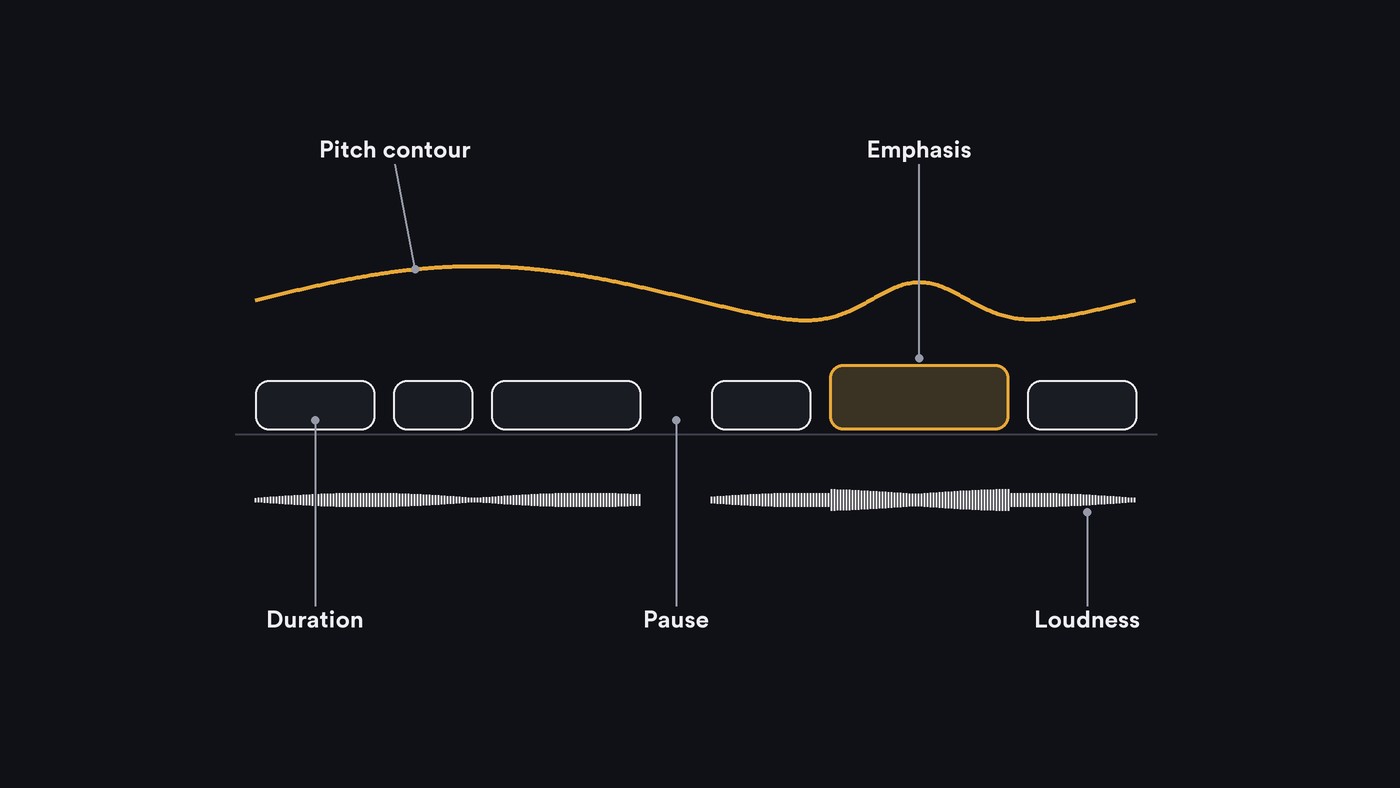
How prosody modeling works inside an AI voice generator
Explicit predictors: FastSpeech 2
FastSpeech 2 (Yi Ren and colleagues, ICLR 2021) gives each part of prosody its own small predictor inside a "variance adaptor":
- Duration. For every phoneme, the model predicts how many spectrogram frames it should occupy. The training targets come from the Montreal Forced Aligner, a tool that lines recorded speech up with its transcript.
- Pitch. Instead of predicting the pitch line directly, which the authors found hard because real pitch varies so much, they decompose it with a continuous wavelet transform into a "pitch spectrogram" and convert the prediction back into a contour at synthesis. Pitch is predicted frame by frame, and their ablation found the prosody got worse without this step.
- Energy. Loudness per frame, computed from each slice of the spectrum and quantised to 256 levels.
Separate numbers make control easy, which is why systems built this way can expose speed or pitch sliders. The weakness is averaging: text alone doesn't say whether a line is sarcastic or sincere, so a predictor trained on many readings lands near the middle.
Stochastic duration: VITS
VITS (Jaehyeon Kim, Jungil Kong and Juhee Son, ICML 2021) learns its own alignment between text and audio with a method called monotonic alignment search, so no external aligner is needed. Its key change for rhythm is the duration predictor. A fixed predictor, the authors write, "cannot express the way a person utters at different speaking rates each time." VITS samples each phoneme's duration from a learned distribution instead.
They tested it by generating "How much variation is there?" 100 times. A comparison model with fixed durations produced the same length every time; VITS produced a spread of lengths and pitch tracks. That is why regenerating a line can change its rhythm: the randomness is deliberate.
Style from a reference: reference encoders and style tokens
Global Style Tokens (Yuxuan Wang and colleagues, March 2018) are a bank of style embeddings trained inside Tacotron with no labels. Weighting them changes speed and speaking style independently of the text, or copies the style of one clip across a long script. A companion prosody transfer paper by RJ Skerry-Ryan and colleagues learned a prosody embedding from a reference clip and applied it to new text, even with a different speaker. Both steer prosody by example rather than by number.
Token-based models: prosody from context
The newest generators treat speech like language. BASE TTS (Mateusz Łajszczak and colleagues at Amazon, February 2024) uses a 1-billion-parameter autoregressive Transformer that predicts discrete "speechcodes" from text and a reference clip. The codes are built to carry phonetic and prosodic information, while a separate decoder restores speaker identity and recording conditions. The same autoregressive model handles the sounds, the prosody and the duration, so timing and melody come out of the code sequence itself.
The authors report that variants trained on 10,000+ hours of speech with 500 million+ parameters begin to show natural prosody on textually complex sentences. Their test set covers exactly the things podcast scripts are full of: questions, compound nouns, punctuation, foreign words, emotions, paralinguistics such as "shhh", and long, nested sentences. Questions were judged on intonation pattern; emotions and paralinguistics stayed the hardest categories even for the largest model. For these models, the shape of your script is the main input to prosody.
What podcasters can control
SSML: prosody, emphasis and break
The W3C's SSML 1.1 specification, a Recommendation since 7 September 2010, defines the standard markup:
<prosody>sets pitch, pitch contour, pitch range, rate, duration and volume.<emphasis>takes the levels strong, moderate, none and reduced. The spec's example of reduced: "going to" spoken as "gonna".<break>takes a strength from none to x-strong, or an exact time such as 250ms. The default behaviour matters: "If the element is not present between tokens, the synthesis processor is expected to automatically determine a break based on the linguistic context."
Support varies by provider and by voice. Google's Cloud Text-to-Speech SSML reference (last updated 10 November 2026) supports rate, pitch and volume in <prosody>, plus <say-as> for dates, times and units. It adds a warning worth knowing: <prosody> and <emphasis> should wrap only full sentences, because wrapping single words inside a sentence may cause unwanted pauses. For an audible pause, Google suggests wrapping sentences in <s> tags and placing the break between them:
<speak>
  <s>We tested four microphones.</s>
  <break time="600ms"/>
  <s><prosody rate="90%">Only one survived the rain.</prosody></s>
</speak>
For which tools support which tags, see our comparison of AI voice synthesizers with expressive control for podcasting.
Settings and tags in current voice generators
ElevenLabs' text to speech documentation describes Stability as the control over how stable the voice is and how much each generation varies. Lower settings widen the emotional range, but too low can give odd, overly random reads that speak too quickly; too high can sound monotonous. Its suggested starting point is stability around 50, similarity around 75 and style at 0. Think of it as the user-facing version of the variation VITS samples on purpose: more difference between takes, or more consistency. Speed runs from 0.7 to 1.2, though not on Eleven v3, and Audio Tags for steering delivery are available on Eleven v4 and v3.
The same page states the principle behind every script tip below: the model reads delivery from context, including punctuation, grammar and the general formatting of the text, and it won't correct a misspelled word.
Podcast traps: where prosody breaks
- Questions versus statements. "You booked the studio?" depends entirely on the question mark to rise. Wh-questions ("Where did you record it?") usually fall in English, so a model that rises on every question mark sounds odd. Rephrase when the read comes out wrong.
- Lists. Long comma lists come out sing-song or flat. Keep lists to three items, or give each item its own short sentence.
- Numbers and dates. "03/04" is March or April depending on the listener. Write "the third of April", or use
<say-as>with an explicit date format where SSML is supported. - Long paragraphs. One 90-word sentence leaves the model guessing where phrases end. Split it, and generate long scripts in sections.
- Names and compound nouns. A guest's surname or "podcast production budget" can get the stress on the wrong word. Respell names phonetically, and rewrite stacked nouns ("the budget for producing the podcast").
A script-formatting checklist
- One idea per sentence, mostly under 20 words.
- A full stop where you want the pitch to fall; a comma only where you'd breathe briefly.
- Question marks only on real questions; rewrite statements that pose as questions if they don't rise.
- Numbers, dates and units written as you'd say them.
- Names spelled the way they sound, checked once and reused.
- Emphasis through word order (put the key word last) before markup.
- Breaks between sentences, not inside them.
For intro scripts in particular, our guide to the most natural AI voice generators for podcast intros adds a blind listening test.
Where Soundverse fits
Soundverse is an AI music platform that takes you from idea to audience, built for independent artists who release music. Its AI Speech Generator names podcasters among the people it's for, with intros, ad reads and segment links in the same voice every episode. It reads up to 3,000 characters per run in a built-in voice. Every voice has a sample to play and labels for its tone and accent, such as warm storyteller or articulate anchor, so you pick a voice whose natural delivery suits the show. If a read misses, Soundverse's page advises adjusting the wording or trying another voice, which is where the checklist above earns its keep. You can regenerate a single line when the script changes, and for a two-host intro, generate each host's lines in a different voice and place them on separate tracks in AI Studio, next to your music. Licensing is set by plan: the Free plan is for personal use, and the Creator plan comes with a royalty-free license.
In Soundverse's Create walkthrough, the AI Speech Generator part, narration or dialogue in a chosen voice, starts at 0:39.
FAQ
Is prosody the same as emotion in an AI voice? No. Prosody is the set of cues (pitch, timing, loudness, pauses, emphasis), and emotion is one thing those cues can express. A neutral, well-phrased news read has strong prosody and very little emotion.
Why does the same script sound different every time I generate it? Many models sample timing and delivery from a distribution instead of computing one fixed answer, as VITS does with duration. Settings such as stability in ElevenLabs control how wide that variation is. Generate a few takes and keep the best one.
Does SSML work in every AI voice generator? No. SSML is a W3C standard, but each provider supports a different subset, and some newer voices rely on audio tags, style prompts or plain text instead. Check the provider's documentation for the exact voice you use.
Sign up for Soundverse free and audition voices for your next episode intro. More guides on AI voice and audio on the Soundverse blog.