How Do AI Voice Synthesis Models Handle Emotional Inflection?
How emotional inflection in AI voice works: pitch, energy, timing and voice quality, style tokens, prompts, reference clips and SSML, and how it's tested.
Emotional inflection in AI voice comes from how a model shapes pitch contour, loudness, timing and voice quality across a phrase. Models learn those patterns from expressive recordings, then let you steer them with a reference clip, learned style tokens, explicit pitch, energy and duration values, emotion labels, written style prompts, or markup such as SSML.
When nothing steers it, a model falls back on the most typical reading of the text, which is why so many AI voices sound pleasant and flat. For the full text-to-waveform pipeline, see how AI voice synthesis works.
What emotional inflection is, acoustically
Emotion in a voice is carried by four measurable things:
- Pitch contour: how the fundamental frequency rises and falls across a phrase, and how wide the range is.
- Energy: loudness and how it moves, including stress on the words that matter.
- Timing: speaking rate, syllable length and where the pauses fall.
- Voice quality: breathy, tense, creaky or bright. Acoustically it shows up in spectral balance, how energy spreads between low and high frequencies, and in perturbation, small irregularities in the voice signal.
A study of opera singers expressing ten emotions, by Klaus Scherer, Johan Sundberg and colleagues in Computer Speech and Language (2015), found that spectral balance and perturbation, beyond loudness and tempo, helped tell the emotions apart, with patterns closely matching actors' emotional speech.
Speech researchers group these cues as prosody. In their prosody transfer paper (March 2018), RJ Skerry-Ryan and colleagues at Google defined it by subtraction: whatever varies in speech after you account for the sounds being spoken, the speaker's identity and the recording channel.
Why text alone can't fix the emotion
The FastSpeech 2 paper (Yi Ren et al., June 2020) names the root problem one-to-many mapping: many possible readings fit one text, and text alone can't predict pitch, duration and volume. So a model learns prosody from the statistics of its data. Skerry-Ryan's team gave an example: a yes-or-no question ending in a question mark probably rises in pitch. That gives plausible speech, not the doubt or warmth a particular line needs.
Six ways models represent and control emotion
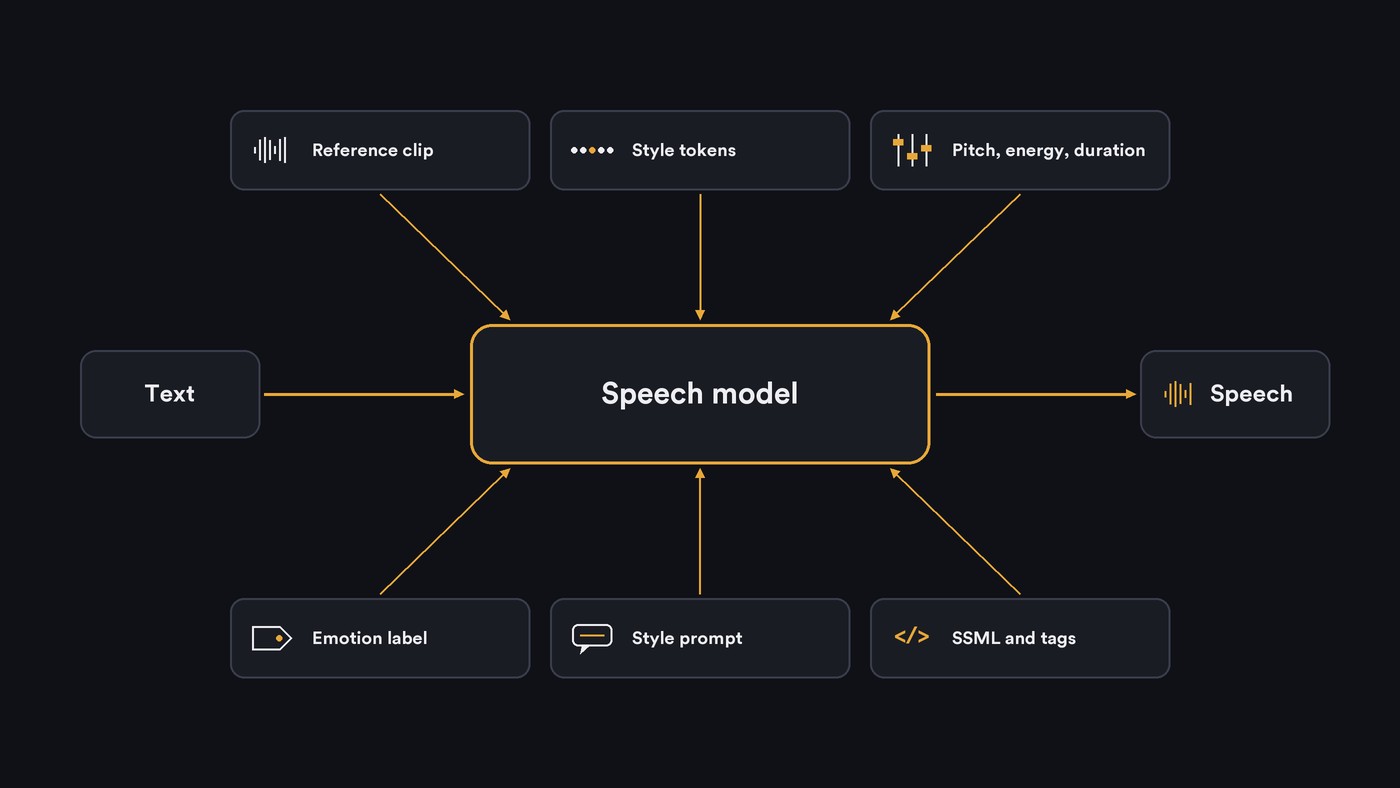
1. Reference encoders: "say it like this"
Skerry-Ryan's team added a reference encoder to Tacotron that compresses a recorded clip into a fixed-length prosody embedding. Condition the model on it and the output matches the reference's prosody in fine timing detail, even with a different speaker or different text. The catch: you need a clip that already sounds the way you want.
2. Global Style Tokens
The Global Style Tokens paper (Yuxuan Wang et al., March 2018) trained a bank of style embeddings inside Tacotron without any emotion or style labels. Each clip becomes a weighted mix of tokens, and the weights act as soft labels: you can set them by hand to change speed and speaking style independently of the text, or copy the style of one clip across a long text.
3. Explicit pitch, energy and duration predictors
FastSpeech 2 makes prosody explicit. Its variance adaptor predicts how long each sound lasts and how pitch and energy move over time; during training it uses the true values measured from recordings, and at inference its own predictions. The authors describe pitch as a key carrier of emotion. Because the values are explicit, you can edit them: the paper shows pitch scaled from 0.75 to 1.5 times the predicted contour.
4. Emotion labels with an intensity dial
The simplest route is to tag each training clip with a category. EmoDiff (Yiwei Guo et al., November 2022) shows both the method and its limits. Its English training set has four emotions (angry, happy, sad, surprise) plus neutral. Instead of a hard label, EmoDiff blends the target emotion with neutral by a weight from 0 to 1, which gives an intensity dial. Categories are easy to use, but you only get the emotions somebody labelled.
5. Natural-language style prompts
PromptTTS (Zhifang Guo et al., November 2022) takes a written description of the delivery, along the lines of a woman whispering slowly to a friend, and encodes style and content separately. InstructTTS (Dongchao Yang et al., January 2023) explains why this direction matters: models built on predefined style categories can produce only those styles, and style pulled from reference speech is hard to interpret. Both teams had to build new datasets with style descriptions, because none existed.
6. In-context imitation from a reference clip
Codec language models treat speech as discrete audio tokens. VALL-E (Chengyi Wang et al., January 2023) clones an unseen voice from a 3-second recording used as an acoustic prompt, and its authors found it could preserve the speaker's emotion and the acoustic environment of that prompt.
User-facing controls: SSML, speaking styles and inline tags
Microsoft's Azure SSML documentation (updated 30 January 2026) shows all three common types:
- SSML prosody: the
prosodyelement sets pitch, contour, range, rate and volume. Contour doesn't work on single words or short phrases. - Speaking styles: neural voices default to a neutral style. The
mstts:express-aselement sets a style such as sad or cheerful on supported voices, with astyledegreefrom 0.01 to 2, where 1 is the preset intensity. - Inline tags: Azure's HD voices also accept markers such as
[whispering]typed straight into the text. A marker applies to the sentences after it until you reset it, for example with[Neutral]; line breaks and paragraph tags reset it too.
Here's how the two SSML controls look side by side, inside the voice element of a voice that supports the sad style:
<mstts:express-as style="sad" styledegree="1.4">I kept the letter.</mstts:express-as>
<prosody rate="-10%" pitch="-2st">I never opened it.</prosody>
The first sentence gets a sad style a little above preset strength; the second keeps the default style but reads slower and two semitones lower. For a vendor-by-vendor comparison, see our guide to AI voice synthesizers with expressive control for podcasting.
Why emotion drifts or sounds flat
Averaging. The GST authors put it plainly: "Many TTS models, including recent end-to-end systems, only learn an averaged prosodic distribution over their input data, generating less expressive speech especially for long-form phrases." They also saw pitch sag toward the end of each sentence. On long narration, re-apply style per paragraph or scene.
Text that fights the style. Microsoft notes for its HD voices: "Style results are strongly relevant to the input content: the model adapts style application based on the semantic meaning of the text." A cheerful style on a sombre sentence works against the model.
Silent fallbacks. On Azure, an invalid style makes the service ignore the whole express-as element and read in the default neutral style, and an unsupported styledegree is skipped. Check every render by ear.
Reference leakage. With reference clips and prompts, the clip's mood, pace and room come along.
Singing adds vibrato and breath problems of its own, covered in the challenges of expressive AI vocals.
How emotional speech is evaluated, and the limits
- Mean opinion score (MOS): listeners rate naturalness or quality on a scale, as in FastSpeech 2 and EmoDiff. It tells you whether speech sounds good, not whether it sounds sad.
- Side-by-side prosody tests: Skerry-Ryan's team asked raters which of two clips was closer in prosody to a reference, on a 7-point scale.
- Emotion classifiers: a speech emotion recognition model checks whether the target emotion is recognisable. EmoDiff used classifier probabilities to show its intensity dial worked.
Each has blind spots. A classifier trained on five categories can only say which of those five a clip resembles, not whether the emotion suits the line, and MOS answers only the question raters were asked. Whether a delivery fits your script is still a human call, and a big part of what makes an AI voice sound robotic versus authentic.
What this means when you choose or prompt a voice
- Pick a voice whose default already suits the job. Styles and tags only work within what a voice supports.
- Write the emotion into the words. Style follows meaning, so a line that reads sad on paper renders sad more easily.
- Change one control at a time. Set style first, then adjust prosody, then re-render.
- Record your reference in the mood you want. For clone and prompt-based tools, the clip's emotion and room come through.
- Raise intensity in small steps. On Azure, a style degree of 2 doubles the preset, which can sound overplayed.
- Run a blind test. Play two takes to someone who hasn't read the script and ask what each one feels like.
For sung vocals, where pitch is written in the notes, our guide to the best control over vocal expression in AI voice synthesis compares the singing editors.
Where Soundverse fits
Soundverse is an AI music platform that takes you from idea to audience, built for independent artists who release music. For spoken parts, the AI Speech Generator reads up to 3,000 characters per run in a built-in voice. Each voice has a sample to play and labels for its tone and accent, such as warm storyteller or articulate anchor, so you choose the emotional starting point by ear. If a read misses, Soundverse's page advises adjusting the wording or trying another voice, and you can regenerate a single line when the script changes. Generate inside AI Studio to put the speech on a track next to your music.
Licensing is set by plan: the Free plan is for personal use, and the Creator plan comes with a royalty-free license.
In Soundverse's Create walkthrough, the AI Speech Generator part, narration or dialogue in a chosen voice, starts at 0:39.
FAQ
Can AI voices actually feel emotion? No. They reproduce acoustic patterns in pitch, loudness, timing and voice quality that listeners hear as emotion, learned from expressive recordings.
Why does my AI voice sound flat even with a style setting? Common causes: the style isn't supported for that voice and is ignored, the text contradicts the style, or a long passage drifted back toward an average read. Try a voice whose default suits the mood, reword the line, and set the style per paragraph.
What's the difference between a style prompt and an emotion tag? A tag picks one item from a fixed list, such as sad or cheerful. A style prompt describes the delivery in your own words, so it can ask for blends a fixed list doesn't have.
Sign up for Soundverse free and audition voices for your next spoken intro. More explainers on AI voice and music on the Soundverse blog.