How Should a Marketing Agency Approach Music Distribution for Client Campaigns?
Music distribution for agencies: who owns and releases a campaign song, whose distributor account, rights to clear, release timing and the Content ID trap.
Music distribution for agencies starts with one decision: who owns the song and releases it. Put the brand anthem, jingle single or client artist's track out under the rights owner's name and distributor account, sign every rights transfer in writing, deliver weeks before launch, and allowlist the brand's and creators' channels before ads run.
We checked each rule below on the page it links to on 23 November 2026. This is guidance for campaign teams, not legal advice; the client's counsel should sign off the contracts.
Who should own and release the campaign song
There are three workable models, and the right one depends on whose song it is.
- The brand releases it. For a brand anthem or a jingle turned single, the brand owns the composition and the master and acts as label of record, so it controls licensing, Content ID and takedowns.
- The artist or label releases it, and the brand licenses it. When a client artist's track is the campaign song, the artist keeps the master and the brand gets a written license for ads and social.
- The agency releases it for the client. Only as a stopgap, with a written agreement that the account, revenue and recordings pass to the client when the retainer ends.
Paying for a song doesn't settle who owns it. Under the US Copyright Act's definition in section 101, a commissioned work is a "work made for hire" only in listed categories, such as part of a motion picture or other audiovisual work, and only when both parties sign a written agreement saying so. A song commissioned for an ad film can fit; one commissioned purely as a single fits none of them. Then you need an assignment, and section 204(a) says a transfer of copyright ownership isn't valid unless it's in writing and signed by the owner. Outside the US, ask local counsel, but get the composition and the master into signed paperwork before anything is uploaded.
Whose distributor account the release goes through
The account holder accepts the distributor's terms, receives the royalties, approves takedowns and decides on Content ID. So:
- Release through the master owner's account: the brand's own account for a brand anthem, the artist's or label's account for an artist's track.
- Open the account in the brand's legal name if it has none, on an email address the client controls. The agency gets team access, never ownership.
- Use roles, not shared passwords. Spotify says anyone with Admin or Editor access on the artist team can view and edit a pitch, and Apple opens its Pitch tool to Apple Music Connect users with an Admin or Marketing Manager role. Ask the client to give your team those roles.
- Keep one artist name. Two spellings of the brand split the artist profile and the reporting.
The delivery mechanics, from metadata to store rejections, are in our workflow for distributing music to multiple stores at once.
Rights to clear before release
Build one rights sheet per track and don't book the release date until every line is signed.
- Composition. Every writer, their publisher if they have one, and the agreed splits, signed by each.
- Master. Who paid for the recording, who owns it, and the assignment or license that moves it to the releasing party.
- Performers. Singers, voice talent, session players and any featured artist, with signed consent covering a streaming release, paid ads, social cutdowns, term and territories, plus name and likeness if they appear on screen.
- Samples and loops. Amuse's UGC matching rules (updated 19 October 2026) exclude releases containing non-exclusive beats, samples or toplines, or stock and free-to-use music, from Content ID and social monetization. YouTube's eligibility rules also bar content licensed non-exclusively from a third party. A library loop in the hook can be released, but not claimed.
- AI tools. An AI-made track follows the terms of the plan it was made on, so save the plan name and terms with the files. For Soundverse: Licensing is set by plan: the Free plan is for personal use, and the Creator plan comes with a royalty-free license. Distributors set their own AI rules: Amuse lists AI-generated music as ineligible for UGC monetization and says Content ID can't be added to AI-generated releases later. Our comparison of AI music subscriptions for creative agencies sets plan terms side by side.
Timing the release with the campaign
Work back from the day the paid flight starts. The official lead times:
- Distributor delivery. Ditto recommends uploading three to four weeks before release, so it can map the release to the right stores and artist profiles.
- Spotify. Pitch an unreleased song at least 7 days before release and it goes into your followers' Release Radar playlists. Spotify asks for delivery at least 7 days ahead, and you can pitch one song at a time.
- Apple Music. Pitch at least 10 days before release for full consideration; seven days is the final deadline for late adds. Apple calls campaign details and rollout plans critical to a pitch, so put the media plan in it.
A schedule that respects all three:
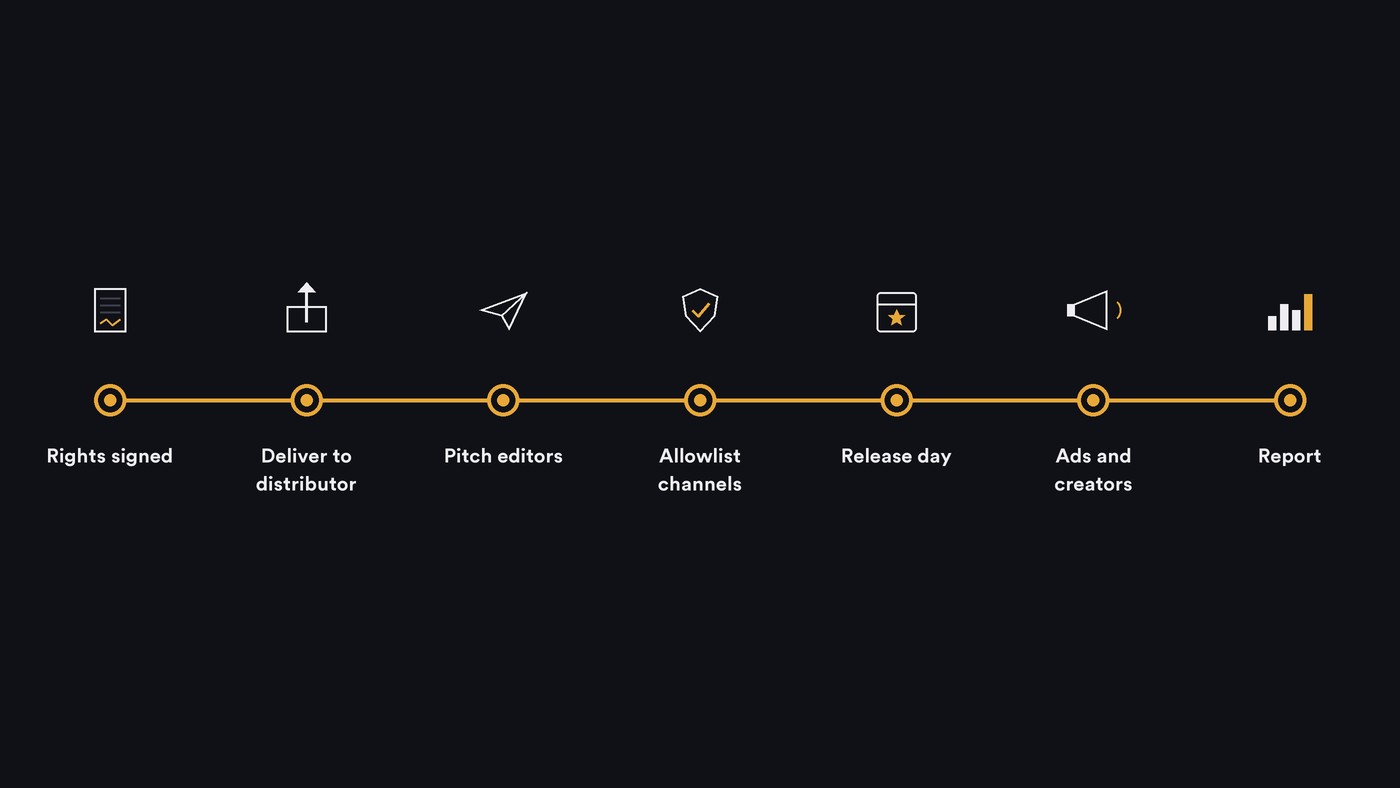
- Five to six weeks out: rights sheet signed, master and artwork final.
- Four weeks out: deliver, set the release date and open a pre-save campaign.
- Two to three weeks out: pitch Spotify and Apple Music with the campaign dates.
- One week out: allowlist channels and brief the creators.
- Release day: start the ads once the song is live, so every link resolves.
The Content ID and social-library trap
Here is how campaigns trip. The distributor registers the master with YouTube Content ID and Meta's rights system, and then the brand's own pre-roll and every creator post using the song match the reference. Amuse notes that, depending on the use, Meta may monetize such a video or mute, restrict or block it.
YouTube puts the duty on the claimant: "You're responsible for avoiding incorrect results, such as claims that result from misidentified content or claims that interfere with authorized uses of content." So:
- Decide whether to opt in during the campaign. Content ID protects the song and earns from fan uploads, but it also claims authorized uses. If reach is the goal, ask whether your distributor lets you add it after the flight.
- Allowlist before anyone posts. YouTube's allowlist exempts channels by channel ID, and only partners using Studio Content Manager can add them, so your distributor does it. It works going forward only, earlier claims aren't released automatically, and if several partners own the asset, each must allowlist the channel. Collect IDs for the brand, the agency and every contracted creator.
- Confirm the steps with your distributor. DistroKid's, TuneCore's and CD Baby's help centres returned HTTP 403 to our requests on 23 November 2026, so check their allowlist options in your account. TikTok's help centre didn't load for us that day either; read its rules for business accounts directly.
- Keep non-exclusive music out. If any part of the track is licensed non-exclusively, don't opt in.
Claims and disputes in detail: how distribution platforms handle Content ID.
Using the track in paid ads and with influencers
A paid placement is commercial use. Meta's Music Guidelines (effective 26 March 2024) say: "Use of music for commercial or non-personal purposes in particular is prohibited unless you have obtained appropriate licenses." If an artist owns the song, the brand needs a written license naming the ad platforms, formats, term and territories.
Give every creator a short brief with:
- A written license covering platforms, number of posts, how long posts stay up and whether the brand may boost them as ads.
- The final audio file and the song's store link, so posts carry the released version.
- Their channel ID, collected for the allowlist before they post.
- Performer limits: check the session singer's release covers ads before the brand boosts a creator's post.
Disclosure rules for AI visuals in ads are covered in our guide to how agencies use AI video for promotional tracks.
What to report to the client
Report against the campaign dates, not the calendar month:
- Release health: live on every store on release day, under the right artist profile.
- Listening: streams and saves from Spotify for Artists and Apple Music for Artists, set against the ad flight.
- Rights log: claims on brand and creator videos (the target is zero), disputes and the allowlist as sent.
- Creator usage: posts per creator that used the song.
- Paperwork: who receives the royalties, the latest distributor statement and the signed rights sheet.
Where Soundverse fits
Soundverse is an AI music platform that takes you from idea to audience, built for independent artists who release music. For an agency it covers the making side of a campaign song. Agent One takes a written brief and plans a song for each track it describes, keeping your titles and lyrics as written. In AI Studio the team edits one project together and, on Creator and above, exports stems for ad cutdowns. Asset Studio makes matching cover art, story backgrounds and a YouTube thumbnail, and Release Planner lays out a day-by-day rollout with pre-save and pitch deadlines. The release itself goes through the rights owner's distributor account.
FAQ
Should the agency hold the distributor account for a client's song? Only as a stopgap with a written hand-back clause. The account holder receives the royalties and controls takedowns and Content ID, so the account belongs with whoever owns the master. Ask for team roles on the client's accounts instead.
Can a brand jingle be released on Spotify and Apple Music? Yes, if the brand controls the composition and the master, every performer has signed off, and the track meets your distributor's content rules. Check those rules before you promise a date.
Should a campaign song go into Content ID? Only when every element is exclusively owned and the brand's, agency's and creators' channels are already allowlisted. If any part is licensed non-exclusively, keep it out.
Do influencers need a license to use the brand's song? Yes, in writing. Meta's guidelines prohibit commercial use of music without appropriate licenses, and a creator's paid post is commercial.
Can an AI-made campaign track get Content ID? It depends on the distributor and the AI tool's terms. Amuse, for one, lists AI-generated music as ineligible for UGC monetization, so read both before you plan around claims.
Sign up for Soundverse free to draft the campaign song and its release visuals. More release guides on the Soundverse blog.