What Is the Importance of Pre-Save Campaigns in the Distribution Strategy?
Why pre-save campaigns matter in a distribution strategy: how Spotify pre-saves and Apple Music pre-adds work, timing, tools, consent and a 3-week plan.
Pre-save campaigns matter in a distribution strategy because they turn interest before release into library saves and streams on release day. A fan pre-saves once, and Spotify, Apple Music or a smart-link service adds the release to their library when it goes live. That only works if your distributor delivers early enough for the store entries to exist.
So a pre-save is a delivery deadline as much as a marketing tactic. Every source below was checked on 20 November 2026.
What a pre-save is on each service
Spotify pre-save. Spotify's own Countdown Pages let fans pre-save inside the app, and its help page (updated 16 June 2026) describes the result: "On release day, we notify everyone who pre-saved and add it straight to their library." Countdown Pages are for new albums and EPs only, not singles, and need at least 3,000 monthly active listeners. Everything else, singles included, runs through third-party pre-save links that use the fan's Spotify login.
Apple Music pre-add. Apple's provider page on music pre-releases says: "When a fan uses this feature, Apple Music will automatically add the complete release to their library once it's available." The setup is stricter. The release must be delivered as an iTunes Store pre-order with at least one instant-gratification track or video, and a sales start date at least one day in the future.
Deezer, Amazon Music, TIDAL and YouTube Music. These come through smart-link services. Feature.fm supports pre-save on Spotify, Apple Music and Deezer; Linkfire's pre-release page lists Spotify, Apple Music, YouTube Music, Amazon Music, Deezer and TIDAL. We found no Amazon Music help page describing a pre-save of its own.
How a pre-save works technically
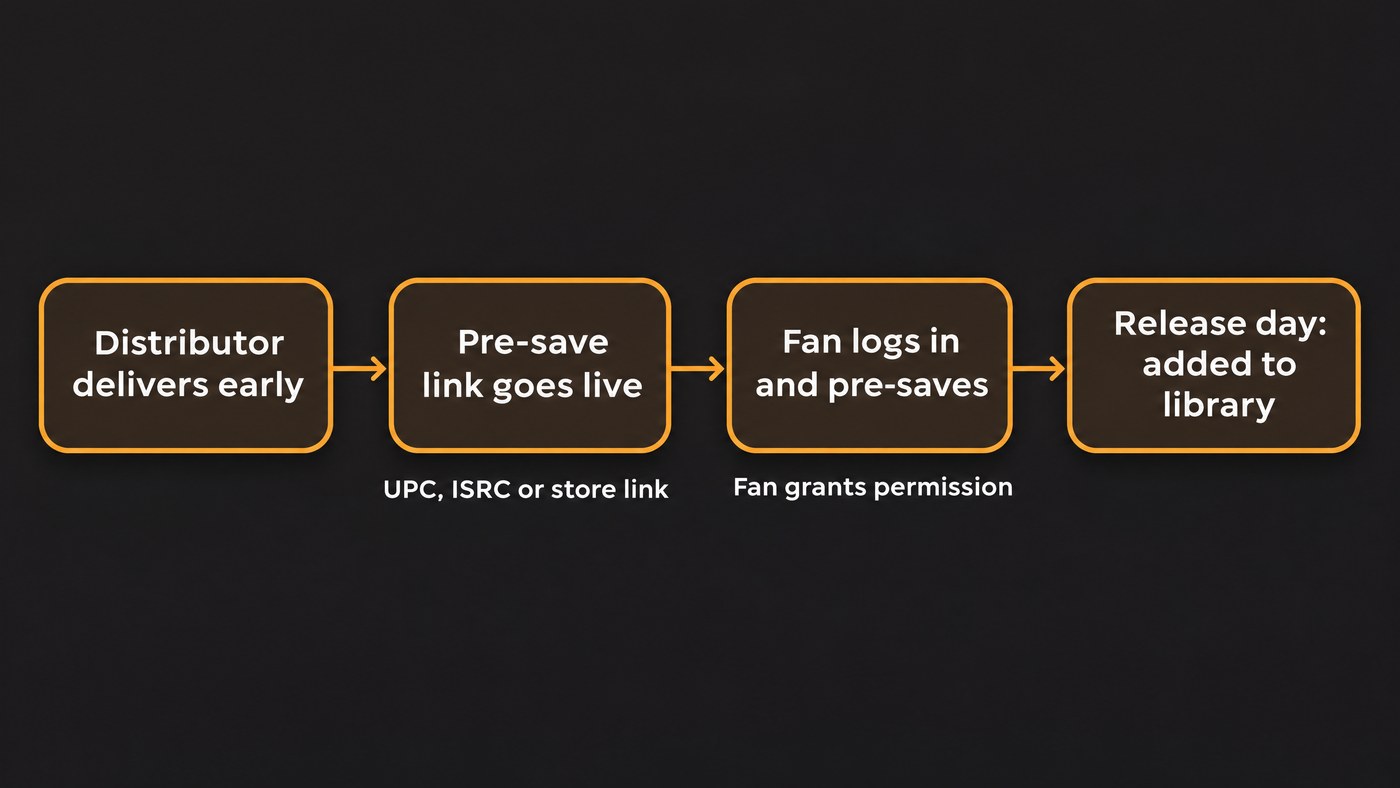
- Your distributor delivers the release with a future date. The store creates an unreleased entry. Spotify says the option to create a Countdown Page appears within 72 hours of your distributor delivering the metadata.
- You build the link. The service needs a code to match on release day. Feature.fm's guide to pre-save URLs sends you to your distributor for these codes. It suggests the UPC for EPs and albums, the ISRC for singles, or a Spotify or Apple Music URL. You can collect pre-saves before the code exists, but nothing is saved until a valid one is added.
- The fan logs in. Feature.fm notes that every pre-save needs the fan to authorize their own account.
- Release day. The service finds the live release, saves it to each fan's library and turns the page into a normal smart link. Feature.fm warns that the title and description don't update on their own.
Not sure which code is which? Our guide on why ISRC codes matter for tracking streams covers ISRC versus UPC.
Why pre-save campaigns matter
Day-one listening. The firmest numbers are Spotify's, about album Countdown Pages. Its help page says that on average, nearly 60% of people who pre-save an album stream it in the first week. Its Upcoming Releases announcement (May 21, 2025, updated September 29, 2025) adds that Countdown Pages published at least seven days before release see nearly twice as many pre-saves as later ones, and that nearly one in seven people who pre-save through one become super listeners by release week. Those figures don't cover third-party links for singles.
Saves shape each fan's recommendations. Spotify's page on how recommendations work (updated October 23, 2026) says searching, listening, skipping and saving to Your Library all shape how Spotify reads a listener's taste. A pre-save ends as a library save.
Release Radar runs on followers. Spotify puts a song pitched at least seven days before release on your followers' Release Radar. Pre-save links can also ask fans to follow you (Feature.fm's do, with an opt-out), so the campaign can widen that audience. Our guide on how distribution affects playlist visibility covers the pitching side.
What's anecdotal. You'll read that a big pre-save count triggers the algorithm or wins editors over. Spotify hasn't published that, and we found no primary source for it. The documented effects are narrower: saves shape each fan's own recommendations, pre-savers tend to stream early, and followers get Release Radar if you pitch in time.
A list you keep. Linkfire says presavers can subscribe to email updates about future releases, and Ditto lets fans tick a box to join your mailing list.
When your distributor has to deliver early
- Allow for review. Ditto says its pre-save SmartLink becomes available 48 hours after the release passes its checks and store approval, and recommends at least three to four weeks of promotion.
- Get the codes at upload. Note each ISRC and the UPC as soon as they're assigned and add them to the link straight away.
- Plan Apple pre-adds at upload. The pre-order is part of the delivery, and Apple says you can't add tracks or change the pre-order track link-up or sequence once the album is delivered. Ask your distributor whether it offers pre-orders for your release type.
- Pitch in the same window. Apple Music Pitch takes Pre-add/Pre-order pitches on the new-release deadlines: at least 10 days ahead for full consideration.
For three clean weeks of pre-saves, upload four to five weeks before release day.
Pre-save tools, checked 20 November 2026
- Spotify Countdown Pages. Built into Spotify for Artists; albums and EPs; 3,000 monthly active listeners. Spotify's May 2025 newsroom post said 5,000, so the help page is the newer figure.
- Feature.fm. Spotify, Apple Music and Deezer, matched by UPC, ISRC or store URL. TuneCore's partner page offers its artists a discount on Feature.fm's pre-save tools.
- Linkfire. Six services, an automatic switch to the live release, and email sign-up for presavers. Its help centre blocked our fetch, so we used its product page.
- Hypeddit. Its pricing page lists unlimited pre-saves from the Basic plan; the free Rookie plan covers smart links and download gates.
- Distributor pages. Ditto generates free pre-save SmartLinks for Spotify and Apple Music on releases it distributes. DistroKid's HyperFollow and help pages returned an access error to us, so check its pre-save options in your account.
- ToneDen and Show.co. Neither site loaded for us, so we couldn't confirm their current pre-save features.
Privacy and consent
A pre-save asks for access to fans' accounts, so take only what you use. Spotify's list of permissions shows what fans see: "Manage your saved content" for library access, "Manage who you are following" for follows, and "Get your real email address" for email.
Collecting emails from fans in the UK or EU brings consent rules. The UK regulator's guidance on valid consent says, quoting the GDPR, that silence, pre-ticked boxes or inactivity don't count as consent. It also asks you to name any third party relying on the consent. Use an unticked box, say who will email fans, link a privacy policy, and let fans opt out of extra follows. This is general information, not legal advice.
A 3-week pre-save plan
- Day −28 or earlier: upload with final metadata and a future date. Record the ISRC and UPC; set up the Apple pre-order if you use one.
- Day −24: confirm the release shows in Spotify for Artists. Build the link, add the codes, and test it on your own accounts.
- Day −21: announce with the cover art and a short clip, put the link in your bios and email your list. Publish a Countdown Page if you qualify.
- Day −14: post a second piece, such as a studio clip or a lyric line. Submit the Spotify pitch now and ask your distributor about Apple Music.
- Day −7: last day for a Spotify pitch to reach Release Radar. Remind everyone who hasn't pre-saved.
- Day −1: "Out tomorrow, already in your library if you pre-saved."
- Release day: check the link switched to the live release, confirm the save in your test library, and share the live link.
- Day +7: compare pre-saves with first-week streams and export the email list.
Where Soundverse fits
Soundverse is an AI music platform that takes you from idea to audience. It doesn't deliver music to stores or run pre-save links; your distributor and link service do that. It helps with the campaign around them.
Release Planner turns your track into a dated, day-by-day rollout split by platform, with pre-save, smart link and playlist pitch deadlines. Set Rollout Length to three weeks for this plan. Where it needs something you didn't give, it leaves a blank such as [smartlink URL]. It writes the plan; it doesn't post or submit anything.
Asset Studio makes matching cover art, Instagram story backgrounds and a YouTube thumbnail from your track. The images carry no text, so add "Pre-save now" in your own design app. Music Business Agent can build a smart link in its Release Autopilot workflow while you sign in yourself. For the wider toolkit, see release-ready with AI.
This walkthrough shows Release Planner turning a finished song into a day-by-day rollout with pre-save and playlist pitch deadlines.
FAQ
Do pre-saves help with Spotify's algorithm? A pre-save becomes a library save, and Spotify says saves shape each listener's taste profile. It hasn't said that pre-save totals push a song to other listeners or editors, so treat that claim as anecdotal.
Can I run a pre-save campaign for a single? Yes, through a smart-link service or your distributor's pre-save page. Spotify's Countdown Pages are for albums and EPs only, and an Apple Music pre-add depends on a pre-order setup, so ask your distributor what it supports.
Is a pre-save the same as a pre-order? No. A pre-order is an iTunes Store purchase that downloads on release day. A pre-save or pre-add is free and adds the release to the fan's streaming library.
What if my release date moves? Ask your distributor to update it with every store, then update your pre-save page, whose title and description don't always change on their own. Tell fans the new date, and check how your link service handles a moved release first.
Sign up for Soundverse free and plan your pre-save deadlines before you announce. More release guides on the Soundverse blog.