How Does Machine Learning Affect the Creative Process for Independent Musicians?
Machine learning for musicians, explained: where AI fits in writing, stems, mixing and mastering, what stays human, the risks, and how artists set limits.
Machine learning for musicians now handles much of the technical work around a song: cleaning recordings, splitting stems, suggesting parts, drafting lyrics and mastering mixes. For independent musicians, that means faster sketches and more options to choose from, while the writing, the performance and the final calls still decide whether a song is any good.
This guide covers where machine learning sits in a real session, what it changes, what stays with you, the risks, and the boundaries working artists draw. Every survey and study below is named and dated, and was checked on 14 November 2026. Whether AI music counts as collaboration or automation is a separate argument, which we made in is AI music generation creative collaboration or automation.
Where machine learning sits in a musician's workflow
Two recent surveys show the same pattern. Musicians use machine learning for technical jobs first and for writing much less.
- Sonarworks and Sound On Sound surveyed 1,194 producers, engineers, songwriters and other working music makers and published the results on 4 February 2026. Audio restoration was the most used AI category at 58%, followed by mixing assistants at 38%, mastering services at 33.9% and composition tools at 20.9%.
- Water & Music surveyed 1,525 musicians for Moises in late 2025 and published the report in March 2026. Among the 1,021 who use AI, stem separation led at 71%, then practice (44%), accompaniment generation (40%), mixing and mastering (32%), melody and chord ideas (28%) and full song generation from a text prompt (24%). Moises says most respondents came through its own user base, which probably favors stem tools.
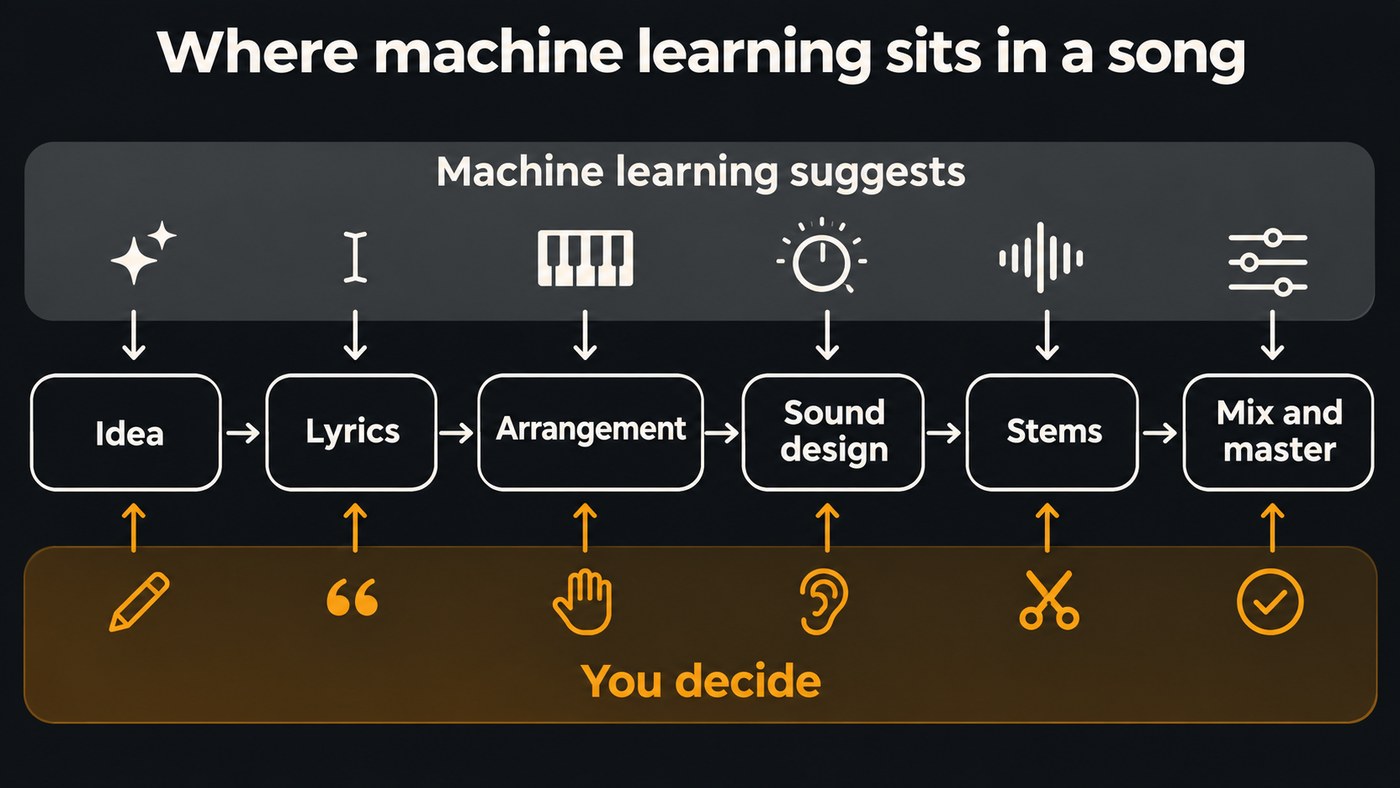
Stage by stage, this is how it looks in a working session:
- Ideas and sketches. Models continue a clip, vary a groove or turn a hummed line into a full arrangement, so you can hear where an idea might go before you commit. Google DeepMind's Music AI Sandbox has an Extend tool built for this, and the producer The Range said in DeepMind's 24 April 2025 post: "I've found it really useful to help me cut writer's block right at the point that it hits as opposed to letting it build."
- Lyrics. Language models draft verses, rhymes and alternative lines. They work best as something to react to, for reasons the risks section explains.
- Arrangement. Accompaniment tools write parts that follow your chords. Logic Pro's Session Players, for example, lay down synth, bass, keyboard and drum parts, and take your direction as you go.
- Sound design. Some tools build sounds from a description. In Suno Studio you can describe a synth or an effect in the chat bar and have it built for you.
- Stems. Separation pulls the vocal, drums or bass out of a finished bounce, so an old demo or a project with lost session files can be reworked.
- Mixing and mastering. Assistants listen to your track and propose starting settings for EQ, compression and loudness, which you then adjust by ear.
What changes about how a song gets made
The biggest change is the order of the work. You used to build a song up layer by layer. Now you can often hear a rough version of the whole thing first and then decide what to keep.
- You hear the song sooner. A hummed hook can become a full arrangement in minutes, so you judge a chorus in context before you've spent a day producing it. Weak ideas die earlier. So, sometimes, do good ones, because a quick draft sounded flat.
- Writing turns into choosing. When a tool hands you five versions of a bridge, your taste does more of the work than your hands. Deciding quickly, and knowing why you picked one, becomes a core skill.
- Old material comes back. Cleanup and stem separation make phone demos and orphaned bounces usable again.
- The technical floor drops. Respondents to the Sonarworks survey said manual audio editing, routine mix balancing and transcription are becoming less central skills, because AI now does them competently.
- Your range widens. In the Water & Music report, 40% of AI users said it helped them learn more songs and 33% said they had experimented with new genres. Our guide to AI practice tools for musicians covers that side.
What stays human when you use machine learning for music
The same Sonarworks respondents named the skills they consider irreplaceable: musicality, critical listening, arrangement, emotional judgment, interpersonal communication and creative direction. Asked about the future, 57.9% described AI as a tool, while 8.8% expected full automation. Many said they see the producer's role moving toward creative direction: guiding musicians and directing tools.
The artist Adrie, one of the musicians who tested Google's Music AI Sandbox, said it plainly in the same DeepMind post: "It's not as simple as typing a prompt and getting a perfect song - I think music will always need a human touch behind it."
In practice, the human jobs are the ones listeners connect with. What the song is about. The melody people hum in the shower. The voice and the phrasing. The moment the arrangement drops out before the last chorus. And the decision that the song is finished. Machine learning can propose any of these, but it has no stake in which one is right for you.
The risks: sameness, over-reliance and rights
Sameness. Loss of originality was the top concern in the Sonarworks survey, named by 77% of respondents, ahead of ethical issues (54%), a flood of low-quality music (53%) and job displacement (42%). Research supports the worry. In a study published in Science Advances on 12 July 2024, Anil Doshi and Oliver Hauser found that writers given story ideas by a language model wrote stories that readers rated as more creative, especially among less creative writers, but the AI-assisted stories were more similar to each other. Lyrics and toplines work the same way: the most likely suggestion is the most likely one for everybody.
Over-reliance. A preprint by Nataliya Kosmyna and colleagues, first posted on 10 June 2025, followed 54 people writing essays with a language model, a search engine or no tools. The language model group reported the lowest sense of ownership over their essays and struggled to quote their own work accurately. It's a small study about essays, not songs, but anyone who has generated a lyric sheet and forgotten it the next morning will recognize the effect.
Rights. In the Water & Music report, 58% of AI users worried about authenticity and 55% about copyright and licensing. Three questions matter most: who owns what you make with a tool, what its model learned from, and whether you're imitating someone's voice. Many Sonarworks respondents described using ethically sourced AI as a professional obligation rather than a personal preference. For the legal detail, see how AI tools handle copyright and ownership.
How working artists set boundaries with AI
The artists who use these tools well tend to set their rules before a session starts, not halfway through it. These are the rules that hold up:
- Name your jobs. Write down which parts are yours alone, for example lyrics, topline and lead vocal, and which you're happy to hand over, such as noise removal, stem splits and loudness.
- Write first, generate second. Draft your own chorus before you ask for alternatives, so the model's first idea doesn't become your anchor.
- Feed it your own material. Start from a hummed melody, your chord chart or your own stems rather than a blank text prompt.
- Limit the options. Generate three versions, pick one and move on. Fifty takes of a hook turn a writing session into hours of listening.
- Ask the report's three questions. Water & Music suggests asking what data trained a tool, whether you own what you create with it, and whether it enhances your voice or flattens it.
- Keep your drafts. Save lyric sheets, prompts and project versions, so you can show how a song was made if a distributor or co-writer asks.
- Leave other people's voices alone. Don't clone or imitate a living artist's voice without their permission.
Where Soundverse fits
Soundverse is an AI music platform that takes you from idea to audience, built for independent artists who release music, and it works best when you start from your own material. Melody to Song Generator takes 5 to 60 seconds of a melody you hum, sing or play, adds your lyrics, and builds a full song that follows your tune. AI Lyrics Writer gives you a draft to react to, and drafting from its panel is free on every plan.
AI Studio is the browser studio where you take it further: record your own vocals over a generated song, ask Agent One for a bassline that lands on its own track, and mix and master with Mix One and Mastering One, which use no tokens. On Creator and above, you can split a song into stems that land on their own tracks. On Pro and Max, Soundverse v9 can sing in a voice clone made from your own recordings.
Licensing is set by plan: the Free plan is for personal use, and the Creator plan comes with a royalty-free license.
FAQ
Does using machine learning make my music less original? Not by itself. The risk comes from accepting the most likely suggestion, which research suggests pulls everyone toward similar results. Writing your core material first and treating generated options as something to push against keeps the song yours.
What do most musicians use AI for today? Technical work. Water & Music's March 2026 report found 71% of musicians who use AI use it for stem separation, while full song generation came sixth at 24%. Sonarworks' February 2026 survey put audio restoration first, at 58%.
Will machine learning replace producers and songwriters? Most working producers don't expect it to. In the Sonarworks survey, 57.9% saw AI as a tool and 8.8% expected full automation, and respondents named arrangement, critical listening and creative direction as skills that are becoming more important.
Should I tell people I used AI on a song? Be honest when a distributor, platform or collaborator asks, and keep drafts that show what you did. Few Sonarworks respondents thought AI use should be hidden, and many wanted disclosure that fits the context, since listeners may not tell AI cleanup apart from AI-written music.
Sign up for Soundverse free and start a song from your own melody. More guides for independent musicians on the Soundverse blog.