Is AI Music Generation Considered Creative Collaboration or Automation?
Is AI music generation collaboration or automation? What copyright law, the Grammys, Spotify, Deezer, Bandcamp and artists say, with dates and sources.
AI music generation counts as creative collaboration when a person makes the decisions that shape the song, and as automation when the software makes them. Copyright law, the Grammy rules and the major streaming platforms now draw the line in roughly that place, so the same tool can be either, depending on how you use it.
Each source below is named and dated, and was checked on 7 November 2026. The guide ends with practical steps for keeping your own songs on the collaboration side.
Collaboration or automation: a scale, not a switch
Most arguments about AI in music go wrong because they treat it as one thing. Spotify said as much in its September 2025 policy post, describing AI use as increasingly a spectrum rather than a binary, with artists using it for some parts of a production and not others. In practice, artists use AI music generation in four quite different ways:
- Assistive tools. Stem separation, pitch correction, a mastering preset. The software processes something you made, and almost nobody calls that anything but a tool.
- Co-writing. You bring the lyrics, a hummed melody or a chord progression, generate several options, then keep, cut and rearrange. The musical choices stay yours.
- Prompt and accept. You type a description and release whatever comes back. The model made nearly every musical decision.
- Mass automation. Accounts upload thousands of generated tracks to collect streams. Nobody is making creative choices at all.
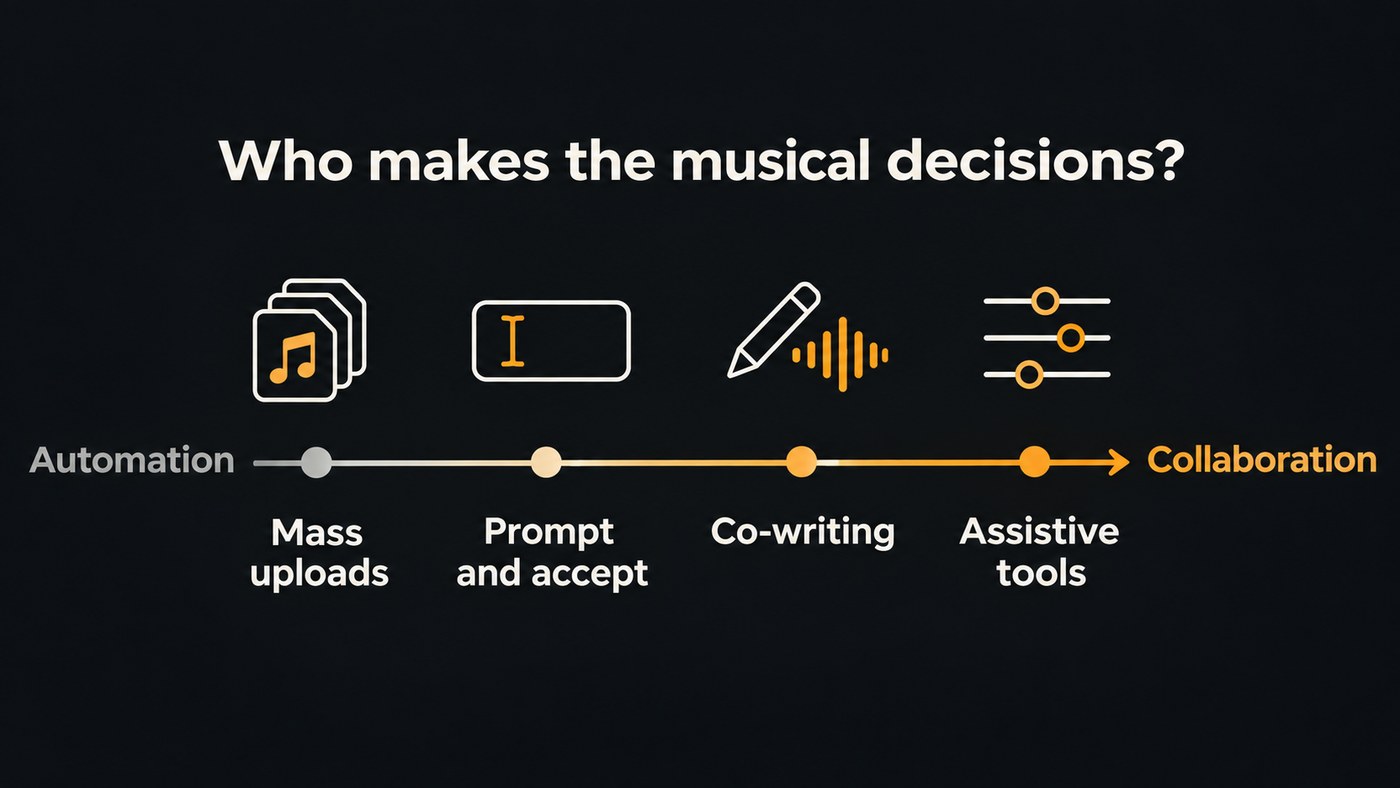
The first two are collaboration by any reasonable definition, and the last is automation. The third is where the legal and ethical arguments sit.
What copyright law says about AI music generation
On 29 January 2025 the U.S. Copyright Office released Part 2 of its report on copyright and artificial intelligence. It concluded that AI outputs can be protected only where a human author has determined sufficient expressive elements. That can be a human-authored work perceptible in the output, or creative arrangements or modifications of the output, but the mere provision of prompts doesn't qualify. The Office also confirmed that using AI to assist the creative process doesn't bar protection.
Shira Perlmutter, the Register of Copyrights, put the dividing line plainly: "Where that creativity is expressed through the use of AI systems, it continues to enjoy protection. Extending protection to material whose expressive elements are determined by a machine, however, would undermine rather than further the constitutional goals of copyright."
The courts agree so far. In Thaler v. Perlmutter, decided on 18 March 2025, the D.C. Circuit held that the Copyright Act requires a work to be authored in the first instance by a human being. The same opinion notes that this rule doesn't stop people copyrighting work made with the assistance of AI. The Supreme Court denied review on 2 March 2026, so that ruling stands.
The UK has been the exception. Since 1988 it has protected "computer-generated works" with no human author, for 50 years. The government's Report on Copyright and Artificial Intelligence, published on 18 March 2026, proposes removing that protection while copyright continues to cover works created with AI assistance. It's a proposal for now, not a change in the law.
In legal terms, then, the collaboration is protected and the automated part largely isn't.
How the Grammys treat AI-assisted music
The Recording Academy's rulebook for the 69th Grammy Awards, covering releases from 31 August 2025 to 28 August 2026, says only human creators can be submitted, nominated or win, and a work with no human authorship isn't eligible in any category.
Work with AI elements can still compete, on three conditions:
- The human contribution must be meaningful and more than de minimis, which the rulebook defines as so minor as to merit disregard.
- It must match the category: the music or lyrics for songwriting awards, the performance for performance awards.
- Whoever authored the AI-generated portion can't be nominated for that portion.
Our explainer on Grammy rules for human creativity and AI assistance goes into the history of these rules.
What streaming and download platforms do about AI music
Platform policies are where the automation end of the scale gets handled:
- Spotify announced three measures on 25 September 2025: vocal impersonation is allowed only when the impersonated artist has authorized it, a spam filter identifies uploaders and tracks using tactics such as mass uploads, duplicates and artificially short tracks, then tags them and stops recommending them, and AI credits follow a DDEX industry standard. Spotify said the disclosures aren't meant to punish artists who use AI responsibly or to down-rank tracks that disclose.
- Deezer reported on 21 July 2026 that it receives nearly 90,000 fully AI-generated tracks a day, more than half of all daily deliveries at peak in June 2026. Those tracks drew only 1 to 3% of streams, and Deezer found up to 85% of streams on fully AI-generated tracks were fraudulent in 2025. It tags fully AI-generated music, keeps it out of algorithmic recommendations and editorial playlists, and says it will take down AI tracks used for fraud or not streamed for six months.
- Bandcamp published its policy on 13 January 2026: music and audio generated wholly or in substantial part by AI isn't permitted, and using AI to impersonate other artists or styles is prohibited.
Read together, these policies go after volume without authorship, impersonation and stream fraud. Artists who use AI inside their own process can release on Spotify and Deezer with honest disclosure, while Bandcamp draws a stricter line. For a platform-by-platform view, see our guide to AI music disclosure rules.
Where artists stand
Artists are split, and the split often isn't about the tools themselves.
Holly Herndon released Holly+, a model of her own voice that others could perform through, in 2021; Rolling Stone reported at the time that she framed it as an experiment in shared ownership of a voice. In a Scientific American interview published on 3 March 2026, she described what she's after: "It's not about putting in 'write me a pop song with a guitar.' It's about using this technology to bring humans together to make art in real space."
On the other side, the Statement on AI Training, whose signatories include ABBA's Björn Ulvaeus, argues that training generative AI on creative works without a license threatens the livelihoods of the people who made those works and shouldn't be allowed. That objection is about how models are built and who gets paid, which is a separate question from whether using a tool can be creative. Our list of pro-AI artists shows how differently musicians have answered it.
How to keep your AI music on the collaboration side
To keep your releases clearly your own work:
- Write the core yourself. Lyrics, a topline you hum, a chord progression. These are the parts the Copyright Office and the Grammy rules look for. Tools differ a lot here, as our comparison of AI music generators with lyric control shows.
- Generate options, not the final track. Ask for three takes on a chorus or two arrangements of a verse, then pick, cut and combine.
- Put your performance on it. Record the lead vocal, a guitar line or harmonies over the generated bed.
- Arrange and mix by ear. Move sections, mute stems, rewrite the bridge. Creative arrangement and modification of AI output is exactly what the Copyright Office says can be protected.
- Keep a session log. Save lyric drafts, prompts, versions and project files. You'll want them if you register the song or your distributor asks how it was made.
- Disclose when asked. Use your distributor's AI credit fields; Spotify has said disclosure isn't used to down-rank tracks.
- Never imitate a real artist without permission. Spotify and Bandcamp both prohibit it.
This video shows AI Studio with Agent One built in: you ask for a part or an arrangement change, and it lands on your timeline as something you can edit.
Where Soundverse fits
Soundverse is an AI music platform that takes you from idea to audience, built for independent artists who release music, and it covers both ends of this scale. Agent One can turn one message into a song with lyrics, vocals, a title and cover art, which is useful for sketches.
When you want the song to be more yours, AI Studio opens it on a multitrack timeline where you can record your own vocals, harmonies or ad-libs over it, play parts on built-in instruments, and ask Agent One for a bassline that lands on its own track for you to edit. Collaborators you invite by email or link see changes as they happen. On Pro and Max, Soundverse v9 sings your own lyrics, and you can give it a melody you hum.
Licensing is set by plan: the Free plan is for personal use, and the Creator plan comes with a royalty-free license.
If Bandcamp is your main store, remember its policy rules out music generated wholly or in substantial part by AI, whichever tool you use.
FAQ
Is using AI music generation cheating? It depends on how you use it and where you release. Spotify accepts AI-assisted music with disclosure, the Grammys accept it when the human contribution is meaningful, and Bandcamp bans music generated wholly or in substantial part by AI.
Can I copyright a song I made with AI? In the US you can protect the parts a human authored: your lyrics, your melody, your performance, and creative arrangement or modification of the output. The Copyright Office's January 2025 report says prompts alone aren't enough, and the courts have held that a work needs a human author.
Does writing a detailed prompt count as creative input? Not on its own, according to the U.S. Copyright Office. What counts is the expressive material you determine yourself, such as words you write, notes you play and the choices you make when editing and arranging what the model gives you.
Do streaming services accept AI-generated music? Spotify and Deezer do, with rules on impersonation, spam and disclosure, and Deezer keeps fully AI-generated tracks out of recommendations. Bandcamp doesn't allow music generated wholly or in substantial part by AI.
Sign up for Soundverse free and try writing with AI on your own terms. More guides on AI, rights and releasing on the Soundverse blog.