What Is the Impact of Latency on Real-Time Voice Synthesis Applications?
How latency shapes real-time voice synthesis: the delay budget, thresholds for singing, voice agents and voice changers, vendor fixes and how to measure.
In real-time voice synthesis, latency decides whether a voice feels live: too much delay and a singer drifts off the beat, a voice agent talks over its user, and a voice changer turns squad chat into a satellite call. The acceptable figure depends on the use, from a few milliseconds for monitoring to a few hundred for conversation.
Below: where the delay comes from, the thresholds research and official docs give for each use, how vendors cut it, the quality cost, and how to measure it. Sources were read on 23 November 2026. For instruments rather than voices, see our explainer on how AI audio platforms achieve low-latency processing.
Where the milliseconds go: the latency budget for live voice
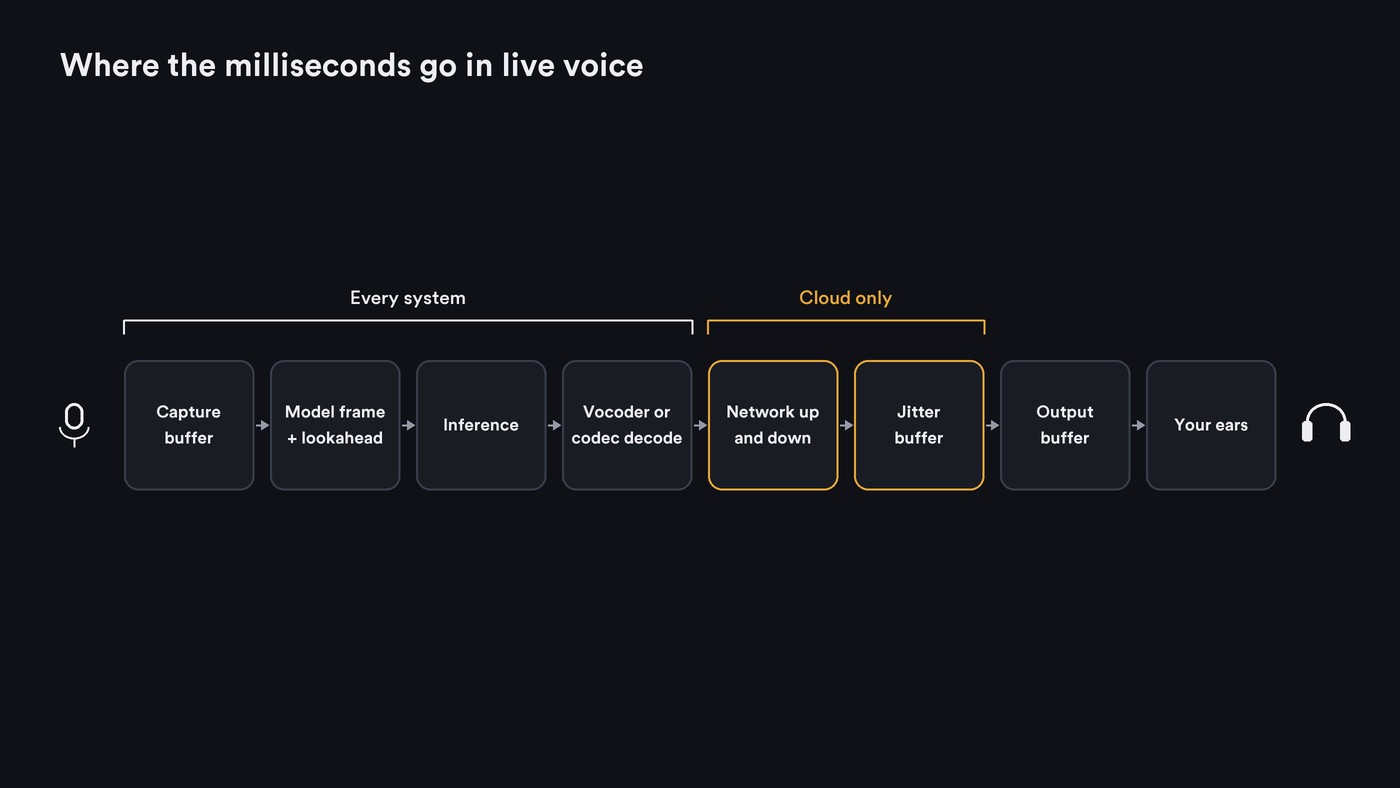
Live voice comes in two shapes: a voice changer converts your microphone into another voice, and a text-to-speech engine in a voice agent speaks text a language model has just written. Both run the stages our guide to how AI voice synthesis works walks through, and each adds delay:
- Capture buffer. Audio reaches software in blocks, and nothing happens until a block is full.
- Model frame and lookahead. A streaming model needs a minimum chunk of input and often a little future audio. In the StreamVC paper (January 2024), the smallest inference frame is 320 samples, 20 ms at 16 kHz, and its lookahead adds up to 60 ms of architectural latency.
- Inference. StreamVC's content encoder and decoder take 10.8 ms per 20 ms chunk on one CPU core of a Pixel 7, so its end-to-end figure, architectural plus inference latency, is 70.8 ms. The phone's own audio input and output path comes on top.
- Vocoder or codec decode. The model's output must become a waveform. Kyutai's Mimi codec, described in the Moshi paper (September 2024), works in 80 ms frames: given a first 80 ms of audio, it outputs one latent step that decodes to 80 ms of sound.
- Network up and down. A cloud model adds the trip to the server and back. ElevenLabs' latency guide lists time to first byte for its Flash models over WebSockets at 100 to 150 ms in North America, Europe and South East Asia, and 150 to 200 ms in South Asia and North East Asia.
- Jitter and output buffers. The client holds a small reserve so late packets don't cause gaps, then the device's output buffer plays the audio out.
How much latency is acceptable? Thresholds by use
Live monitoring and singing
This is the strictest case. Shure's guide to wireless latency (30 November 2016) calls 5 to 10 ms generally acceptable for stage monitors, says delay may become noticeable beyond 10 ms, and recommends 5 ms or less for in-ear monitors, particularly for vocalists. The reason: singers hear themselves through bone conduction as well as through the monitors, so any delay stands out.
No AI voice converter covered here meets that for self-monitoring: StreamVC measures 70.8 ms on a phone and the fastest CPU model below about 20 ms. On stage or in the booth, let the singer monitor their dry voice and send the converted voice to the audience or the recording.
Conversational voice agents and game NPCs
The classic telephony benchmark is ITU-T Recommendation G.114 (May 2003). Of mouth-to-ear delays under 150 ms, it says: "if delays can be kept below this figure, most applications, both speech and non-speech, will experience essentially transparent interactivity." It sets 400 ms as the one-way limit for general network planning.
Agents add thinking time on top. The Moshi authors note that pipelines chaining voice activity detection, speech recognition, a text model and text-to-speech compound latency to several seconds, whereas natural conversations show response times of a few hundred milliseconds. Their full-duplex model reports a theoretical latency of 160 ms and 200 ms in practice. For an NPC, text-to-speech time to first audio is one slice; the gap between the player finishing a sentence and the character starting to answer is what players feel.
Streaming voice changers in voice chat
A voice changer's delay counts against the same mouth-to-ear budget as the call itself, so it eats into G.114's 150 ms. The LLVC paper (November 2023) shows how much the converter alone can take. On an Intel Core i9-10850K CPU, LLVC measured 19.696 ms end to end, while the two converters it was compared with, each run with the context window it needed to keep up in real time, measured 97.616 ms and 189.772 ms. The last of those uses more than the whole 150 ms budget before the audio leaves the player's PC. Our explainer on how voice conversion alters timbre covers what these models change in the voice.
How vendors reduce latency in real-time voice synthesis
- Streaming synthesis. Microsoft's Speech SDK guide (25 February 2026) is blunt: "Streaming is critical to lowering latency." Playback starts at the first audio chunk instead of the whole file. For text arriving from a language model, Microsoft offers input text streaming over a WebSocket, and ElevenLabs a bidirectional WebSocket. ElevenLabs warns that with a fixed chunk schedule, the model waits for enough text before generating, which can add delay.
- Smaller and distilled models. LLVC combines a generative adversarial setup with knowledge distillation, cuts the encoder of the model it builds on from 10 layers to 8 and its lookahead to 16 samples. ElevenLabs says its Flash models, built for real-time use, come with a slight reduction in audio quality.
- Chunked vocoders and codecs. StreamVC runs inference every 20 ms, Mimi decodes in 80 ms frames, and LLVC streams in chunks with a short lookahead. LLVC's authors note you can process several chunks at once to improve speed at the cost of more latency.
- Edge or cloud. On-device models skip the network: StreamVC runs on one phone CPU core, and LLVC streams on devices without a dedicated GPU, such as laptops and phones. Cloud vendors move servers closer: ElevenLabs routes requests across regions in the USA, the Netherlands and Singapore, and Microsoft recommends pre-connecting and reusing the synthesizer and sending compressed audio.
- WebRTC transport. OpenAI's WebRTC guide recommends WebRTC rather than WebSockets when a browser or mobile app connects to a realtime model, for more consistent performance.
The trade-off: latency versus voice quality
Every millisecond saved usually costs something you can hear.
- Less context, rougher output. The LLVC authors found that naively converting short audio segments one after another degrades the result, so many real-time converters prepend earlier audio to each chunk, which costs compute and time.
- A little delay buys quality. In the Moshi ablations, 80 ms is the minimum latency Mimi tokens allow; adding 80 ms of acoustic delay significantly improved the generated speech, and 240 ms brought a further, moderate improvement.
- Voice and format choices. ElevenLabs lists default voices, synthetic voices and Instant Voice Clones as faster than Professional Voice Clones, and says higher-quality output formats can increase latency.
For the separate question of how fast a voice can be cloned in the first place, see our roundup of AI voice cloning apps with fast processing.
How to measure latency in your own voice app
- Name the interval. Mouth to ear for a voice changer; text ready to first audio for text-to-speech; end of the player's speech to the first audio of the reply for an agent.
- Log first audio and finish separately. Microsoft's Speech SDK reports first byte client latency, finish latency, network latency and first byte service latency for each request, so you can split network time from service time.
- Record a loopback. Record the dry microphone and the converted output on two tracks of the same interface at once, clap, and measure the offset between the two transients in your DAW. That captures the device buffers the published figures leave out.
- Track percentiles, not averages. Log hundreds of turns and watch the slow tail, not just the median.
- Test from your players' regions, under load. ElevenLabs' time to first byte varies by region, and Microsoft notes that its service takes time to scale out, so raise concurrency step by step or expect long latency or 429 errors.
- Check the real-time factor definition. LLVC defines it as seconds of speech generated per second of wall time, so higher is better; some tools use the inverse. A model that can't keep up with real time can't stream.
- Read WebRTC stats. In the browser, getStats() reports jitterBufferDelay for incoming audio and a round-trip time estimate, per the W3C WebRTC Statistics specification.
Where Soundverse fits
Soundverse is an AI music platform that takes you from idea to audience, built for independent artists who release music. Its voice tools produce finished audio you place on a timeline, which suits pre-rendered dialogue and vocals where latency isn't the constraint. AI Speech Generator turns up to 3,000 characters of text per run into narration you download as an MP3 or generate onto an AI Studio timeline, and its page names game developers voicing characters and placeholder dialogue. Voice Swap re-sings a recorded vocal in another voice model, keeping the phrasing and timing of your take.
For the live side of a session, AI Studio records each audio track with live monitoring, and its effects, including live pitch correction, run in your browser.
This two-minute tour shows AI Studio's built-in instruments, effects and real-time collaboration running in the browser.
FAQ
How much latency is acceptable for a real-time voice changer? It depends on who hears it. For other players, the converter's delay adds to the call's own delay, and ITU-T G.114 treats mouth-to-ear delays under 150 ms as essentially transparent for most uses. For the speaker's own monitoring, Shure recommends 5 ms or less in-ear, which none of the converters covered here reaches.
What is time to first byte in text-to-speech? It's the time from sending a request to receiving the first chunk of audio. With streaming, playback can start then, so it matters more than the time to finish the whole clip. Measure it from your own servers, since vendor figures exclude your network and application.
Is on-device voice synthesis always faster than cloud? It skips the network trip, but the device must still keep up in real time, and lookahead still counts: StreamVC's 70.8 ms on a phone is mostly architectural latency.
Sign up for Soundverse free and try AI Speech Generator for game dialogue and narration. More guides on voice and audio tech on the Soundverse blog.